pútao+ (grape 葡萄) 👈🏼 Tap/click to show/hide the “flashcard”
As part of a series of posts about some common myths about Chinese characters, this post discusses the Monosyllabic Myth. So, this week’s MEotW is pútao+ (grape 葡萄)”, since the very existence of this simple, well-known Mandarin word, with its two inseparable syllables that together express a single meaning, handily disproves this myth.


Monosyllabic?
In the book The Chinese Language: Fact and Fantasy, linguist and sinologist John DeFrancis thus introduces the chapter entitled “The Monosyllabic Myth”:
“In this language there is neither an alphabet nor any definite number of letters, but there are as many characters as there are words or expressions.” So said the sixteenth-century Catholic missionary Michele Ruggieri, one of the first Westerners to undertake what he called the “semi-martyrdom” of studying Chinese (quoted in Bernard 1933:149). Ruggieri’s views were similar to those of his superior, Father Matteo Ricci, as paraphrased by Father Nicola Trigault, who also transmitted the opinion that in Chinese “word, syllable, and written symbol are the same” and that the words “are all monosyllabic; not even one disyllabic or polysyllabic word can be found” (Trigault 1615:25-26).
Even these early observations reveal one of the main reasons for the confusion leading to the Monosyllabic Myth—namely, the failure to distinguish between speech and writing. It is the despair of linguists, who insist on keeping the two apart, that they have so little success in achieving their aim and hence must do incessant battle against the practice of using an observation about writing to reach a conclusion about speech.
Just as with the Emulatability Myth, it seems that missionaries of Christendom were involved in spreading the Monosyllabic Myth, the erroneous idea that each Chinese character represents a one-syllable word. Yes, the list of erroneous ideas that Christendom has been involved in spreading is certainly a long one!
As for speech and writing, the article “Pīnyīn (Pīn·yīn {Piecing Together of} · Sounds → [Pinyin] 拼音) Was Plan A” says the following about their relative importance:
Jehovah built right into us the specialized equipment we need to directly produce speech, but we can only produce writing indirectly through the general purpose tools that are our hands, which generally must do so using external, man-made tools and media such as pens and keyboards and paper and computer screens. If even us humans can design and build things with screens that can dynamically display writing, then Jehovah certainly could have designed our bodies to be able to do so as well, but he didn’t. Instead, Jehovah himself designed our bodies so that “speech is primary, writing secondary”.
Chinese Characters, Chinese Speech, and Monosyllabism
Having reminded us of the important distinction between speech and writing when it comes to any human language, including Mandarin, DeFrancis goes into some detail about how the views of many about Chinese writing and about Chinese speech have contributed to the pervasiveness of the Monosyllabic Myth:
MONOSYLLABISM DERIVED FROM WRITING
In alphabetic writing systems such as English the separation of graphic units by white space, a relatively late development in the history of writing (Gelb 1963:19), is a popular means of defining a word despite the somewhat haphazard way in which many of the demarcations came about. In Chinese the fact that the characters in a running text are normally set off from each other by the same amount of space between adjacent characters regardless of how closely they may be tied together in meaning is also an important factor in defining characters as words.
It is individual characters that form the basis for dictionary entries. Each character is provided with a dictionary listing which gives its pronunciation, consisting always of a single syllable, and its meaning, which may be single or multiple. The conventional dictionary pronunciation of a character does not always correspond with the sound in speech that the syllable is supposed to represent. …
A more serious objection to the handling of characters in ordinary dictionaries involves semantics. Each character is presented as an independent unit and is defined as having at least one meaning. The assumption that each character represents an independent meaningful syllable leads to the conclusion that each character represents a monosyllabic word.
MONOSYLLABISM SURMISED FROM SPEECH
The notion of monosyllabism derived from the writing system is further reinforced by the generally held view of Chinese speech. The syllable in Chinese is often considered phonologically distinct in that it is more rigidly determined than is the case in many other languages, such as English. Chinese syllables, with some exceptions that can be disregarded here, are invariant in the sense that they do not undergo the kind of internal change exhibited by English man-men, his-him, love-loved. In itself this is not a particularly distinctive or particularly significant feature. It has, however, helped to create a situation in which “the syllable is accorded a special status in Chinese…as a psychological unit” (Arlotto 1968:521). The syllable is held to be the type of unit between phoneme and sentence that in English is called a “word” (Chao 1968a:136). Since the syllable is represented by a character, the latter too is held to represent a word. The equating of syllable with character, the notion that both represent a word, and the fact that each individual character, and hence each individual syllable attached to it, has individual meaning, all combine to characterize both speech and writing as “monosyllabic.”
Commenting on the extent to which the Monosyllabic Myth has spread because of factors such as those mentioned above, DeFrancis speaks of
the popular view that the syllable always has meaning and is not a mere morpheme [e.g., the “er” in “teacher”] but a full-fledged word.
He goes on to say:
The popular misconception of the Chinese speaking entirely in words of one syllable is reinforced by some specialists who exaggerate…either because they lack…understanding or because in the interest of popularization they oversimplify to the point of error.
Sweet Grapes
Providing a well-known example of a Mandarin word which definitely has more than one syllable, DeFrancis discusses “pútao (grape 葡萄)”, this week’s MEotW:
Assiduous scholarly research may sometimes succeed in tracing the provenance of a specific term, such as pútao (“grape”). The usual dictionary handling of this term, similar to that for “butterfly,” presents a two-character expression meaning “grape” under both the character 葡 (pú) defined as “grape” and the character 萄 (tao) also defined as “grape.” In fact, however, the two syllables are inseparable and meaningless in themselves. They actually constitute a phonetic loan derived from an Iranian word *badag(a) that entered into Chinese when the grapevine was brought back from Ferghana in Central Asia by the Chinese general Zhang Qian in 126 B.C. (Chmielewski 1958). This precise dating of the origin of a disyllabic expression in Chinese further illustrates how misleading is the dictionary procedure that gives independent meanings for each of the characters used to write the two syllables in such terms.
Not Created Equal
It’s true that in the Chinese characters writing system, each character represents a Mandarin syllable. However, all Mandarin syllables are not created equal. DeFrancis gives us a breakdown about the different types of Mandarin syllables:
There are thus three types of Chinese syllables:
1. F: free, meaningful
2. SB: semibound, meaningful
3. CB: completely bound, meaninglessThese three categories are roughly comparable in English to the free form teach, the semibound form er in “teacher” and “preacher,” and the completely bound forms cor and al in “coral.” The first two categories are morphemes, the third is not, as is the case also with their counterparts in Chinese.
…
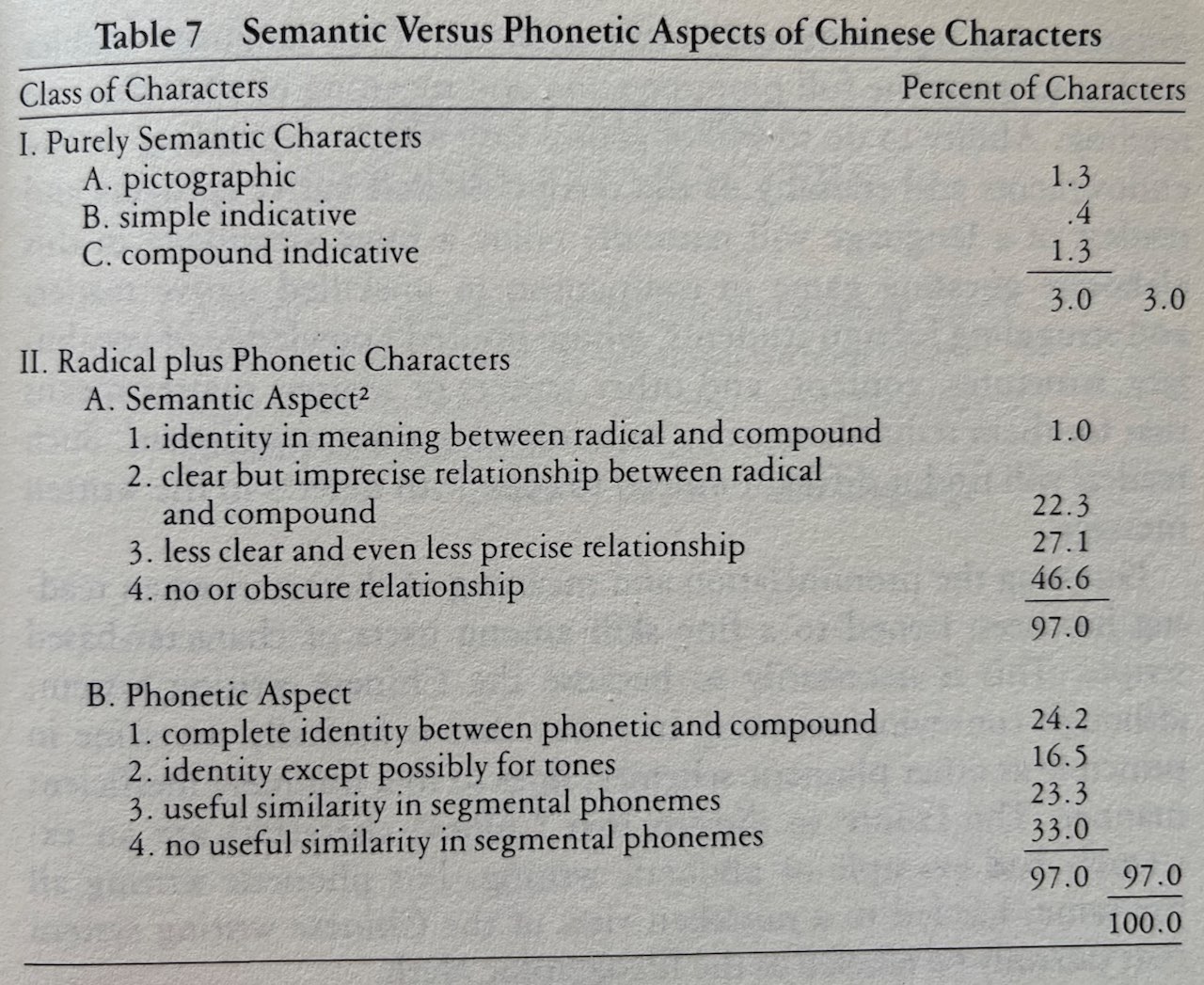
A random sample of two hundred characters reveals the following distribution:
44% free (includes 7% literary) 45% semibound 11% completely bound 100%
So, while the Monosyllabic Myth holds that “each character represents a monosyllabic word”, the reality is that, as shown above, fewer than half of characters stand on their own as free, monosyllabic words—the rest are bound as components of multisyllable words. DeFrancis goes on to share what Zhōu Yǒuguāng ((Zhōu {Circumference; Circle (surname)} 周 周/週) (Yǒu·guāng Has · Light 有光) (Chinese linguist, etc., known as “the father of Pīnyīn”)), who led the team that developed Pīnyīn (Pīn·yīn {Piecing Together of} · Sounds → [Pinyin] 拼音), had to say on the matter:
Zhou Youguang, using a different corpus of characters than the approximately 4,800 of the Chao and Yang dictionary, and also perhaps having a different opinion as to whether a specific character is free or bound, says that “44 percent free is too much!” In his opinion, only 2,000 or so, or about 30 percent, of the 6,800 “modern standard characters” needed to write contemporary Chinese are free words (Zhou 1982:personal communication).
Where’s the Harm?
Is the Monosyllabic Myth merely of academic concern? Has it resulted in any real, practical harmful effects? Note how DeFrancis concludes his chapter on the Monosyllabic Myth:
HARMFUL ASPECTS OF “MONOSYLLABIC”
As in the case of the Ideographic Myth, the Monosyllabic Myth has fostered a kind of cliché thinking about Chinese. Because of its application to both speech and writing it has helped to obscure the difference between the two. Moreover, it has distracted scholarly attention from pursuing certain meaningful lines of research, such as a closer examination of the possible relationship between speech and writing as revealed in China’s voluminous literature.
But the worst aspect of the myth is when it is taken up in a distorted version by the public at large, as for example by the illustrious and authoritative Oxford English Dictionary, in which “monosyllabic” is glossed as a philological term “used as the distinctive epithet of those languages (e.g., Chinese) which have a vocabulary wholly of monosyllables.”…
For the impact of the term “monosyllabic” on the general public has been generally bad. The notion of speaking wholly in words of one syllable, or of reading and writing in the same fashion, in many minds carries with it a connotation of inadequacy and backwardness or at best of childish simplicity. …
…
…This is unfortunate because, apart from denigrating a language and a script of enormous complexity and sophistication, it reveals our failure to get across to the public at large the idea that the real world of Chinese speech and writing is much more fascinating than the mythological world of Chinese monosyllabism.
Reverberations Beyond Characters
The Monosyllabic Myth about characters has even reverberated in the world of Pīnyīn (Pīn·yīn {Piecing Together of} · Sounds → [Pinyin] 拼音), which some have insisted on writing as if each syl la ble was a sep a rate word, in slav ish de vo tion to the sup pos ed ly mon o syl lab ic na ture of the char ac ters.
At the other extreme, in their efforts to properly move past the erroneously perceived monosyllabism of the Chinese characters when they write Pīnyīn (Pīn·yīn {Piecing Together of} · Sounds → [Pinyin] 拼音), some seem to have overcompensated for the Great Wall of spaceless, faceless, seemingly monosyllabic text written in characters by often smooshing multiple syllables together into long, unbroken, hard-to-read expressions. For example, some would write “dānyīnjié” as one continuous string.
However, breaking up long, multisyllable expressions with spaces or hyphens can often significantly improve readability, as in the case of “dān‐yīnjié”+ ((dān single 单 單)‐(yīn·jié sound · node; knot → [syllable] 音节 音節) → [monosyllabic | monosyllable]) compared to “dānyīnjié”, “wùlǐ‐xué‐jiā”+ ((wù·lǐ things’ · {logic → [laws]} [→ [physics]] 物理)‐(xué studying 学 學)‐(jiā -ist 家) → [physicist]) compared to “wùlǐxuéjiā”, or “wù‐rù‐qítú”+ ((wù {by mistake}; mistakenly; {by accident} 误 誤/悞)‐(rù enter; {go into}; join 入)‐(qí·tú {fork; branch → [different; divergent | wrong]} · road; route; journey; way 歧途) → [go astray; be misled; take a wrong step in life]) compared to “wùrùqítú” or even “wùrù‐qítú”. So, Pīnyīn (Pīn·yīn {Piecing Together of} · Sounds → [Pinyin] 拼音) Plus material now often uses spaces and hyphens as appropriate to enhance readability when rendering multisyllable Mandarin expressions, especially those with three or more syllables.
Anyway, to conclude, the Monosyllabic Myth about Chinese characters is…BUSTED!