Categories
Culture Experiences History Language Learning Names Science Theocratic

Gēlìyà

Gēlìyà (Go·liʹath 歌利亚 歌利亞) 👈🏼 Tap/click to show/hide the “flashcard”

A few years back, I wrote up a brief web page listing reasons for producing Pīnyīn (Pīn·yīn {Piecing Together of} · Sounds → [Pinyin] 拼音), etc. material for the Imitate (ia) book. Some, especially some who grew up in the West, may have felt that this book is made up of “just stories”, and ones that they were already quite familiar with, at that. However, we must remember that Chinese Bible students may often have a different perspective regarding the Bible accounts that are made to come to life in the Imitate book. As that web page said:

  • Many Chinese people in the world have not been exposed to Bible accounts the way many Westerners have.
  • Also, I have heard that some, perhaps many, Chinese Bible students tend to approach their Bible studies like intellectual exercises for accumulating chōuxiàng (abstract) head knowledge as if for a school exam, rather than as training for their hearts for their own real lives.

Later, the web page touches on how some of the real-world benefits of good storytelling like that found in the Imitate book involve empathy:

    • The actress Natalie Portman once said, “I love acting. I think it’s the most amazing thing to be able to do. Your job is practicing empathy. You walk down the street imagining every person’s life.”
  • The Imitate book helps build Bible students’ empathy towards Bible characters, which in turn helps Bible students realize that others would feel empathy towards them as well if they imitated these Bible characters—not everyone will just think they’re crazy, like many worldly friends or family members might think.

While even fictional stories can have the benefits described in the links and the quote above, true stories from the Bible can have even greater benefits, including spiritual ones.

Besides the Imitate book, another book from Jehovah’s organization that relates Bible accounts is the Learn From the Bible (lfb) book. The letter from the Governing Body in this book says that, similarly to the Imitate book, the Learn From the Bible book also “brings the Bible accounts to life and captures the feelings of those depicted”, while, unlike the Imitate book, it “tells the story of the human family from creation onward”. While the Learn From the Bible book is especially suitable for children, the letter from the Governing Body in this book says that “it can also be used to help adults who desire to learn more about the Bible”. So, it would be good to consider on this blog some of the expressions used in the Mandarin Learn From the Bible book.

Goliath, By the Sound of It

This week’s MEotW, “Gēlìyà (Go·liʹath 歌利亚 歌利亞)”, is the Mandarin version of the name “Goliath”. It is used in Lesson 40 of the Mandarin Learn From the Bible book, which is entitled “Dàwèi (David 大卫 大衛) Yǒngzhàn (Yǒng·zhàn Bravely · Fights 勇战 勇戰) Gēlìyà (Go·liʹath 歌利亚 歌利亞) (“David and Goliath”).

It is apparent that “Gēlìyà (Go·liʹath 歌利亚 歌利亞) was chosen to represent “Goliath” in Mandarin because of what it sounds like, not because of the meanings of the supposedly ideographic (representing meaning directly through visible symbols, bypassing speech) Chinese characters used to write it out (“Song Profit Inferior”??? 🤷🏻).

A Cultural Goliath in the Chinese World

In this world ruled by Satan, Chinese characters loom large in people’s minds, like a cultural and traditional Goliath. To Jehovah God, though, the Creator and Sovereign of the entire universe, Goliath was small and insignificant back in David’s time, and Chinese characters are small and insignificant today. Indeed, even though Chinese characters have been around for millenia and are the oldest writing system still in use among humans, to Jehovah, to whom ‘a thousand years is as one day’, characters have only been around for a few days!—2 Peter 3:8.

Don’t Submit to Goliath—Trust in Jehovah!

It may seem like we have no choice but to submit to Chinese characters, these seemingly mighty symbols of worldly Chinese culture, and give them the egregious amounts of time, energy, and devotion they demand. However, for us dedicated ones, our time, energy, and devotion belong to Jehovah, so we should spend them carefully, in ways that are worthwhile with regard to our efforts to glorify Jehovah and accomplish the urgent, life-saving work he has assigned to us.

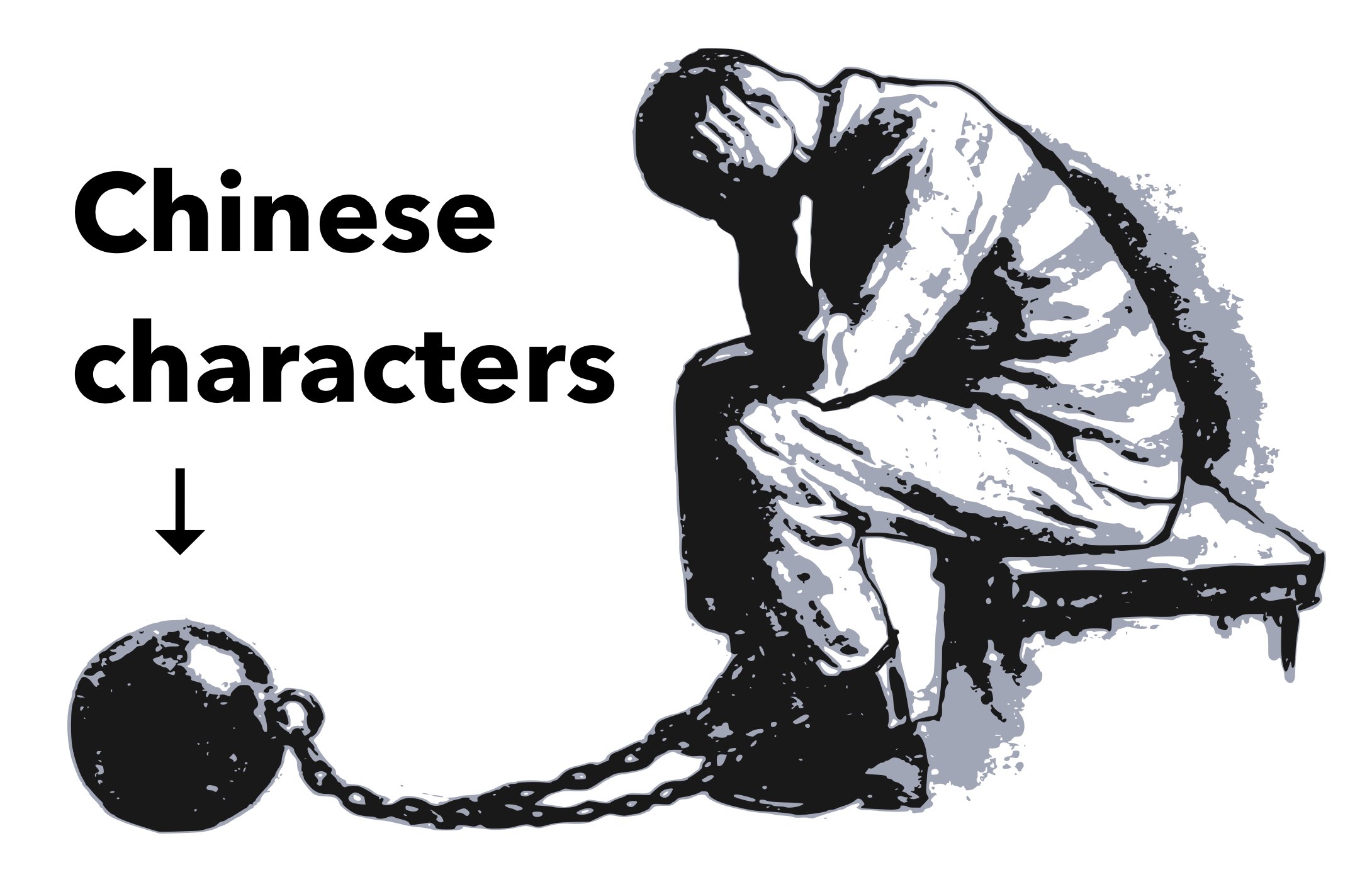
Chinese characters are a ball and chain made of human tradition.

Back in David’s time, it may have seemed to the Israelites facing Goliath that they had no option but to become slaves to the Philistines, because who could defeat the mighty Goliath? However, rather than being intimidated by this abnormally large but still limited and imperfect human, David put Jehovah first and really trusted in him, resulting in Jehovah blessing his efforts and helping him to soundly and decisively defeat Goliath. And yes, besides trusting in Jehovah, David did also contribute his own efforts—he both prepared to battle Goliath (for example, by carefully selecting “five smooth stones from the streambed”, stones that would come off his sling and fly through the air smoothly), and also actually stepped up and fought this battle.—1 Samuel 17:40.

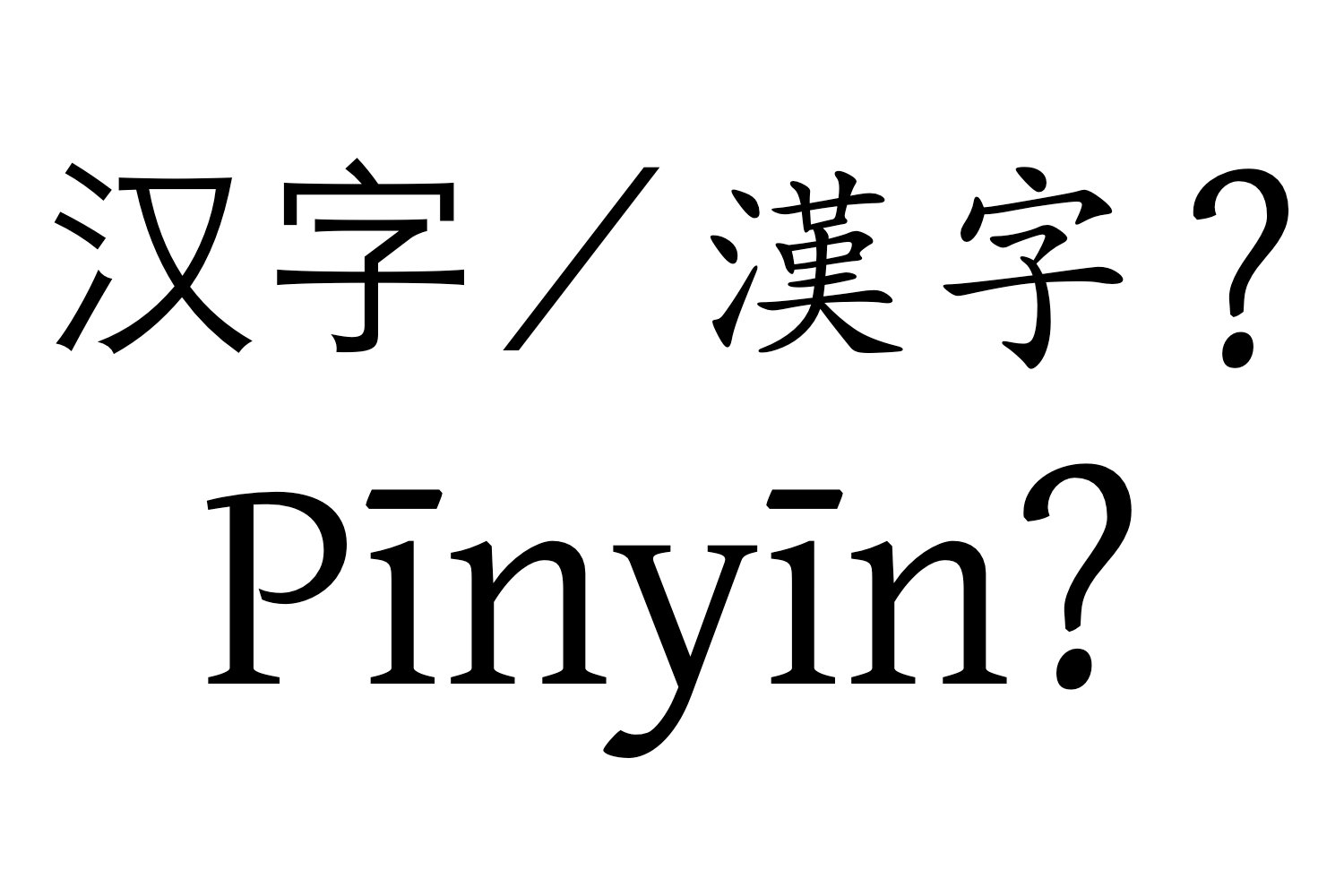
汉字 / 漢字? Pīnyīn?

Today, Pīnyīn (Pīn·yīn {Piecing Together of} · Sounds → [Pinyin] 拼音) can be one of our symbolic “smooth stones” that help us prepare for and successfully fight our personal battle to, with Jehovah’s help, defeat the cultural Goliath that is the characters, and learn to understand Mandarin and speak it understandably (and smoothly!) to the Mandarin-speaking people we meet in the field.


For convenience:

The direct link for the Pīnyīn (Pīn·yīn {Piecing Together of} · Sounds → [Pinyin] 拼音) Plus resource for the Learn From the Bible book is:

The short link for Chinese field language-learning links for the Learn From the Bible book is:

More Pīnyīn (Pīn·yīn {Piecing Together of} · Sounds → [Pinyin] 拼音) and Pīnyīn (Pīn·yīn {Piecing Together of} · Sounds → [Pinyin] 拼音) Plus web material based on the Mandarin Learn From the Bible book will be made available in the Pīnyīn (Pīn·yīn {Piecing Together of} · Sounds → [Pinyin] 拼音) Plus web resource as time allows.
Categories
Culture Current Events Names Nations Technology Theocratic

Zhōngdōng

Zhōngdōng (Zhōng·dōng Middle · East 中东 中東) 👈🏼 Tap/click to show/hide the “flashcard”

[Notes: Tap/click on a Pīnyīn (Pīn·yīn {Piecing Together of} · Sounds → [Pinyin] 拼音) expression to reveal its “flashcard”; tap/click on a “flashcard” or its Pīnyīn (Pīn·yīn {Piecing Together of} · Sounds → [Pinyin] 拼音) expression to hide the “flashcard”. 📖 📄 📘 icons mean 📖 Reveal All, 📄 Reveal Advanced, and 📘 Reveal None re all the “flashcards” in the heading, paragraph, etc. that they are placed at the beginning of.]

At the time of this writing, jw.org was featuring the article “War in the Middle East—What Does the Bible Say?”. Where the English version of this article uses the expression “Middle East”, the Mandarin version uses this week’s MEotW, “Zhōngdōng (Zhōng·dōng Middle · East 中东 中東)”. For example, here are the English and Mandarin versions of the article’s title:

English:

War in the Middle East—What Does the Bible Say?

Mandarin:

📖 📄 📘 Guānyú (Guān·yú {Closing → [Relating]} · to 关于 關於) Zhōngdōng (Zhōng·dōng Middle · East’s 中东 中東) Fāshēng (Fā·shēng {Issuing Forth} · {Coming to Life} → [Happening] 发生 發生) de (’s 的) Zhànzhēng (Zhàn·zhēng War · Contending → [War] 战争 戰爭), Shèngjīng (Shèng·jīng (the) Holy · Scriptures → [the Bible] 圣经 聖經) de (’s 的) Guāndiǎn (Guān·diǎn {Looking at → [View]} · Point → [Viewpoint] 观点 觀點) Shì (Is 是) Shénme (Shén·me What · [suf] 什么 什/甚麼)?

Related Expressions

The “Zhōng ({within/among/[in] the midst of (it/them…)} | centre; middle | midst | amid | medium; intermediate 中) in “Zhōngdōng (Zhōng·dōng Middle · East 中东 中東) corresponds to “Middle”, and it also occurs in expressions such as past MEotW’s “Zhōngguó (Zhōng·guó Central · Nation → [China | Chinese] 中国 中國) 🔗, “Zhōngwén (Zhōng·wén {Central → [Chinese]} · Writing 中文) 🔗, and “Zhōngyāng Zhǎnglǎo‐Tuán ((Zhōngyāng Central 中央) (Zhǎng·lǎo {Grown → [Elder]} · Old (Men) → [Elders] 长老 長老)‐(Tuán {Rolled into a Ball (Thing)} → [Group] → [Body]團/糰) [Governing Body]) 🔗. (Note that in these past MEotW’s, “Zhōng ({within/among/[in] the midst of (it/them…)} | centre; middle | midst | amid | medium; intermediate 中) is really used to mean “Central”, which is a bit different from “Middle”.)

The “dōng (east) in “Zhōngdōng (Zhōng·dōng Middle · East 中东 中東) corresponds to “East”. For reference, here are the Mandarin expressions for the cardinal directions and the ordinal or intercardinal directions:

  • běi (north | northern 北)
  • dōngběi (dōng·běi {east | eastern} · {north | northern} → [north-east | north-eastern] 东北 東北)
  • dōng (east | eastern)
  • dōngnán (dōng·nán {east | eastern} · {south | southern} → [south-east | south-eastern] 东南 東南)
  • nán (south | southern 南)
  • xīnán (xī·nán {west | western} · {south | southern} → [south-west | south-western] 西南)
  • (west | western 西)
  • xīběi (xī·běi {west | western} · {north | northern} → [north-west | north-western] 西北)

Note how the Mandarin expressions for the ordinal or intercardinal directions use reverse word order compared to their English counterparts. For example, “xīběi (xī·běi {west | western} · {north | northern} → [north-west | north-western] 西北) literally means “west · north”, in contrast to the English word “north-west”. This may remind one of how the Mandarin word for “compass”, past MEotW “zhǐnán‐zhēn ((zhǐ·nán {(points with) finger → [points]} · south 指南)‐(zhēn needle) [compass])”, on a certain level of literalness means “points south needle”, in contrast to the Western view that a compass needle points north. Both are right—when one end of a symmetrical compass needle is pointing south, the other end is simultaneously pointing north—they’re just different ways of thinking about the same thing.

A Longer Usage Example

To provide a longer, more extensive example of how “Zhōngdōng (Zhōng·dōng Middle · East 中东 中東) and some related expressions can be used in the ministry, here is some Pīnyīn (Pīn·yīn {Piecing Together of} · Sounds → [Pinyin] 拼音) Plus material based on the introductory paragraphs of the above-mentioned article:

English:

The world is anxiously watching the conflict involving the United States, Israel, and Iran. Will the situation escalate into a wider war? Can governments avert disaster and achieve lasting peace?

Those familiar with Bible prophecy may wonder whether this Middle East conflict could be the start of the battle of Armageddon mentioned in the book of Revelation.

What does the Bible say?

Mandarin:

📖 📄 📘 Měiguó (Měi·guó American · Nation → [USA] 美国 美國), Yǐsèliè (Israel 以色列), ({(together) with} → [and]和/龢) Yīlǎng (Iran 伊朗) zhījiān (zhī·jiān them · among 之间 之間) de (’s 的) chōngtū (chōng·tū {dashing → [clashing]} · {chimney → [dashing forward]} → [conflict] 冲突 衝突), nòngde (nòng·de {has played with → [has made]} · getting 弄得) shìjiè (shì·jiè {generation → [world]} · extent’s → [world’s] 世界) gèdì (gè·dì various · lands 各地) rénxīn (rén·xīn people’s · hearts → [public feeling] 人心)huánghuáng (huáng·huáng {to be fearful → [to be anxious]} · {to be fearful → [to be anxious]} 惶惶). Zhèige (Zhèi·ge this · [mw] 这个 這個) chōngtū (chōng·tū {dashing → [clashing]} · {chimney → [dashing forward]} → [conflict] 冲突 衝突) huì (will) yǎnbiàn (yǎn·biàn perform · changing → [develop] 演变 演變) chéng ({to become} 成) (large 大)guīmó (guī·mó {compasses → [rules]} · model → [scale] 规模 規模) de (’s 的) zhànzhēng (zhàn·zhēng war · contending → [war] 战争 戰爭) ma ([? ptcl for “yes/no” questions])? Zhèngfǔ (Zhèng·fǔ political · {seats of government} → [governments] 政府) yǒu ({do have} 有) nénglì (néng·lì ability · power 能力) píngxī (píng·xī {to make to be flat, level, even → [to make to be calm]} · {to stop} → [to calm/quiet down] 平息) chōngtū (chōng·tū {dashing → [clashing]} · {chimney → [dashing forward]} → [conflict] 冲突 衝突), dàilái (dài·lái {to bring} · {to come} 带来 帶來) chángjiǔ (cháng·jiǔ long · {for a long time} 长久 長久) de (’s 的) hépíng (hé·píng {being (together) with (one another)} · {being flat, level, even} → [peace (nwtsty-CHS Appx. A2 says this term mainly refers to the absence of war or conflict)] 和平) ma ([? ptcl for “yes/no” questions])?

📖 📄 📘 Yǒuxiē (Yǒu·xiē {(there) are having → [(there) are]} · some 有些) dúguo (dú·guo reading · {have passed} → [have read] 读过 讀過) Shèngjīng (Shèng·jīng Holy · Scriptures → [Bible] 圣经 聖經) yùyán (yù·yán {in advance} · sayings → [prophecy] 预言 預言) de (’s 的) rén (people (who) 人) kěnéng (kě·néng maybe · {being able} → [maybe] 可能) huì (will) dānxīn (dān·xīn {carry on a shoulder pole → [take on (a heavy)]} · heart → [worry] 担/耽心 擔/耽心), zài (in 在) Zhōngdōng (Zhōng·dōng Middle · East 中东 中東) fāshēng (fā·shēng {issuing forth} · {coming to life} → [happening] 发生 發生) de (’s 的) chōngtū (chōng·tū {dashing → [clashing]} · {chimney → [dashing forward]} → [conflict] 冲突 衝突) huì (will) yǐnfā (yǐn·fā {draw (out)} · {to send out} → [lead to] 引发 引發) Hāmǐjíduōdùn (Armageddon 哈米吉多顿 哈米吉多頓) dàzhàn (dà·zhàn {big → [great]} · war 大战 大戰), cóng’ér (cóng’·ér {from (that)} · thus 从而 從而) dàilái (dài·lái bring · {to come} 带来 帶來) shìjiè (shì·jiè {generation → [world]} · extent’s → [world’s] 世界) mòrì (mò·rì end · {sun → [day]} → [doomsday] 末日).

📖 📄 📘 Nàme (Nà·me {(in) that (case)} · [suf] 那么/末 那麼/末), Shèngjīng (Shèng·jīng (the) Holy · Scriptures → [the Bible] 圣经 聖經) de (’s 的) guāndiǎn (guān·diǎn {looking at → [view]} · point → [viewpoint] 观点 觀點) shì (is 是) shénme (shén·me what · [suf] 什么 什/甚麼) ne ([? ptcl] 呢)?

Categories
Culture Current Events Names Science Theocratic

Tiānfāng‐Yè‐Tán

Tiānfāng‐Yè‐Tán ((Tiān·fāng Heaven’s · {Direction → [Region]} → [Arabian] 天方)‐(Yè Night夜/亱)‐(Tán Chats) [Arabian Nights; One Thousand and One Nights]) 👈🏼 Tap/click to show/hide the “flashcard”

[Notes: Tap/click on a Pīnyīn (Pīn·yīn {Piecing Together of} · Sounds → [Pinyin] 拼音) expression to reveal its “flashcard”; tap/click on a “flashcard” or its Pīnyīn (Pīn·yīn {Piecing Together of} · Sounds → [Pinyin] 拼音) expression to hide the “flashcard”. 📖 📄 📘 icons mean 📖 Reveal All, 📄 Reveal Advanced, and 📘 Reveal None re all the “flashcards” in the heading, paragraph, etc. that they are placed at the beginning of.]

Recently, the No. 1 2025 issue of The Watchtower, entitled “An End to War—How?”, became available on jw.org. This week’s MEotW, Tiānfāng‐Yè‐Tán ((Tiān·fāng Heaven’s · {Direction → [Region]} → [Arabian] 天方)‐(Yè Night夜/亱)‐(Tán Chats) [Arabian Nights; One Thousand and One Nights])”, appears in the first paragraph of the introduction of the Mandarin version of this issue:

English:

Do you long to live in a world without war or violent conflict? For many, that idea sounds appealing but unrealistic.

Mandarin:

📖 📄 📘 (you 你) shì (are 是) bu (not 不) shì (are 是) hěn ({very much} 很) xiǎng (wanting 想) shēnghuó ({to live} 生活) zài (in 在) (one 一) ge ([mw]個/个) méiyǒu (méi·yǒu not · having 没有 沒有) zhànzhēng (zhàn·zhēng war · contending → [war] 战争 戰爭) de (’s 的) shìjiè (shì·jiè {generation → [world]} · extent → [world] 世界) li (inside裡/裏) ne ([? ptcl] 呢)? Duì (towards → [to]) hěn (very 很) duō (many 多) rén (people 人) lái (coming) shuō ({to be saying}說/説), zhè (this) jiǎnzhí (jiǎn·zhí {being simple} · {being straight} → [simply] 简直 簡直) shì (is 是) Tiānfāng‐Yè‐Tán ((Tiān·fāng Heaven’s · {Direction → [Region]} → [Arabian] 天方)‐(Yè Night夜/亱)‐(Tán Chats) [Arabian Nights; One Thousand and One Nights]).

The Tale of the Morphemes

In Tiānfāng‐Yè‐Tán ((Tiān·fāng Heaven’s · {Direction → [Region]} → [Arabian] 天方)‐(Yè Night夜/亱)‐(Tán Chats) [Arabian Nights; One Thousand and One Nights])”, “Tiānfāng (Tiān·fāng Heaven’s · {Direction → [Region]} → [Arabia | Arabian] 天方)”, meaning “Heaven’s Region”, is a Mandarin expression used to refer to “Arabia” or “Arabian”. “Yè (night; evening夜/亱) here means “Night”, and “Tán ({talk; speak; converse; chat; discuss [about]}) here means “Chats”.

When these morphemes are put together in Tiānfāng‐Yè‐Tán ((Tiān·fāng Heaven’s · {Direction → [Region]} → [Arabian] 天方)‐(Yè Night夜/亱)‐(Tán Chats) [Arabian Nights; One Thousand and One Nights])”, they on one level of literalness mean “Arabian Night Chats”, and they are used to refer to the collection of Middle Eastern folktales known in English as Arabian Nights, or One Thousand and One Nights.

In the context of the above quote from the Mandarin version of The Watchtower, saying that the idea of a world without war “jiǎnzhí (jiǎn·zhí {being simple} · {being straight} → [simply] 简直 簡直) shì (is 是) Tiānfāng‐Yè‐Tán ((Tiān·fāng Heaven’s · {Direction → [Region]} → [Arabian] 天方)‐(Yè Night夜/亱)‐(Tán Chats) [Arabian Nights; One Thousand and One Nights])” is kind of like saying in English that this idea is “just a fairy tale”.

Just a Fairy Tale?

Considering mankind’s ongoing failure to bring about a world without war, it may indeed seem reasonable to doubt how realistic such an idea is. However, the paragraph of The Watchtower quoted above goes on to say:

English:

The Bible reveals why mankind’s efforts to end war have failed. It also explains how you can be sure that worldwide peace is possible and will soon become a reality.

Mandarin:

📖 📄 📘 Shèngjīng (Shèng·jīng (the) Holy · Scriptures → [the Bible] 圣经 聖經) gàosu (tells 告诉 告訴) wǒmen (wǒ·men us · [pl] 我们 我們), wèi‐shénme ((wèi for)‐(shén·me what · [suf] 什么 什/甚麼) [why]) rén (humans 人) (not 不) kěnéng ({are able} 可能) kào ({to lean on} → [to rely on] 靠) zìjǐ (selves 自己) de ( 的) lìliang (lì·liang strength · quantity 力量) ràng ({to make}) shìjiè (shì·jiè {generation → [world]} · extent → [world] 世界) hépíng (hé·píng {be (together) with (one another)} · {be flat, level, even} → [be peaceful (nwtsty-CHS Appx. A2 says this term mainly refers to the absence of war or conflict)] 和平). Búguò (Bú·guò not · {do pass} → [however] 不过 不過) Shèngjīng (Shèng·jīng (the) Holy · Scriptures → [the Bible] 圣经 聖經) (also 也) shuō (says說/説), tiānxià (tiān·xià heaven · under → [the whole world] 天下) yídìng (yí·dìng {(with) one} · {setting fixedly} → [definitely] 一定) huì (will) tàipíng (tài·píng supremely · {be flat, level, even → [be peaceful]} 太平), érqiě (ér·qiě and · moreover 而且) zhè (this) yi (one 一) tiān (sky → [day] 天) yǐjing (yǐ·jing already · {has gone through} 已经 已經) ({being apart from}離/离) wǒmen (wǒ·men us · [pl] 我们 我們) (not 不) yuǎn (far) le ([(at the end of a phrase/sentence) indicates a change] 了)!

So, let us take advantage of whatever opportunities we have to make good use of the above-mentioned issue of The Watchtower (and its Mandarin version’s available Pīnyīn (Pīn·yīn {Piecing Together of} · Sounds → [Pinyin] 拼音)) in the Mandarin field. Let us do what we can to help Mandarin-speaking sheeplike ones to know that despite the wars now raging in Ukraine and elsewhere, and despite the conflicts threatening to break out, including a possible conflict between China and the USA over Taiwan, “tiānxià (tiān·xià heaven · under → [the whole world] 天下) (a past MEotW) yídìng (yí·dìng {(with) one} · {setting fixedly} → [definitely] 一定) huì (will) tàipíng (tài·píng supremely · {be flat, level, even → [be peaceful]} 太平)—there will definitely be worldwide peace—because of what Jehovah God, our loving Almighty Creator, will accomplish through his own very real Kingdom government.

Evidently an Actual Fairy Tale

In contrast to what the above-mentioned issue of The Watchtower says about the realistic hope of seeing God’s Kingdom make the earth into a peaceful paradise, I recently came across an interesting article entitled “Statistically Speaking, We Should Have Heard from Aliens by Now”, which says:

The paper presents a model to explore the Fermi Paradox and assess the value of SETI in the search for intelligent life. Despite its limitations, the model suggests that the absence of detected electromagnetic signals from alien civilizations can place limits on how many such civilizations exist. Under certain assumptions, the model predicts a 99% chance of detecting at least one signal if the estimated number of civilizations (based on the Drake equation) is around 1.

[For reference, here are the links to the Wikipedia articles regarding some of the terms mentioned above: Fermi paradox; SETI; Drake equation.]

So, while some people these days hope to make contact with space aliens who could maybe help us solve our problems, it seems that scientific evidence is starting to accumulate that shows that such a hope actually is just Tiānfāng‐Yè‐Tán ((Tiān·fāng Heaven’s · {Direction → [Region]} → [Arabian] 天方)‐(Yè Night夜/亱)‐(Tán Chats) [Arabian Nights; One Thousand and One Nights]), like a story out of Arabian Nights.

Rather than looking to space aliens out of science fiction, how much better it would be for people, including those in the Mandarin field, to look to the true God Jehovah, the Extraterrestrial Superintelligence who, as shown by much evidence, created us and has already made contact with us through his Word the Bible and his organization!