Categories
Current Events Science Theocratic

chōngtū

chōngtū (chōng·tū {dashing → [clashing]} · {chimney → [dashing forward; charging]} → [conflicting; clashing] 冲突 衝突) ← Tap/click to show/hide the “flashcard”

[Notes: Tap/click on a Pīnyīn (Pīn·yīn {Piecing Together of} · Sounds → [Pinyin] 拼音) expression to reveal its “flashcard”; tap/click on a “flashcard” or its Pīnyīn (Pīn·yīn {Piecing Together of} · Sounds → [Pinyin] 拼音) expression to hide the “flashcard”. 📖 📄 📘 icons mean 📖 Reveal All, 📄 Reveal Advanced, and 📘 Reveal None re all the “flashcards” in the heading, paragraph, etc. that they are placed at the beginning of.]

War has certainly been a prominent subject in the news lately. Here are a couple of recent headlines I found with a quick web search:

Why the World’s Biggest Powers Can’t Stop a Middle East War

Thinking the ‘unthinkable’: NATO wants Canada and allies to gear up for a conventional war

The looming shadow of a possible future war over Taiwan must also especially concern many people in the Mandarin field.

At the time of this writing, jw.org was featuring the article “When Will the Fighting Stop?—What Does the Bible Say?”. Where the English version of this article uses the expressions “fighting” or “conflicts”, the Mandarin version uses this week’s MEotW, “chōngtū (chōng·tū {dashing → [clashing]} · {chimney → [dashing forward; charging]} → [conflicting; clashing] 冲突 衝突)”. For example, here are the English and Mandarin titles of the article:

English:

When Will the Fighting Stop?—What Does the Bible Say?

Mandarin:

📖 📄 📘 Shìshang (Shì·shang {Generation → [World]} · Upon 世上) de (’s 的) Wǔzhuāng (Wǔ·zhuāng Militarily · {Dressed Up} → [Armed] 武装 武裝) Chōngtū (Chōng·tū {Dashings → [Clashings]} · {Chimneys → [Chargings]} → [Conflicts] 冲突 衝突) Huì (Will) Yǒu (Have 有) Píngxī (Píng·xī {Being Made to Be Flat, Level, Even → [Being Made to Be Peaceful]} · Ceasing → [Subsiding] 平息) de (’s 的) (One 一) Tiān (Sky → [Day] 天) Ma ([? ptcl for “yes/no” questions])?

In addition to being used to refer to armed conflicts, “chōngtū (chōng·tū {dashing → [clashing]} · {chimney → [dashing forward; charging]} → [conflicting; clashing] 冲突 衝突) can also be used to refer to other kinds of conflicts. For example, the section of the Was Life Created? brochure entitled “Science and the Genesis Account” in English and “Kēxué (Kē·xué {Branches of Study} · Learning → [Science] 科学 科學) (and與/与) Chuàngshìjì (Chuàng·shì·jì {Initiating, Creating of} · {Generation → [World]} · Record → [Genesis] 创世记 創世記) in Mandarin contains this statement:

English:

However, the real contradiction is, not between science and the Bible, but between science and the opinions of Christian Fundamentalists.

Mandarin (WOL, Pīnyīn (Pīn·yīn {Piecing Together of} · Sounds → [Pinyin] 拼音) Plus)

📖 📄 📘 Qíshí (Qí·shí its · {being solid → [actuality]} → [actually] 其实 其實), gēn (with 跟) kēxué (kē·xué {branches of study} · learning → [science] 科学 科學) yǒu (having 有) chōngtū (chōng·tū {dashing → [clashing]} · {chimney → [charging]} → [conflict] 冲突 衝突) de (’s 的) (not 不) shì (is 是) Shèngjīng (Shèng·jīng (the) Holy · Scriptures → [the Bible] 圣经 聖經) de (’s 的) jìzǎi (jì·zǎi recorded · writing → [account] 记载 記載), ér ({but (rather)} 而) shì (are 是) mǒuxiē (mǒu·xiē certain · {indefinite number of} → [certain] 某些) rén (people 人) de (’s 的) guāndiǎn (guān·diǎn view·points 观点 觀點).

Morphemes and Related Expressions

The “chōng (charge; rush; dash [→ [clash; collide]] | {pour boiling water on} | rinse; flush [→ [develop (film)]]沖/衝) in “chōngtū (chōng·tū {dashing → [clashing]} · {chimney → [dashing forward; charging]} → [conflicting; clashing] 冲突 衝突) can mean “charge; rush; dash”, leading to an effective meaning of “clash”, which is what it means in “chōngtū (chōng·tū {dashing → [clashing]} · {chimney → [dashing forward; charging]} → [conflicting; clashing] 冲突 衝突)”. Other expressions that use this morpheme include “chōngjìn (chōng·jìn charge; rush; dash · {to advance; enter [into; in]} 冲进 沖/衝進)”, “chōngpò (chōng·pò charge; rush; dash · {to break (through)} 冲破 沖/衝破)”, and “chōngzǒu (chōng·zǒu rinse; flush · {to walk → [to go away]} 冲走 沖走)”.

Oddly, the “tū (chimney [→ [sticking out | dashing forward; charging [→ [sudden[ly]; unexpected[ly]]]]] 突) in “chōngtū (chōng·tū {dashing → [clashing]} · {chimney → [dashing forward; charging]} → [conflicting; clashing] 冲突 衝突) has a traditional literal meaning of “chimney”, which can lead to an effective meaning of “dashing forward” or “charging”, presumably reflecting how a chimney suddenly juts out of the roof of a house. This is what it means in “chōngtū (chōng·tū {dashing → [clashing]} · {chimney → [dashing forward; charging]} → [conflicting; clashing] 冲突 衝突)”. Other expressions that use this “tū (chimney [→ [sticking out | dashing forward; charging [→ [sudden[ly]; unexpected[ly]]]]] 突) include “tūchù (tū·chù {chimney → [projecting]} · contacting (thing) → [synapse] 突触 突觸)”, “tūpò (tū·pò {chimney → [sticking out | dashing forward]} · {breaking → [through]} → [breaking through | breakthrough | surmounting; exceeding; overcoming] 突破)”, “tūrán (tū·rán {chimney → [dashing forward] → [sudden[ly]; abrupt[ly]]} · {-ly | like that} 突然)”, and past MEotW “tūbiàn (tū·biàn {chimney → [dashing forward] → [sudden[ly]; unexpected[ly]]} · changing [→ [mutation]] 突变 突變)”.

To Talk About a War to End All Wars

The above-mentioned jw.org article uses “chōngtū (chōng·tū {dashing → [clashing]} · {chimney → [dashing forward; charging]} → [conflicting; clashing] 冲突 衝突) when it discusses how today’s wars show that the end of all war is near. Here are a couple of examples:

English:

Global conflicts today indicate that an end to all war is soon to come. These wars fulfill Bible prophecy about the time period in which we live. The Bible calls it “the conclusion of the system of things.”

Mandarin:

📖 📄 📘 Shìshang (Shì·shang {generation → [world]} · upon 世上) de (’s 的) zhànzhēng (zhàn·zhēng wars · contendings → [wars] 战争 戰爭) biǎomíng (biǎo·míng indicate · {to be clear} 表明) wǒmen (wǒ·men we · [pl] 我们 我們) zhèng ({just now} 正) shēnghuó ({are living} 生活) zài (in 在) Shèngjīng (Shèng·jīng (the) Holy · Scriptures → [the Bible] 圣经 聖經) yùgào (yù·gào fore·told 预/豫告 預/豫告) de (’s 的)mòqī (mò·qī end · period 末期)”, zhè (this) biǎoshì (biǎo·shì indicates · shows 表示) wǔzhuāng (wǔ·zhuāng militarily · {dressed up} → [armed] 武装 武裝) chōngtū (chōng·tū {dashings → [clashings]} · {chimneys → [chargings]} → [conflicts] 冲突 衝突) búduàn (bú·duàn not · {breaking off} → [being constant] 不断 不斷) de (’s 的) xiànxiàng (xiàn·xiàng appearing · appearance → [phenomenon] 现象 現象) jíjiāng (jí·jiāng {is near/close to being} · {will soon be} 即将 即將) zhōngzhǐ (zhōng·zhǐ ended · stopped 终止 終止).

English:

The Bible foretells the end of human conflicts. …by means of Armageddon, “the war of the great day of God the Almighty.”

Mandarin:

📖 📄 📘 Shèngjīng (Shèng·jīng (the) Holy · Scriptures → [the Bible] 圣经 聖經) yùgào (yù·gào fore·tells 预/豫告 預/豫告), Shàngdì (Shàng·dì Above’s · {Emperor → [God]} → [God] 上帝) huì (will) tōngguò (tōng·guò through · passing → [passing through] → [through] 通过 通過)Quánnéng (Quán·néng All · Able → [Almighty] 全能) Shàngdì (Shàng·dì Above’s · {Emperor → [God]} → [God] 上帝) de (’s 的) (big → [great] 大) rìzi (rì·zi {sun → [day]} · [suf for nouns] 日子)de (’s 的) zhànzhēng (zhàn·zhēng war · contending → [war] 战争 戰爭), (also 也) jiùshì (jiù·shì exactly · is 就是)Hāmǐjíduōdùn (Armageddon 哈米吉多顿 哈米吉多頓)”, lái (come) zhōngzhǐ (zhōng·zhǐ {to end} · {to stop} 终止 終止) yíqiè (yí·qiè {one (whole)} · {corresponding (set of)} → [all] 一切) wǔzhuāng (wǔ·zhuāng militarily · {dressed up} → [armed] 武装 武裝) chōngtū (chōng·tū {dashings → [clashings]} · {chimneys → [chargings]} → [conflicts] 冲突 衝突).

Categories
Culture Current Events History Science Technology Theocratic

app

app (a-p-p)

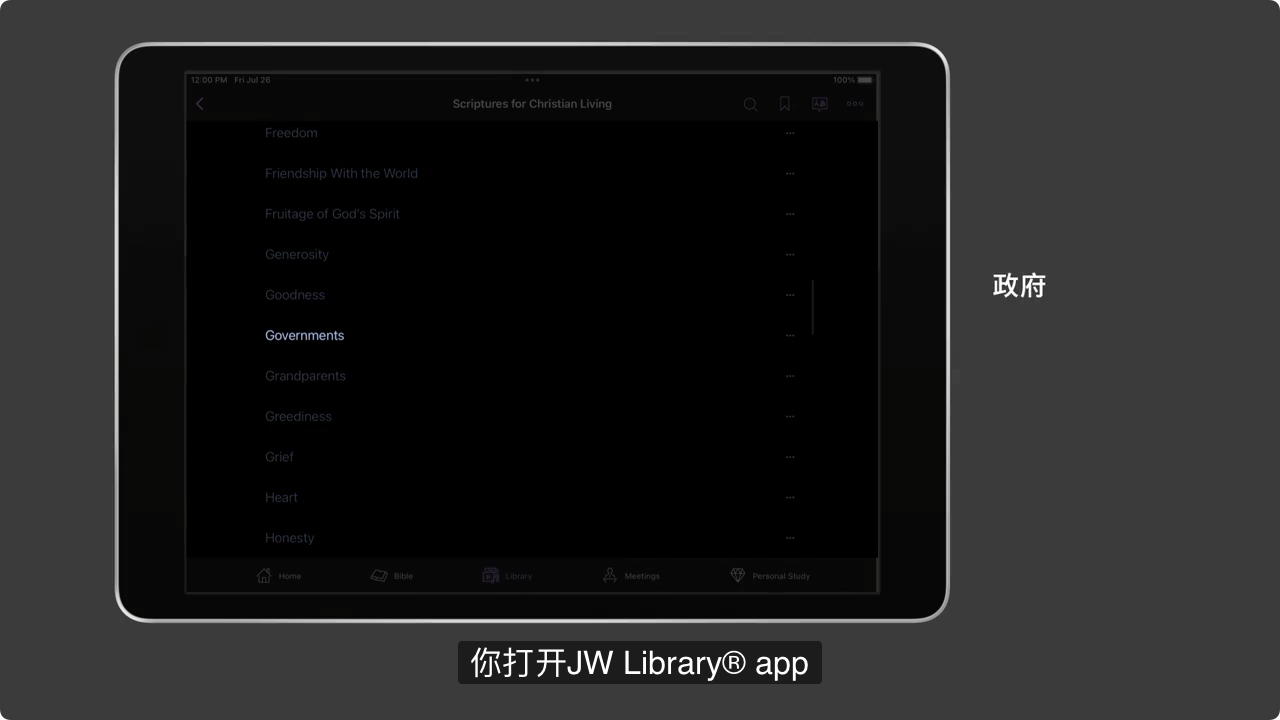
This week’s MEotW, “app” (sometimes written as “APP”), is now the organization’s official way to translate “app” in Mandarin, as much as there is an official way to do so. For example, it’s used in the Mandarin version of the 2024 Governing Body Update #5 video, at around the 11:06 mark—the subtitles say “app”, while the narrator says what sounds like “ay pee pee”.

“app” used in the Mandarin version of the 2024 Governing Body Update #5 video

(By the way, note that in this screenshot, the JW Library app is shown in Dark Mode—afters many years of people being used to using computer displays with white backgrounds that mimick paper, the organization is showing that there is nothing objectionable about the dark or black backgrounds enabled by computing device displays, backgrounds which can be easier on the eyes in some situations. After all, the default mode of the universe that Jehovah created is dark mode!)

An Unexpected Pronunciation

Yes, interestingly, as we can hear from the aforementioned video, when one refers to the JW Library app in Mandarin, in addition to using the English app name “JW Library” instead of a corresponding native Mandarin expression, one spells out the letters of “app” instead of just saying the English word “app”.

Why use three syllables to pronounce this exceedingly simple one-syllable English word in such an unusual and unexpected way? An Internet search turned up a Quora page discussing this question, which page contains the following excerpt that seems to summarize the points made in many of the replies:

Since the the original form “application” is not widely known, app is thought to be an acronym. In the aspect of pronunciation, closed syllables ending with p do not meet the Chinese pronunciation habit.

So, in other words, some believe that:

  • Being unfamiliar with the English word “application” that “app” is an abbreviation for, many Mandarin-speaking people erroneously thought that “app” is an acronym/initialism like “USA” or “PRC”, and acronyms are pronounced by saying the names of the letters in them. [2024-08-21: Thanks to reader SB for bringing up the matter of acronyms vs. initialisms. It seems that there is agreement that initialisms are, or can be, pronounced letter by letter, like “USA” and the Mandarin “app” are. However, there is not agreement about whether expressions pronounced that way count as acronyms, since some hold that only expressions like “NASA” that are pronounced as words should be considered acronyms.]
    • The fact that the Mandarin “app” is sometimes written in all upper case letters as “APP”, like an acronym/initialism would be written, lends credence to this theory.
  • Because Mandarin does not have words that end with a “p” sound, people who have only ever spoken Mandarin are not used to saying such words, and thus were naturally inclined to not just pronounce “app” like it is pronounced in English.
    • Some drag Chinese characters and Pīnyīn (Pīn·yīn {Piecing Together of} · Sounds → [Pinyin] 拼音) into discussion of this question, but these writing systems are just secondary visual representations of the actual primary factor relating to this issue, which is the system of sounds used in Mandarin speech. (I believe that technically, this is referred to as Mandarin phonology.)
    • Personally, I have doubts about this proposed factor, since other one-syllable English words ending with a “p” sound, like “jeep” (“jípǔ (jeep 吉普)”) and “Trump” (“Tèlǎngpǔ (Trump 特朗普)/Chuānpǔ (Trump (Tw) 川普)”), have been borrowed by Mandarin without requiring Mandarin-speakers to spell out their letters. I suppose it’s possible, as some have said, that putting “app” through this process results in a Mandarin expression that sounds confusingly similar to other expressions.

It’s also interesting that “app”, with its spelled-out letters, is used in Mandarin to correspond with the English word “app”, including in official media published by the organization, even though a native Mandarin expression meaning “app” does indeed exist. As shown in dictionaries, “yìngyòng (yìng·yòng apply · use | applied · used [(instance/etc.)] [→ [applied; for practical application; practical | application; practical use | (computing) app]] 应用 應用) may be used to mean “app”, and just as “app” is short for “application”, “yìngyòng (yìng·yòng apply · use | applied · used [(instance/etc.)] [→ [applied; for practical application; practical | application; practical use | (computing) app]] 应用 應用) is short for “yìngyòng chéngxù ((yìng·yòng applied · used (instance) → [application] 应用 應用) (chéng·xù {journey → [procedure]} · order; sequence → [(computer) programme] 程序) [application programme]) (or “yìngyòng chéngshì ((yìng·yòng applied · used (instance) → [application] 应用 應用) (chéng·shì {journey → [procedure]} · pattern → [(computer) programme (Tw)] 程式) [application programme (Tw)]) in Taiwan).

“Resistance Is Futile”

While Chinese traditionalists may futilely carry on about keeping Chinese culture “pure”, the common use of “app” in Mandarin is yet another example of Chinese culture naturally being influenced by Western culture, since the phenomenon of the modern mobile app followed on from the Western invention of the iPhone. Regarding the influence of Western culture on Chinese people, I have also noticed that some Chinese people seem to consider it “cool” to sprinkle in some English words here and there when they are speaking Mandarin, Cantonese, etc., even when they know the corresponding native Mandarin, Cantonese, etc. expressions.

Speaking of “cool”, a recent Language Log blog post written by Victor Mair and entitled “The Englishization of Chinese enters a new phase” said the following about “cool”, and about our MEotW “app”:

He takes the well-known example of “cool” (I’ll summarize what he says here). Before the year 2000, if somebody mentioned in a praiseworthy way that something was “kù 酷”, which at that time literally meant “cruel; ruthless; brutal; oppressive; savage”, people would consider that he was mixing English “coo[l]” in his Chinese speech, because at that time English “cool” was still in the early stages of being absorbed into Chinese. Standard dictionaries listed only the negative, pejorative meanings of “kù 酷”; there was not a trace of the positive meaning of “neat; nifty” and so forth. However, with the passage of time and with more and more saying “coo[l]” in a positive, approbatory sense, it gradually became a Chinese word. Now, if you say that someone or something is “kù 酷” (i.e., “cool”), no one would think that you’re mixing English in your speech. The positive meanings “cool; neat; nifty” have now become the primary definitions for “kù 酷”.

…people are no longer feeling the need to syllabize, much less hanziize, English words. They just say them flat out, and nobody blinks an eye that they are English words in Chinese. They have already instantly become Chinese terms — at least in speech. Nobody has cared to figure out how they should be written in hanzi [Chinese characters]. Even if you write them, you write them with roman letters…the roman alphabet has become an integral part of the Chinese writing system

There are hundreds of such words in current Chinese discourse, and they are at diverse stages of absorption into Chinese, e.g., “app”, “logo”, and “Ptú P图” (lit. “P picture/image”).

Yes, along with the “JW Library” app name, “app” is yet another example of how English words and Latin alphabet letters—like those used in Pīnyīn (Pīn·yīn {Piecing Together of} · Sounds → [Pinyin] 拼音)—are being incorporated into how people speak and write Mandarin Chinese “in the wild”, in the real world.

Anyway, as discussed in the 2024 Governing Body Update #5 video mentioned above, we stay neutral with regard to the world’s conflicts. While this obviously includes the world’s wars and political conflicts, in principle, this also applies to the world’s culture wars and its cultural conflicts and competitions. Our focus should be on how we can advance the interests of God’s Kingdom, and promote God’s righteous ways of doing things.—Matthew 6:33.

Categories
Current Events

zhèngzhì

zhèngzhì (zhèng·zhì {politics | political} · governing [→ [politics | political]] 政治) ← Tap/click to show/hide the “flashcard”

[Notes: Tap/click on a Pīnyīn (Pīn·yīn {Piecing Together of} · Sounds → [Pinyin] 拼音) expression to reveal its “flashcard”; tap/click on a “flashcard” or its Pīnyīn (Pīn·yīn {Piecing Together of} · Sounds → [Pinyin] 拼音) expression to hide the “flashcard”. 📖 📄 📘 icons mean 📖 Reveal All, 📄 Reveal Advanced, and 📘 Reveal None re all the “flashcards” in the heading, paragraph, etc. that they are placed at the beginning of.]

At the time of this writing, jw.org was featuring the article “Political Violence—What Does the Bible Say?”. As the article says:

A wave of political violence is sweeping the world.

  • The assassination of a record-high 39 political candidates along with other forms of political violence has marred Mexico’s 2023-2024 election season.
  • Europe has recently witnessed numerous incidents of political violence, including the attempted assassination of the prime minister of Slovakia on May 15, 2024.
  • The United States has been shaken by the attempted assassination of former president Donald Trump on July 13, 2024.

Incidentally, “former president Donald Trump” is translated in the Mandarin version of this article as “qián (former 前) zǒngtǒng (zǒng·tǒng {overall → [chief]} · {gathering together → [commanding]} (person) → [president] 总统 總統) Tèlǎngpǔ (Trump 特朗普) (Chuānpǔ (Trump (Tw) 川普))”.

Speaking of Trump and this year’s US presidential election, another, um, unusual development has been President Joe Biden’s recent announcement that he is ending his campaign for president, which will require a different Democratic presidential nominee to be selected and promoted in the relatively short time remaining before the election is to take place in November. In turbulent and uncertain times such as these, we as Jehovah’s people can especially appreciate that coming to know and accept the truth about the good news of God’s Kingdom frees us from the anxiety and concern that many in this world that is greatly affected by the USA’s political policies are undoubtedly feeling.—Daniel 2:44; John 8:32.

Anyway, where the English version of the above-mentioned jw.org article uses the word “political”, the Mandarin version generally uses this week’s MEotW, “zhèngzhì (zhèng·zhì {politics | political} · governing [→ [politics | political]] 政治)”, which in other contexts can also be used as a noun that corresponds to “politics”. (Be careful not to confuse “zhèngzhì (zhèng·zhì {politics | political} · governing [→ [politics | political]] 政治) with “jīngjì (jīng·jì {managing [of]} · {crossing [of] a river → [helping]} → [economy | [is] economical | economic] 经济 經濟)”, which basically means “economy” or “economic”.)

Morphemic Breakdown and Related Expressions

The first morpheme in “zhèngzhì (zhèng·zhì {politics | political} · governing [→ [politics | political]] 政治) basically means “politics” or “political”, and it also appears in “zhèngfǔ (zhèng·fǔ political · {seat of government} → [government] 政府)”, which means “government”. Other expressions in which it appears include “zhèngcè (zhèng·cè political; government · {bamboo/wooden slip used for writing → [plan; scheme; strategy]} → [policy; political tactic] 政策)”, “zhèngquán (zhèng·quán political · power; authority [→ [regime]] 政权 政權)”, and “zhízhèng (zhí·zhèng {catch; capture → [hold]} · {government → [political power]} 执政 執政)”.

The second morpheme in “zhèngzhì (zhèng·zhì {politics | political} · governing [→ [politics | political]] 政治) can mean “governing” or “ruling”, and it also appears in “tǒngzhì (tǒng·zhì {gather together → [command]} · rule (v) | {gathering together → [commanding]} · ruling → [rule] 统治 統治)”. Another sort of related meaning that this morpheme has is “treat; cure”, which likely comes from its meaning of “manage”. For example, it’s used this way in “zhìbìng (zhì·bìng {manage → [treat; cure]} · disease; illness; sickness 治病) and in “zhìliáo (zhì·liáo {managing → [treating; curing]} · treating; curing [→ [medical treatment; cure]] 治疗 治療)”.

Usage Examples

Here are a couple of examples of “zhèngzhì (zhèng·zhì {politics | political} · governing [→ [politics | political]] 政治) in use, taken from the above-mentioned jw.org article:

English:

Political Violence—What Does the Bible Say?

Mandarin:

📖 📄 📘 Zhèngzhì (Zhèng·zhì Political · Governing → [Political] 政治) Bàolì (Bào·lì Violent · Force → [Violence] 暴力) Shìjiàn (Shì·jiàn Incidents · [mw] 事件) Huì (Will) Yǒu (Have 有) Zhōngzhǐ (Zhōng·zhǐ Ending · Stopping 终止 終止) de (’s 的) (One 一) Tiān (Sky → [Day] 天) Ma ([? ptcl for “yes/no” questions])?

English:

Why is there so much political violence? Will it ever end? What does the Bible say?

Mandarin:

📖 📄 📘 Wèishénme (Wèi·shén·me for · what · [suf] [why] 为什么 為什/甚麼) yǒu ({are (there) having} → [are (there)] 有) zhème (zhè·me this · [suf for interrogatives and adverbs] 这么/末 這麼/末) duō (many 多) zhèngzhì (zhèng·zhì political · governing → [political] 政治) bàolì (bào·lì violent · force → [violence] 暴力) shìjiàn (shì·jiàn incidents · [mw] 事件) ne ([? ptcl] 呢)? Zhèixiē (Zhèi·xiē this · {indefinite number of} → [these] 这些 這些) shìqing (shì·qing events · situations 事情) huì (will) yǒu (have 有) zhōngzhǐ (zhōng·zhǐ ending · stopping 终止 終止) de (’s 的) (one 一) tiān (sky → [day] 天) ma ([? ptcl for “yes/no” questions])? Shèngjīng (Shèng·jīng (the) Holy · Scriptures → [the Bible] 圣经 聖經) zěnme (zěn·me what · [suf] 怎么 怎麼/麽) shuō ({does say}說/説)?