Categories
Culture Current Events History

wēijī

wēijī (wēi·jī {dangerous | endangering} · {incipient moment; crucial point | occasion} | {(for) danger} · occasion; opportunity → [crisis] 危机 危機) ← Tap/click to show/hide the “flashcard”

As of this writing, jw.org is featuring the article “Ukraine War Fuels Global Food Crisis”. The Mandarin version of this article uses “quánqiú (quán·qiú entire · globe → [global] 全球) liángshi (liáng·shi {grain → [food]} · {eating (matter) → [food]} → [food] 粮食 糧食) wēijī (wēi·jī {dangerous | endangering} · {incipient moment; crucial point | occasion} | {(for) danger} · occasion; opportunity → [crisis] 危机 危機)” to correspond with “global food crisis”.

The previous use on jw.org of “nànmín (nàn·mín calamity · {persons of a certain occupation} → [refugees] 难民 難民) cháo (tide → [(social) upsurge] 潮)” to correspond with “refugee crisis” (as discussed in a past MEotW post) makes for an interesting contrast—the use here of “cháo (tide → [(social) upsurge] 潮)”, literally meaning “tide”, is relatively specific, whereas “wēijī (wēi·jī {dangerous | endangering} · {incipient moment; crucial point | occasion} | {(for) danger} · occasion; opportunity → [crisis] 危机 危機)” is more generally used to correspond with “crisis”.

The “Danger + Opportunity” Trope

Wēijī (Wēi·jī {dangerous | endangering} · {incipient moment; crucial point | occasion} | {(for) danger} · occasion; opportunity → [crisis] 危机 危機)” has unfortunately been used—or misused—by Westerners so much to refer to positive opportunity in the midst of danger that there is a whole Wikipedia article on that.

Other articles have been written on this subject as well, such as the following:

Are All Opportunities Good?

It seems that the crux of the issue is the morpheme “ ({machine; mechanism [→ [airplane; aircraft | being organic]]} | {incipient moment; crucial point} | chance; opportunity; occasion機/机)” in “wēijī (wēi·jī {dangerous | endangering} · {incipient moment; crucial point | occasion} | {(for) danger} · occasion; opportunity → [crisis] 危机 危機)”, and how it does or doesn’t relate to the English word “opportunity”.

The English word “opportunity” is often defined as a situation that is favourable or allowing for progress. Naturally, people love progress and things that are favourable, so many naturally want to believe that “opportunity” being a possible meaning of the “ ({machine; mechanism [→ [airplane; aircraft | being organic]]} | {incipient moment; crucial point} | chance; opportunity; occasion機/机)” in “wēijī (wēi·jī {dangerous | endangering} · {incipient moment; crucial point | occasion} | {(for) danger} · occasion; opportunity → [crisis] 危机 危機)” means that they can find some favourable things for themselves in any crisis, because “the Chinese say so”.

It should be noted, though, that technically, an opportunity is not necessarily always a positive thing. One dictionary in fact defines an “opportunity” as “a time or set of circumstances that makes it possible to do something”, and not all possibilities are positive—it depends on who or what a possibility is for.

Possibilities

Speaking of possibilities, both “wēi (danger | dangerous | endanger 危)” and “ ({machine; mechanism [→ [airplane; aircraft | being organic]]} | {incipient moment; crucial point} | chance; opportunity; occasion機/机)” (but especially “ ({machine; mechanism [→ [airplane; aircraft | being organic]]} | {incipient moment; crucial point} | chance; opportunity; occasion機/机)”) are polysemous, that is, having many possible related meanings—they are sort of like linguistic Schrödinger’s cats that could be in several possible states until sufficient context collapses the possibilities into one (or perhaps, still, a few).

How do the possibilities collapse when “wēi (danger | dangerous | endanger 危)” and “ ({machine; mechanism [→ [airplane; aircraft | being organic]]} | {incipient moment; crucial point} | chance; opportunity; occasion機/机)” are put together as “wēijī (wēi·jī {dangerous | endangering} · {incipient moment; crucial point | occasion} | {(for) danger} · occasion; opportunity → [crisis] 危机 危機)” and then used in typical contexts? Since “wēijī (wēi·jī {dangerous | endangering} · {incipient moment; crucial point | occasion} | {(for) danger} · occasion; opportunity → [crisis] 危机 危機)” is a Mandarin word, the most important context to consider is that of the Mandarin language itself.

How does “wēijī (wēi·jī {dangerous | endangering} · {incipient moment; crucial point | occasion} | {(for) danger} · occasion; opportunity → [crisis] 危机 危機)” work as a word in the Mandarin language? For what it’s worth, my sense, influenced by decades of translating Mandarin words into English, is that “wēijī (wēi·jī {dangerous | endangering} · {incipient moment; crucial point | occasion} | {(for) danger} · occasion; opportunity → [crisis] 危机 危機)”, as used in Mandarin, should be understood to primarily mean an incipient moment, or even opportunity, for danger itself, not for a Western or other opportunist who tries to make the situation about himself/herself. That is to say, with a Mandarin wēijī (wēi·jī {dangerous | endangering} · {incipient moment; crucial point | occasion} | {(for) danger} · occasion; opportunity → [crisis] 危机 危機), the focus is primarily on how in the situation referred to, dangerous things could happen. As Prof. Mair says in his essay mentioned above:

If one wishes to wax philosophical about the of wēijī, one might elaborate upon it as the dynamic of a situation’s unfolding, when many elements are at play. In this sense, is neutral. This can either turn out for better or for worse, but — when coupled with wēi — the possibility of a highly undesirable outcome (whether in life, disease, finance, or war) is uppermost in the mind of the person who invokes this potent term.

Even the seemingly unrelated meaning for “ ({machine; mechanism [→ [airplane; aircraft | being organic]]} | {incipient moment; crucial point} | chance; opportunity; occasion機/机)” of “machine” or “mechanism” may be (somewhat, at least) connected to the concept of “opportunity”, since, as the tech lovers among us know, machines and mechanisms make possible things that were not possible before, opening up opportunities for good or bad things to happen, depending on who or what uses them, and how. Also, in an abstract way, a situation can be likened to a machine or mechanism with which certain inputs can cause certain things to happen. With “wēijī (wēi·jī {dangerous | endangering} · {incipient moment; crucial point | occasion} | {(for) danger} · occasion; opportunity → [crisis] 危机 危機)”, the input of concern is danger.

Responding Well to Crises

It is true, though, that how we respond to the potential dangers of an actual wēijī (wēi·jī {dangerous | endangering} · {incipient moment; crucial point | occasion} | {(for) danger} · occasion; opportunity → [crisis] 危机 危機), an actual crisis, can determine whether we end up better off or worse off. For example, the recent daily text for June 3, 2022 discussed 2 Corinthians 12:10, in which the apostle Paul said he ‘took pleasure’ in various crises as opportunities to exercise reliance on “the power of the Christ” rather than on his own relative insignificant power. (2 Corinthians 12:9) Thus, he would become truly powerful. As shown by a cross reference in the New World Translation Study Bible, related to this is what Paul wrote in Philippians 4:13:

“For all things I have the strength through the one who gives me power.”

So, while the Mandarin expression “quánqiú (quán·qiú entire · globe → [global] 全球) liángshi (liáng·shi {grain → [food]} · {eating (matter) → [food]} → [food] 粮食 糧食) wēijī (wēi·jī {dangerous | endangering} · {incipient moment; crucial point | occasion} | {(for) danger} · occasion; opportunity → [crisis] 危机 危機)” directly refers to potential dangers relating to global food availability, a quánqiú (quán·qiú entire · globe → [global] 全球) liángshi (liáng·shi {grain → [food]} · {eating (matter) → [food]} → [food] 粮食 糧食) wēijī (wēi·jī {dangerous | endangering} · {incipient moment; crucial point | occasion} | {(for) danger} · occasion; opportunity → [crisis] 危机 危機) also provides opportunity for us to exercise reliance on Jehovah and his King, Jesus, as the apostle Paul did. Additionally, it may give us opportunities to share the good news of God’s Kingdom with people who are receptive to it, as it becomes more and more evident that only God’s Kingdom can truly bring an end to such crises.

Categories
Culture Theocratic

liánmǐn

liánmǐn ({sympathizing with}; pitying [→ [having compassion; mercy]] 怜悯/闵/愍 憐憫/閔/愍) ← Tap/click to show/hide the “flashcard”

Appendix A2 of the English New World Translation of the Holy Scriptures (Study Edition), entitled “Features of This Revision”, discusses vocabulary changes that have been made in the current revision, words that have been translated differently than before. As noted in various entries in the excellent resource Referenced Theo. Expressions (RTE), Appendix A2 of the current Mandarin version of the New World Translation Bible (nwtsty) correspondingly discusses words that have been translated differently in the current revision of the Mandarin NWT Bible, compared to how they had been translated before.

Since we base what we say in Jehovah’s service on his Word the Bible, the vocabulary used in it—and the way those vocabulary words are translated—should be reflected in how we speak in our ministry, at our meetings, etc. So, it is beneficial for us Mandarin field language learners to be familiar with the latest thinking from the organization on how Bible terms should be translated into Mandarin.

A Different Mandarin “Merciful”

As Appendix A2 of the current Mandarin version of the New World Translation Bible (nwtsty) points out, this current version builds on the previous version’s efforts to avoid expressions that could easily be associated with false religious concepts.

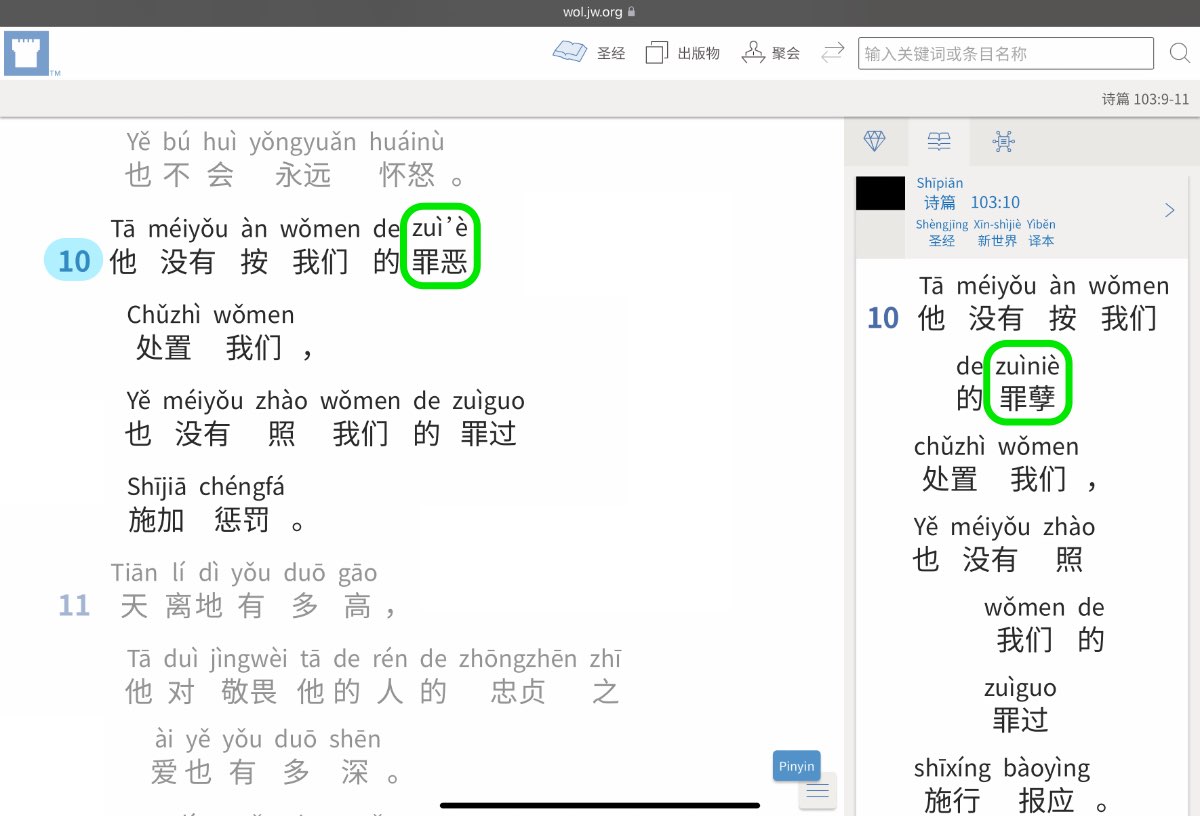
The first example that it points to is that in scriptures such as Exodus 34:6 (English, Mandarin), “cíbēi (cí·bēi {[is] kind} · {[is] compassionate} → [[is] merciful | mercy; benevolence; pity] 慈悲)” has been changed to “liánmǐn ({sympathizing with}; pitying [→ [having compassion; mercy]] 怜悯/闵/愍 憐憫/閔/愍)”:

Exodus 34:6 (WOL CHS+Pinyin Parallel Translations)

Not What We Mean

So, what’s the deal with “cíbēi (cí·bēi {[is] kind} · {[is] compassionate} → [[is] merciful | mercy; benevolence; pity] 慈悲)”? The entries for “cíbēi (cí·bēi {[is] kind} · {[is] compassionate} → [[is] merciful | mercy; benevolence; pity] 慈悲)” in a couple of the dictionaries that are available to be installed in the Pleco app give us some clues. First, consider the entry for this expression in the Referenced Theo. Expressions (RTE) Chinese-English dictionary:

mercy (old translation); Insight article heading in Watchtower Library 2011 CHS. NWT-2019’s Appendix A2 notes 慈悲 changed to 怜悯 to avoid conveying false-religious concepts (in this case perhaps the Buddhist/Jain concept of “karuna” which can be written 慈悲, although that is not stated)

In partial confirmation, Pleco’s own CC-Canto dictionary says this about “cíbēi (cí·bēi {[is] kind} · {[is] compassionate} → [[is] merciful | mercy; benevolence; pity] 慈悲)”:

(noun) (of Buddhism) Karuṇā

For reference, Wikipedia provides these summaries regarding Karuṇā:

Karuṇā (Sanskrit: करुणा) is generally translated as compassion or mercy and sometimes as self-compassion or spiritual longing. It is a significant spiritual concept in the Indic religions of Hinduism, Buddhism, Sikhism, and Jainism.

Karuṇā is important in all schools of Buddhism. For Theravada Buddhists, dwelling in karuṇā is a means for attaining a happy present life and heavenly rebirth. For Mahāyāna Buddhists, karuṇā is a co-requisite for becoming a Bodhisattva.

Karuṇā is associated with the Jain practice of compassion.

Indeed, we definitely would not want people to think we mean any of the above when we talk about the mercifulness of the true God Jehovah!

Categories
Culture Current Events

Liánhé Guó

Liánhé Guó ((Lián·hé United · {Closed → [Joined]} 联合 聯合) (Guó Nations) [United Nations]) ← Tap/click to show/hide the “flashcard”

On February 24, 2022, Russia sent significant military forces into Ukraine, resulting in the largest scale open warfare in Europe since World War II. The jw.org article “Russia Invades Ukraine”, which discusses this subject, includes a quote from the secretary-general of the United Nations, and we may on occasion want to talk about the United Nations in the Mandarin field. So, this week’s MEotW is “Liánhé Guó ((Lián·hé United · {Closed → [Joined]} 联合 聯合) (Guó Nations) [United Nations])”, the Mandarin expression corresponding to “United Nations”.

It can be noted from the Pīnyīn (Pīn·yīn {Piecing Together} · Sounds → [Pinyin] 拼音) Plus information for “Liánhé Guó ((Lián·hé United · {Closed → [Joined]} 联合 聯合) (Guó Nations) [United Nations])” (tap/click on a Pīnyīn (Pīn·yīn {Piecing Together} · Sounds → [Pinyin] 拼音) expression in this blog to show/hide its Pīnyīn (Pīn·yīn {Piecing Together} · Sounds → [Pinyin] 拼音) Plus information) that the morpheme ({close; shut [with]} [→ [join; combine [with] | accord [with]; conform [to]; suit; agree [with] | be fitting | be equal [to] | be proper; be appropriate | be matching [with]]] 合)” that’s in it in this case literally means “closed”, and effectively means “joined”—when two or more things are closed together, they are joined together, and thus united.

Avoiding Mental Indigestion

Another thing that may be noted about the rendering “Liánhé Guó ((Lián·hé United · {Closed → [Joined]} 联合 聯合) (Guó Nations) [United Nations])” is that it has a space between “Liánhé (Lián·hé United · {Closed → [Joined]} 联合 聯合)” and “Guó (Nations)”, whereas this expression is often rendered as the single word “Liánhéguó (Lián·hé·guó United · {Closed → [Joined]} · Nations → [United Nations] 联合国 聯合國)”. In this blog and in other resources that contain Pīnyīn (Pīn·yīn {Piecing Together} · Sounds → [Pinyin] 拼音) Plus material, such added spaces are included in certain expressions so that they are easier to parse (mentally digest and separate into meaningful parts) and read.

Regarding differing Pīnyīn (Pīn·yīn {Piecing Together} · Sounds → [Pinyin] 拼音) renderings, the MEotW post for “diǎnliàng (diǎn·liàng {dot → [light (v); ignite]} · {to be bright} [→ [illuminate; shine light on]] 点亮 點亮)” said:

Regarding standards and conventions, even officially recommended ones, for things like language and writing, views and practices vary in different places, and at different times.

When it comes to Pīnyīn (Pīn·yīn {Piecing Together} · Sounds → [Pinyin] 拼音), another factor to keep in mind is that due primarily to cultural prejudice, Pīnyīn (Pīn·yīn {Piecing Together} · Sounds → [Pinyin] 拼音) has simply not been used much overall, relatively speaking, especially as a full writing system on its own. So, it has not really gone through much of the process of receiving the widely agreed upon tweaks and refinements that a system typically receives as it gets tried out and put to extensive use by many people.

As a relatively “young” alphabetical writing system, Pīnyīn (Pīn·yīn {Piecing Together} · Sounds → [Pinyin] 拼音) can often benefit from following the example of a more “experienced” alphabetical writing system like the English writing system. It seems reasonable to conclude that this is the case with “Liánhé Guó ((Lián·hé United · {Closed → [Joined]} 联合 聯合) (Guó Nations) [United Nations])” following the word separation example of “United Nations”. In contrast, “Liánhéguó (Lián·hé·guó United · {Closed → [Joined]} · Nations → [United Nations] 联合国 聯合國)” is kind of like “Unitednations”—significantly harder to decipher and read.

The above-mentioned MEotW post concludes:

In the end, what matters most re how anything is written is not just what is officially recommended or what happens to be popular among changing, imperfect humans. Rather, what matters most is what really works best to accomplish the goal of writing: To communicate to readers. This is especially true when God-honouring and life-saving Bible truths need to be communicated. So, this blog and the other Pīnyīn (Pīn·yīn {Piecing Together} · Sounds → [Pinyin] 拼音) Plus resources will continue to seek to render Pīnyīn (Pīn·yīn {Piecing Together} · Sounds → [Pinyin] 拼音) in ways that maximize how clearly, easily, effectively, and appropriately it communicates with readers.

Related Mandarin Expressions

Here are some related Mandarin expressions that may also be useful to know regarding this situation with Ukraine:

  • Běi Dàxī Yáng Gōngyuē Zǔzhī ((Běi North 北) (Dà·xī {Big → [Great]} · Western → [Atlantic] 大西) (Yáng Ocean 洋) (Gōng·yuē International · Treaty → [Treaty] 公约 公約) (Zǔ·zhī Organized · Woven (System) → [Organization] 组织 組織) [North Atlantic Treaty Organization (NATO)])
    • Běiyuē (Běi·yuē North · Treaty → [NATO (abbr. for Běi Dàxī Yáng Gōngyuē Zǔzhī)] 北约 北約)
  • Ōuzhōu Liánméng ((Ōu·zhōu {European (abbr. for Ōuluóbā)} · Continent → [European (abbr. for Ōuluóbā Zhōu)] 欧洲 歐洲) (Lián·méng United · Union → [Union] 联盟 聯盟) [European Union (EU)])
    • Ōuméng (Ōu·méng {European (abbr. for Ōuluóbā Zhōu, Ōuzhōu)} · {Union (abbr. for Liánméng)} → [EU (abbr. for Ōuzhōu Liánméng)] 欧盟 歐盟)