Categories
Current Events

xǐshǒu

xǐshǒu (xǐ·shǒu wash · hands [→ [go to the washroom/lavatory/toilet/restroom]] 洗手) ← Tap/click to show/hide the “flashcard”

[Note: Tap/click on a Pīnyīn (Pīn·yīn {Piecing Together} · Sounds → [Pinyin] 拼音) expression to reveal its “flashcard”, tap/click on a “flashcard” or its Pīnyīn (Pīn·yīn {Piecing Together} · Sounds → [Pinyin] 拼音) expression to hide the “flashcard”.]

As of this writing, nearing the middle of the year 2022, the subject of the COVID-19 pandemic has been, to say the least, on people’s minds now for a while. So, it would be good to be able to refer to things related to it in Mandarin when speaking to people in the Mandarin field, or when speaking to our brothers and sisters in the truth.

electron microscope image of SARS-CoV-2—also known as 2019-nCoV, the virus that causes COVID-19

An electron microscope image of SARS-CoV-2—also known as 2019-nCoV, the virus that causes COVID-19
Creative Commons Attribution License logo NIAID

This week’s MEotW, “xǐshǒu (xǐ·shǒu wash · hands [→ [go to the washroom/lavatory/toilet/restroom]] 洗手)”, literally means “wash hands”, something that has taken on even more importance than before after the COVID-19-causing coronavirus got added to the list of disease-causing things that washing our hands can help protect us from.

Xǐshǒu (Xǐ·shǒu wash · hands [→ [go to the washroom/lavatory/toilet/restroom]] 洗手)” can also effectively mean “go to the washroom/lavatory/toilet/restroom”. Indeed, “xǐshǒu jiān ((xǐ·shǒu washing · hands 洗手) (jiān {space in between} → [room]) [washroom; lavatory; toilet; restroom])” is a commonly used Mandarin expression which literally means “washing hands space in between”, and which effectively means “washroom; lavatory; toilet; restroom”.

Verb-Object Construction

Xǐshǒu (Xǐ·shǒu wash · hands [→ [go to the washroom/lavatory/toilet/restroom]] 洗手)”, with the verb “ (wash; bathe; rinse 洗)” (“wash”) and its object “shǒu (hand | personally | [→ [mw for skill]] 手)” (“hands”), is an example of a Mandarin expression with verb-object construction.

The ABC Chinese-English Dictionary, edited by John DeFrancis and Victor H. Mair, among others, tells us the following about the entries in it that are marked as having verb-object construction:

V.O. (Verb-Object Construction, Dòng-Bīn Jiégòu 动宾结构).

Many English verbs get translated into natural Chinese as a verb plus an object noun, e.g. chīfàn for ‘eat’, shuōhuà for ‘speak’, etc. It is important for two reasons to know what is merely a verb in Chinese and what is actually a verb-object construction.

First, verb-object constructions can never take a second object, i.e. chīfàn can never be followed directly by something else to be eaten.

Second, a verb and its object can be separated from one another, thus allowing

(i) aspect particles to be placed directly after the verb, e.g. chīle fàn ‘after finishing eating’;

(ii) modification of the object, e.g. chī Zhōngguófàn ‘eat Chinese food’; and (iii) quantification of the noun, e.g. chīle sān wǎn fàn ‘ate three bowls of rice’.

One Word? Not Two Words?

While “wash hands” is two words in the English writing system, the Pīnyīn (Pīn·yīn {Piecing Together} · Sounds → [Pinyin] 拼音) writing system typically renders “xǐshǒu (xǐ·shǒu wash · hands [→ [go to the washroom/lavatory/toilet/restroom]] 洗手)” as one word. The MEotW post on “Jìniàn Jùhuì ((Jì·niàn Remembering · {Thinking Of} → [Commemorating] 记/纪念 記/紀念) (Jùhuì Meeting 聚会 聚會) [[the] Memorial])” (including a recently added comment there) went into some reasons why it can be good for the relatively “young” Pīnyīn (Pīn·yīn {Piecing Together} · Sounds → [Pinyin] 拼音) writing system to at times emulate the relatively “experienced” English writing system, but in cases like the relatively digestible two-syllable “xǐshǒu (xǐ·shǒu wash · hands [→ [go to the washroom/lavatory/toilet/restroom]] 洗手)”, there is little practical reason relating to readability to impose English word separation conventions.

On the other hand, while “xǐshǒu jiān ((xǐ·shǒu washing · hands 洗手) (jiān {space in between} → [room]) [washroom; lavatory; toilet; restroom])” is generally rendered in the world as one three-syllable word, this blog and other Pīnyīn (Pīn·yīn {Piecing Together} · Sounds → [Pinyin] 拼音) Plus resources will generally render such expressions as two separate words, to make them easier to read. This is similar to how in English, “changeroom” is a single two-syllable word, but “changing room” is separated into two words, rather than being rendered as the single three-syllable word “changingroom”.

“Melting” Away the Pounds Viruses

While researching the subject of washing hands in this age of COVID-19, I found the following interesting information:

…soap — all sorts of it: liquid, solid, honeysuckle-scented, the versions inexplicably only marketed to men or women — is…even more routinely effective than hand sanitizer. …

That’s because when you wash your hands with soap and water, you’re not just wiping viruses off your hands and sending them down the drain. You’re actually annihilating the viruses, rendering them harmless. Soap “is almost like a demolition team breaking down a building and taking all the bricks away,” says Palli Thordarson, a chemistry professor at the University of New South Wales…

…coronaviruses are…bits of genetic information — encoded by RNA — surrounded by a coat of fat and protein. Thordarson likes to call viruses “nano-sized grease balls.” And grease balls, no matter the size, are the exact type of thing soap loves to annihilate.

The soap takes care of the virus much like it takes care of the oil in the water. “It’s almost like a crowbar; it starts to pull all the things apart,” Thordarson says.

One side of the soap molecule (the one that’s attracted to fat and repelled by water) buries its way into the virus’s fat and protein shell. Fortunately, the chemical bonds holding the virus together aren’t very strong, so this intrusion is enough to break the virus’s coat. “You pull the virus apart, you make it soluble in water, and it disintegrates,” he says.

Then the harmless shards of virus get flushed down the drain. And even if it the soap doesn’t destroy every virus, you’ll still rid them from your hands with soap and water, as well as any grease or dirt they may be clinging to.

So, while technically soap and water disintegrates and dissolves coronaviruses, if a coronavirus subjected to soap and water could talk, it might say, “I’m melting!”
Categories
Culture Current Events

Liánhé Guó

Liánhé Guó ((Lián·hé United · {Closed → [Joined]} 联合 聯合) (Guó Nations) [United Nations]) ← Tap/click to show/hide the “flashcard”

On February 24, 2022, Russia sent significant military forces into Ukraine, resulting in the largest scale open warfare in Europe since World War II. The jw.org article “Russia Invades Ukraine”, which discusses this subject, includes a quote from the secretary-general of the United Nations, and we may on occasion want to talk about the United Nations in the Mandarin field. So, this week’s MEotW is “Liánhé Guó ((Lián·hé United · {Closed → [Joined]} 联合 聯合) (Guó Nations) [United Nations])”, the Mandarin expression corresponding to “United Nations”.

It can be noted from the Pīnyīn (Pīn·yīn {Piecing Together} · Sounds → [Pinyin] 拼音) Plus information for “Liánhé Guó ((Lián·hé United · {Closed → [Joined]} 联合 聯合) (Guó Nations) [United Nations])” (tap/click on a Pīnyīn (Pīn·yīn {Piecing Together} · Sounds → [Pinyin] 拼音) expression in this blog to show/hide its Pīnyīn (Pīn·yīn {Piecing Together} · Sounds → [Pinyin] 拼音) Plus information) that the morpheme ({close; shut [with]} [→ [join; combine [with] | accord [with]; conform [to]; suit; agree [with] | be fitting | be equal [to] | be proper; be appropriate | be matching [with]]] 合)” that’s in it in this case literally means “closed”, and effectively means “joined”—when two or more things are closed together, they are joined together, and thus united.

Avoiding Mental Indigestion

Another thing that may be noted about the rendering “Liánhé Guó ((Lián·hé United · {Closed → [Joined]} 联合 聯合) (Guó Nations) [United Nations])” is that it has a space between “Liánhé (Lián·hé United · {Closed → [Joined]} 联合 聯合)” and “Guó (Nations)”, whereas this expression is often rendered as the single word “Liánhéguó (Lián·hé·guó United · {Closed → [Joined]} · Nations → [United Nations] 联合国 聯合國)”. In this blog and in other resources that contain Pīnyīn (Pīn·yīn {Piecing Together} · Sounds → [Pinyin] 拼音) Plus material, such added spaces are included in certain expressions so that they are easier to parse (mentally digest and separate into meaningful parts) and read.

Regarding differing Pīnyīn (Pīn·yīn {Piecing Together} · Sounds → [Pinyin] 拼音) renderings, the MEotW post for “diǎnliàng (diǎn·liàng {dot → [light (v); ignite]} · {to be bright} [→ [illuminate; shine light on]] 点亮 點亮)” said:

Regarding standards and conventions, even officially recommended ones, for things like language and writing, views and practices vary in different places, and at different times.

When it comes to Pīnyīn (Pīn·yīn {Piecing Together} · Sounds → [Pinyin] 拼音), another factor to keep in mind is that due primarily to cultural prejudice, Pīnyīn (Pīn·yīn {Piecing Together} · Sounds → [Pinyin] 拼音) has simply not been used much overall, relatively speaking, especially as a full writing system on its own. So, it has not really gone through much of the process of receiving the widely agreed upon tweaks and refinements that a system typically receives as it gets tried out and put to extensive use by many people.

As a relatively “young” alphabetical writing system, Pīnyīn (Pīn·yīn {Piecing Together} · Sounds → [Pinyin] 拼音) can often benefit from following the example of a more “experienced” alphabetical writing system like the English writing system. It seems reasonable to conclude that this is the case with “Liánhé Guó ((Lián·hé United · {Closed → [Joined]} 联合 聯合) (Guó Nations) [United Nations])” following the word separation example of “United Nations”. In contrast, “Liánhéguó (Lián·hé·guó United · {Closed → [Joined]} · Nations → [United Nations] 联合国 聯合國)” is kind of like “Unitednations”—significantly harder to decipher and read.

The above-mentioned MEotW post concludes:

In the end, what matters most re how anything is written is not just what is officially recommended or what happens to be popular among changing, imperfect humans. Rather, what matters most is what really works best to accomplish the goal of writing: To communicate to readers. This is especially true when God-honouring and life-saving Bible truths need to be communicated. So, this blog and the other Pīnyīn (Pīn·yīn {Piecing Together} · Sounds → [Pinyin] 拼音) Plus resources will continue to seek to render Pīnyīn (Pīn·yīn {Piecing Together} · Sounds → [Pinyin] 拼音) in ways that maximize how clearly, easily, effectively, and appropriately it communicates with readers.

Related Mandarin Expressions

Here are some related Mandarin expressions that may also be useful to know regarding this situation with Ukraine:

  • Běi Dàxī Yáng Gōngyuē Zǔzhī ((Běi North 北) (Dà·xī {Big → [Great]} · Western → [Atlantic] 大西) (Yáng Ocean 洋) (Gōng·yuē International · Treaty → [Treaty] 公约 公約) (Zǔ·zhī Organized · Woven (System) → [Organization] 组织 組織) [North Atlantic Treaty Organization (NATO)])
    • Běiyuē (Běi·yuē North · Treaty → [NATO (abbr. for Běi Dàxī Yáng Gōngyuē Zǔzhī)] 北约 北約)
  • Ōuzhōu Liánméng ((Ōu·zhōu {European (abbr. for Ōuluóbā)} · Continent → [European (abbr. for Ōuluóbā Zhōu)] 欧洲 歐洲) (Lián·méng United · Union → [Union] 联盟 聯盟) [European Union (EU)])
    • Ōuméng (Ōu·méng {European (abbr. for Ōuluóbā Zhōu, Ōuzhōu)} · {Union (abbr. for Liánméng)} → [EU (abbr. for Ōuzhōu Liánméng)] 欧盟 歐盟)
Categories
Science Technology Theocratic

huídào

huídào (huí·dào {circle back}; return; {go/come back} · {to arrive [at]}; to 回到 回/迴/逥/廻到) ← Tap/click to show/hide the “flashcard”

Appendix A2 of the English New World Translation of the Holy Scriptures (Study Edition), entitled “Features of This Revision”, discusses vocabulary changes that have been made in the current revision, words that have been translated differently than before. As noted in various entries in the excellent resource Referenced Theo. Expressions (RTE), Appendix A2 of the current Mandarin version of the New World Translation Bible (nwtsty) correspondingly discusses words that have been translated differently in the current revision of the Mandarin NWT Bible, compared to how they had been translated before.

Since we base what we say in Jehovah’s service on his Word the Bible, the vocabulary used in it—and the way those vocabulary words are translated—should be reflected in how we speak in our ministry, at our meetings, etc. So, it is beneficial for us Mandarin field language learners to be familiar with the latest thinking from the organization on how Bible terms should be translated into Mandarin.

Mandarin “Presence”

The Greek word pa·rou·siʹa has often been translated less than ideally into English, as the Insight book thus explains:

Many translations vary their renderings of this word. While translating pa·rou·siʹa as “presence” in some texts, they more frequently render it as “coming.” This has been the basis for the expression “second coming” or “second advent” (adventus [“advent” or “coming”] being the Latin Vulgate translation of pa·rou·siʹa at Mt 24:3) with regard to Christ Jesus. While Jesus’ presence of necessity implies his arrival at the place where he is present, the translation of pa·rou·siʹa by “coming” places all the emphasis on the arrival and obscures the subsequent presence that follows the arrival. Though allowing for both “arrival” and “presence” as translations of pa·rou·siʹa, lexicographers generally acknowledge that the presence of the person is the principal idea conveyed by the word.

It is not surprising, then, that attention was paid to how pa·rou·siʹa should be translated into Mandarin for the current Mandarin version of the New World Translation Bible (nwtsty).

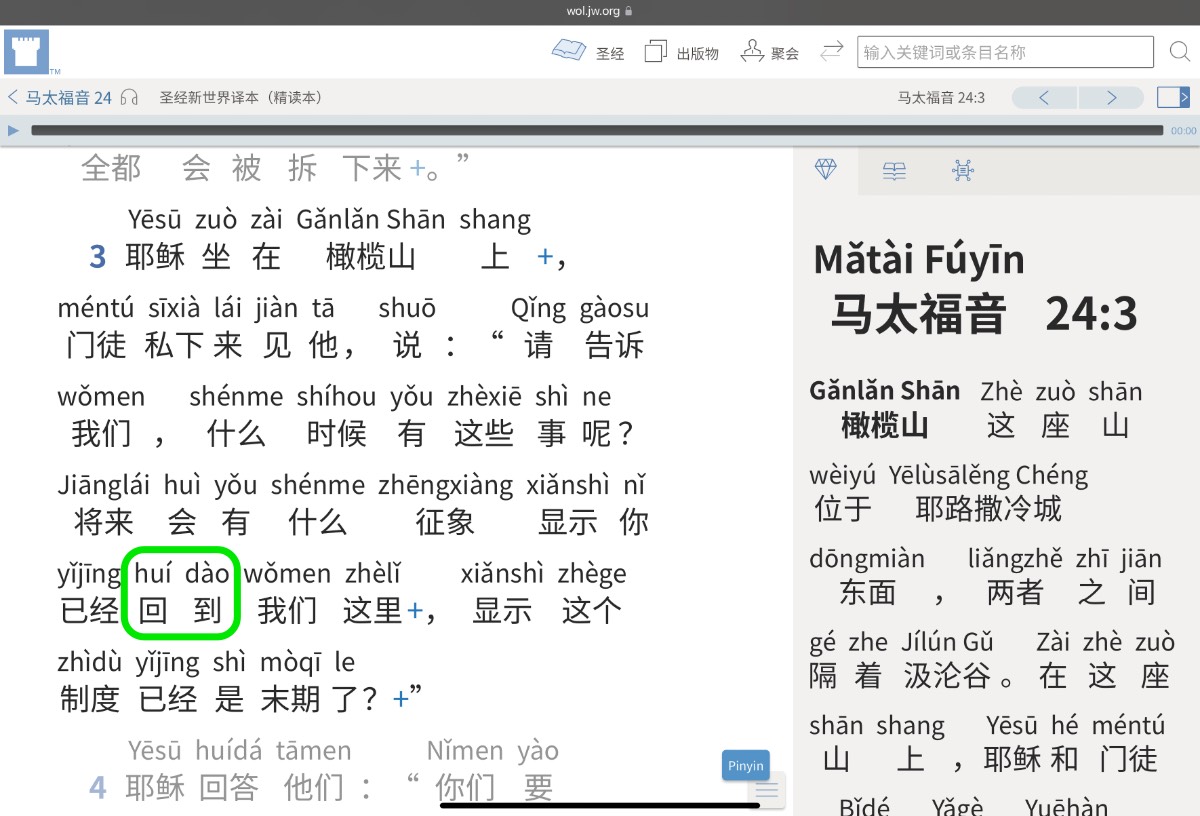
The older Mandarin NWT Bible generally translated pa·rou·siʹa as “línzài (lín·zài arriving · {being present} 临在 臨在)”. However, many people find this word to be relatively unfamiliar. So, the current Mandarin version of the NWT Bible (nwtsty) usually translates Christ’s pa·rou·siʹa as “huídào (huí·dào {circling back} · {to arrive at} 回到 回/迴/逥/廻到) wǒmen (wǒ·men us · [pl] 我们 我們) zhèlǐ (zhè·lǐ this · inside → [here] 这里 這裡/裏)”. This should help to avoid unnecessarily obstructing beginning Bible readers from understanding the meanings of scriptures that use pa·rou·siʹa in the original Greek text. At Matthew 24:3, to further clarify the meaning, the current Mandarin version of the NWT Bible (nwtsty) uses the expression “yǐjing (yǐ·jing already · {have gone through} 已经 已經) huídào (huí·dào {circling back} · {to arrive at} 回到 回/迴/逥/廻到)”, to emphasize that it is referring to the situation in which Jesus has already gone through the process of arriving, and thus is present.

Matthew 24:3 (WOL CHS+Pinyin)

Verb-Complement Togetherness

Note that in the scripture in the Watchtower ONLINE LIBRARY linked to above, “huídào (huí·dào {circling back} · {to arrive at} 回到 回/迴/逥/廻到)” is rendered as “huí ({circling back}回/迴/逥/廻) dào ({to arrive at} 到)”, with a space. The post on this blog on “diǎnliàng (diǎn·liàng {dot → [light (v); ignite]} · {to be bright} [→ [illuminate; shine light on]] 点亮 點亮)” discussed such differing renderings:

Getting back to the MEotW “diǎnliàng (diǎn·liàng {dot → [light (v); ignite]} · {to be bright} [→ [illuminate; shine light on]] 点亮 點亮)”, the PRC national standard GB/T 16159-2012 recommends that, being made up of a single-syllable verb and its single-syllable complement, this expression should be written together. Recent official Pīnyīn (Pīn·yīn {Piecing Together} · Sounds → [Pinyin] 拼音) publications such as those on the Watchtower ONLINE LIBRARY often do not follow this recommendation regarding single-syllable verbs and their single-syllable complements, whereas older official Pīnyīn (Pīn·yīn {Piecing Together} · Sounds → [Pinyin] 拼音) publications did follow this recommendation, and as do the unofficial Pīnyīn (Pīn·yīn {Piecing Together} · Sounds → [Pinyin] 拼音) Plus resources.

On the other hand, the unofficial Pīnyīn (Pīn·yīn {Piecing Together} · Sounds → [Pinyin] 拼音) Plus resources join the official Pīnyīn (Pīn·yīn {Piecing Together} · Sounds → [Pinyin] 拼音) publications, old and new, in explicitly indicating tone sandhi for “ (not 不)” and “ (one 一)” (e.g., “zài (bú·zài not · again; further; continuing; anymore 不再)” instead of the standard “zài (bù·zài not · again; further; continuing; anymore 不再)”) to make things easier for readers, even though this practice is not included in the GB/T 16159-2012 standard’s recommendations.

In the end, what matters most re how anything is written is not just what is officially recommended or what happens to be popular among changing, imperfect humans. Rather, what matters most is what really works best to accomplish the goal of writing: To communicate to readers. This is especially true when God-honouring and life-saving Bible truths need to be communicated. So, this blog and the other Pīnyīn (Pīn·yīn {Piecing Together} · Sounds → [Pinyin] 拼音) Plus resources will continue to seek to render Pīnyīn (Pīn·yīn {Piecing Together} · Sounds → [Pinyin] 拼音) in ways that maximize how clearly, easily, effectively, and appropriately it communicates with readers.