búyì+ (bú·yì un·righteous[ness] 不义 不義) 👈🏼 Tap/click to show/hide the “flashcard”
[Notes: Tap/click on a Pīnyīn (Pīn·yīn {Piecing Together of} · Sounds → [Pinyin] 拼音) expression to reveal its “flashcard”; tap/click on a “flashcard” or its Pīnyīn (Pīn·yīn {Piecing Together of} · Sounds → [Pinyin] 拼音) expression to hide the “flashcard”. 📖 📄 ➕ icons mean 📖 Reveal All, 📄 Reveal Advanced, and ➕ Reveal + Symbols re all the “flashcards” in the heading, paragraph, etc. that they are placed at the beginning of.]
I have long especially liked 1 Corinthians 13. It contains counsel on what really does and doesn’t matter in life, an extensive description and definition of the most important kind of love, and a sublime discussion about the need to become complete, mature, as a person. As these apply to life in general, so too do they apply to our lives as Mandarin field language learners.
As Mandarin field language learners, it can benefit us greatly to consider what we can learn from 1 Corinthians 13, and along the way, we can also consider some of the Mandarin expressions used in that chapter in the current version of the Mandarin New World Translation Bible (nwtsty).
“Unrighteousness”
This week’s MEotW, “búyì (bú·yì un·righteous[ness] 不义 不義)”, is used in verse 6 (WOL) of 1 Corinthians 13:
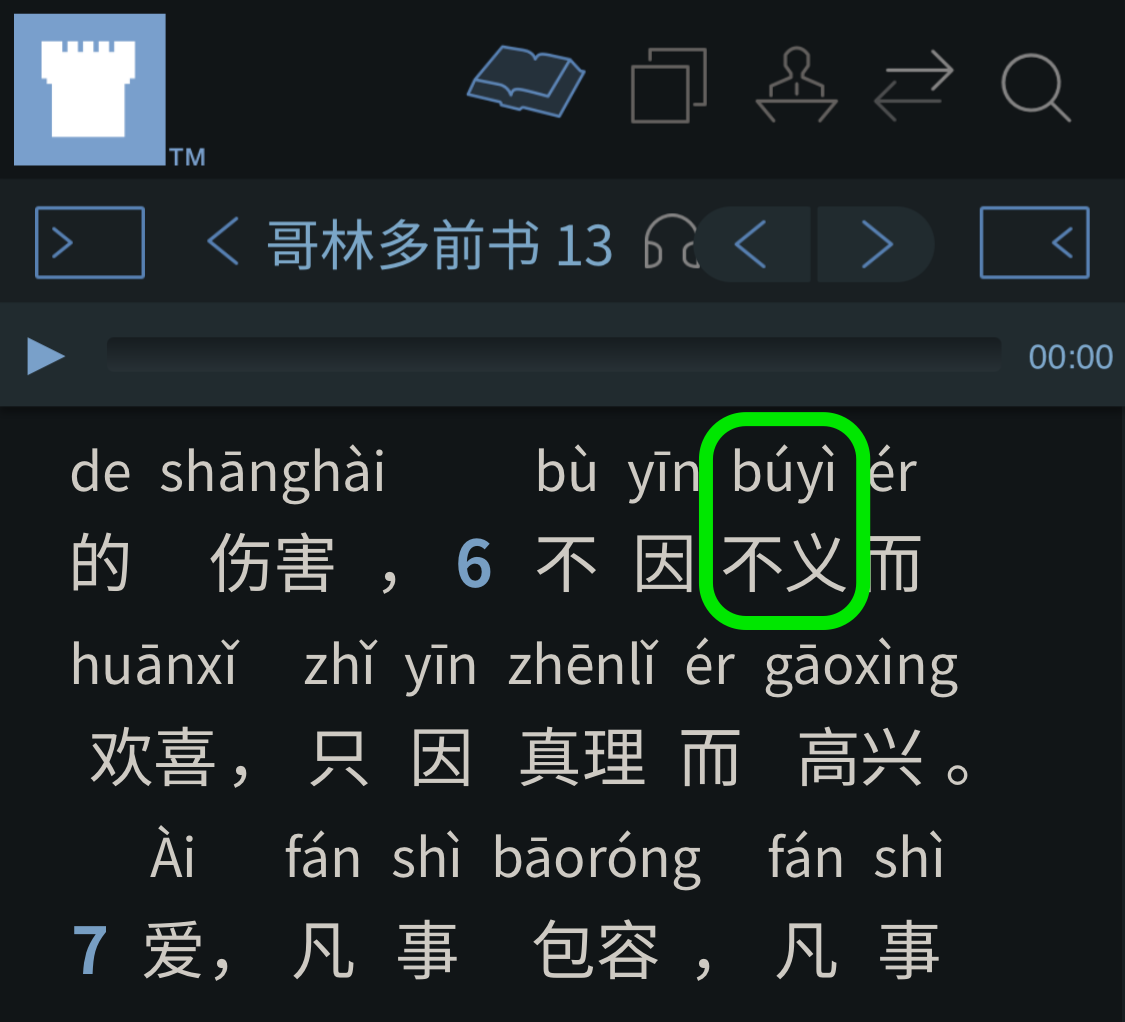
(Dark mode for the Watchtower ONLINE LIBRARY (WOL) website, as shown in the above image, can be enabled in the Safari web browser by using the Noir Safari extension. Other web browsers may also have extensions with similar functionality.)
For comparison, here are the current English and Pīnyīn (Pīn·yīn {Piecing Together of} · Sounds → [Pinyin] 拼音) Plus renderings of 1 Corinthians 13:6:
It does not rejoice over unrighteousness, but rejoices with the truth.
Pīnyīn (Pīn·yīn {Piecing Together of} · Sounds → [Pinyin] 拼音) Plus:
📖 📄 ➕ bù (not 不) yīn ({because of} 因) búyì (bú·yì un·righteousness 不义 不義) ér (thus 而) huānxǐ+ (huān·xǐ {does be joyful} · {does be happy} 欢喜 歡喜), zhǐ (only 只 只/秖/衹/祇) yīn ({because of} 因) zhēnlǐ (zhēn·lǐ true · reasoning → [the truth] 真理) ér (thus 而) gāoxìng (gāo·xìng (is with) high · enthusiasm → [is glad] 高兴 高興).
In the above examples, “búyì (bú·yì un·righteous[ness] 不义 不義)” corresponds to “unrighteousness”, and it does so pretty straightforwardly, right down to the literal meanings of its morphemes. Regarding righteousness, the Insight book’s entry on “Righteousness” says:
the original-language terms are at times translated “justice”
So, “unrighteous” can mean “unjust” or “unfair”.
Don’t Be Unfair
While a certain amount of knowledge about Chinese characters is obviously of some practical benefit in this world in which characters are “everywhere”, remember that ultimately, Chinese characters are only “everywhere” because of human tradition—linguistically speaking, there is actually no technical need for any of the Chinese languages to be written using Chinese characters. With regard to the Mandarin field specifically, this is exemplified by the fact that Pīnyīn (Pīn·yīn {Piecing Together of} · Sounds → [Pinyin] 拼音) works well as a full writing system for Modern Standard Mandarin, meaning that anything that can be said in Modern Standard Mandarin, from the simpest expressions to the deepest, most advanced expressions, can be written with Pīnyīn (Pīn·yīn {Piecing Together of} · Sounds → [Pinyin] 拼音). (In fact, Plan A for modern China was for Pīnyīn (Pīn·yīn {Piecing Together of} · Sounds → [Pinyin] 拼音) to eventually replace Chinese characters, but unfortunately, the B players have gotten their way in China so far.)
With that in mind, and also remembering the scriptural counsel at 1 Corinthians 14:8–11, it follows then that just following the crowd and focusing in our Mandarin field language learning on the traditionally imposed but extraordinarily complex Chinese characters, and thus allowing them to distract from, hinder, and impede our efforts to learn to understand Mandarin speech and to use understandable Mandarin speech to praise Jehovah and help people spiritually, would be unfair in the following ways:
- It would be unfair to people in the field and at the meetings who lose out on how we could have helped and encouraged them spiritually using understandable Mandarin speech.
- It would also be unfair to us ourselves, because it makes it much harder than necessary for us to function in the Mandarin field, and we also lose out and get weakened spiritually because of not understanding Mandarin speech at the meetings, assemblies, etc. that we could have been strengthened and encouraged by if we had only understood it!
- Last but not least, it would be unfair to Jehovah God, to whom we have dedicated our best, but who would not be getting our best, if we are giving our first devotion to the human traditions involving Chinese characters, and then just giving Jehovah whatever’s left over after we’ve let the characters drain us with their unnecessary and self-indulgent difficulties and vagaries.
Indeed, it just wouldn’t be right for us to let devotion to mere human tradition prevent us from serving Jehovah and helping people in the Mandarin field as well as we ought to be able to, based on how Jehovah actually made us to use language!