Categories
Culture Theocratic

liánmǐn

liánmǐn ({sympathizing with}; pitying [→ [having compassion; mercy]] 怜悯/闵/愍 憐憫/閔/愍) ← Tap/click to show/hide the “flashcard”

Appendix A2 of the English New World Translation of the Holy Scriptures (Study Edition), entitled “Features of This Revision”, discusses vocabulary changes that have been made in the current revision, words that have been translated differently than before. As noted in various entries in the excellent resource Referenced Theo. Expressions (RTE), Appendix A2 of the current Mandarin version of the New World Translation Bible (nwtsty) correspondingly discusses words that have been translated differently in the current revision of the Mandarin NWT Bible, compared to how they had been translated before.

Since we base what we say in Jehovah’s service on his Word the Bible, the vocabulary used in it—and the way those vocabulary words are translated—should be reflected in how we speak in our ministry, at our meetings, etc. So, it is beneficial for us Mandarin field language learners to be familiar with the latest thinking from the organization on how Bible terms should be translated into Mandarin.

A Different Mandarin “Merciful”

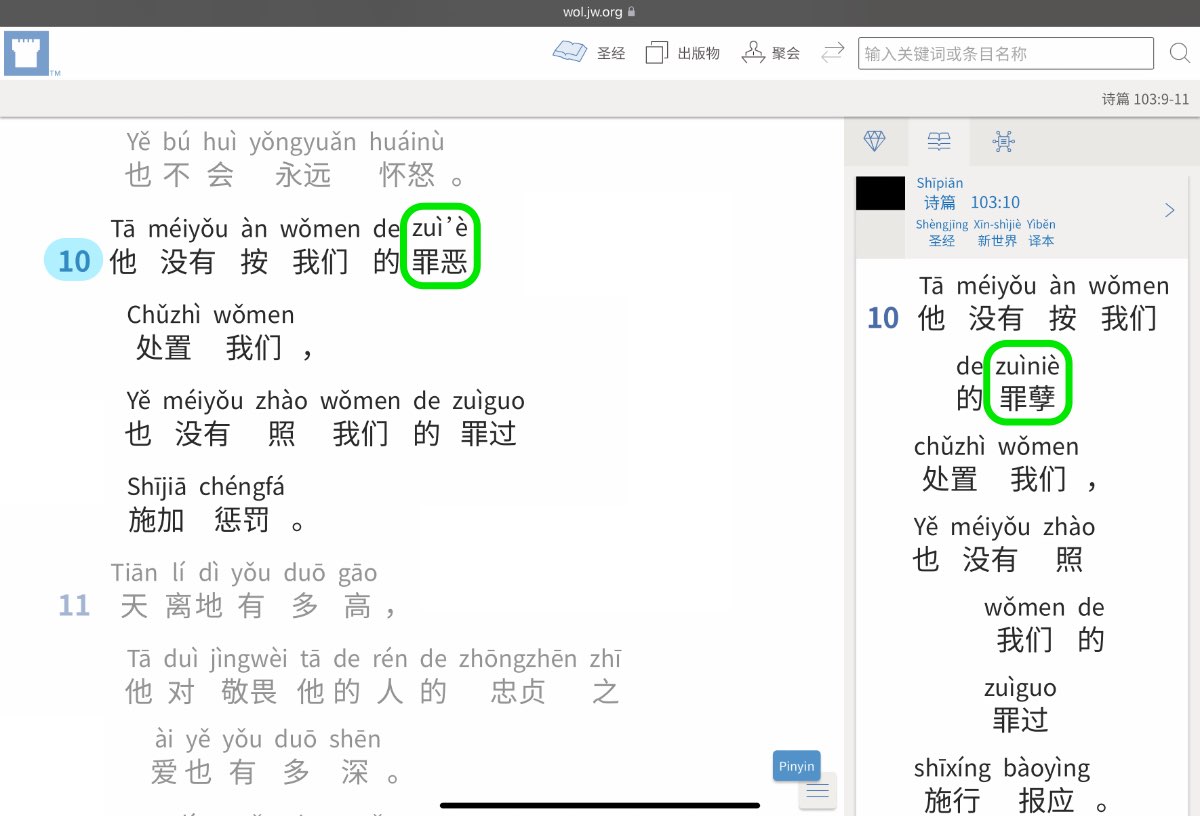
As Appendix A2 of the current Mandarin version of the New World Translation Bible (nwtsty) points out, this current version builds on the previous version’s efforts to avoid expressions that could easily be associated with false religious concepts.

The first example that it points to is that in scriptures such as Exodus 34:6 (English, Mandarin), “cíbēi (cí·bēi {[is] kind} · {[is] compassionate} → [[is] merciful | mercy; benevolence; pity] 慈悲)” has been changed to “liánmǐn ({sympathizing with}; pitying [→ [having compassion; mercy]] 怜悯/闵/愍 憐憫/閔/愍)”:

Exodus 34:6 (WOL CHS+Pinyin Parallel Translations)

Not What We Mean

So, what’s the deal with “cíbēi (cí·bēi {[is] kind} · {[is] compassionate} → [[is] merciful | mercy; benevolence; pity] 慈悲)”? The entries for “cíbēi (cí·bēi {[is] kind} · {[is] compassionate} → [[is] merciful | mercy; benevolence; pity] 慈悲)” in a couple of the dictionaries that are available to be installed in the Pleco app give us some clues. First, consider the entry for this expression in the Referenced Theo. Expressions (RTE) Chinese-English dictionary:

mercy (old translation); Insight article heading in Watchtower Library 2011 CHS. NWT-2019’s Appendix A2 notes 慈悲 changed to 怜悯 to avoid conveying false-religious concepts (in this case perhaps the Buddhist/Jain concept of “karuna” which can be written 慈悲, although that is not stated)

In partial confirmation, Pleco’s own CC-Canto dictionary says this about “cíbēi (cí·bēi {[is] kind} · {[is] compassionate} → [[is] merciful | mercy; benevolence; pity] 慈悲)”:

(noun) (of Buddhism) Karuṇā

For reference, Wikipedia provides these summaries regarding Karuṇā:

Karuṇā (Sanskrit: करुणा) is generally translated as compassion or mercy and sometimes as self-compassion or spiritual longing. It is a significant spiritual concept in the Indic religions of Hinduism, Buddhism, Sikhism, and Jainism.

Karuṇā is important in all schools of Buddhism. For Theravada Buddhists, dwelling in karuṇā is a means for attaining a happy present life and heavenly rebirth. For Mahāyāna Buddhists, karuṇā is a co-requisite for becoming a Bodhisattva.

Karuṇā is associated with the Jain practice of compassion.

Indeed, we definitely would not want people to think we mean any of the above when we talk about the mercifulness of the true God Jehovah!

Categories
Current Events

xīwàng

xīwàng (xī·wàng hoping · {gazing (into the distance [at]) → [hoping; expecting]} [→ [hope; wishing]] 希望) ← Tap/click to show/hide the “flashcard”

On February 24, 2022, Russia sent significant military forces into Ukraine, resulting in the largest scale open warfare in Europe since World War II. Knowing certain Mandarin expressions will help us in the Mandarin field as we hear about and talk about Ukraine in the time ahead.

Two articles about this situation that have been featured on jw.org are “Russia Invades Ukraine” and “Refugee Crisis​—Millions Flee Ukraine”. In the Mandarin versions of those articles, “xīwàng (xī·wàng hoping · {gazing (into the distance [at]) → [hoping; expecting]} [→ [hope; wishing]] 希望)”, this week’s MEotW, is used to correspond with the English word “hope”.

Hopeful Examples

Here are some examples of how “xīwàng (xī·wàng hoping · {gazing (into the distance [at]) → [hoping; expecting]} [→ [hope; wishing]] 希望)” is used in the above-mentioned articles:

English:

Why can you be hopeful about the future?

Mandarin:

📖 📄 📘 Wèishénme (Wèi·shén·me for · what · [suf] → [why] 为什么 為什/甚麼) (you 你) kěyǐ (kě·yǐ can · [suf] 可以) duì (towards) wèilái (wèi·lái {(what) is not yet} · come → [the future] 未来 未來) chōngmǎn (chōng·mǎn {be filled} · {full with} 充满 充滿) xīwàng (xī·wàng hoping · {gazing (into the distance) → [hoping]} → [hope] 希望)?

English:

Where can refugees turn for hope?

Mandarin:

📖 📄 📘 Nànmín (Nàn·mín calamity · {persons of a certain occupation} → [refugees] 难民 難民) de ( 的) zhēnzhèng (zhēn·zhèng true · proper 真正) xīwàng (xī·wàng hoping · {gazing (into the distance) → [hoping]} → [hope] 希望)

English:

Besides giving refugees a sure hope for the future, the Bible can help with the challenges that they face now.

Mandarin:

📖 📄 📘 Shèngjīng (Shèng·jīng (the) Holy · Scriptures → [the Bible] 圣经 聖經) búdàn (bú·dàn not · only 不但) gěi (gives) tāmen (tā·men him/her · [pl] → [them] 他们 他們) (one 一) ge ([mw]個/个) wěnquè (wěn·què {firm → [sure]} · {real → [sure]} 稳确 穩確) de (’s 的) xīwàng (xī·wàng hoping · {gazing (into the distance) → [hoping]} → [hope] 希望), hái (also) bāngzhù (helps 帮助 幫助) tāmen (tā·men him/her · [pl] → [them] 他们 他們) miànduì (miàn·duì faces · {to be directed at} → [to face] 面对 面對) yǎnqián (yǎn·qián eyes · before → [now] 眼前) de (’s 的) nántí (nán·tí difficult · topics → [problems] 难题 難題).

Hoping and Wishing

Besides being used to correspond with “hope”, “xīwàng (xī·wàng hoping · {gazing (into the distance [at]) → [hoping; expecting]} [→ [hope; wishing]] 希望)” is also used in recent official material to correspond to “want” or “wish”. For instance, lesson 04 point 1 of the Enjoy Life Forever! book contains this example:

English:

Jehovah wants us to know his name.

Mandarin:

📖 📄 📘 Yēhéhuá (Jehovah 耶和华 耶和華) xīwàng (xī·wàng {hopes for} · {gazes (into the distance) for → [hopes for]} → [wishes for] 希望) wǒmen (wǒ·men us · [pl] 我们 我們) zhīdào (zhī·dào {to know} · {(the) way (of)} → [to know] 知道) tā de ((tā him 他) (de ’s 的) [his]) míngzi (míng·zi name · word → [name] 名字).

Gazing into the Distance

One may note from the Pīnyīn (Pīn·yīn {Piecing Together} · Sounds → [Pinyin] 拼音) Plus information for “xīwàng (xī·wàng hoping · {gazing (into the distance [at]) → [hoping; expecting]} [→ [hope; wishing]] 希望)” that the morphemewàng ({gaze into the distance [→ [hope; expect; look forward]]}; {look over}; observe望/朢)” that’s used in it literally means “gaze into the distance”. Thus, it should come as no surprise that it’s also the “wàng ({gaze into the distance [→ [hope; expect; look forward]]}; {look over}; observe望/朢)” used in “Shǒuwàngtái (Shǒu·wàng·tái {Guarding → [Keeping Watch]} · {Gazing into the Distance} · Platform → [The Watchtower] 守望台 守望臺/台)”.

Categories
Current Events

zhèngfǔ

zhèngfǔ (zhèng·fǔ political · {seat of government} → [government] 政府) ← Tap/click to show/hide the “flashcard”

On February 24, 2022, Russia sent significant military forces into Ukraine, resulting in the largest scale open warfare in Europe since World War II. Knowing certain Mandarin expressions will help us in the Mandarin field as we hear about and talk about Ukraine in the time ahead.

The Mandarin versions of the articles “Russia Invades Ukraine” and “Refugee Crisis​—Millions Flee Ukraine”, both recently featured on the home page of jw.org, use the expression “zhèngfǔ (zhèng·fǔ political · {seat of government} → [government] 政府)”, this week’s MEotW. This expression corresponds with the English word “government”, and thus it is a good word to know for discussions with people in the Mandarin field about how human governments have failed to end wars and other problems, and about how God’s Kingdom government will succeed where human governments have failed.

Interestingly, the first morpheme in “zhèngfǔ (zhèng·fǔ political · {seat of government} → [government] 政府)” is also the first morpheme in zhèngzhì (zhèng·zhì {politics | political} · governing [→ [politics | political]] 政治), which corresponds to “politics” or “political” in English.

Usage Examples

The Mandarin versions of the above-mentioned articles contain excellent examples of how we can use “zhèngfǔ (zhèng·fǔ political · {seat of government} → [government] 政府)” in the Mandarin field:

English:

[God’s] Kingdom is the heavenly government that will accomplish God’s will for the earth, and God’s will includes world peace.

Mandarin:

📖 📄 📘 [Shàngdì (Shàng·dì Above’s · {Emperor → [God]} → [God] 上帝) de (’s 的)] Wángguó (Wáng·guó King’s · Nation → [Kingdom] 王国 王國) shì (is 是) (one 一) ge ([mw]個/个) tiānshang (tiān·shang heaven · upon 天上) de (’s 的) zhèngfǔ (zhèng·fǔ political · {seat of government} → [government] 政府), (it 它) huì (will) shíxiàn (shí·xiàn solidly · {make appear} → [make come true] 实现 實現) Shàngdì (Shàng·dì Above’s · {Emperor → [God]} → [God] 上帝) duì (towards) rénlèi (rén·lèi human·kind 人类 人類) de (’s 的) chéngnuò (chéng·nuò {bearings of} · promising → [promises] 承诺 承諾), bāokuò (bāo·kuò wrapping · {drawing together} → [including] 包括) wèi (for為/爲) shìjiè (shì·jiè {generation → [world]} · extent → [world] 世界) dàilái (dài·lái {to bring} · {to come} 带来 帶來) hépíng (peace (nwtsty-CHS Appx. A2 says this term mainly refers to the absence of war or conflict) 和平).

English:

Human governments worldwide have failed the human family.

Mandarin:

📖 📄 📘 Zhèngfǔ (Zhèng·fǔ political · {seats of government} → [governments] 政府) méiyǒu (méi·yǒu not · {have had} 没有 沒有) bànfǎ (bàn·fǎ handling · ways 办法 辦法) mǎnzú (mǎn·zú {to fill} · {to be sufficient} → [to satisfy] 满足 滿足) rénmín (rén·mín {(the) people} 人民) de (’s 的) xūyào ({(things) needed} 需要),

English:

He promises to solve the problems of refugees by means of his heavenly government, called God’s Kingdom, which will replace human governments.

Mandarin:

📖 📄 📘 Shàngdì (Shàng·dì Above’s · {Emperor → [God]} → [God] 上帝) chéngnuò (chéng·nuò bears · promising → [promises] 承诺 承諾), (he 他) huì (will) tōngguò (tōng·guò through · passing → [passing through] → [through] 通过 通過) (one 一) ge ([mw]個/个) tiānshang (tiān·shang heaven · upon 天上) de (’s 的) zhèngfǔ (zhèng·fǔ political · {seat of government} → [government] 政府), (even 也) jiùshì (jiù·shì exactly · is 就是) Shàngdì (Shàng·dì Above’s · {Emperor → [God]} → [God] 上帝) de (’s 的) Wángguó (Wáng·guó King’s · Nation → [Kingdom] 王国 王國) lái (come) qǔdài (qǔ·dài {take (and)} · replace 取代) rénjiān (rén·jiān humans · among 人间 人間) zhèngfǔ (zhèng·fǔ political · {seats of government} → [governments] 政府), zhèige (zhèi·ge this · [mw] 这个 這個) Wángguó (Wáng·guó King’s · Nation → [Kingdom] 王国 王國) huì (will) jiějué (jiě·jué {untie → [solve]} · decide → [solve] 解决 解決) nànmín (nàn·mín calamity · {persons of a certain occupation} → [refugees] 难民 難民) cháo (tide → [(social) upsurge] 潮) de (’s 的) wèntí (wèn·tí asking · problems → [problems] 问题 問題).

(Remember that since the above Mandarin examples are rendered with Pīnyīn (Pīn·yīn {Piecing Together} · Sounds → [Pinyin] 拼音) Plus technology, tapping/clicking on a Pīnyīn (Pīn·yīn {Piecing Together} · Sounds → [Pinyin] 拼音) expression in the examples above will reveal a Pīnyīn (Pīn·yīn {Piecing Together} · Sounds → [Pinyin] 拼音) Plus “flashcard” with additional information, such as English meanings, Chinese characters, etc. Tapping/clicking on a “flashcard” or its Pīnyīn (Pīn·yīn {Piecing Together} · Sounds → [Pinyin] 拼音) expression will hide the “flashcard” again.)