Categories
Experiences Technology Theocratic

chǎojià

chǎojià (chǎo·jià {make noise (of) → [quarrel; squabble]} · {frame → [fight; quarrel]} → [quarrel; have a row/spat] 吵架) ← Tap/click to show/hide the “flashcard”

[Notes: Tap/click on a Pīnyīn (Pīn·yīn {Piecing Together of} · Sounds → [Pinyin] 拼音) expression to reveal its “flashcard”; tap/click on a “flashcard” or its Pīnyīn (Pīn·yīn {Piecing Together of} · Sounds → [Pinyin] 拼音) expression to hide the “flashcard”. 📖 📄 📘 icons mean 📖 Reveal All, 📄 Reveal Advanced, and 📘 Reveal None re all the “flashcards” in the heading, paragraph, etc. that they are placed at the beginning of.]

One of the publications that is now recommended to be used on Bible studies is the Yǒngyuǎn Xiǎngshòu Měihǎo de Shēngmìng—Hùdòng Shì Shèngjīng Kèchéng ((Yǒng·yuǎn Eternally · {Far (in Time)} 永远 永遠) (Xiǎng·shòu Enjoy · Receive 享受) (Měi·hǎo Beautiful · Good 美好) (de ’s 的) (Shēngmìng Life 生命)—(Hù·dòng {Each Other} · Moving → [Interactive] 互动 互動) (Shì (Type 式) (Shèng·jīng Holy · Scriptures → [Bible] 圣经 聖經) (Kè·chéng Lessons · Procedure → [Course] 课程 課程) [Enjoy Life Forever!—An Interactive Bible Course (lff)]) (Enjoy Life Forever! (lff)) book. An outstanding feature of this book is its extensive use of the post-paper technology of video, which enables information to be presented much more vividly than could be done with paper. Also, at this time, one of the unique features of Pīnyīn (Pīn·yīn {Piecing Together of} · Sounds → [Pinyin] 拼音) Plus material is Pīnyīn (Pīn·yīn {Piecing Together of} · Sounds → [Pinyin] 拼音) Plus video transcripts. These can help us Mandarin field language learners to analyze and understand the Mandarin speech used in the many videos referenced in the Mandarin Enjoy Life Forever! book. This in turn can help us make more effective use of these videos while participating in Mandarin Bible discussions using this book.

This week’s MEotW, “chǎojià (chǎo·jià {make noise (of) → [quarrel; squabble]} · {frame → [fight; quarrel]} → [quarrel; have a row/spat] 吵架)”, occurs in subtitle 5 of the transcript for the video for lesson 12, point 5 of the Mandarin Enjoy Life Forever! book:

English:

Because as far back as I remember, they have always argued with each other.

Mandarin:

5
00:00:16,996 → 00:00:20,875
📖 📄 📘 (I 我) jìde (jì·de {to remember} · get → [(get to) remember] 记得 記得) xiǎo ({(when I) was little} → [(when I) was young] 小) shíhou (shí·hou {(particular) time} · season 时候 時候), fùmǔ (fù·mǔ father · mother 父母) chángcháng (cháng·cháng constantly · constantly 常常) chǎojià (chǎo·jià {were making noise (of) → [were quarrelling]} · {frames → [quarrels]} → [were quarrelling] 吵架).

Construction

In “chǎojià (chǎo·jià {make noise (of) → [quarrel; squabble]} · {frame → [fight; quarrel]} → [quarrel; have a row/spat] 吵架)”, “chǎo ({make [a] noise} [→ [quarrel; squabble]] | {[is] noisy} 吵)”, which literally means “make [a] noise”, is used to effectively mean “quarrel” or “squabble”. Another Mandarin expression in which “chǎo ({make [a] noise} [→ [quarrel; squabble]] | {[is] noisy} 吵) is used is “chǎonào ({(disturbing by) making [a] noise} [→ [noisy; raucous | noisily disputing | harassing; disturbing | shouting; screaming | din; hubbub]] 吵闹 吵鬧)”, which means “(disturbing by) making [a] noise”.

The “jià (frame; rack; shelf; stand [→ [fight; quarrel]] | {put up}; erect | support; {prop [up]} 架) in this week’s MEotW can literally mean “frame” or “rack”, as it does in “shízì‐jià ((shí·zì ten · character → [cross-shaped] 十字)‐(jià frame 架) [cross])”. In the context of “chǎojià (chǎo·jià {make noise (of) → [quarrel; squabble]} · {frame → [fight; quarrel]} → [quarrel; have a row/spat] 吵架)”, “jià (frame; rack; shelf; stand [→ [fight; quarrel]] | {put up}; erect | support; {prop [up]} 架) effectively means “fight” or “quarrel”—when two people are squared off against each other and quarrelling, they do indeed assume a kind of framing, a kind of geometry, as shown by the English expression “squared off”.

When put together, the morphemes of “chǎojià (chǎo·jià {make noise (of) → [quarrel; squabble]} · {frame → [fight; quarrel]} → [quarrel; have a row/spat] 吵架) on a certain level of literalness mean “fight a fight” or “quarrel a quarrel”, so this expression is of verb-object construction. The ABC Chinese-English Dictionary, edited by John DeFrancis and Victor H. Mair, among others, says the following about verb-object construction in Mandarin:

V.O. (Verb-Object Construction, Dòng-Bīn Jiégòu 动宾结构).

Many English verbs get translated into natural Chinese as a verb plus an object noun, e.g. chīfàn for ‘eat’, shuōhuà for ‘speak’, etc. It is important for two reasons to know what is merely a verb in Chinese and what is actually a verb-object construction.

First, verb-object constructions can never take a second object, i.e. chīfàn can never be followed directly by something else to be eaten.

Second, a verb and its object can be separated from one another, thus allowing

(i) aspect particles to be placed directly after the verb, e.g. chīle fàn ‘after finishing eating’;
(ii) modification of the object, e.g. chī Zhōngguófàn ‘eat Chinese food’; and
(iii) quantification of the noun, e.g. chīle sān wǎn fàn ‘ate three bowls of rice’. See also Stative Verb (S.V.).

Arguing vs. Bearing Witness

Jesus is “the Prince of Peace”, but on occasion he “squared off” against opposers like the tradition-loving, self-centred Pharisees. (Isaiah 9:6) Note, though, that while “chǎojià (chǎo·jià {make noise (of) → [quarrel; squabble]} · {frame → [fight; quarrel]} → [quarrel; have a row/spat] 吵架) is used in the Enjoy Life Forever! book in relation to parents arguing, it seems that it would not really be appropriate to use “chǎojià (chǎo·jià {make noise (of) → [quarrel; squabble]} · {frame → [fight; quarrel]} → [quarrel; have a row/spat] 吵架) to describe the times when Jesus and the Pharisees, etc. exchanged words. Typically, the English New World Translation Bible just says matter-of-factly that they “said” things to each other, with “said” being translated in the Mandarin version as good old “shuō (say; said; speak; {speak of}; talk | scold說/説)”.—Matthew 15:1–3 (English, Mandarin); Luke 6:9 (English, Mandarin).

Was Jesus wrong to speak up when confronted with such ones? No—Jesus was obligated to “bear witness to the truth”, because ultimately, there is no real peace without the truth. (John 18:37; Ezekiel 13:10) Even if most of the Pharisees and ones like them would not listen to and benefit from what Jesus said, “everyone who is on the side of the truth listens” to voices speaking the truth, including any others present to hear words of truth being spoken or later able to read words of truth recorded in writing. So, sometimes we also may need to speak up or write things down to defend the truth against the attacks and distortions of those who put traditions or their own personal preferences ahead of the truth, although of course, as followers of Christ, we should do so with Christian kindness and tact.—Colossians 4:6.


For convenience:

The direct link for the Pīnyīn (Pīn·yīn {Piecing Together of} · Sounds → [Pinyin] 拼音) Plus resource for the Enjoy Life Forever! book is:

The short link for Chinese field language-learning links for the Enjoy Life Forever! book is:

More Pīnyīn (Pīn·yīn {Piecing Together of} · Sounds → [Pinyin] 拼音) and Pīnyīn (Pīn·yīn {Piecing Together of} · Sounds → [Pinyin] 拼音) Plus web material based on the Mandarin Enjoy Life Forever! book will be made available in the Pīnyīn (Pīn·yīn {Piecing Together of} · Sounds → [Pinyin] 拼音) Plus web resource as time allows.
Categories
Culture History Language Learning Languages Science

fāngyán

fāngyán (fāng·yán {direction → [place]} · speech → [topolect; dialect (common but misleading translation)] 方言) ← Tap/click to show/hide the “flashcard”

The term “fāngyán (fāng·yán {direction → [place]} · speech → [topolect; dialect (common but misleading translation)] 方言)” has been used in the Chinese-speaking world in various ways, but the literal meanings of the words that make it up indicate that it refers to the speech pattern of a place, even a place as small as a village. For reference, the “fāng (direction [→ [side; party | place; region | method; way [→ [prescription; recipe]] | power (math.)]] | {[is] square} [→ [[is] upright; honest]] | [mw for square things] 方)” in “fāngyán (fāng·yán {direction → [place]} · speech → [topolect; dialect (common but misleading translation)] 方言)” is the “fāng (direction [→ [side; party | place; region | method; way [→ [prescription; recipe]] | power (math.)]] | {[is] square} [→ [[is] upright; honest]] | [mw for square things] 方)” in “dìfang (dì·fang {(section of) earth → [place]} · {direction → [place]} → [place] 地方)”, and the “yán (speech; word; talk; language | say; talk; speak | character; syllable; word 言)” in “fāngyán (fāng·yán {direction → [place]} · speech → [topolect; dialect (common but misleading translation)] 方言)” is the “yán (speech; word; talk; language | say; talk; speak | character; syllable; word 言)” in “yǔyán (yǔ·yán language · {(type of) speech} 语言 語言)”.

Fāngyán (Fāng·yán {direction → [place]} · speech → [topolect; dialect (common but misleading translation)] 方言)” has customarily been translated into English as “dialect”, but this practice can be misleading and confusing, because while “fāngyán (fāng·yán {direction → [place]} · speech → [topolect; dialect (common but misleading translation)] 方言)” and “dialect” can sometimes both be applied to a particular speech pattern, the two terms don’t mean exactly the same thing.

What is a Chinese “Dialect”?

American sinologist and University of Pennsylvania Professor of East Asian Languages and Civilizations Victor H. Mair wrote an extensive article on this subject, “What Is a Chinese ‘Dialect/Topolect’? Reflections on Some Key Sino-English Linguistic Terms”, which can be found here (PDF) and here (web page) on his website Sino-Platonic Papers.

It has been said that “a language is a dialect with an army and navy”, but in his article Professor Mair gives us a more linguistically correct and useful way to distinguish between a language and a dialect:

Regardless of the imprecision of lay usage, we should strive for a consistent means of distinguishing between language and dialect. Otherwise we might as well use the two terms interchangeably. That way lies chaos and the collapse of rational discourse. Mutual intelligibility [emphasis added] is normally accepted by most linguists as the only plausible criterion for making the distinction between language and dialect in the vast majority of cases. Put differently, no more suitable, workable device for distinguishing these two levels of speech has yet been proposed. If there are to be exceptions to the useful principle of mutual intelligibility, there should be compelling reasons for them. Above all, exceptions should not be made the rule.

What is mutual intelligibility? Simply put, in linguistics, two or more speech varieties are said to be mutually intelligible if they are “able to be understood by one another’s speakers”. For example, if one person only knows English, and another person only knows Spanish, they can’t really understand each other if they try to talk to each other—English and Spanish are not mutually intelligible, and are suitably recognized as being different languages, not just different dialects of “European”.

Similarly, if one person only knows Mandarin, and another person only knows Cantonese, they can’t really understand each other if they try to talk to each other—Mandarin and Cantonese are not mutually intelligible. So, while they may be “fāngyán (fāng·yán {direction → [place]} · {(patterns of) speech} 方言)”, linguistically, Mandarin and Cantonese should really be considered to be different languages, not just different dialects of “Chinese”.

If many of the varieties of speech in China are really different languages, as linguists would refer to them, why have so many people come to think that they are just dialects of a single Chinese language? China’s central government is highly motivated to convince people that China is one unified political and cultural entity which should thus be governed by one central government—them—so they have promoted this idea. In other words, it’s basically political propaganda!

Being Clear on What’s What

Why is it especially important for language-learners in a language field like the Mandarin field to recognize, in spite of the commonly accepted political propaganda, that Chinese varieties of speech like Mandarin and Cantonese really function like different languages, and not different dialects of the same language? Well, as someone who along with many others has come to the Mandarin field from the Cantonese field, I have had the dubious pleasure of observing how some have tried to speak Mandarin by just taking the Cantonese they knew and twisting it a little, since they were relying on the conventional wisdom that Mandarin and Cantonese are just different dialects of the same language. As well-meaning as they may have been, the results were often just as bad as when someone sings badly off-key, or as Star Trek fans may say, they often sounded like the language equivalent of a transporter accident 🙀. Even after decades in the Mandarin field, some publishers who had come over from the Cantonese field still say some Mandarin words with Cantonese-y pronunciations.

In contrast, when one recognizes, for example, that Cantonese is Cantonese and Mandarin is Mandarin, and that neither one is just a slightly mutated version of the other, then that paves the way for language-learning progress that is free of being distorted by untruthful and misleading beliefs. Yes, by recognizing and accepting a variety of speech for what it really is, we can go on to freely learn to speak it well and properly, so that we can be as effective as possible at helping people whose mother tongue is that variety of speech.

As with everything else in life, in language-learning too, the truth matters. As Jehovah’s people, we especially want to “worship the Father with spirit and truth”, and when we seek to do so as we learn a language to use it in Jehovah’s service, we will find that ‘the truth will set us free’ from the distortions and burdens of untruthful and misleading beliefs.—John 4:23; 8:32.

Some Official Recognition

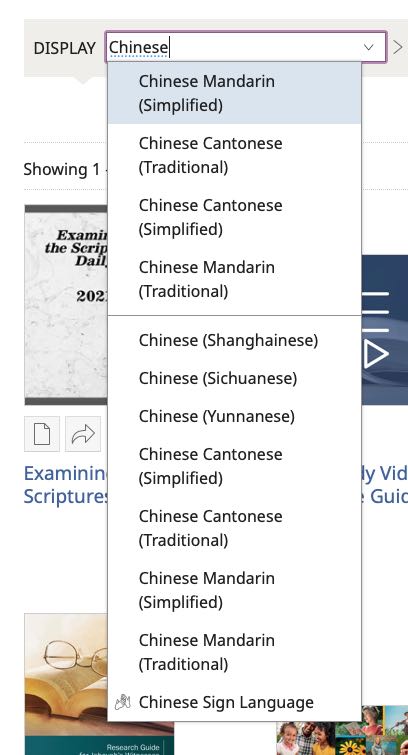
The organization has recently demonstrated that it recognizes the truth about how different many of the Chinese varieties of speech are from one another. For example, whereas before there was one Chinese edition of each publication (using Mandarin wording), now, some publications are available in different Chinese editions for different Chinese languages (including Cantonese), each with different wording.

List of different Chinese languages in which publications are available on jw.org
jw.org now has publications in different Chinese languages.

To help reduce the confusion around the inappropriate use of the English word “dialect” to translate “fāngyán (fāng·yán {direction → [place]} · speech → [topolect; dialect (common but misleading translation)] 方言)”, Professor Mair proposed that the word “topolect” (topo- (“place”) +‎ -lect (“[language] variety”)) be used instead as an exact, neutral English translation of “fāngyán (fāng·yán {direction → [place]} · speech → [topolect; dialect (common but misleading translation)] 方言)”. While not as well-known as “dialect”, the word “topolect” has gained a certain amount of recognition, and it can now be found in several dictionaries, e.g., The American Heritage Dictionary of the English Language, Wordnik, and Wiktionary.