qiānqiū+ (qiān·qiū thousand · autumns 千秋)‐wàndài+ (wàn·dài {ten thousand} · {replacings → [generations]} 万代 萬代) 👈🏼 Tap/click to show/hide the “flashcard”
[Notes: Tap/click on a Pīnyīn (Pīn·yīn {Piecing Together of} · Sounds → [Pinyin] 拼音) expression to reveal its “flashcard”; tap/click on a “flashcard” or its Pīnyīn (Pīn·yīn {Piecing Together of} · Sounds → [Pinyin] 拼音) expression to hide the “flashcard”. 📖 📄 ➕ icons mean 📖 Reveal All, 📄 Reveal Advanced, and ➕ Reveal + Symbols re all the “flashcards” in the heading, paragraph, etc. that they are placed at the beginning of.]
Rather than dismissively thinking to ourselves that the songs produced by the organization are “just songs”, we should remember that the slave class takes seriously its responsibility to provide spiritual food to God’s people, and so it is going to make sure that the lyrics in its songs are spiritually correct, while also being emotionally moving.—Ezekiel 33:32; Matthew 24:45.
“In Ev’ry Generation”
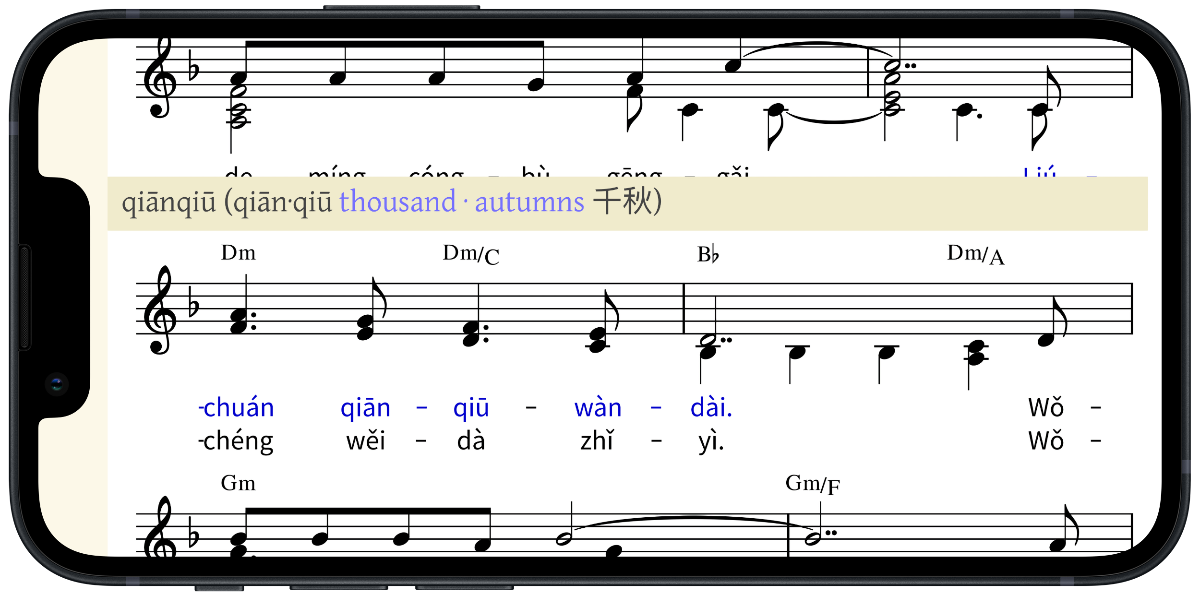
This week’s MEotW in the unofficial Pīnyīn (Pīn·yīn {Piecing Together of} · Sounds → [Pinyin] 拼音) Plus resource “Sing Out Joyfully” Bk. (Pīnyīn+Music, Pīnyīn Plus, Web)
This week’s MEotW, “qiānqiū (qiān·qiū thousand · autumns 千秋)‐wàndài (wàn·dài {ten thousand} · {replacings → [generations]} 万代 萬代)”, comes from the first verse of song 2, which is entitled “Jehovah Is Your Name” in English and “Nǐ de ((Nǐ You 你) (de ’s 的) → [Your]) Míng (Name 名) Shì (Is 是) Yēhéhuá (Jehovah 耶和华 耶和華)” in Mandarin:
In ev’ry generation—
Jehovah is your name.
Mandarin (WOL, Pīnyīn (Pīn·yīn {Piecing Together of} · Sounds → [Pinyin] 拼音) Plus):
📖 📄 ➕ Nǐ de ((Nǐ you 你) (de ’s 的) → [your]) míng (name 名) cóngbù (cóng·bù ever · not → [never] 从不 從不) gēnggǎi (gēng·gǎi {does change} · {does alter} 更改),
Liúchuán (Liú·chuán {flows → [circulates]} · {is handed down} (for) 流传 流傳) qiānqiū (qiān·qiū thousand · autumns 千秋)‐wàndài (wàn·dài {ten thousand} · {replacings → [generations]} 万代 萬代).
“Qiānqiū (Qiān·qiū thousand · autumns 千秋)‐wàndài (wàn·dài {ten thousand} · {replacings → [generations]} 万代 萬代)” literally means “thousand autumns ten thousand replacings”. However, as explained in the MEotW post on “dài ({take the place of}; replace; subsitute | replacing; substituting → [acting; substitute | generation [→ [period; era; age]]] 代)”, this expression, while literally meaning “replacing”, can effectively mean “generation”:
gǔdài
(gǔ·dài ancient · {replacings → [generations] → [period; era]} 古代)Why “replacings” to mean “generations”? Among mortal humans, new generations replace older generations.#PīnyīnPlus
— Troubadour WW (@troubadourww) November 27, 2021
Yes, the Chinese concept of a “generation” is that it is something that takes the place of or replaces what was there before—the emphasis seems to be on continuation, and a new generation is viewed as having done well if it lived up to or maintained what came before it. In contrast, in the English-speaking world, a “generation” is something new that is generated—the emphasis seems to be more on innovation, progress, and a new generation is viewed as having done well if it improved upon what came before it, and moved things ahead. For example, the English expression “next generation” indeed implies innovation and progress compared to previous generations, such as when applied to vehicles, computers, and other technology.
So, on a certain level of literalness, “qiānqiū (qiān·qiū thousand · autumns 千秋)‐wàndài (wàn·dài {ten thousand} · {replacings → [generations]} 万代 萬代)” means “thousand autumns ten thousand generations”. As shown in the example above from song 2, this is basically a poetic way to refer to “ev’ry generation”, or “forever”. Another expression that means basically the same thing is “qiānqiū (qiān·qiū thousand · autumns 千秋)‐wànshì+ (wàn·shì {ten thousand} · generations 万世 萬世)”.
Also, another example of “wàn ({ten thousand} [→ [all; a very great number of]] 万 萬/万)” (“ten thousand”) being used in Mandarin to effectively mean “all” or “every” occurs in “wànwù (wàn·wù {ten thousand → [all]} · things 万物 萬物)”, which literally means “ten thousand things” and effectively means “all things”.
Is Everyone Replaceable?
This talk of replacing reminds me: It’s a pet peeve of mine that people sometimes use the expression “no one is irreplaceable”. While it’s true that each of us should maintain appropriate modesty and humility, I suspect that this expression really reflects worldly human corporate culture that treats people like fungible, disposable widgets instead of as individual human beings that each have different qualities and abilities. Such thinking that justifies exploiting people for small-minded short-term profit without having to appropriately recognize and reward them for their individual contributions and potential is in stark contrast to the Bible’s depiction of how Jehovah God knows and values each one of us as individuals. As Jesus said at Matthew 10:29–31:
Two sparrows sell for a coin of small value, do they not? Yet not one of them will fall to the ground without your Father’s knowledge. But even the hairs of your head are all numbered. So have no fear; you are worth more than many sparrows.
Musical Notation 🎼 and the Mandarin Field
In this post about a Mandarin expression found in our songbook, another subject that I want to touch on is: Is musical notation 🎼 too hard to be worth the trouble of producing it and using it? Are fewer and fewer people able to read it? I was fortunate enough to have been taught how to read musical notation in school. I have never thought of musical notation as being particularly difficult to use (it’s much easier to learn than characters, which many unquestioningly try to learn), and I find that it helps me to sing Kingdom songs more correctly (according to the intended melody, message, etc.) and more confidently more of the time. However, I am aware that not everyone in the Mandarin field has the same experience with musical notation. For example, a while ago, an older brother told me that he didn’t know how to read musical notation. Also, some people in the Mandarin field may have been affected by how education systems in this old world have been facing significant challenges relating to providing music education for younger ones.
Regardless of how the world may be failing in many cases to equitably provide good music education, Jehovah’s organization has pointed out that music is important in Jehovah’s worship. For example, not long ago, a Meeting Workbook said:
Music can have a powerful influence on the mind and body. Singing is an important part of our worship of Jehovah.
In accordance with the importance of music in Jehovah’s worship, Mandarin field language learners used to have available to them official material from the organization containing musical notation with Pīnyīn (Pīn·yīn {Piecing Together of} · Sounds → [Pinyin] 拼音) in the lyrics. However, perhaps at least partially because of the technical difficulty and costliness of producing material with musical notation and both Chinese characters and Pīnyīn (Pīn·yīn {Piecing Together of} · Sounds → [Pinyin] 拼音) in the lyrics, as of this writing, late in 2024, there is no official material currently available from the organization that shows Pīnyīn (Pīn·yīn {Piecing Together of} · Sounds → [Pinyin] 拼音) and musical notation on the same page or screen.
The organization continues to publish official songbook material for different languages in general that contains musical notation, so it evidently still considers musical notation to generally be worthwhile to produce. It continues to produce official material for the current songbook that uses musical notation along with lyrics rendered only in Chinese characters, without Pīnyīn (Pīn·yīn {Piecing Together of} · Sounds → [Pinyin] 拼音), and it has even produced official material that uses jiǎnpǔ+ (jiǎn·pǔ simple · {register or record for reference → [musical notation]} → [numbered musical notation] 简谱 簡譜) (a kind of musical notation also known as numbered musical notation) and Chinese characters.
For those who find it helpful in their Mandarin field activities to put musical notation together with Pīnyīn (Pīn·yīn {Piecing Together of} · Sounds → [Pinyin] 拼音), the unofficial Pīnyīn (Pīn·yīn {Piecing Together of} · Sounds → [Pinyin] 拼音) Plus resource “Sing Out Joyfully” Bk. (Pīnyīn+Music, Pīnyīn Plus, Web) exists and is continuing to be improved. As shown in the screenshot above, this resource aids Mandarin field language learners by breaking with tradition and featuring lyrics in the musical notation that are only in relatively large-print Pīnyīn (Pīn·yīn {Piecing Together of} · Sounds → [Pinyin] 拼音) by default—characters are relegated to Pīnyīn (Pīn·yīn {Piecing Together of} · Sounds → [Pinyin] 拼音) Plus “flashcards” that are added as time allows.
Unlike the traditionally-used but unnecessarily extraordinarily complex characters that need to be accompanied by Pīnyīn (Pīn·yīn {Piecing Together of} · Sounds → [Pinyin] 拼音) before many are able to read them, Pīnyīn (Pīn·yīn {Piecing Together of} · Sounds → [Pinyin] 拼音) itself is a simple, elegant alphabetical full writing system for Mandarin that is easy to learn and remember. Also, it is no harder to typeset than other alphabetical writing systems with diacritics, such as the writing systems now used for French, Czech, Vietnamese, etc.*
In its Tips: section at the bottom of its home page, the “Sing Out Joyfully” Bk. (Pīnyīn+Music, Pīnyīn Plus, Web) resource contains these links that some may find helpful:
- Watchtower article about the “Sing Out Joyfully” book, with basic advice on how to improve our singing:
- Resources for learning how to read musical notation 🎼:
For convenience:
The direct link for the Pīnyīn (Pīn·yīn {Piecing Together of} · Sounds → [Pinyin] 拼音) Plus resource for the “Sing Out Joyfully” book is:
The short link for Chinese field language-learning links for the “Sing Out Joyfully” book is:
More Pīnyīn (Pīn·yīn {Piecing Together of} · Sounds → [Pinyin] 拼音) and Pīnyīn (Pīn·yīn {Piecing Together of} · Sounds → [Pinyin] 拼音) Plus web material based on the Mandarin “Sing Out Joyfully” book will be made available in the Pīnyīn (Pīn·yīn {Piecing Together of} · Sounds → [Pinyin] 拼音) Plus web resource as time allows.
* Thanks to ongoing advancements in personal computing hardware and software, producing material that contains things like musical notation and Pīnyīn (Pīn·yīn {Piecing Together of} · Sounds → [Pinyin] 拼音) text at reasonable cost is quicker and easier than ever. At this time, production of the musical notation in the “Sing Out Joyfully” Bk. (Pīnyīn+Music, Pīnyīn Plus, Web) resource begins in free open source software called MuseScore Studio, running on a Mac. Pīnyīn (Pīn·yīn {Piecing Together of} · Sounds → [Pinyin] 拼音) text for the lyrics in the musical notation is entered using macOS’s ABC – Extended input source (keyboard layout). (Just using Pīnyīn (Pīn·yīn {Piecing Together of} · Sounds → [Pinyin] 拼音) text only here simplifies things so much compared to having to somehow input characters with Pīnyīn (Pīn·yīn {Piecing Together of} · Sounds → [Pinyin] 拼音) ruby text!) When it’s ready, the musical notation for a song is exported from MuseScore Studio into SVG format, which is a plain text format that allows for the inclusion of links that activate Pīnyīn (Pīn·yīn {Piecing Together of} · Sounds → [Pinyin] 拼音) Plus flashcards on webpages. The coding for the SVG links is currently mostly done using the text editor BBEdit, in which editing large text files is quite performant. For Pīnyīn (Pīn·yīn {Piecing Together of} · Sounds → [Pinyin] 拼音) Plus web material production in general, my current favourite tool is Nova, but such web material can be produced in any application suitable for web development, such as Visual Studio Code, etc. ^