Categories
Culture History Language Learning Theocratic

yíyì‐gūxíng

yíyì+ (yí·yì {(having) one} · intention → [stubbornly] 一意)gūxíng+ (gū·xíng {orphaned → [alone]} · {go; walk → [do]} → [cling to one’s own course; insist on having one’s own way] 孤行) ← Tap/click to show/hide the “flashcard”

Appendix A2 of the English New World Translation of the Holy Scriptures (Study Edition), entitled “Features of This Revision”, discusses vocabulary changes that have been made in the current revision, words that have been translated differently than before. As noted in various entries in the excellent resource Referenced Theo. Expressions (RTE), Appendix A2 of the current Mandarin version of the New World Translation Bible (nwtsty) correspondingly discusses words that have been translated differently in the current revision of the Mandarin NWT Bible, compared to how they had been translated before.

Since we base what we say in Jehovah’s service on his Word the Bible, the vocabulary used in it—and the way those vocabulary words are translated—should be reflected in how we speak in our ministry, at our meetings, etc. So, it is beneficial for us Mandarin field language learners to be familiar with the latest thinking from the organization on how Bible terms should be translated into Mandarin.

Communication and Love

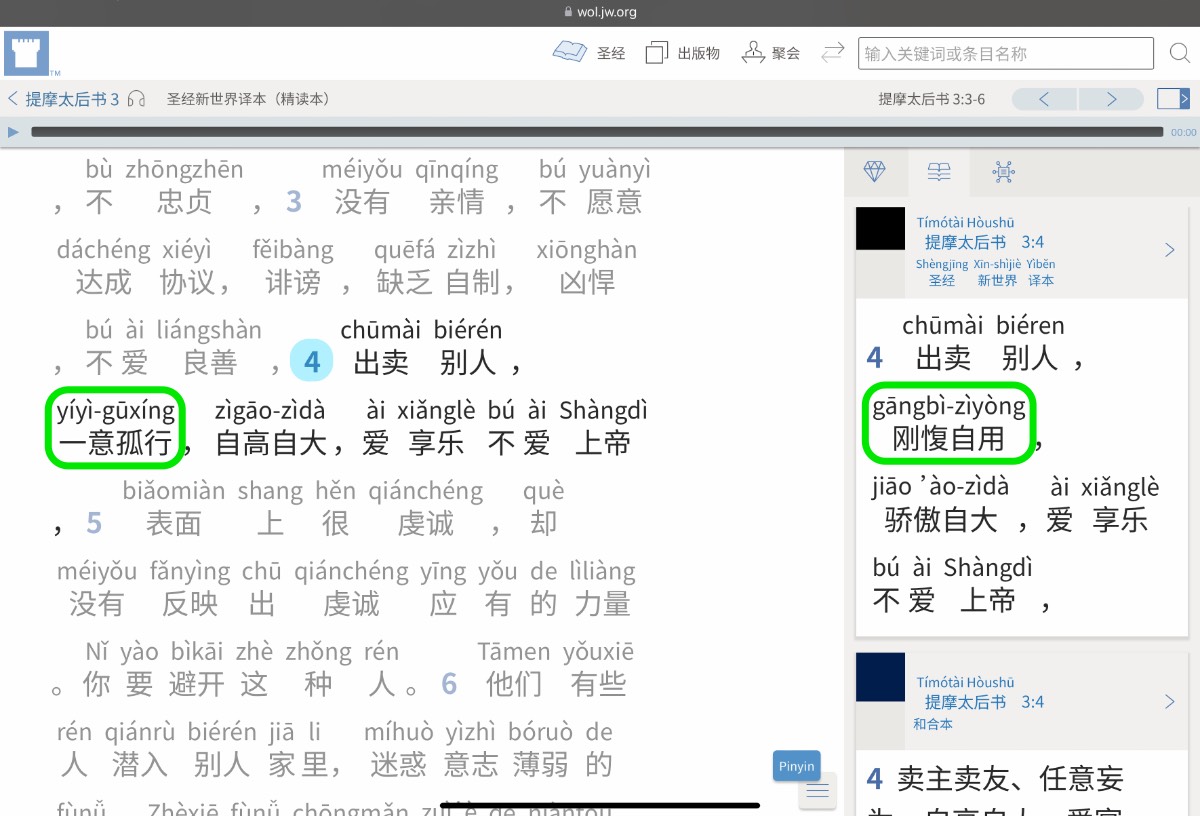
Appendix A2 of the current Mandarin version of the New World Translation Bible (nwtsty) mentions that one of the goals for this version was to reduce the number of hard-to-recognize, hard-to-read Chinese characters used, and to replace them with more commonly used characters. One example it provides is that “gāngbì+ (gāng·bì {[is] firm} · {[is] wilful} 刚愎 剛愎)zìyòng (zì·yòng {[is] self-·applying} → [[is] opinionated] 自用) was changed to this week’s MEotW, “yíyì (yí·yì {(having) one} · intention → [stubbornly] 一意)gūxíng (gū·xíng {orphaned → [alone]} · {go; walk → [do]} → [cling to one’s own course; insist on having one’s own way] 孤行).—2 Timothy 3:4.

2 Timothy 3:4 (WOL CHS+Pinyin Parallel Translations)

In this case, a relatively unfamiliar, hard-to-parse expression was replaced with a different one that conveys the intended meaning, while being more familiar and easier to understand. This helpful simplification reminds us that the ultimate goal of language should be to communicate, not to show off one’s knowledge of hard words or whatever. And, as the September 1, 1991 Watchtower emphasizes, good communication is motivated by unselfish love:

Christian communication especially needs to be effective because it has as its goal the reaching of people’s hearts with the truth from God’s Word so that, hopefully, they will act on what they learn. Uniquely, it is motivated by unselfishness, by love.

Yes, as 1 Corinthians 8:1 says:

Knowledge puffs up, but love builds up.

More Understandable Alternate Expressions

As discussed in the article “Pīnyīn (Pīn·yīn {Piecing Together of} · Sounds → [Pinyin] 拼音) Was Plan A”, Zhōu Yǒuguāng ((Zhōu {Circumference; Circle (surname)}周/週) (Yǒu·guāng Has · Light 有光) (Chinese linguist, etc., known as “the father of Pīnyīn”)) (Wikipedia article), who led the team that designed Pīnyīn (Pīn·yīn {Piecing Together of} · Sounds → [Pinyin] 拼音), pointed out that assigning alternate expressions with different pronunciations is a good way to address Mandarin’s so-called homophone problem. (Homophones are words that have the same pronunciation, but different meanings.)

From the examples referred to in the Mandarin NWT Appendix A2, we can see that assigning alternate expressions can also be a good way to address the problem of excessively hard-to-recognize or hard-to-understand expressions. Rather than being attached to the idea that particular characters are required to represent certain meanings, as perhaps suggested by the Ideographic Myth, the translators of the Mandarin NWT Bible recognized that representing easily understandable speech is the true priority for God’s people.—1 Corinthians 14:8–11.

So, let us not be yíyì (yí·yì {(having) one} · intention → [stubbornly] 一意)gūxíng (gū·xíng {orphaned → [alone]} · {walking → [doing]} → [clinging to one’s own course] 孤行), insisting that the new translated expressions in the current Mandarin NWT are not as good as the old expressions, or clinging to old, erroneous ideas like “Pīnyīn (Pīn·yīn {Piecing Together of} · Sounds → [Pinyin] 拼音) could never work as a writing system for Mandarin because characters are needed to deal with all the homophones in Mandarin.”

Categories
Culture Current Events History Language Learning Names Nations Science

Tǔ’ěrqí

Tǔ’ěrqí+ (Turkey 土耳其) ← Tap/click to show/hide the “flashcard”

[Notes: Tap/click on a Pīnyīn (Pīn·yīn {Piecing Together} · Sounds → [Pinyin] 拼音) expression to reveal its “flashcard”; tap/click on a “flashcard” or its Pīnyīn (Pīn·yīn {Piecing Together} · Sounds → [Pinyin] 拼音) expression to hide the “flashcard”. 📖 📄 ➕ icons mean 📖 Reveal All, 📄 Reveal Advanced, and ➕ Reveal + Symbols re all the “flashcards” in the heading, paragraph, etc. that they are placed at the beginning of.]

On February 6, 2023, strong earthquakes struck Turkey and Syria, resulting in tens of thousands of people being killed (over 36,000 at the time of this writing), tens of thousands being injured, and hundreds of thousands being left homeless. So, as of this writing, the article “Devastating Earthquakes Strike Turkey and Syria—What Does the Bible Say?” is being featured on jw.org, and this week’s MEotW is “Tǔ’ěrqí  (Turkey 土耳其)”, the Mandarin word for “Turkey”. Knowing this will help us in the Mandarin field as we hear about, talk about, and pray about Turkey in the time ahead.

Note that it is apparent that “Tǔ’ěrqí  (Turkey 土耳其)” was chosen to represent “Turkey” in Mandarin because of what it sounds like, not because of the meanings of the supposedly ideographic (representing meaning directly through visible symbols, bypassing speech) Chinese characters used to write it out (“Soil Ear It”??? 🤷🏻).

Some Related Mandarin Expressions

Here are some other Mandarin expressions from the above-mentioned article that should be useful to know regarding this situation:

  • Xùlìyà+ (Syria 叙利亚 敘利亞)
  • qiángzhèn+ (qiáng·zhèn strong; powerful · {quaking → [earthquake]} (abbr. for qiángliè dìzhèn) 强震 強震)
    • + (big → [great] 大) dìzhèn+ (dì·zhèn earth·quake 地震)
  • wú‐jiā‐kě‐guī+ ((wú without無/无)‐(jiā home 家)‐(kě {(that) can} 可)‐(guī {be returned to}) [homeless])
  • cǎnjù+ (cǎn·jù miserable; tragic · {theatrical work (drama, play, opera, etc.)} → [tragedy; calamity; disaster] 惨剧 慘劇)
  • ānwèi+ (ān·wèi calming · consoling; comforting 安慰)
    • 📖 📄 (gives) yíqiè (yí·qiè {one (whole)} · {corresponding (set of)} → [all] 一切) ānwèi+ (ān·wèi calming · comforting 安慰) de (’s 的) Shàngdì (Shàng·dì Above’s · {Emperor → [God]} → [God] 上帝).”—Gēlínduō Hòushū ((Gēlínduō Corinth 哥林多) (Hòu·shū Later · Book 后书 後/后書) [2 Corinthians]) 1:3 (Pīnyīn (Pīn·yīn {Piecing Together} · Sounds → [Pinyin] 拼音) WOL; Pīnyīn (Pīn·yīn {Piecing Together} · Sounds → [Pinyin] 拼音) Plus).

“Tofu-Dreg Projects”

Some have wondered why so many even relatively new buildings failed to withstand these earthquakes. One news report explains:

experts said there is a mountain of evidence — and rubble — pointing to a harsh reality about what made the quakes so deadly: Even though Turkey has, on paper, construction codes that meet current earthquake-engineering standards, they are too rarely enforced, explaining why thousands of buildings crumbled.

Buildings being poorly constructed, whether or not earthquake-engineering standards exist, is unfortunately not uncommon in this old system of things. There is even a Mandarin expression with its own Wikipedia page that describes such buildings:

“Tofu-dreg project” (Chinese: 豆腐渣工程; pinyin: dòufuzhā gōngchéng) is a phrase used in the Chinese-speaking world to describe a poorly constructed building, sometimes called just “Tofu buildings”. The phrase was coined by Zhu Rongji, the former premier of the People’s Republic of China, on a 1998 visit to Jiujiang City, Jiangxi Province to describe a poorly-built set of flood dykes in the Yangtze River.[source] The phrase is notably used referring to buildings collapsed in the 2008 Sichuan earthquake disaster.[source][source][source][source][source][source]

In China, the term tofu dregs (the pieces left over after making tofu) is widely used as a metaphor for shoddy work, hence the implication that a “tofu-dreg project” is a poorly executed project.[source]

As we look forward to the new world that will no longer have such natural disasters as these earthquakes, nor the man-made conditions that make them even more deadly, may we keep our brothers and sisters in the affected areas in our prayers to Jehovah, the only true God and the “God of all comfort”—John 17:3, 2 Corinthians 1:3.

Categories
Culture Current Events History Language Learning Names Nations Science

Wūkèlán

Wūkèlán+ (Ukraine 乌克兰 烏克蘭) ← Tap/click to show/hide the “flashcard”

On February 24, 2022, a few days before the date of this post, Russia sent significant military forces into Ukraine, resulting in the largest scale open warfare in Europe since World War II. So, this week’s MEotW is “Wūkèlán (Ukraine 乌克兰 烏克蘭)”, the Mandarin word for “Ukraine”. Knowing this will help us in the Mandarin field as we hear about, talk about, and pray about Ukraine in the time ahead.

Note that it is apparent that “Wūkèlán (Ukraine 乌克兰 烏克蘭)” was chosen to represent “Ukraine” in Mandarin because of what it sounds like, not because of the meanings of the supposedly ideographic (representing meaning directly through visible symbols, bypassing speech) Chinese characters used to write it out (“Crow Overcomes Orchid”??? 🤷🏻).

Some Related Mandarin Expressions

Here are some other Mandarin expressions that should be useful to know regarding this situation:

  • Éluósī+ (Russia 俄罗斯 俄羅斯)
  • Sūlián+ (Sū·lián Soviet · {Uniting → [Union]} 苏联 蘇聯) – Make sure you don’t use this expression to refer to present-day Russia, since the Soviet Union no longer exists. Some say that a desire to restore the power and influence of the old Soviet Union is one of Russian president Putin’s main motivations for waging war on Ukraine.
  • Bái Éluósī+ ((Bái White 白) (Éluósī Russia 俄罗斯 俄羅斯) [Belarus])
  • zhànzhēng+ (zhàn·zhēng war · contending → [war; warfare] 战争 戰爭)
  • hépíng+ (peace | {[is] peaceful} (nwtsty-CHS Appx. A2 says this term mainly refers to the absence of war or conflict) 和平)

Neutrality

As pointed out in the article “Russia Invades Ukraine” on jw.org:

There are more than 129,000 of Jehovah’s Witnesses living in Ukraine. Like the Witnesses in every other country, they imitate Jesus by remaining politically neutral and refusing to take part in war. (John 18:36)

There are also thousands of Jehovah’s Witnesses in Russia, who are being persecuted for their faith. We can be sure that like their Ukranian brothers and sisters, they are also remaining politically neutral and refusing to take part in war, such that none of the Russian military personnel currently attacking their neighbours (and maybe in some cases, friends and relatives) in Ukraine are Jehovah’s Witnesses.

May we keep our brothers and sisters in the affected areas in our prayers to Jehovah, the only true God and the “God of all comfort”—John 17:3, 2 Corinthians 1:3.