Categories
Culture History Language Learning Names Technology

Hànzì

Hànzì (Hàn·zì {Han (Chinese)} · Characters 汉字 漢字) ← Tap/click to show/hide the “flashcard”

[This is a reposting of a post that was originally posted on November 23, 2020. It discusses how, in the big picture, we Mandarin field language learners should view Chinese characters, those seemingly essential but maddeningly difficult-to-learn-and-remember icons of worldly Chinese culture.]

Hànzì (Hàn·zì {Han (Chinese)} · Characters 汉字 漢字)” is what Chinese characters are called in Mandarin. Actually, “Hànzì (Hàn·zì {Han (Chinese)} · Characters 汉字 漢字)” literally means “Han characters”, but as discussed in the MEotW post on “Hànyǔ (Hàn·yǔ {Han (Chinese)} · Language [→ [(Modern Standard) Mandarin]] 汉语 漢語)”, the Han are by far the largest ethnic group in China, and they are the dominant cultural force in China. Thus, Han characters are, in effect, Chinese characters.
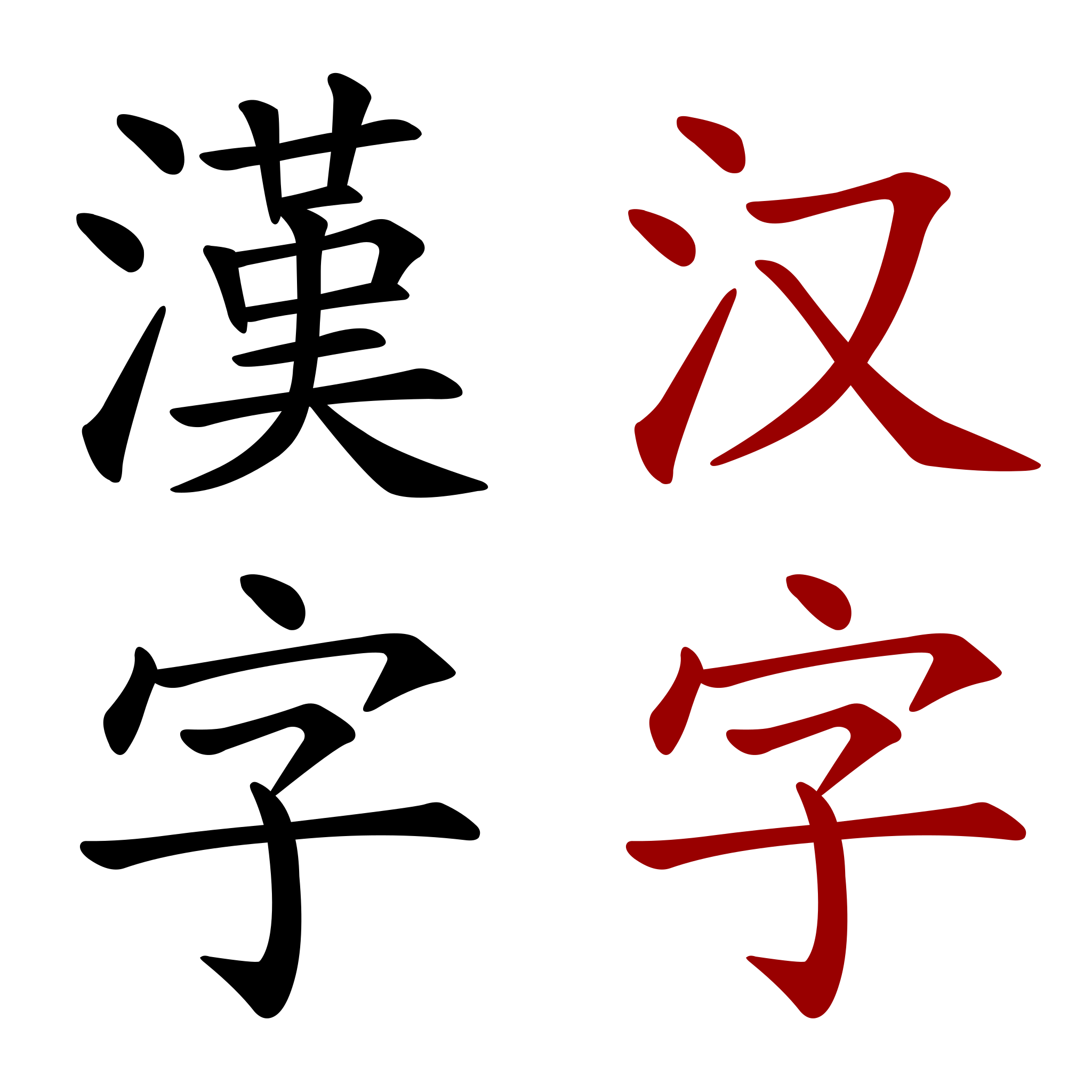
漢字 汉字

Han culture has affected not only China, but also many of the surrounding nations. The words used by some of these nations to refer to “Chinese characters” are obvious echoes of “Hànzì (Hàn·zì {Han (Chinese)} · Characters 汉字 漢字)”:

  • Japanese: kanji
  • Korean: Hanja
  • Vietnamese: hán tự

Hànzì (Hàn·zì {Han (Chinese)} · Characters 汉字 漢字) are still used a lot in modern Japanese writing. However, although Hànzì (Hàn·zì {Han (Chinese)} · Characters 汉字 漢字) used to be the dominant writing system in Korea and in Vietnam, those nations have moved on to mainly use alphabetic writing systems.

The Korean Connection

Regarding the situation in Korea, the Awake! article “Let’s Try Writing in Hankul!” says:

BEFORE Hankul [or Hangul] was created, the Korean language did not have its own script. For more than a thousand years, educated Koreans wrote their language using Chinese characters. Over the years, however, various attempts were made to devise a better writing system. But since all of them were based on Chinese characters, only the well-educated could use them.

King Sejong spearheaded the creation of an alphabet that would both suit spoken Korean and be easy to learn and use.

Sadly, some scholars opposed Hankul, precisely because it was so easy to learn! They derisively called it Amkul, meaning “women’s letters.” They disdained a system that could be learned even by women, who back then were not taught to read in the schools. This prejudice against Hankul persisted among upper-class Koreans for some time. In fact, more than 400 years elapsed before the Korean government declared that Hankul could be used in official documents.

The Chinese Conundrum

How about the writing system situation in China itself? Do the Chinese languages need to be written using Hànzì (Hàn·zì {Han (Chinese)} · Characters 汉字 漢字)? Chinese traditionalists have influenced many people to assume so, but there is actually no technical linguistic requirement that any Chinese language be written using Hànzì (Hàn·zì {Han (Chinese)} · Characters 汉字 漢字)—writing Chinese languages using Hànzì (Hàn·zì {Han (Chinese)} · Characters 汉字 漢字) is purely and merely a deeply embedded tradition.

Proof that the use of Hànzì (Hàn·zì {Han (Chinese)} · Characters 汉字 漢字) is merely a tradition and not a technical requirement comes from the fact that Pīnyīn (Pīn·yīn {Piecing Together of} · Sounds → [Pinyin] 拼音), a phonetic alphabetic system designed by a Chinese government team, is a good, workable full writing system for Modern Standard Mandarin.

Why has China held on to its traditional use of Hànzì (Hàn·zì {Han (Chinese)} · Characters 汉字 漢字) when other nations have moved on to alphabetic writing systems? As mentioned in the MEotW post on “Zhōngguó (Zhōng·guó Central · Nation → [China | Chinese] 中国 中國)”,

Some wonder why China has held on to its archaic characters writing system instead of moving on to using a modern alphabetic writing system like almost every other nation does, even though outstanding native sons like Lǔ Xùn ((Lǔ Stupid; Rash (surname)) (Xùn Fast; Quick; Swift 迅) (pen name of Zhōu Shùrén, the greatest Chinese writer of the 20th cent. and a strong advocate of alphabetic writing)) have advocated strongly for that. Perhaps the proud self-centredness of the only nation to name itself the centre of the world provides a clue….

When the Communists took over China a few years after World War II, their Plan A for China’s writing system situation actually did involve eventually moving on from the characters to an alphabetic writing system that would be developed, which turned out to be Pīnyīn (Pīn·yīn {Piecing Together of} · Sounds → [Pinyin] 拼音). However, the government needed the help of the people already educated in Hànzì (Hàn·zì {Han (Chinese)} · Characters 汉字 漢字), and many of these people opposed this plan that they feared would involve leaving behind, or at least de-emphasizing, a cultural tradition that they were very proud of, that they had invested very much time and effort into mastering, and that gave them much prestige in the existing environment.1 In other words, the pride and prejudice of those who had already been educated in the Hànzì (Hàn·zì {Han (Chinese)} · Characters 汉字 漢字) caused them to disparage and oppose the idea of a simpler alternative writing system, just as had been the case in Korea, as noted above. So, the simplification of the Hànzì (Hàn·zì {Han (Chinese)} · Characters 汉字 漢字) is the farthest China has gotten so far with regard to official writing system reform, and even that has only been achieved in the face of much criticism and opposition.

Chairman Máo Zédōng ((Máo Hair (surname) 毛) (Zé·dōng Marsh · East 泽东 澤東) (the founder of the People’s Republic of China)) (Wikipedia article) himself supported continuing to move on, from simplification of the characters to actually adopting Pīnyīn (Pīn·yīn {Piecing Together of} · Sounds → [Pinyin] 拼音) as a writing system. In a letter to an old schoolmate, he wrote:

…Pinyin writing is a form of writing that is relatively convenient. Chinese characters are too complicated and difficult. At present we are only engaged in reform along the lines of simplification, but some day in the future we must inevitably carry out a basic reform.2
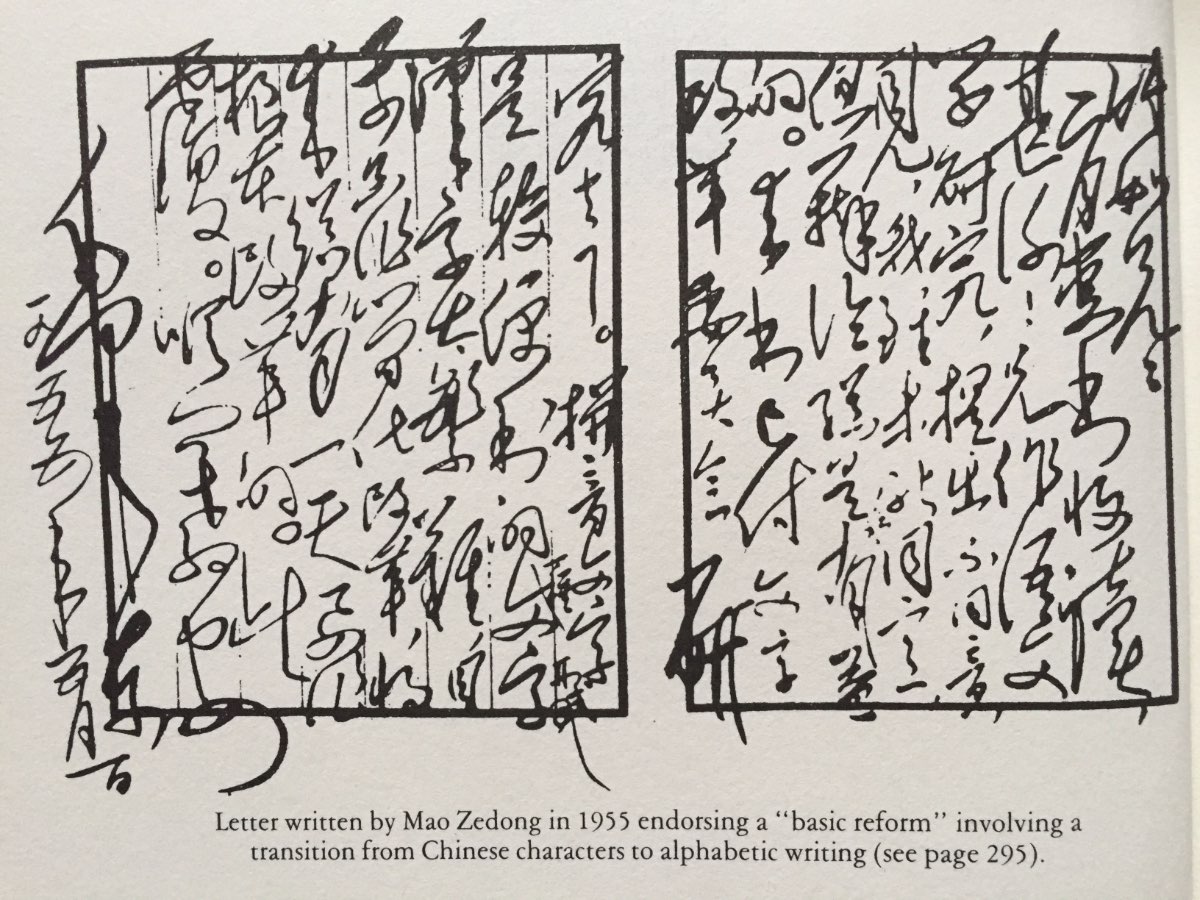
Letter from Mao endorsing a transition from Chinese characters to alphabetic writing

(The above picture is from near the beginning of the book The Chinese Language: Fact and Fantasy, by John DeFrancis.)

While obviously what Máo ((Máo Hair (surname) 毛) (abbr. for Máo Zédōng, the founder of the People’s Republic of China)) foresaw regarding a writing system “basic reform” in China has not yet come true, American sinologist and University of Pennsylvania Professor of East Asian Languages and Civilizations Victor H. Mair wrote in a blog post:

So, those who are in favor of HP [Hànyǔ (Hàn·yǔ {Han (Chinese)} · Language → [(Modern Standard) Mandarin] 汉语 漢語) Pīnyīn (Pīn·yīn {Piecing Together of} · Sounds → [Pinyin] 拼音)] don’t need to be concerned, and those who are opposed to HP don’t need to be frightened. HP is ineluctably playing a greater and greater role in the educational, cultural, social, political, and every other aspect of the lives of Chinese citizens, and this is occurring without regard to anyone pushing it as a governmental program. It is happening because of the wishes of those who actually use it for a wide variety of helpful purposes.

Digraphia [the use of more than one writing system for the same language, in this case the use of both Hànzì (Hàn·zì {Han (Chinese)} · Characters 汉字 漢字) and Pīnyīn (Pīn·yīn {Piecing Together of} · Sounds → [Pinyin] 拼音) for writing Modern Standard Mandarin] is emerging before our very eyes, enabling people to use the alphabet and the characters for whatever purposes they deem suitable. Nobody needs to take a vote or carry out a survey for this to happen.

Tourists or Missionaries?

Regardless of how worldly Chinese people view the Hànzì (Hàn·zì {Han (Chinese)} · Characters 汉字 漢字), how should we dedicated Mandarin field language-learners view them? It would be easy to fall back on the commonly accepted view, the tourist’s view, that the Hànzì (Hàn·zì {Han (Chinese)} · Characters 汉字 漢字) are an integral and fascinating part of China’s precious cultural heritage that we should duly respect and even heap adulation upon.

However, as Mandarin field language-learners, we are not in the Mandarin field to be tourists just enjoying the exotic foreign culture. On the contrary, we must be more like missionaries or spiritual rescue workers involved in an urgent life-saving work, because lives are indeed involved. As ones involved in an urgent, life-saving work, we need tools, technologies, and systems that efficiently and effectively help us to get this work done without wasting time and effort when people’s everlasting lives are at stake. From this sober and pragmatic angle, the extraordinarily difficult-to-learn-and-remember Hànzì (Hàn·zì {Han (Chinese)} · Characters 汉字 漢字) are far from ideal. Thus, while there is obviously value in learning as many Hànzì (Hàn·zì {Han (Chinese)} · Characters 汉字 漢字) as one is reasonably able to, it is fortunate that Pīnyīn (Pīn·yīn {Piecing Together of} · Sounds → [Pinyin] 拼音) exists and is available as a simple, effective alternative writing system for Mandarin, for the many times when it is not necessary to use Hànzì (Hàn·zì {Han (Chinese)} · Characters 汉字 漢字).


1. John DeFrancis, The Chinese Language: Fact and Fantasy (Honolulu: University of Hawaii Press, 1984), p. 258. ^

2. Ibid., p. 295. ^
Categories
Culture History Language Learning Science Technology Theocratic

zìdà

zìdà (zì·dà {(consider) self} · {to be big → [to be great]} 自大) 👈🏼 Tap/click to show/hide the “flashcard”

[Notes: Tap/click on a Pīnyīn (Pīn·yīn {Piecing Together of} · Sounds → [Pinyin] 拼音) expression to reveal its “flashcard”; tap/click on a “flashcard” or its Pīnyīn (Pīn·yīn {Piecing Together of} · Sounds → [Pinyin] 拼音) expression to hide the “flashcard”. 📖 📄 📘 icons mean 📖 Reveal All, 📄 Reveal Advanced, and 📘 Reveal None re all the “flashcards” in the heading, paragraph, etc. that they are placed at the beginning of.]

I have long especially liked 1 Corinthians 13. It contains counsel on what really does and doesn’t matter in life, an extensive description and definition of the most important kind of love, and a sublime discussion about the need to become complete, mature, as a person. As these apply to life in general, so too do they apply to our lives as Mandarin field language learners.

As Mandarin field language learners, it can benefit us greatly to consider what we can learn from 1 Corinthians 13, and along the way, we can also consider some of the Mandarin expressions used in that chapter in the current version of the Mandarin New World Translation Bible (nwtsty).

How Do We View Ourselves?

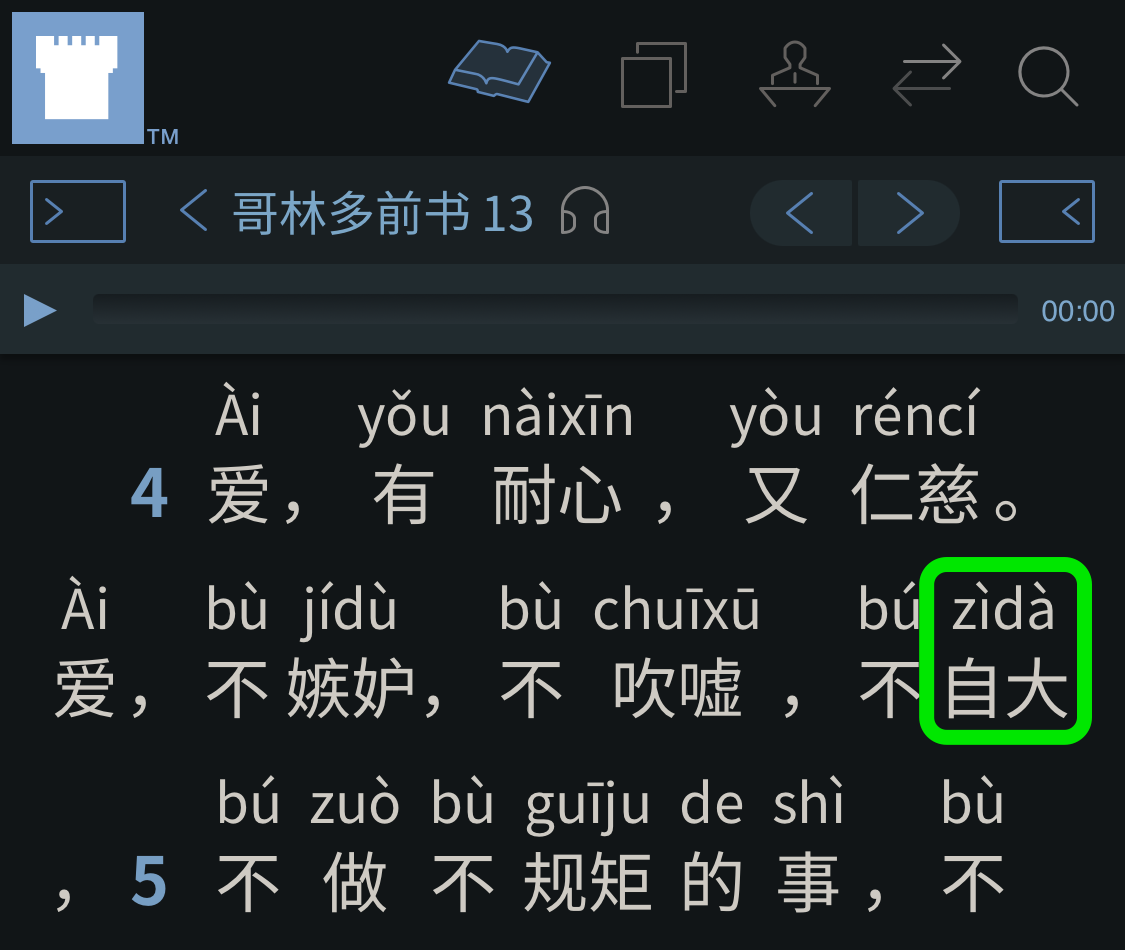
This week’s MEotW, “zìdà (zì·dà {(consider) self} · {to be big → [to be great]} 自大)”, is used in verse 4 (WOL) of 1 Corinthians 13:

Screenshot of “_zìdà_” in 1 Co. 13:4 (nwtsty, CHS+_Pīnyīn_ WOL)

(Dark mode for the Watchtower ONLINE LIBRARY (WOL) website, as shown in the above image, can be enabled in the Safari web browser by using the Noir Safari extension. Other web browsers may also have extensions with similar functionality.)

For comparison, here are the current English and Pīnyīn (Pīn·yīn {Piecing Together of} · Sounds → [Pinyin] 拼音) Plus renderings of 1 Corinthians 13:4:

English:

Love is patient and kind. Love is not jealous. It does not brag, does not get puffed up,

Pīnyīn (Pīn·yīn {Piecing Together of} · Sounds → [Pinyin] 拼音) Plus:

📖 📄 📘 Ài (love), yǒu (has 有) nàixīn (nài·xīn {being (of/with) enduring} · heart → [patience] 耐心), yòu (also 又) réncí (rén·cí {is kind} 仁慈). Ài (love), (not 不) jídù ({is jealous} 嫉妒), (not 不) chuīxū (chuī·xū {does puff → [does brag]} · {does sigh → [does praise]} → [does brag] 吹嘘 吹噓), (not 不) zìdà (zì·dà {(does consider) self} · {to be big → [to be great]} 自大),

The individual morphemes in “zìdà (zì·dà {(consider) self} · {to be big → [to be great]} 自大)”, which are relatively simple and well-known, literally mean “self” and “big”. When these morphemes are put together in “zìdà (zì·dà {(consider) self} · {to be big → [to be great]} 自大)”, the resulting expression effectively means “(consider) self to be great”, corresponding, in 1 Corinthians 13:4 in the current English and Mandarin versions of the New World Translation Bible, with the English expression “puffed up”.

A Nation That Calls Itself “Central Nation”

As discussed in the MEotW post on “Zhōngguó (Zhōng·guó Central · Nation → [China | Chinese] 中国 中國)”, “the people of China have long viewed their nation as central to the world that they knew, or cared most about, to the point that ‘China was the only culture to use the concept for its name’ ”:

The English translation of Zhongyuan as the “Middle Kingdom” entered European languages through the Portuguese in the 16th century and became popular in the mid-19th century. By the mid-20th century, the term was thoroughly entrenched in the English language, reflecting the Western view of China as the inward-looking Middle Kingdom, or more accurately, the Central Kingdom or Central State. Endymion Wilkinson points out that the Chinese were not unique in thinking of their country as central, although China was the only culture to use the concept for its name.[source]

This cultural trait is such a thing that there are several words and concepts related to it, including “Sinocentrism”.

While many worldly Chinese people think nothing of calling their nation “Central Nation”, or think that this is only natural considering China’s history, many cultures consider calling oneself the centre of the world to be puffed up, overly and offputtingly self-important. As a Chinese person, I find this proud, self-centred aspect of worldly Chinese culture to be regrettable. Note that this characteristic should not be taken as a stereotype to be applied to all individual Chinese people, since each individual is different. However, it does tell us something about part of the true nature of worldly Chinese culture.

The Mark of B Players and Bozos

When it comes to writing systems, the zìdà (zì·dà {(consider) selves} · {to be big → [to be great]} 自大) attitudes of many people in China unfortunately motivated them to act as B players, as described by Steve Jobs. The MEotW post on “gāo’ào (gāo’·ào {[is] (considering self to be of) high (status)} · {[is] proud; haughty; arrogant} 高傲) discusses this:

The below quote was recently added to the article “Pīnyīn (Pīn·yīn {Piecing Together of} · Sounds → [Pinyin] 拼音) Was Plan A”:

This tendency of many to prioritize their own pride and position over what’s really better for everyone is also described in this quote from Guy Kawasaki about something he learned from Steve Jobs:

A players hire A+ players. Actually, Steve believed that A players hire A players—that is people who are as good as they are. I refined this slightly—my theory is that A players hire people even better than themselves. It’s clear, though, that B players hire C players so they can feel superior to them, and C players hire D players. If you start hiring B players, expect what Steve called “the bozo explosion” to happen in your organization.

Yes, Pīnyīn was Plan A, but China unfortunately let the proud, self-serving B players have their way.

Note that what makes someone a B player or worse is not necessarily that person’s level of intelligence, skill, talent, etc. What characterizes B players or worse is their proud, self-serving rejection of others who are better in some way, their need to feel superior to others.

Yes, rather than embracing Pīnyīn (Pīn·yīn {Piecing Together of} · Sounds → [Pinyin] 拼音) as the way forward for the benefit of all, as it deserves to be embraced based on its technical merits, many worldly Chinese people showed a zìdà (zì·dà {(consider) selves} · {to be big → [to be great]} 自大) attitude and stuck with the characters that they had personally invested heavily in, and that brought them status and glory in the status quo.

Jesus Loves Those Who Are Humble Like Children

At Luke 22:25, 26, Jesus himself explained what it takes for one to be viewed by him and his Father as a truly great A player, and not an inferior B player:

But he said to them: “The kings of the nations lord it over them, and those having authority over them are called Benefactors. You, though, are not to be that way. But let the one who is the greatest among you become as the youngest, and the one taking the lead as the one ministering.

Also, Luke 9:46–48 says this about Jesus:

Then a dispute arose among them about which one of them was the greatest. Jesus, knowing the reasoning of their hearts, took a young child, stood him beside him, and said to them: “Whoever receives this young child on the basis of my name receives me also; and whoever receives me also receives the One who sent me. For the one who conducts himself as a lesser one among all of you is the one who is great.”

Chinese character chauvinists often say that Pīnyīn (Pīn·yīn {Piecing Together of} · Sounds → [Pinyin] 拼音) is for children. Well, according to Jesus’ words above, that would be fine with him, even if that were true! When this matter is examined in the light of first principles of linguistics (language science), though, it becomes obvious that it’s categorically not true that Pīnyīn (Pīn·yīn {Piecing Together of} · Sounds → [Pinyin] 拼音) is just for children—Pīnyīn (Pīn·yīn {Piecing Together of} · Sounds → [Pinyin] 拼音) works fine for people of all ages as a full writing system for Modern Standard Mandarin, including its most complex and advanced expressions. So, anything that can be spoken and understood in Modern Standard Mandarin can be written and understood in Pīnyīn (Pīn·yīn {Piecing Together of} · Sounds → [Pinyin] 拼音), regardless of the ages of those involved.

As Mandarin field language learners who are dedicated to, and who glorify, the true God Jehovah, let us not unthinkingly adopt the thinking and attitudes of proud, self-centred, self-glorifying worldly people, regardless of what human nation they come from. Remember, we are here in the Mandarin field, not to be gullible, unquestioningly admiring tourists (email me for login information, and include information on who referred you and/or what group/cong. you are in), but to be missionaries and spiritual rescue workers in this world that Jehovah God views as a spiritual disaster area.

Categories
Culture History Language Learning Science Theocratic

chuán

chuán (boat; ship; vessel船/舩) ← Tap/click to show/hide the “flashcard”

This week, we are revisiting “chuán (boat; ship; vessel船/舩)”, an expression that was featured in an early Expression of the Week post on the tiandi.info blog. (If you need login information for the parts of tiandi.info that require it, request it by email, and include information on how you learned of tiandi.info and/or what group/cong. you are in.)

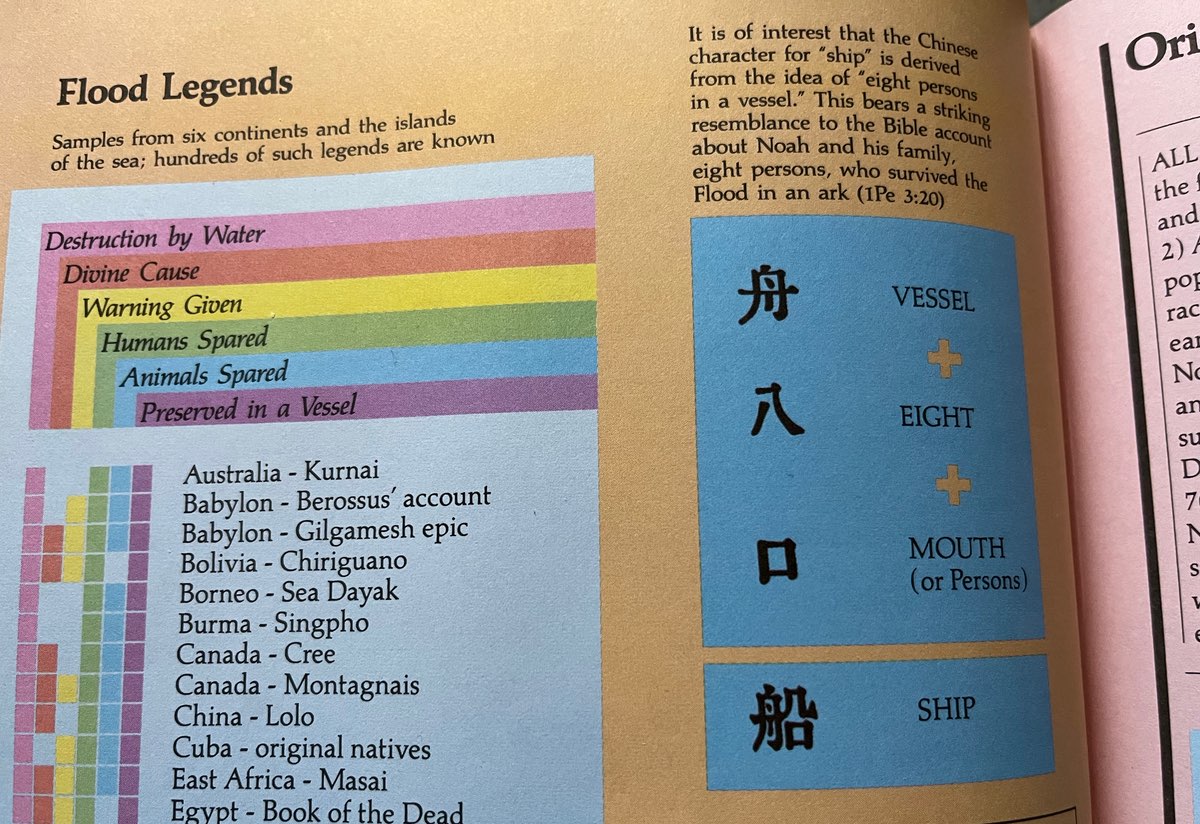
As shown in the image below, the first printing of the Insight book (on p. 328 of Volume 1) included a section regarding the Chinese character for “chuán (boat; ship; vessel船/舩)”:

P. 328 of Vol. 1 of the first printing of the _Insight_ book (1988), with a section about “船”

However, this section on this Chinese character no longer appears in current versions of the Insight book. Why might it have been removed?

Murky Speculation

Several years after the above-mentioned tiandi.info post was originally posted, I appended the following update to it:

Note that the section about the Chinese character “船 (chuán)” that was originally in the Insight book, Vol. 1, p. 328 is not present in the more recently published Chinese version of the Insight book.

Perhaps it was eventually decided that the origins of Chinese characters, which have been used for thousands of years, are too murky to do anything more than speculate about. I myself have recently become convinced that Chinese characters in general have been over-glamourized by the world.

It’s also worth going over an interesting, well-researched comment that the tiandi.info post mentioned above received. (Thanks again, Ed!) Here are a couple of excerpts from it:

The Insight article isn’t the only place in the Slave’s writings that the reference to this Chinese character appears. It originally appeared in the article “Chinese Characters—Why Are They Written That Way?” in g84 8/8 p. 23 [Here is a link to that article. Note that in addition to mentioning “chuán (boat; ship; vessel船/舩)”, this old article unfortunately repeats the Ideographic Myth. Also, it conflates language with writing, when actually, linguists understand that language primarily has to do with speech.—ed.], which ended with the caveat, “The similarity between the thoughts behind many of the Chinese characters and the Bible record of man’s early history is nothing less than remarkable. Although the evidence is only circumstantial, it is, nonetheless, fascinating to think that there is a possibility that the Chinese [characters contain Biblical concepts].”

The article was written in response to the book The Discovery of Genesis: How the Truths of Genesis Were Found Hidden in the Chinese Language, which had been published only a few years earlier. This book is full of fascinating parallels between Biblical accounts and elements that appear to comprise certain Chinese characters.

There are many resources available these days even to English speakers that contain scholarly research into the meaning and origins of Chinese characters. During the course of learning the language, I have made it a hobby to investigate some of these. I have to say that, based on what I have discovered, I disagree with the coauthors of Discovery of Genesis. In fact, there is a web site that has existed for several years for the purpose of rebutting these claims. While I don’t know the author’s motive for putting up the page, it does seem to have logical arguments.

For an alternative to Zhongwen.com, you could try looking up 船 at this site. (Disclosure: this web site is run by me.)

Truly right-hearted people won’t be stumbled if we share accurate knowledge from the Bible with them. But in any case, it’s best not to get too involved with matters of speculation that could be of interest to us but not have a direct bearing on God’s word of truth.

Sound vs. Meaning

The Raccoon Bend website page mentioned in the above quote contains some technical points such as the following:

A typical error made…is to analyze a semantic-phonetic compound as though it were compound-indicative (which they refer to as “ideographic”).

In other words, some mistakenly treat a character component that indicates sound as if it indicates meaning. The information at the Chinese-Characters.org link that the brother quoted above provided indicates that doing that with “船” seems to be what led to the story of “vessel + eight + mouths/persons”, when this character should actually be understood as being made up of the components “vessel + [phonetic (sound) component]”.

Stories vs. the Truth

As humans, we naturally love stories, since our minds use stories to make sense of the world around us. Also, stories add or reveal meaning or significance regarding things that these things would lack if they were not part of a story. However, not all stories are true. And while even fictional stories can help to reveal deeper truths about life, like Jesus’ parables did, false stories can take us farther away from the truth, if we let them. As the apostle Paul warned in 2 Timothy 4:3, 4:

For there will be a period of time when they will not put up with the wholesome teaching, but according to their own desires, they will surround themselves with teachers to have their ears tickled. They will turn away from listening to the truth and give attention to false stories.

While Chinese characters sometimes have appealing stories attached to them, let us make sure that we don’t let mere love of a good story take us away from the truth in any way. While naive tourists may be easily misled by appealing but false stories, as literal or figurative missionaries in the Mandarin field, we have a responsibility to serve God and our Mandarin-speaking neighbours “with spirit and truth”.—John 4:23, 24.