Categories
Culture Current Events History Theocratic

jiǎodù

jiǎodù (jiǎo·dù {horn(-shaped thing) → [angle]} · degree → [angle | point of view; perspective] 角度) ← Tap/click to show/hide the “flashcard”

[Notes: Tap/click on a Pīnyīn (Pīn·yīn {Piecing Together} · Sounds → [Pinyin] 拼音) expression to reveal its “flashcard”; tap/click on a “flashcard” or its Pīnyīn (Pīn·yīn {Piecing Together} · Sounds → [Pinyin] 拼音) expression to hide the “flashcard”. 📖 📄 📘 icons mean 📖 Reveal All, 📄 Reveal Advanced, and 📘 Reveal None re all the “flashcards” in the heading, paragraph, etc. that they are placed at the beginning of.]

One of the publications that is now recommended to be used on Bible studies is the Yǒngyuǎn Xiǎngshòu Měihǎo de Shēngmìng—Hùdòng Shì Shèngjīng Kèchéng ((Yǒng·yuǎn Eternally · {Far (in Time)} 永远 永遠) (Xiǎng·shòu Enjoy · Receive 享受) (Měi·hǎo Beautiful · Good 美好) (de ’s 的) (Shēngmìng Life 生命)—(Hù·dòng {Each Other} · Moving → [Interactive] 互动 互動) (Shì (Type 式) (Shèng·jīng Holy · Scriptures → [Bible] 圣经 聖經) (Kè·chéng Lessons · Procedure → [Course] 课程 課程) [Enjoy Life Forever!—An Interactive Bible Course (lff)]) (Enjoy Life Forever! (lff)) book. This week’s MEotW, “jiǎodù (jiǎo·dù {horn(-shaped thing) → [angle]} · degree → [angle | point of view; perspective] 角度)”, occurs in the transcript for the video used in lesson 06, point 5 of this book:
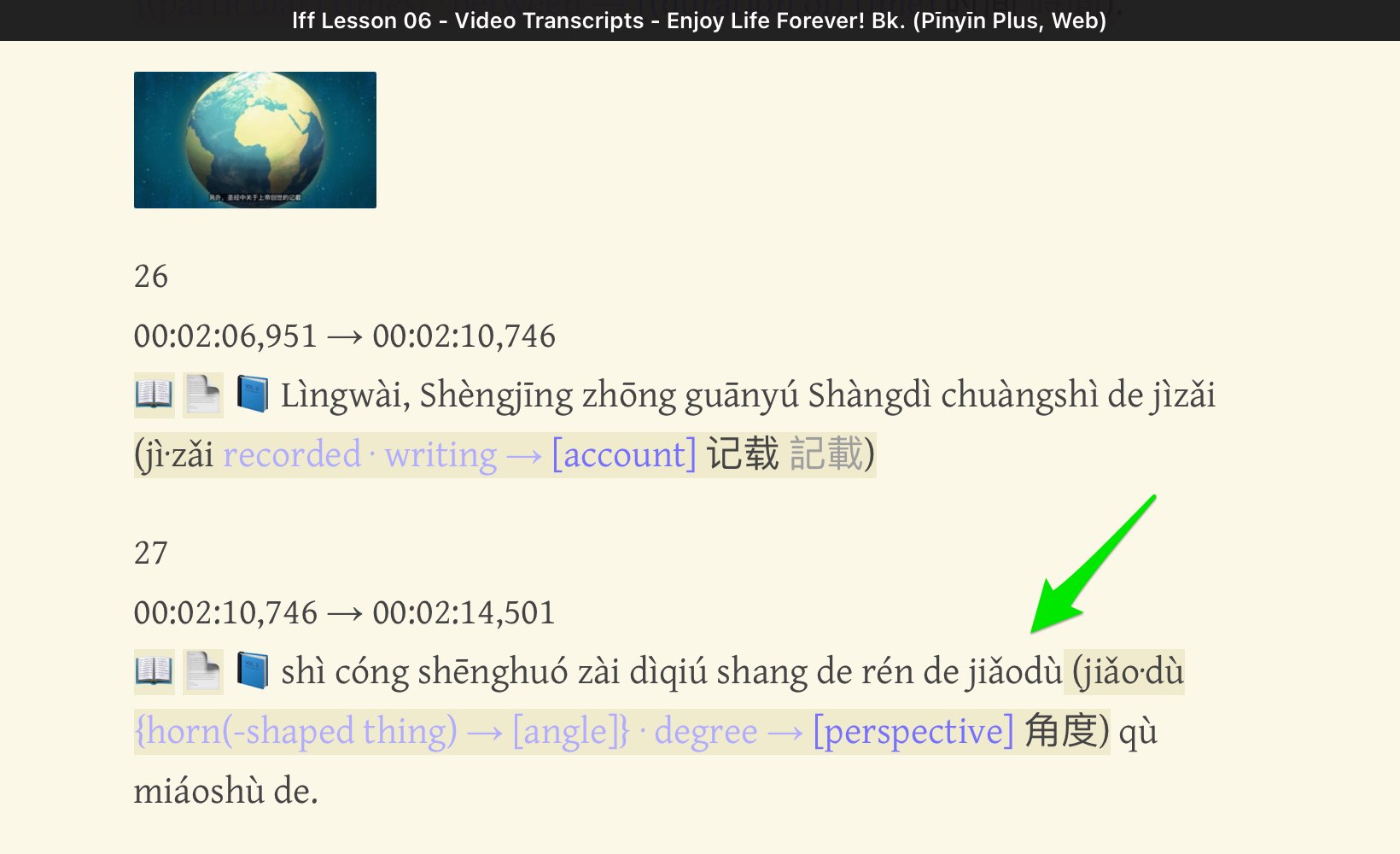
Screenshot of “jiǎodù” in _Enjoy Life Forever!_ bk. lesson 06 point 5 _Pīnyīn_ Plus video transcript

The Pīnyīn (Pīn·yīn {Piecing Together} · Sounds → [Pinyin] 拼音) Plus material for the sentence in the video in which “jiǎodù (jiǎo·dù {horn(-shaped thing) → [angle]} · degree → [angle | point of view; perspective] 角度)” occurs is as follows:

📖 📄 📘 Lìngwài (Lìng·wài separately · outside → [additionally] 另外), Shèngjīng (Shèng·jīng (the) Holy · Scriptures → [the Bible] 圣经 聖經) zhōng (within’s 中) guānyú (guān·yú {closing → [relating]} · to 关于 關於) Shàngdì (Shàng·dì Above’s · {Emperor’s → [God’s]} → [God’s] 上帝) chuàngshì (chuàng·shì {initiating, creating of} · {generation → [world]} 创世 創世) de (’s 的) jìzǎi (jì·zǎi recorded · writing → [account] 记载 記載) shì (is 是) cóng (from) shēnghuó (living 生活) zài (on 在) dìqiú (dì·qiú earth · globe 地球) shang (upon 上) de (’s 的) rén (person 人) de (’s 的) jiǎodù (jiǎo·dù {horn(-shaped thing) → [angle]} · degree → [perspective] 角度) ({having gone} 去) miáoshù (miáo·shù {to be traced → [to be depicted]} · {to be related} → [to be described] 描述) de (’s 的).

Horns, Corners, and Angles

It’s interesting to consider some of the other expressions that use the morphemes in “jiǎodù (jiǎo·dù {horn(-shaped thing) → [angle]} · degree → [angle | point of view; perspective] 角度)”. The first morpheme, “jiǎo ({horn [→ [sth. horn-shaped]]} | corner | angle 角)”, seems to literally mean “horn”, and it is also used to refer to things that are shaped like a horn. Probably related to that, it can also mean “corner”, or “angle”. Some other expressions that include “jiǎo ({horn [→ [sth. horn-shaped]]} | corner | angle 角)” are:

  • sānjiǎo (sān·jiǎo three · {horns → [corners]} → [triangle; delta] 三角) [xíng (form; shape 形)]

    • Interestingly, while in the English-speaking world, we say that a triangle has three sides, Mandarin calls a triangle something with three corners (or perhaps angles).
    • Recall that in the MEotW post on “Dé’ěrtǎ (Delta 德尔塔 德爾塔)”, this expression was listed as one of the ways to say “Delta”—as in the Delta variant of the virus that causes COVID-19—in Mandarin. (“Delta” is the fourth letter of the Greek alphabet, and its uppercase form (Δ) looks like a triangle.)
  • Fēizhōu zhī Jiǎo ((Fēi·zhōu Africa · Continent → [Africa] 非洲) (zhī ’s 之) (Jiǎo Horn 角) [Horn of Africa])
  • tiānyá‐hǎijiǎo ((tiān·yá sky’s · boundaries; edges → [remotest corners of the earth] 天涯)‐(hǎi·jiǎo sea’s · {horns → [corners]} 海角) [ends of the earth; remotest corners of the earth | separated worlds apart])

    • It turns out that there’s actually a real place called “Tiānyá (Tiān·yá Sky’s · Edge 天涯) Hǎijiǎo (Hǎi·jiǎo Sea’s · {Horn → [Corner]} → [Cape] 海角)”, called Cape Haijiao in English, in the vicinity of the city of Sānyà (Sān·yà Three · Inferiors → [Sanya, a city on Hainan Island, China] 三亚 三亞), which is on Hǎinán (Hǎi·nán Sea · South → [Hainan] 海南) Island in China.
    • The Wikipedia post on Sānyà (Sān·yà Three · Inferiors → [Sanya, a city on Hainan Island, China] 三亚 三亞) summarizes for us that:

      Sanya’s history dates to the Qin Dynasty (221–206 BCE). Due to its remoteness from the political centers during the Qin Dynasty, Sanya was sometimes called Tianya Haijiao (天涯海角), meaning “the end of the sky and ocean” or “the end of the earth”. As a result, the city served as a place of exile for officials who found themselves out of favor with the country’s rulers.

Degrees of…

(degree; extent; {degree of intensity} | {spend; pass (time)} | [mw for occasions/times] 度)”, the other morpheme in “jiǎodù (jiǎo·dù {horn(-shaped thing) → [angle]} · degree → [angle | point of view; perspective] 角度)”, can mean “degree(s)”, “extent”, or “degree of intensity”, among other things. Some other expressions that include it are:

  • chángdù (cháng·dù {being long → [length]} · degree; extent → [length] 长度 長度)

    • This expression occurs in the Mandarin Was Life Created? brochure, when it makes the point that “the Hebrew word translated ‘day’ can mean various lengths of time, not just a 24-hour period”. (Pīnyīn (Pīn·yīn {Piecing Together} · Sounds → [Pinyin] 拼音) WOL; Pīnyīn (Pīn·yīn {Piecing Together} · Sounds → [Pinyin] 拼音) Plus)
  • sùdù (sù·dù {being fast; rapid; quick; speedy → [speed; velocity]} · degree → [speed; velocity; tempo; pace; rate] 速度)
  • wēndù (wēn·dù {(of) being warm} · {degree of intensity} → [temperature] 温度 溫度)
  • tàidu (tài·du state · degree → [attitude; manner] 态度 態度)

Same Character, Different Words?

One thing that came to light during the research for this post is that “角”, the character for the “jiǎo ({horn [→ [sth. horn-shaped]]} | corner | angle 角)” in “jiǎodù (jiǎo·dù {horn(-shaped thing) → [angle]} · degree → [angle | point of view; perspective] 角度)”, can also be pronounced “jué ”, “”, or “”. For example, it’s pronounced “jué ” in “juésè (jué·sè role; part; character · {colour → [[theatrical] role]} 角色 角/腳色)”, where it also means something completely different. (Oddly, the first morpheme in “juésè (jué·sè role; part; character · {colour → [[theatrical] role]} 角色 角/腳色)” can alternately be written with the character “脚/腳”, which, like “角”, can also be pronounced either “jiǎo” or “jué ”.)

This illustrates that the contention that characters are the best way to disambiguate (tell apart) the homophones in Mandarin is problematic. One of the problems is that many characters have multiple possible pronunciations and meanings. Even for a given pronunciation, a character can still have multiple possible meanings. (A classic example is “机/機 ( jī )”, as discussed in the MEotW post on “wēijī (wēi·jī {ridge of a roof → [dangerous | endangering]} · {incipient moment; crucial point | occasion} | {(for) ridge of a roof → [(for) danger]} · occasion; opportunity → [crisis] 危机 危機)”.) So, the way to tell what pronunciation and what meaning a particular character has basically involves taking the same approach that Mandarin-speakers routinely take to disambiguate homophones when speaking Mandarin—consider the context.

Another thing to ponder is that if two Mandarin expressions are pronounced differently and have different meanings, but are written with the same character, do they count as two different words? Or does being written with the same character override their differences and unite them to be one word? There are different viewpoints regarding what is a word in Mandarin, but I think these two Mandarin expressions should indeed be considered two different words that just happen to be written with the same character, because in linguistics (the scientific study of language), speech is primary and writing is secondary, so the different spoken pronunciations (and meanings!) trump being written with the same character. If you have a different take, please share your reasoning and supporting evidence in the comments.


For convenience:

The direct link for the current generation Pīnyīn (Pīn·yīn {Piecing Together of} · Sounds → [Pinyin] 拼音) Plus resource for the Enjoy Life Forever! book is:

The short link for Chinese field language-learning links for the Enjoy Life Forever! book is:

More Pīnyīn (Pīn·yīn {Piecing Together of} · Sounds → [Pinyin] 拼音) and Pīnyīn (Pīn·yīn {Piecing Together of} · Sounds → [Pinyin] 拼音) Plus web material based on the Mandarin Enjoy Life Forever! book will be made available in the Pīnyīn (Pīn·yīn {Piecing Together of} · Sounds → [Pinyin] 拼音) Plus web resource as time allows.
Categories
Culture Language Learning Theocratic

bùzú

bùzú (bù·zú sectional · {ethnic group} → [tribe] 部族) ← Tap/click to show/hide the “flashcard”

Appendix A2 of the English New World Translation of the Holy Scriptures (Study Edition), entitled “Features of This Revision”, discusses vocabulary changes that have been made in the current revision, words that have been translated differently than before. As noted in various entries in the excellent resource Referenced Theo. Expressions (RTE), Appendix A2 of the current Mandarin version of the New World Translation Bible (nwtsty) correspondingly discusses words that have been translated differently in the current revision of the Mandarin NWT Bible, compared to how they had been translated before.

Since we base what we say in Jehovah’s service on his Word the Bible, the vocabulary used in it—and the way those vocabulary words are translated—should be reflected in how we speak in our ministry, at our meetings, etc. So, it is beneficial for us Mandarin field language learners to be familiar with the latest thinking from the organization on how Bible terms should be translated into Mandarin.

Adding Context

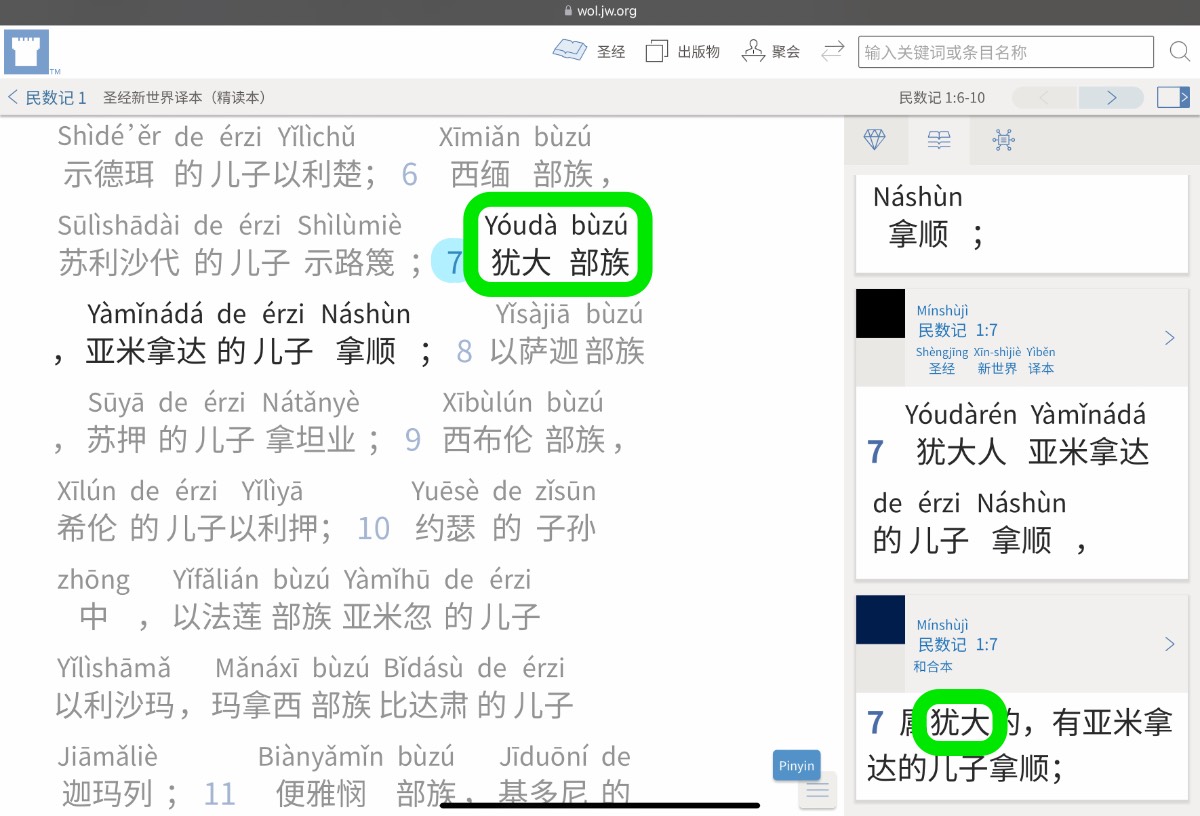
In past Mandarin Bible translations, a name like “Yóudà (Judah 犹大 猶大)” might be used to refer to a man, a tribe, a nation, etc., and this could cause readers to be confused. So, the current Mandarin version of the New World Translation Bible (nwtsty) translates such names more clearly, for example using “Yóudà (Judah 犹大 猶大) bùzú (bù·zú sectional · {ethnic group} → [tribe] 部族)” to mean “the tribe of Judah”, using “Yóudà (Judah 犹大 猶大) guó (nation)” to mean “the nation of Judah”, using “Yóudà (Judah 犹大 猶大) dìqū (dì·qū land · region 地区 地區)” to mean “the land of Judah”, etc.—Mínshùjì (Mín·shù·jì {The People} · Numbers · Record → [Numbers] 民数记 民數記) 1:7; Lièwángjì Shàng ((Liè·wáng·jì {Series of} · Kings · Record 列王纪 列王紀) (Shàng Upper 上) [1 Kings]) 13:1; Níxīmǐjì (Níxīmǐ·jì Nehemiah · Record 尼希米记 尼希米記) 11:3.

Numbers 1:7 (WOL CHS+Pinyin Parallel Translations)

By the way, the “ (part; section [→ [unit; ministry; department; board]] | [mw for large books, films, machines, vehicles, etc.] 部)” in “bùzú (bù·zú sectional · {ethnic group} → [tribe] 部族)” (this week’s MEotW) is also the one that appears in the well-known expression “bùfen (bù·fen part; section · component; share; part; portion 部分)”.

Solving “The Homophone Problem”

A section of the article “Pīnyīn (Pīn·yīn {Piecing Together} · Sounds → [Pinyin] 拼音) Was Plan A” addresses the common contention that Pīnyīn (Pīn·yīn {Piecing Together} · Sounds → [Pinyin] 拼音) is not suitable as a writing system for Mandarin because of the high number of homophones in Mandarin:

Some may object, saying that there are so many homophones in Chinese that the characters are needed to tell them apart from each other. (A homophone is a word that has the same pronunciation as another word, but that has a different meaning from it.) However, consider: When people are just speaking Mandarin, with no characters in sight to help them, do they have problems understanding each other because of all the homophones? Can blind Mandarin-speakers, who cannot see characters, still “see” what people mean when those people speak Mandarin? Native Mandarin-speakers have confirmed to me that no, homophones are not a significant problem in spoken Mandarin—people can use the context and understand each other okay. So, people can use the context and understand each other okay when using Pīnyīn too, since Pīnyīn directly represents the sound of spoken Mandarin.

…other ways [besides resorting to characters] to alleviate the problem. Those other ways could include:

  • Including as much clarifying context in the written language as is necessary, as is done in the spoken language
  • Reducing the number of homophones by
    • Adding syllables to existing homophones

The above-described practice used in the current Mandarin NWT, of adding expressions like “bùzú (bù·zú sectional · {ethnic group} → [tribe] 部族)” to expressions like “Yóudà (Judah 犹大 猶大)”, is an example of adding context, and also an example of reducing the number of expressions that sound the same by adding syllables to existing expressions that sound the same, to clarify what means what without resorting to the homophone-enabling crutch that is the characters. In fact, in this case, disambiguation by using different characters is not an option anyway because “Yóudà (Judah 犹大 猶大)” must be written with the same characters whether it means “the man named Judah”, “the tribe of Judah”, “the nation of Judah”, etc. Theoretically, one might contemplate the possibility of using different characters to represent “Judah” depending on whether it refers to “the man named Judah”, “the tribe of Judah”, “the nation of Judah”, etc., but that way lies even madder madness than the madness that already is the Chinese characters!

Categories
Culture Current Events Language Learning

nànmín

nànmín (nàn·mín calamity; disaster; adversity; distress · {person of a certain occupation} → [refugee] 难民 難民) ← Tap/click to show/hide the “flashcard”

On February 24, 2022, Russia sent significant military forces into Ukraine, resulting in the largest scale open warfare in Europe since World War II. Knowing certain Mandarin expressions will help us in the Mandarin field as we hear about and talk about Ukraine in the time ahead.

As of this writing, the article “Refugee Crisis​—Millions Flee Ukraine” is being featured on jw.org. In the Mandarin version of that article, the English word “refugee” is translated as “nànmín (nàn·mín calamity; disaster; adversity; distress · {person of a certain occupation} → [refugee] 难民 難民)”, this week’s MEotW.

While it may seem odd to say in the Pīnyīn (Pīn·yīn {Piecing Together} · Sounds → [Pinyin] 拼音) Plus information that a refugee has an “occupation”, note that an occupation can be defined, not just as a job or profession, but also as “any activity that occupies a person’s attention”. Unfortunately, being a refugee certainly “occupies a person’s attention”.

(By the way, in the Mandarin version of the above-mentioned article, “refugee crisis” is translated as “nànmín (nàn·mín calamity · {persons of a certain occupation} → [refugees] 难民 難民) cháo (tide → [(social) upsurge] 潮)”. “Cháo (tide [→ [(social) upsurge; current; trend]] 潮)” literally means “tide”, which is an easily understood metaphor, similar to how in English we may speak of a “wave” of refugees.)

A Shifty Character

One may notice that the first Chinese character used to write “nànmín (nàn·mín calamity; disaster; adversity; distress · {person of a certain occupation} → [refugee] 难民 難民)”, “难/難”, is also the Chinese character used to write “nán ({[is] difficult}; {[is] hard} | difficultly | {make difficult/difficulties})”, a common word that basically means “difficult”. One then can hardly fail to notice that whereas with “nànmín (nàn·mín calamity; disaster; adversity; distress · {person of a certain occupation} → [refugee] 难民 難民)”, “难/難” is pronounced with a fourth tone, with “nán ({[is] difficult}; {[is] hard} | difficultly | {make difficult/difficulties})” it is pronounced with a second tone. But, aren’t characters supposed to be the grand clarifiers of meaning in a Mandarin language awash in homophones (words that sound the same, but that have different meanings)?

Yes, it has become customary to rely (too much) on characters that are seen to disambiguate or clarify pronunciations that are heard, but the truth is that characters themselves can also be ambiguous on their own, since, as our example above shows, characters can have multiple pronunciations and meanings.

What is the real ultimate clarifier of meaning in Mandarin, even when it has been allowed to develop as many homophones as it has? The ultimate clarifier is context, not characters! For example, when we see that “难/難” is followed by “民”, that context tells us that here, “难/難” is pronounced as “nàn”, with its associated meaning, not as “nán”, with its different associated meaning. On its own, without context, the character “难/難” is ambiguous.

For more information on why it’s problematic to rely on characters to disambiguate homophones in Mandarin, see the subheading “But There Are So Many Words That Sound the Same!” in the article “Pīnyīn (Pīn·yīn {Piecing Together} · Sounds → [Pinyin] 拼音) Was Plan A”.

“Context is God”

Regarding context, the MEotW post on “yǔjìng (yǔ·jìng language · {(set of) boundaries → [(bounded) place; area] → [condition; situation; circumstances]} → [context] 语境 語境)” had this to say:

Context and Mandarin Writing Systems

Research into the importance of context turned up a couple of interesting sayings from the business world:

Content is king.
—Bill Gates

Content is king, but context is God.
—Gary Vaynerchuk

Mandarin field language-learners may hear the assertion from Chinese culture traditionalists that it is necessary to use Chinese characters to clarify the ambiguity that results from Mandarin having so many homophones, words that sound the same but that have different meanings. The insinuation, or even the outright accusation, is that the upstart Pīnyīn (Pīn·yīn {Piecing Together} · Sounds → [Pinyin] 拼音) system is thus unusable as a writing system for Mandarin, that the Chinese characters writing system is still the rightful king. Besides, there is so much existing content written in Chinese characters, and content is king!

However, a little consideration of the yǔjìng (yǔ·jìng language · {(set of) boundaries → [(bounded) place] → [situation]} → [context] 语境 語境), the language situation or context, shows up the fallacy of this assertion. The Chinese characters writing system exists along with Mandarin speech, and if Chinese characters are truly required to clearly communicate meaning in Mandarin, then that would mean that Mandarin speech on its own, without the help of visible characters, is unusable as a means of communication. That, however, is obviously not true—people who are proficient in spoken Mandarin communicate clearly with each other all the time, undoubtedly pretty much as clearly as proficient English speakers communicate with each other.

The key reason why proficient Mandarin speakers can communicate clearly with each other despite all of the homophones in Mandarin is not that they are constantly referring to Chinese characters, although people do occasionally do that in the current characters-saturated cultural climate. No, the key reason why Mandarin-speakers routinely communicate clearly with each other is because they use sufficient context to clarify any potentially ambiguous homophones. And, since Pīnyīn (Pīn·yīn {Piecing Together} · Sounds → [Pinyin] 拼音) is a simple and direct representation of Mandarin speech, anything that is understandable when spoken in Mandarin is understandable when written in Pīnyīn (Pīn·yīn {Piecing Together} · Sounds → [Pinyin] 拼音).—1 Corinthians 14:8–11.

So, while Chinese characters-based content may be so predominant in the Chinese world that it’s king there, context is God, relatively and metaphorically speaking, and Mandarin speech and Pīnyīn (Pīn·yīn {Piecing Together} · Sounds → [Pinyin] 拼音) rightly rely on context, not on Chinese characters, just like we rightly rely on God, not on merely human kings.