Categories
Culture Experiences Language Learning Science Technology Theocratic

dòngnù

dòngnù (dòng·nù {have moved} · anger; rage; fury → [get angry; lose temper; fly into a rage] 动怒 動怒) 👈🏼 Tap/click to show/hide the “flashcard”

[Notes: Tap/click on a Pīnyīn (Pīn·yīn {Piecing Together of} · Sounds → [Pinyin] 拼音) expression to reveal its “flashcard”; tap/click on a “flashcard” or its Pīnyīn (Pīn·yīn {Piecing Together of} · Sounds → [Pinyin] 拼音) expression to hide the “flashcard”. 📖 📄 📘 icons mean 📖 Reveal All, 📄 Reveal Advanced, and 📘 Reveal None re all the “flashcards” in the heading, paragraph, etc. that they are placed at the beginning of.]

I have long especially liked 1 Corinthians 13. It contains counsel on what really does and doesn’t matter in life, an extensive description and definition of the most important kind of love, and a sublime discussion about the need to become complete, mature, as a person. As these apply to life in general, so too do they apply to our lives as Mandarin field language learners.

As Mandarin field language learners, it can benefit us greatly to consider what we can learn from 1 Corinthians 13, and along the way, we can also consider some of the Mandarin expressions used in that chapter in the current version of the Mandarin New World Translation Bible (nwtsty).

Moved to Anger

This week’s MEotW, “dòngnù (dòng·nù {have moved} · anger; rage; fury → [get angry; lose temper; fly into a rage] 动怒 動怒)”, is used in verse 5 (WOL) of 1 Corinthians 13:
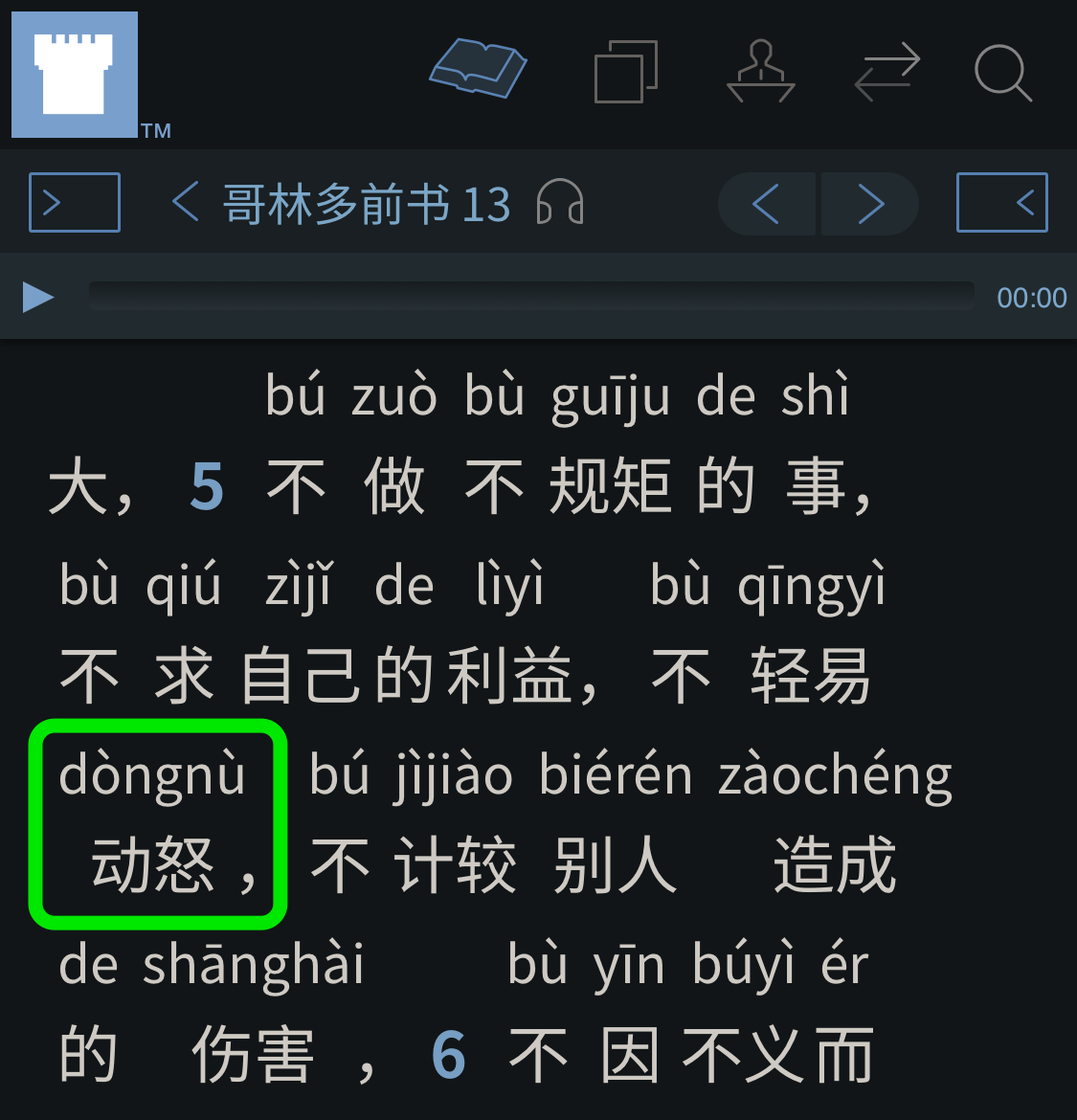
Screenshot of “_dòngnù_” in 1 Co. 13:5 (nwtsty, CHS+_Pīnyīn_ WOL)

(Dark mode for the Watchtower ONLINE LIBRARY (WOL) website, as shown in the above image, can be enabled in the Safari web browser by using the Noir Safari extension. Other web browsers may also have extensions with similar functionality.)

For comparison, here are the current English and Pīnyīn (Pīn·yīn {Piecing Together of} · Sounds → [Pinyin] 拼音) Plus renderings of 1 Corinthians 13:5:

English:

does not behave indecently, does not look for its own interests, does not become provoked. It does not keep account of the injury.

Pīnyīn (Pīn·yīn {Piecing Together of} · Sounds → [Pinyin] 拼音) Plus:

📖 📄 📘 (not 不) zuò ({does do} 做) (not 不) guīju (guī·ju (following) {dividers → [rules]} · {carpenter’s squares → [regulations]} → [following established standards] 规矩 規矩) de ( 的) shì (things 事), (not 不) qiú ({does seek} 求) zìjǐ (self 自己) de (’s 的) lìyì (lì·yì {sharpening → [advantage]} · benefit → [benefit] 利益), (not 不) qīngyì (qīng·yì lightly · easily 轻易 輕易) dòngnù (dòng·nù {does have moved} · anger → [does get angry] 动怒 動怒), (not 不) jìjiào (jì·jiào {does count} · {does dispute about} 计较 計較) biéren (bié·ren other · people 别人 別人) zàochéng (zào·chéng {have created} · {to come to be} 造成) de (’s 的) shānghài (injuring → [injury] 伤害 傷害),

In the example above, the Mandarin phrase “bù (not 不) qīngyì (qīng·yì lightly · easily 轻易 輕易) dòngnù (dòng·nù {does have moved} · anger → [does get angry] 动怒 動怒) corresponds with the English phrase “does not become provoked”. As for the morphemes in “dòngnù (dòng·nù {have moved} · anger; rage; fury → [get angry; lose temper; fly into a rage] 动怒 動怒)”, they literally mean “have moved anger/rage/fury”, and effectively mean “get angry; lose one’s temper; fly into a rage”.

Angrily Holding On to Tradition

I remember more than one Mandarin field language learner who reacted angrily when I suggested that using Pīnyīn (Pīn·yīn {Piecing Together of} · Sounds → [Pinyin] 拼音) more and deemphasizing characters would help them progress in learning Mandarin. Rather than appreciating the evident truth of what I was saying, or being thankful that I was trying to help them, they seemed offended and upset that I had dared to suggest something so out of step with the human traditions that they had been taught all their lives, and, perhaps, indignant that I had, in their estimation, dismissed and invalidated the blood, sweat, and tears that they had personally invested for years and years into the long, hard, bitter struggle that is learning characters.

On the one hand, some may say that such reactions are only human, but on the other hand, the words of 1 Corinthians 13:5 that love “does not become provoked” show that actually, such ones are not completely acting out of Christian love when they react that way. As the Insight book says:

Love “does not become provoked.” It does not look for an occasion or an excuse for provocation. It is not moved to outbursts of anger, which is a work of the flesh. (Ga 5:19, 20) One having love is not easily offended by what others say or do. He is not afraid that his personal “dignity” may be injured.

Happily, not all Mandarin field language learners react as mentioned above. Rather than reacting out of personal indignation, cultural pride, traditionalism, and chauvinism, or the tribalism of the embattled few in “the club” who have long endured together the difficult burdens of dealing with the unnecessarily extraordinarily complex characters, even some long-time Mandarin field language learners who have worked hard for a long time to learn characters listen humbly to the information I share with them about the linguistic truths that apply to our Mandarin field language learning, and are appreciative that these truths help to set them free from the unnecessary burdens imposed by mere human tradition.—John 8:32.
Categories
Culture Language Learning Science Technology Theocratic

qià‐dào‐hǎochu

qià‐dào‐hǎochu ((qià just; exactly 恰)‐(dào {[is] having arrived at} 到)‐(hǎo·chu good · places; points [→ [benefits; advantages | gain; profit]] 好处 好處) [[is] perfect; just right]) 👈🏼 Tap/click to show/hide the “flashcard”

[Notes: Tap/click on a Pīnyīn (Pīn·yīn {Piecing Together of} · Sounds → [Pinyin] 拼音) expression to reveal its “flashcard”; tap/click on a “flashcard” or its Pīnyīn (Pīn·yīn {Piecing Together of} · Sounds → [Pinyin] 拼音) expression to hide the “flashcard”. 📖 📄 📘 icons mean 📖 Reveal All, 📄 Reveal Advanced, and 📘 Reveal None re all the “flashcards” in the heading, paragraph, etc. that they are placed at the beginning of.]

At the time of this writing, the Teaching Toolbox in the JW Library app had recently included the No. 3 2021 issue of Awake! magazine. While it is not currently in the Teaching Toolbox, this question considered in this issue, “Should You Believe in a Creator?”, remains an important one for Mandarin field language learners to pay special attention to. Many of the Mandarin-speaking people in the field especially need help with this matter, because their cultural background tends to cause them to not believe in a Creator. At the same time, though, whether the Creator exists remains the first major question that needs to be settled before they can make real further spiritual progress. Another important factor is that the worldwide Mandarin field continues to be huge, probably the language field with more people in it than any other language field in history.

For us Mandarin field language learners, though, using Mandarin to discuss the question of the Creator’s existence is especially challenging and requires special effort from us, because of the particularly deeply technical concepts and vocabulary involved. And, this is in addition to the usual unusual challenges presented by Chinese characters, the general misinformation and disinformation present in the world about the Chinese languages, etc.

Finely Tuned to Be Just Right

This week’s MEotW, “qià‐dào‐hǎochu ((qià just; exactly 恰)‐(dào {[is] having arrived at} 到)‐(hǎo·chu good · places; points [→ [benefits; advantages | gain; profit]] 好处 好處) [[is] perfect; just right])”, occurs in the No. 3 2021 issue of Awake! magazine in the fifth and sixth paragraphs of the article “What the Universe Tells Us”:

English:

The universe is fine-tuned to support life. Consider what scientists call the weak force. It keeps our sun burning at a steady rate. If the force were weaker, the sun would never have formed. If it were stronger, the sun would have disappeared long ago.

The weak force is just one of several finely tuned features that we depend on. …

Mandarin:

📖 📄 📘 Yǔzhòu (Yǔ·zhòu universe · {all time, past, present, and future} → [universe] 宇宙) zhōng (within 中) de (’s 的) gèzhǒng (gè·zhǒng each · {type of} 各种 各種) (force 力) dōu ({each one of them} 都) qià‐dào‐hǎochu ((qià exactly 恰)‐(dào {is having arrived at} 到)‐(hǎo·chu good · place 好处 好處) [is just right]), suǒyǐ (suǒ·yǐ {that which} · {is the reason} → [thus] 所以) shēngmìng (life 生命) cái ({only then}才/纔) néng ({is able} 能) cúnzài (cún·zài {to exist} · {to be present} 存在). Lái (come) kànkan (kàn·kan {look at} · {look at} 看看) kēxué‐jiā ((kē·xué {branches of study} · learning → [science] 科学 科學)‐(jiā -ists 家) [scientists]) suǒ ({that which (they)} 所) shuō ({speak of}說/説) de (’s 的) ruò (weak 弱)hélì (hé·lì {pit (of a fruit) → [nuclear]} · force 核力), zhèi (this) zhǒng ({type of}種/种) (force 力) ràng (allows) tàiyáng (tài·yáng highest · {positive/active/male principle in nature (Chinese philosophy)} → [sun] 太阳 太陽) (at 以) wěndìng (wěn·dìng steady · set 稳定 穩定) de (’s 的) sùdù (sù·dù {being fast → [speed]} · degree → [rate] 速度) ránshāo (rán·shāo {to be ignited} · {to burn} 燃烧 燃燒). Rúguǒ (Rú·guǒ if · {fruit → [if indeed]} 如果) zhèi (this) zhǒng ({type of}種/种) (force 力) ruò ({was weak} 弱) yìdiǎnr (yì·diǎnr a · bit (more) 一点 一點), tàiyáng (tài·yáng highest · {positive/active/male principle in nature (Chinese philosophy)} → [sun] 太阳 太陽) jiù (then 就) wúfǎ (wú·fǎ {would not have had} · way → [would have been unable] 无法 無法) xíngchéng (xíng·chéng {form (n)} · {to come to be} → [to form] 形成); rúguǒ (rú·guǒ if · {fruit → [if indeed]} 如果) zhèi (this) zhǒng ({type of}種/种) (force 力) qiáng ({was strong}強/彊) yìdiǎnr (yì·diǎnr a · bit (more) 一点 一點), tàiyáng (tài·yáng highest · {positive/active/male principle in nature (Chinese philosophy)} → [sun] 太阳 太陽) jiù (then 就) huì (would) ránshāo (rán·shāo ignite · burn 燃烧 燃燒) de (getting 得) tài ({too much} 太) kuài ({to be quick} 快), zǎo ({early on} 早) jiù (then 就) xiāoshī (xiāo·shī {would have disappeared} · {would have been lost} 消失) le ([(at the end of a phrase/sentence) indicates a change] 了).

📖 📄 📘 Ruò (weak 弱)hélì (hé·lì {pit (of a fruit) → [nuclear]} · force 核力) qià‐dào‐hǎochu ((qià exactly 恰)‐(dào {is having arrived at} 到)‐(hǎo·chu good · place 好处 好處) [is just right]), dàn (but 但) (it 它) zhǐshì (zhǐ·shì only · is 只是) wéichí (wéi·chí maintaining · {holding → [sustaining]} → [sustaining] 维持 維持) shēngmìng (life 生命) de (’s 的) qízhōng (qí·zhōng them · among 其中) (one 一) ge ([mw]個/个) yīnsù (yīn·sù cause · {raw silk → [basic element]} → [factor] 因素). …

In the above examples, “qià‐dào‐hǎochu ((qià just; exactly 恰)‐(dào {[is] having arrived at} 到)‐(hǎo·chu good · places; points [→ [benefits; advantages | gain; profit]] 好处 好處) [[is] perfect; just right]) is used to correspond with the English expressions “fine-tuned” and “finely tuned”. While much cruder than the exquisite systems found in the natural world, many systems produced by human technology can help us to understand the need for certain factors to be finely tuned before an even moderately complex system can function properly. For example, a phone number that’s off by just one number is a wrong number, and older readers will remember radios that needed to be tuned to a certain frequency before the desired radio station could be heard clearly. Speaking of readers, anyone reading this post first had to follow a link (or manually type in a URL) that had to be coded just right—if the web address requested was not within a narrow margin of error, this post would not have loaded!

Let us, then, remember this week’s MEotW, “qià‐dào‐hǎochu ((qià just; exactly 恰)‐(dào {[is] having arrived at} 到)‐(hǎo·chu good · places; points [→ [benefits; advantages | gain; profit]] 好处 好處) [[is] perfect; just right])”, so that we can be helped to be able to talk to Mandarin-speaking people about how the universe, the sun, the earth, our own bodies, etc. are tuned to be just right, so that we can live, ponder how we got here, and get to know our Creator.


A Pīnyīn (Pīn·yīn {Piecing Together of} · Sounds → [Pinyin] 拼音) Plus resource for the No. 3 2021 issue of Awake! magazine, which discusses the question “Should You Believe in a Creator?”, is in the works. For updates on the Pīnyīn (Pīn·yīn {Piecing Together of} · Sounds → [Pinyin] 拼音) Plus resources that are available, keep an eye on this blog, on the Links News blog, and on the related account on the social network of your choice listed on this blog’s Contact page.

Categories
Culture History Language Learning Names Technology

jiǎntǐ‐zì

jiǎntǐ (jiǎn·tǐ simplified · {body → [style] → [typeface; font]} → [simplified Chinese] 简体 簡體) (characters 字) 👈🏼 Tap/click to show/hide the “flashcard”

[This is a reposting of a post that was originally posted on December 7, 2020. I took the opportunity to flesh out the original post and this repost with additional material.]

For a long, long, long time, Chinese characters were just Chinese characters. Then, in 1956, the Communist government of mainland China issued what came to be known as the First Chinese Character Simplification Scheme (a second round of Chinese character simplification was later attempted and ultimately rescinded), and official simplified Chinese characters came into the world. (Some characters had been unofficially simplified and used for various purposes, both everyday and artistic, before that.)

On the matter of what simplified Chinese characters are called in Mandarin, Wikipedia provides this summary:

Simplified Chinese characters may be referred to by their official name above [(简化字; jiǎnhuàzì)[source]] or colloquially (简体字; jiǎntǐzì). In its broadest sense, the latter term refers to all characters that have undergone simplifications of character “structure” or “body”[source], some of which have existed for millennia alongside regular, more complicated forms. On the other hand, the official name refers to the modern systematically simplified character set, which (as stated by then-Chairman Mao Zedong in 1952) includes not only structural simplification but also substantial reduction in the total number of standardized Chinese characters.[source]

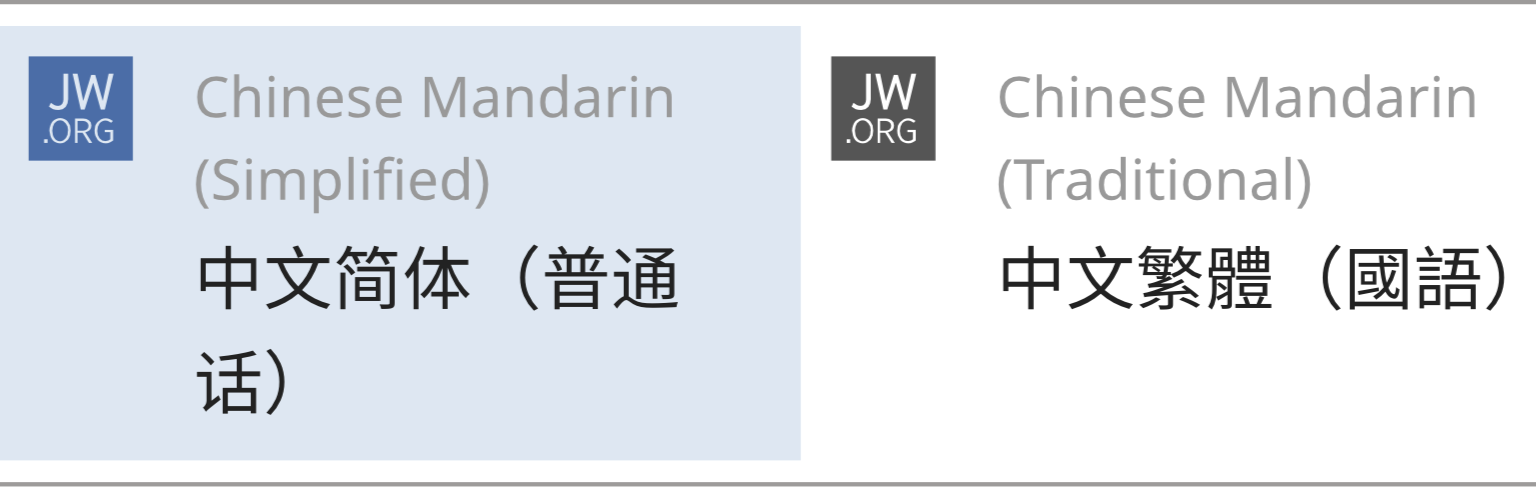
For reference, this is the term used on jw.org when referring to Mandarin written using simplified Chinese characters:

jw.org referring to Mandarin written using simplified Chinese characters

jw.org refers to simplified Chinese characters as “jiǎntǐ (jiǎn·tǐ simplified · {body → [style] → [typeface; font]} → [simplified Chinese] 简体 簡體) characters.

The Great Simplified vs. Traditional Debate

While it seems obvious that simpler is generally better, there is actually much, much debate about the pros and cons of simplified characters vs. traditional characters, as discussed in these articles:

The following posts summarize how many feel about traditional and simplified characters:

Standards and Compromises

While the simplified characters themselves are indeed easier to learn and remember compared to the traditional characters, for many, they have become another set of characters in addition to the traditional characters that has to be learned and remembered. (There is, at least, some overlap between the two systems. Where do they overlap? That is yet more information that has to be learned and remembered…) And while simplified characters have been simplified, they are still characters, and characters are inherently extraordinarily complex and hard to learn and remember.

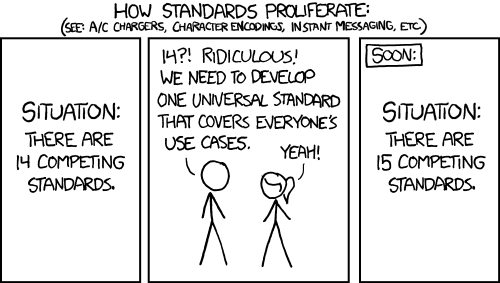
xkcd: Standards

Creative Commons Attribution-NonCommercial Licence logo Randall Munroe [source]

The simplified characters became a new standard that many have had to learn in addition to that of the traditional characters.

While Pīnyīn (Pīn·yīn {Piecing Together of} · Sounds → [Pinyin] 拼音) is also a different system to be learned and remembered, it is in a whole different league compared to any system of Chinese characters when it comes to ease of learning and remembering. One of the scholars who helped create Hangul (or Hankul), the Korean alphabet, said of it: “The wise can learn it in one morning, and even the unwise can learn it in ten days.” Being also a phonetic alphabet, Pīnyīn (Pīn·yīn {Piecing Together of} · Sounds → [Pinyin] 拼音) can be reasonably said to be in the same ballpark (with the added advantage that the Latin alphabet letters used in Pīnyīn (Pīn·yīn {Piecing Together of} · Sounds → [Pinyin] 拼音) are already familiar to many people)—downright revolutionary compared to the years (decades?) required to learn even simplified characters.

Simplified characters are thus a compromise that mainland China, Singapore, etc. have settled on—simpler than traditional characters, but perhaps thus not as good at being characters. Meanwhile, they are still characters, still having many of the complexities and vagaries of characters. They fall short of the fundamental reform envisioned by Máo Zédōng ((Máo Hair (surname) 毛) (Zé·dōng Marsh · East 泽东 澤東) (the founder of the People’s Republic of China)) (Wikipedia article), Lǔ Xùn ((Lǔ Stupid; Rash (surname)) (Xùn Fast; Quick; Swift 迅) (pen name of Zhōu Shùrén, the greatest Chinese writer of the 20th cent. and a strong advocate of alphabetic writing)) (Wikipedia article), and others, that would have involved eventually moving on from any kind of characters to alphabetic writing.

Letter from Máo Zédōng endorsing a transition from Chinese characters to alphabetic writing

A letter written by Máo Zédōng ((Máo Hair (surname) 毛) (Zé·dōng Marsh · East 泽东 澤東) (the founder of the People’s Republic of China)) endorsing “a basic reform” involving a transition from Chinese characters to alphabetic writing1


1. John DeFrancis, The Chinese Language: Fact and Fantasy (Honolulu: University of Hawaii Press, 1984), p. ii. ^