Categories
Culture Experiences Language Learning Science Technology Theocratic

dòngnù

dòngnù (dòng·nù {have moved} · anger; rage; fury → [get angry; lose temper; fly into a rage] 动怒 動怒) 👈🏼 Tap/click to show/hide the “flashcard”

[Notes: Tap/click on a Pīnyīn (Pīn·yīn {Piecing Together of} · Sounds → [Pinyin] 拼音) expression to reveal its “flashcard”; tap/click on a “flashcard” or its Pīnyīn (Pīn·yīn {Piecing Together of} · Sounds → [Pinyin] 拼音) expression to hide the “flashcard”. 📖 📄 📘 icons mean 📖 Reveal All, 📄 Reveal Advanced, and 📘 Reveal None re all the “flashcards” in the heading, paragraph, etc. that they are placed at the beginning of.]

I have long especially liked 1 Corinthians 13. It contains counsel on what really does and doesn’t matter in life, an extensive description and definition of the most important kind of love, and a sublime discussion about the need to become complete, mature, as a person. As these apply to life in general, so too do they apply to our lives as Mandarin field language learners.

As Mandarin field language learners, it can benefit us greatly to consider what we can learn from 1 Corinthians 13, and along the way, we can also consider some of the Mandarin expressions used in that chapter in the current version of the Mandarin New World Translation Bible (nwtsty).

Moved to Anger

This week’s MEotW, “dòngnù (dòng·nù {have moved} · anger; rage; fury → [get angry; lose temper; fly into a rage] 动怒 動怒)”, is used in verse 5 (WOL) of 1 Corinthians 13:
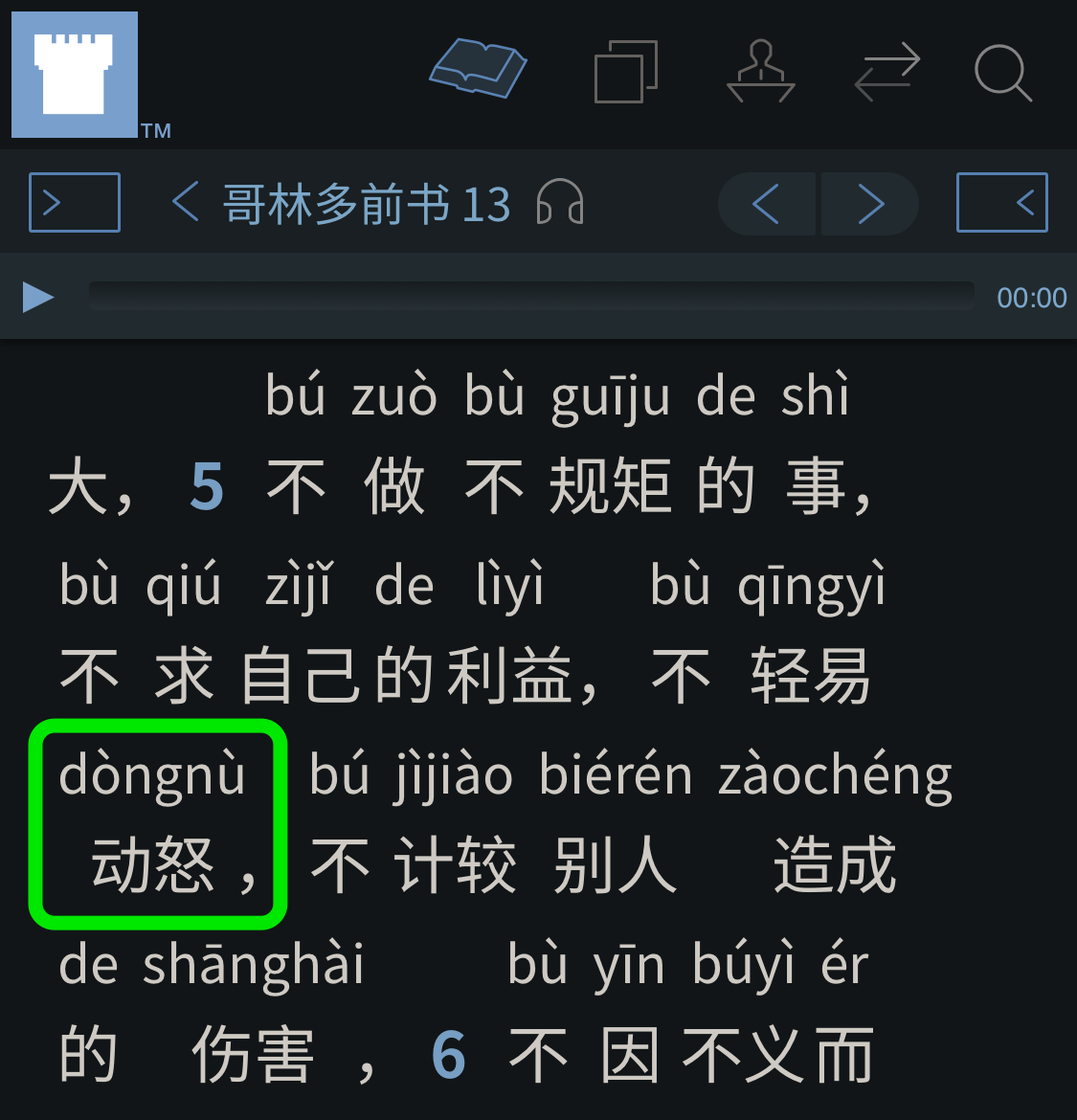
Screenshot of “_dòngnù_” in 1 Co. 13:5 (nwtsty, CHS+_Pīnyīn_ WOL)

(Dark mode for the Watchtower ONLINE LIBRARY (WOL) website, as shown in the above image, can be enabled in the Safari web browser by using the Noir Safari extension. Other web browsers may also have extensions with similar functionality.)

For comparison, here are the current English and Pīnyīn (Pīn·yīn {Piecing Together of} · Sounds → [Pinyin] 拼音) Plus renderings of 1 Corinthians 13:5:

English:

does not behave indecently, does not look for its own interests, does not become provoked. It does not keep account of the injury.

Pīnyīn (Pīn·yīn {Piecing Together of} · Sounds → [Pinyin] 拼音) Plus:

📖 📄 📘 (not 不) zuò ({does do} 做) (not 不) guīju (guī·ju (following) {dividers → [rules]} · {carpenter’s squares → [regulations]} → [following established standards] 规矩 規矩) de ( 的) shì (things 事), (not 不) qiú ({does seek} 求) zìjǐ (self 自己) de (’s 的) lìyì (lì·yì {sharpening → [advantage]} · benefit → [benefit] 利益), (not 不) qīngyì (qīng·yì lightly · easily 轻易 輕易) dòngnù (dòng·nù {does have moved} · anger → [does get angry] 动怒 動怒), (not 不) jìjiào (jì·jiào {does count} · {does dispute about} 计较 計較) biéren (bié·ren other · people 别人 別人) zàochéng (zào·chéng {have created} · {to come to be} 造成) de (’s 的) shānghài (injuring → [injury] 伤害 傷害),

In the example above, the Mandarin phrase “bù (not 不) qīngyì (qīng·yì lightly · easily 轻易 輕易) dòngnù (dòng·nù {does have moved} · anger → [does get angry] 动怒 動怒) corresponds with the English phrase “does not become provoked”. As for the morphemes in “dòngnù (dòng·nù {have moved} · anger; rage; fury → [get angry; lose temper; fly into a rage] 动怒 動怒)”, they literally mean “have moved anger/rage/fury”, and effectively mean “get angry; lose one’s temper; fly into a rage”.

Angrily Holding On to Tradition

I remember more than one Mandarin field language learner who reacted angrily when I suggested that using Pīnyīn (Pīn·yīn {Piecing Together of} · Sounds → [Pinyin] 拼音) more and deemphasizing characters would help them progress in learning Mandarin. Rather than appreciating the evident truth of what I was saying, or being thankful that I was trying to help them, they seemed offended and upset that I had dared to suggest something so out of step with the human traditions that they had been taught all their lives, and, perhaps, indignant that I had, in their estimation, dismissed and invalidated the blood, sweat, and tears that they had personally invested for years and years into the long, hard, bitter struggle that is learning characters.

On the one hand, some may say that such reactions are only human, but on the other hand, the words of 1 Corinthians 13:5 that love “does not become provoked” show that actually, such ones are not completely acting out of Christian love when they react that way. As the Insight book says:

Love “does not become provoked.” It does not look for an occasion or an excuse for provocation. It is not moved to outbursts of anger, which is a work of the flesh. (Ga 5:19, 20) One having love is not easily offended by what others say or do. He is not afraid that his personal “dignity” may be injured.

Happily, not all Mandarin field language learners react as mentioned above. Rather than reacting out of personal indignation, cultural pride, traditionalism, and chauvinism, or the tribalism of the embattled few in “the club” who have long endured together the difficult burdens of dealing with the unnecessarily extraordinarily complex characters, even some long-time Mandarin field language learners who have worked hard for a long time to learn characters listen humbly to the information I share with them about the linguistic truths that apply to our Mandarin field language learning, and are appreciative that these truths help to set them free from the unnecessary burdens imposed by mere human tradition.—John 8:32.

Categories
Culture Language Learning Languages Science

Zhōngwén

Zhōngwén (Zhōng·wén {Central → [Chinese]} · Writing 中文) ← Tap/click to show/hide the “flashcard”

[This is a reposting of a post that was originally posted on October 26, 2020. It’s about something that is fundamentally important for Mandarin field language learners to understand correctly.]

As discussed in a previous MEotW, the expression “Zhōngguó (Zhōng·guó Central · Nation → [China] 中国 中國)” is commonly used to refer to China, since historically, China views itself as the centre of the world, so much so, in fact, that it is the only nation to name itself as such. We can see then that Mandarin expressions starting with “Zhōng (Central → [Chinese] 中)-” can refer to things related to China.

In that case then, are “Zhōnghuà (Zhōng·huà {Central → [Chinese]} · Speech 中话 中話)” or “Zhōngyǔ (Zhōng·yǔ {Central → [Chinese]} · Language 中语 中語)” used to refer to any Chinese language, similarly to how “pǔtōnghuà (pǔ·tōng·huà common; universal · {through(out) → [common]} · speech → [(Modern Standard) Mandarin (term commonly used in China)] 普通话 普通話)” and “Guóyǔ (Guó·yǔ National · Language → [(Modern Standard) Mandarin (term commonly used in Taiwan)] 国语 國語)” are used to refer to Mandarin? Apparently not, according to my dictionaries.

Instead, Chinese people commonly use “Zhōngwén (Zhōng·wén {Central → [Chinese]} · Writing 中文)”—this week’s MEotW—to mean “Chinese language”. It should be noted, though, that although “Zhōngwén (Zhōng·wén {Central → [Chinese]} · Writing 中文)” is often used to refer to Chinese speech (e.g., in “shuō (speak說/説) Zhōngwén (Zhōng·wén {Central → [Chinese]} · Writing 中文)” (“speak Chinese”)), “wén (writing; script [→ [language | culture]] 文)” really means “writing”.

Why do so many Chinese people thus conflate writing with speech and language, when they, while related, are really distinctly different things? This seems to be a symptom of the deeply ingrained Chinese cultural conceit that the Chinese characters are the primary aspect of the Chinese languages—to many Chinese people, the characters are the language. This is contrary to the principle recognized by modern linguists (language scientists) that speech is the primary aspect of any language, not writing. The truth of this basic linguistic principle is shown by the fact that many languages don’t even have a writing system, showing that the required foundation of a language is its speech, not its writing.

Our Creator himself touches on this matter in his Word the Bible:

8 For if the trumpet sounds an indistinct call, who will get ready for battle? 9 In the same way, unless you with the tongue use speech that is easily understood, how will anyone know what is being said? You will, in fact, be speaking into the air. 10 It may be that there are many kinds of speech in the world, and yet no kind is without meaning. 11 For if I do not understand the sense of the speech, I will be a foreigner to the one speaking, and the one speaking will be a foreigner to me.—1 Corinthians 14:8–11.

Yes, Jehovah God himself, the One who designed us with our ability to use language, emphasizes the primary importance of understandable speech when it comes to communicating with people, especially when communicating about the potentially life-saving good news of the Kingdom.

Chinese people, however, often have the mistaken view, based on nothing more than deeply ingrained human tradition and not a little cultural pride, that their characters writing system is the primary aspect of the Chinese languages. So, we must take that into consideration when they or people deferring to them erroneously tell us, with all sincerity, that we need to focus first on Chinese characters in our efforts to learn one or more of the Chinese languages. The truth, as testified to by both real language experts among humans and by the Creator himself, is that speech—both understanding speech and speaking understandably—should be our primary focus as Chinese field language-learners.

Regarding the expression “Zhōngwén (Zhōng·wén {Central → [Chinese]} · Writing 中文)”, another thing I have noticed is that when Mandarin-speakers say “Zhōngwén (Zhōng·wén {Central → [Chinese]} · Writing 中文)”, they mean Mandarin speech, but when Cantonese-speakers say “Zhōngwén (Zhōng·wén {Central → [Chinese]} · Writing 中文)” in Cantonese, they mean Cantonese speech. As a Chinese person, I must reluctantly admit that with such habits, and with naming their nation “Zhōngguó (Zhōng·guó Central · Nation → [China] 中国 中國)”, the central nation of the world, many Chinese people have taken quite far the tendency of imperfect humans to consider themselves the centre of the universe!

Categories
Culture Language Learning Science

shíjí

shíjí (shí·jí ten · {(stair)step [→ [level; rank; grade; class]]} [→ [master/expert level (coll)]] 十级 十級) 👈🏼 Tap/click to show/hide the “flashcard”

[Notes: Tap/click on a Pīnyīn (Pīn·yīn {Piecing Together of} · Sounds → [Pinyin] 拼音) expression to reveal its “flashcard”; tap/click on a “flashcard” or its Pīnyīn (Pīn·yīn {Piecing Together of} · Sounds → [Pinyin] 拼音) expression to hide the “flashcard”. 📖 📄 📘 icons mean 📖 Reveal All, 📄 Reveal Advanced, and 📘 Reveal None re all the “flashcards” in the heading, paragraph, etc. that they are placed at the beginning of.]

Recently, I noticed this week’s MEotW, “shíjí (shí·jí ten · {(stair)step [→ [level; rank; grade; class]]} [→ [master/expert level (coll)]] 十级 十級)”, being used colloquially to mean “master/expert level”. For example, I saw a humorous video in which “Zhōngwén (Zhōng·wén {Central → [Chinese]} · Writing 中文) shíjí (shí·jí ten · {(stair)step → [level]} → [expert level (coll)] 十级 十級) was used to mean “Mandarin expert level”.

Morphemic Breakdown

In “shíjí (shí·jí ten · {(stair)step [→ [level; rank; grade; class]]} [→ [master/expert level (coll)]] 十级 十級)”, the first morpheme “shí (ten 十) is the well-known one referring to the number “ten”. The other morpheme, “jí ((stair)step [→ [level; rank; grade; class]])”, has an old meaning of “step”, as in “stairstep”, and is now used to effectively mean “level; rank; grade; class”.

Google Translate says that “shíjí (shí·jí ten · {(stair)step [→ [level; rank; grade; class]]} [→ [master/expert level (coll)]] 十级 十級) means “Level 10”. However, the only dictionary entries referencing “shíjí (shí·jí ten · {(stair)step [→ [level; rank; grade; class]]} [→ [master/expert level (coll)]] 十级 十級) that I could find were those for “shíjí‐fēng ((shí·jí ten · {(stair)step → [level]} 十级 十級)‐(fēng wind) [force 10 wind (Beaufort scale)])”, (“force 10 wind”), which is a reference to the Beaufort wind force scale.

Expert at Speaking? Or Just Writing?

Web searches I have tried have turned up considerable numbers of occurrences of both “Zhōngwén (Zhōng·wén {Central → [Chinese]} · Writing 中文) shíjí (shí·jí ten · {(stair)step → [level]} → [expert level (coll)] 十级 十級) and “Hànyǔ (Hàn·yǔ {Han (Chinese)} · Language → [(Modern Standard) Mandarin] 汉语 漢語) shíjí (shí·jí ten · {(stair)step → [level]} → [expert level (coll)] 十级 十級)”. As discussed in the MEotW post on “Zhōngwén (Zhōng·wén {Central → [Chinese]} · Writing 中文)”, while this term is often used to mean “Chinese language”, including Chinese speech, it really means “Chinese writing”. (Character chauvinism strikes again!) So, to say someone is very good at speaking Mandarin, it would be better to describe them as “Hànyǔ (Hàn·yǔ {Han (Chinese)} · Language → [(Modern Standard) Mandarin] 汉语 漢語) shíjí (shí·jí ten · {(stair)step → [level]} → [expert level (coll)] 十级 十級)”. or perhaps “pǔtōnghuà (pǔ·tōng·huà common · {through(out) → [common]} · speech → [(Modern Standard) Mandarin (term commonly used in China)] 普通话 普通話) shíjí (shí·jí ten · {(stair)step → [level]} → [expert level (coll)] 十级 十級)”:

English:

He is now at expert level in Mandarin!

Mandarin:

📖 📄 📘 (he 他) xiànzài (xiàn·zài {is appearing → [is presently]} · {is (now) at} → [is now at] 现在 現在) Hànyǔ (Hàn·yǔ {Han (Chinese)} · Language → [(Modern Standard) Mandarin] 汉语 漢語) shíjí (shí·jí ten · {(stair)step → [level]} → [expert level (coll)] 十级 十級)!

Keep in mind that a colloquial or slang expression like “Hànyǔ (Hàn·yǔ {Han (Chinese)} · Language → [(Modern Standard) Mandarin] 汉语 漢語) shíjí (shí·jí ten · {(stair)step → [level]} → [expert level (coll)] 十级 十級) may not be familiar to everyone. Also, usages and meanings of such expressions can change and shift over time, and with different situations.

Is Being an Expert Bad?

Speaking of being an expert, is that a bad thing? Some of those around us, perhaps out of insecurity or jealousy, may seek to “keep us in our place” if we get “uppity”, exhibit “pretensions of grandeur”, and actually try to be good at something, perhaps better at it than they are. (Matthew 13:54–58) Also, the scriptures themselves warn us not to be bragging and not to be puffed up with pride.—1 Corinthians 13:4.

However, God’s Word also encourages us to actually give Jehovah the best “sacrifice of praise” that we can. (Malachi 1:6–8; Hebrews 11:4; 13:15) So, ignore any insecure or jealous naysayers around you, and as Jesus said, “let your light shine” in the Mandarin field, even at shíjí (shí·jí ten · {(stair)step → [level]} → [expert level (coll)] 十级 十級) if you can, not to glorify yourself, but to glorify our heavenly Father Jehovah.—Matthew 5:16.