Categories
Theocratic

hùdòng

hùdòng+ (hù·dòng mutually; {[(with)] each other} · moving → [interacting; interaction; interactive] 互动 互動) ← Tap/click to show/hide the “flashcard”

One of the publications that is now recommended to be used on Bible studies is the Yǒngyuǎn Xiǎngshòu Měihǎo de Shēngmìng—Hùdòng Shì Shèngjīng Kèchéng ((Yǒng·yuǎn Eternally · {Far (in Time)} 永远 永遠) (Xiǎng·shòu Enjoy · Receive 享受) (Měi·hǎo Beautiful · Good 美好) (de ’s 的) (Shēngmìng Life 生命)—(Hù·dòng {Each Other} · Moving → [Interactive] 互动 互動) (Shì (Type 式) (Shèng·jīng Holy · Scriptures → [Bible] 圣经 聖經) (Kè·chéng Lessons · Procedure → [Course] 课程 課程) [Enjoy Life Forever!—An Interactive Bible Course (lff)]) (Enjoy Life Forever! (lff)) book. Looking at the Mandarin title of this book, you may have wondered: What does “hùdòng (hù·dòng mutually; {[(with)] each other} · moving → [interacting; interaction; interactive] 互动 互動)” mean?

_Enjoy Life Forever!_ bk. title page (jw.org CHS+Pinyin)

(The above screenshot from jw.org shows light-coloured text on a dark background because I have set jw.org’s relatively new Appearance Settings to do so. As the related JW News article says, “some users prefer this setting because the screen is less bright. This may help reduce eyestrain, especially at night or in other low-light environments.” Most Pīnyīn (Pīn·yīn {Piecing Together} · Sounds → [Pinyin] 拼音) Plus web resources (short link: tiandi.info/pyp) also have a Night Theme available, that can be turned on or off using the ☀️/🌙 button on their web pages.)

You may surmise that “hùdòng (hù·dòng mutually; {[(with)] each other} · moving → [interacting; interaction; interactive] 互动 互動)” corresponds with the “Interactive” in Enjoy Life Forever!​—An Interactive Bible Course, and you would be right. Now, let’s take a closer look at the morphemes in “hùdòng (hù·dòng mutually; {[(with)] each other} · moving → [interacting; interaction; interactive] 互动 互動)” to see how they work in a way that makes “hùdòng (hù·dòng mutually; {[(with)] each other} · moving → [interacting; interaction; interactive] 互动 互動)” correspond as well as it does with the English word “interactive”, which means “acting upon or influencing each other”.

Morphemic Breakdown

As the Pīnyīn (Pīn·yīn {Piecing Together} · Sounds → [Pinyin] 拼音) Plus information for “hùdòng+ (hù·dòng mutually; {[(with)] each other} · moving → [interacting; interaction; interactive] 互动 互動)” shows us, its first morpheme “hù- (mutually; {[(with)] each other} 互)” means “mutually; [(with)] each other”. It’s the “hù- (mutually; {[(with)] each other} 互)” in “hùxiāng ({each other} 互相) gǔlì (gǔ·lì {drum → [rouse]} · encourage → [encourage] 鼓励 鼓勵)”, which means “encourage one another”.

The other morpheme “dòng (move [→ [stir | arouse | change; alter]])” basically means “move”. In some contexts, it means to move physically, as it does in “dòngwù (dòng·wù moving · thing → [animal] 动物 動物)”, which literally means “moving thing”, and is used to mean “animal”. (Interestingly, the English word “animal” is related to the word “animate”, which can mean “bring into action or movement”.) In other contexts, “dòng (move [→ [stir | arouse | change; alter]])” means to move emotionally, as it does in “gǎndòng+ (gǎn·dòng feeling · moved | {make to feel} · move 感动 感動)”. In yet other contexts, “dòng (move [→ [stir | arouse | change; alter]])” is used to effectively mean “change; alter”.

Breaking down “hùdòng (hù·dòng mutually; {[(with)] each other} · moving → [interacting; interaction; interactive] 互动 互動)” into its morphemes helps us to see that “hù- (mutually; {[(with)] each other} 互)” corresponds with the “inter-” part of “interactive”, and that “dòng (move [→ [stir | arouse | change; alter]])” corresponds with the “active” (“acting [up]on”) part.

Interactive Indeed

The English word “interactive” has a particular meaning in the world of computing, which is “responds to user activity”.

Interestingly, the Enjoy Life Forever! book even has some interactivity in its paper form, with its “Lesson completed on:” and “Goal” sections allowing room for a user to write in them with a pencil or pen. This is in addition to the limited interactivity that any paper publication offers a user, such as being able to write notes in the margins or to highlight or underline text.

The Enjoy Life Forever! book in the PDF file format—a computer file format that is conceptually rooted in the world of paper—adds the ability for a user to tap/click on links to load the web pages on which the videos mentioned in the book can be played. As we move on to more computer-native formats, we find that on the jw.org website and in the JW Library app, where of course links are available for playing the videos, a user can tap/click on text fields in the “Lesson completed on:” and “Goal” sections and type text into them that will be “remembered”. Also, a user can tap/click on the checkboxes in the “Goal” section, and those checkboxes will “remember” and show whether they are checked or unchecked.

As discussed in the JW Broadcasting—January 2021 program, when it comes to the more general meaning of the English word “interactive”, “acting upon or influencing each other”, the Enjoy Life Forever! book in every format is designed to engage and involve people more than past Bible study textbooks did. It indeed qualifies as “interactive”, or as we say in Mandarin, “hùdòng+ (hù·dòng {each other} · moving → [interactive] 互动 互動) shì+ (type 式)”.

(By the way, just as is possible on this blog, in the unofficial Pīnyīn (Pīn·yīn {Piecing Together} · Sounds → [Pinyin] 拼音) Plus material for the Enjoy Life Forever! book, users can interactively tap/click on Pīnyīn (Pīn·yīn {Piecing Together} · Sounds → [Pinyin] 拼音) expressions to show/hide, as desired, flashcards showing English meanings, Simplified character(s), Traditional character(s) (if they’re different), etc. for these expressions.)


For convenience:

The direct link for the current generation Pīnyīn (Pīn·yīn {Piecing Together of} · Sounds → [Pinyin] 拼音) Plus resource for the Enjoy Life Forever! book is:

The short link for Chinese field language-learning links for the Enjoy Life Forever! book is:

More Pīnyīn (Pīn·yīn {Piecing Together of} · Sounds → [Pinyin] 拼音) and Pīnyīn (Pīn·yīn {Piecing Together of} · Sounds → [Pinyin] 拼音) Plus web material based on the Mandarin Enjoy Life Forever! book will be made available in the Pīnyīn (Pīn·yīn {Piecing Together of} · Sounds → [Pinyin] 拼音) Plus web resource as time allows.

Categories
Theocratic

yùyán

yùyán+ (yù·yán {in advance} · say[ing] → [prophecy | prophesy] 预言 預言) ← Tap/click to show/hide the “flashcard”

Appendix A2 of the English New World Translation of the Holy Scriptures (Study Edition), entitled “Features of This Revision”, discusses vocabulary changes that have been made in the current revision, words that have been translated differently than before. As noted in various entries in the excellent resource Referenced Theo. Expressions (RTE), Appendix A2 of the current Mandarin version of the New World Translation Bible (nwtsty) correspondingly discusses words that have been translated differently in the current revision of the Mandarin NWT Bible, compared to how they had been translated before.

Since we base what we say in Jehovah’s service on his Word the Bible, the vocabulary used in it—and the way those vocabulary words are translated—should be reflected in how we speak in our ministry, at our meetings, etc. So, it is beneficial for us Mandarin field language learners to be familiar with the latest thinking from the organization on how Bible terms should be translated into Mandarin.

The Many Meanings of “Prophecy”

When we hear the word “prophecy”, we probably generally think of foretelling of the future. Indeed, in the past, we in the Mandarin field generally used this week’s MEotW, “yùyán (yù·yán {in advance} · say[ing] → [prophecy | prophesy] 预言 預言)”, which literally means “in advance saying”, to translate “prophecy”. However, foretelling of the future is actually only one of several meanings that the English word “prophecy” is used to represent, as explained in the Insight book entry on “Prophecy”:

PROPHECY

An inspired message; a revelation of divine will and purpose or the proclamation thereof. Prophecy may be an inspired moral teaching, an expression of a divine command or judgment, or a declaration of something to come. Prediction, or foretelling, is not the basic thought conveyed by the root verbs in the original languages (Heb., na·vaʼʹ; Gr., pro·phe·teuʹo); yet it forms an outstanding feature of Bible prophecy.

Since there is such a mismatch between “yùyán (yù·yán {in advance} · say[ing] → [prophecy | prophesy] 预言 預言)” and the possible meanings of “prophecy” that do not involve the future, “yùyán (yù·yán {in advance} · say[ing] → [prophecy | prophesy] 预言 預言)” has often been the cause of misunderstandings. So, depending on the context, the current Mandarin version of the New World Translation Bible (nwtsty) will sometimes use other expressions where previous versions used “yùyán (yù·yán {in advance} · say[ing] → [prophecy | prophesy] 预言 預言)”.

Mandarin “Prophecy” Now and Then

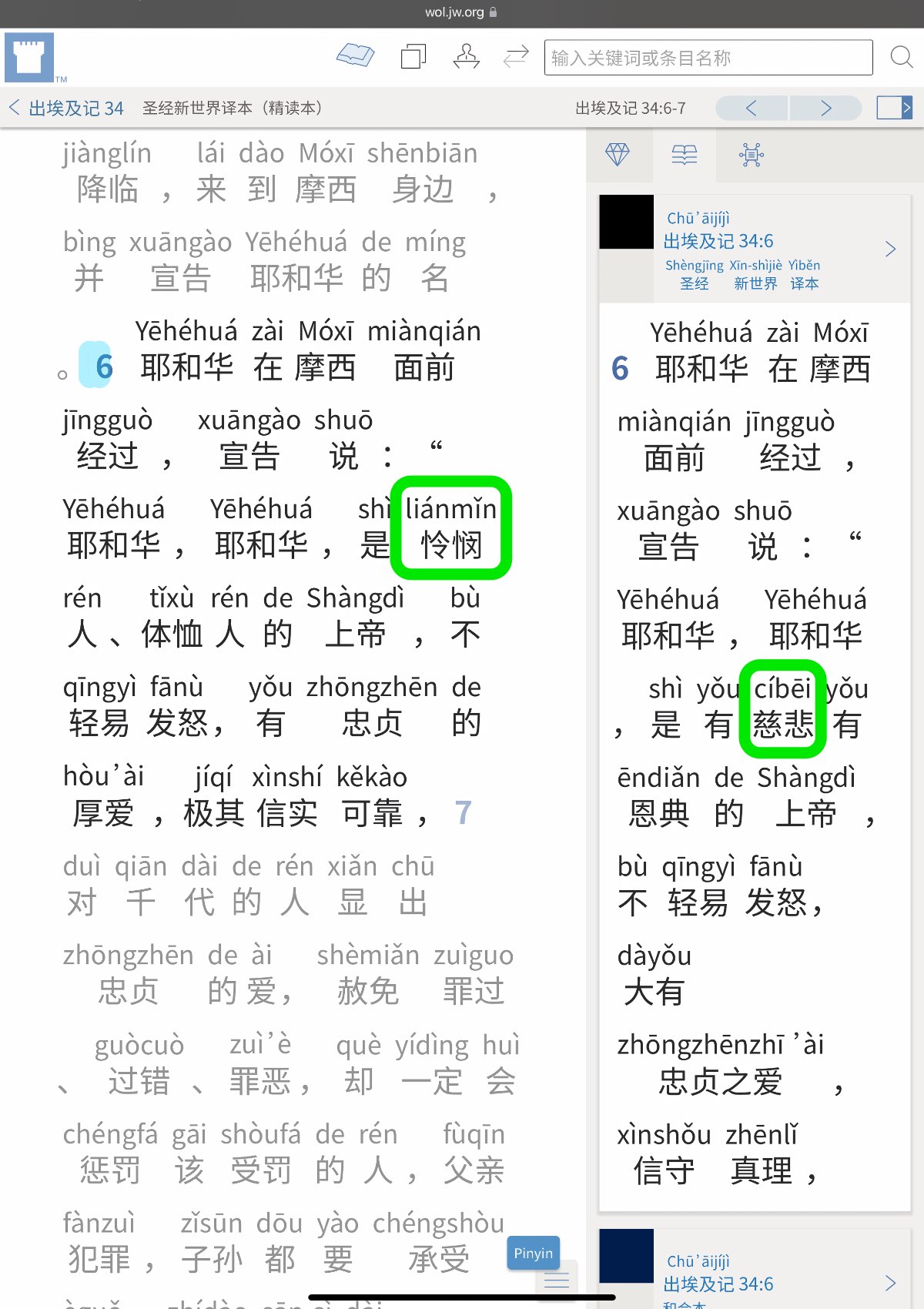
For example, in Romans 12:6, where previously the Mandarin NWT Bible used “yùyán (yù·yán {in advance} · sayings → [prophecies] 预言 預言)”, the current version uses “Shàngdì (Shàng·dì Above’s · {Emperor → [God]} → [God] 上帝) de (’s 的) xìnxī+ (xìn·xī {letters → [messages]} · news → [messages] 信息)”:

Romans 12:6 (WOL CHS+Pinyin Parallel Translations)

Another example can be found at 1 Corinthians 12:10, which now uses “shòu (receiving 受) Shàngdì (Shàng·dì Above’s · {Emperor → [God]} → [God] 上帝) qǐshì+ (qǐ·shì {opening → [enlightening]} · showing → [revealing] 启示 啟示) fāyán (fā·yán {issuing forth} · speech → [speaking] 发言 發言)” instead of “shuō ({to speak}說/説) yùyán (yù·yán {in advance} · sayings → [prophecies] 预言 預言)”:

1 Corinthians 12:10 (WOL CHS+Pinyin Parallel Translations)

(And yes, that is indeed the “qǐshì+ (qǐ·shì {opening → [enlightening]} · showing → [revealing] 启示 啟示)” that’s in “Qǐshìlù+ (Qǐ·shì·lù {Opening → [Enlightening]} · Showing · Record → [Revelation] 启示录 啟示錄)”.)

Of course, the Bible does indeed often speak of foretelling of the future, so in scriptures like Ezekiel 38:14, the current Mandarin NWT Bible continues to use “yùyán (yù·yán {in advance} · say[ing] → [prophecy | prophesy] 预言 預言)”.

Categories
Culture Current Events History

kǒuzhào

kǒuzhào+ (kǒu·zhào mouth · cover → [antiseptic/surgical/breathing/etc. mask (worn over nose and mouth)] 口罩) ← Tap/click to show/hide the “flashcard”

[Note: Tap/click on a Pīnyīn (Pīn·yīn {Piecing Together} · Sounds → [Pinyin] 拼音) expression to reveal its “flashcard”, tap/click on a “flashcard” or its Pīnyīn (Pīn·yīn {Piecing Together} · Sounds → [Pinyin] 拼音) expression to hide the “flashcard”.]

As of this writing, early in the year 2022, the subject of the COVID-19 pandemic has been, to say the least, on people’s minds now for a while. So, it would be good to be able to refer to things related to it in Mandarin when speaking to people in the Mandarin field, or when speaking to our brothers and sisters in the truth.

electron microscope image of SARS-CoV-2—also known as 2019-nCoV, the virus that causes COVID-19

An electron microscope image of SARS-CoV-2—also known as 2019-nCoV, the virus that causes COVID-19
Creative Commons Attribution License logo NIAID

This week’s MEotW, “kǒuzhào (kǒu·zhào mouth · cover → [antiseptic/surgical/breathing/etc. mask (worn over nose and mouth)] 口罩)”, refers specifically to the kind of mask one puts on to cover one’s nose and mouth, as opposed to other kinds of masks. It pretty much has to refer specifically to this kind of mask, since, as its Pīnyīn (Pīn·yīn {Piecing Together} · Sounds → [Pinyin] 拼音) Plus “flashcard” information shows us, “kǒuzhào+ (kǒu·zhào mouth · cover → [antiseptic/surgical/breathing/etc. mask (worn over nose and mouth)] 口罩)” literally means “mouth cover”.

To say “wear/put on” a “kǒuzhào (kǒu·zhào mouth · cover → [antiseptic/surgical/breathing/etc. mask (worn over nose and mouth)] 口罩)” in Mandarin, one would say “dài+ (wear; {put on} 戴) kǒuzhào (kǒu·zhào mouth · cover → [antiseptic/surgical/breathing/etc. mask (worn over nose and mouth)] 口罩)”.

Rhotic (R-Like) Coda

A variant form of “kǒuzhào (kǒu·zhào mouth · cover → [antiseptic/surgical/breathing/etc. mask (worn over nose and mouth)] 口罩)” is “kǒuzhàor (kǒu·zhào·r mouth · cover · {child | youth | son → [(diminutive) non-syllabic retroflex suffix; pronunciation feature in Beijing dialect]} → [antiseptic/surgical/breathing/etc. mask (worn over nose and mouth)] 口罩儿 口罩兒)”, with an “r+ ({child | youth | son} → [(diminutive) non-syllabic retroflex suffix; pronunciation feature in Beijing dialect])” at the end. This is an example of what in Mandarin is called “érhuà (ér·huà {(to have) ér} · transforming → [adding of “r” as a suffix (pronunciation feature in Beijing dialect); erization] 儿化 兒化)”. Wikipedia summarizes this thusly:

Erhua (simplified Chinese: 儿化; traditional Chinese: 兒化; pinyin: érhuà [ɚ˧˥xwä˥˩]); also called erization or rhotacization of syllable finals[source]) refers to a phonological process that adds r-coloring or the “er” (注音:ㄦ, common words: 耳、尔、儿[source]) sound (transcribed in IPA as [ɚ]) to syllables in spoken Mandarin Chinese. Erhuayin (simplified Chinese: 儿化音; traditional Chinese: 兒化音; pinyin: érhuàyīn) is the pronunciation of “er” after rhotacization of syllable finals.

It is most common in the speech varieties of North China, especially in the Beijing dialect, as a diminutive suffix for nouns, though some dialects also use it for other grammatical purposes. The Standard Chinese spoken in government-produced educational and examination recordings features erhua to some extent, as in 哪儿 nǎr (“where”), 一点儿 yìdiǎnr (“a little”), and 好玩儿 hǎowánr (“fun”). Colloquial speech in many northern dialects has more extensive erhua than the standardized language. Southwestern Mandarin dialects such as those of Chongqing and Chengdu also have erhua. By contrast, many Southern Chinese who speak non-Mandarin dialects may have difficulty pronouncing the sound or may simply prefer not to pronounce it, and usually avoid words with erhua when speaking Standard Chinese; for example, the three examples listed above may be replaced with the synonyms 哪里 nǎlǐ, 一点 yìdiǎn, 好玩 hǎowán. Furthermore, Erhua’s presence in Guoyu (國語) in Taiwan is diminishing and it is often not used at all.[source][source]

Also, the excellent Chinese Pronunciation Wiki has a page on “r ({child | youth | son} → [(diminutive) non-syllabic retroflex suffix; pronunciation feature in Beijing dialect])”, which points out that the Mandarin “r ({child | youth | son} → [(diminutive) non-syllabic retroflex suffix; pronunciation feature in Beijing dialect])” is different from the “r” in English. It additionally goes into technical detail about how to use your mouth and tongue to correctly make the Mandarin “r ({child | youth | son} → [(diminutive) non-syllabic retroflex suffix; pronunciation feature in Beijing dialect])” sound.

Western Worldy Politicization

It’s interesting to note how differently many people with an Eastern cultural background view the wearing of masks to help reduce the risk of catching or spreading COVID-19, compared to how some with a Western cultural background view it. One article that I found while researching this post, “Why East Asians Were Wearing Masks Long Before COVID-19”, summarized the situation this way:

Masking up is second nature to East Asian immigrants like Cho. But others haven’t taken so easily to the U.S. Centers for Disease Control and Prevention’s recommendation to wear a facial covering. The guidelines have incited a nationwide feud about public health and civil liberties. Some Americans refuse to wear masks, claiming its contrary to their personal freedom. The most strident in the anti-mask movement have called them “unconstitutional,” “autocratic” and “muzzles.”

Meanwhile, in East Asian countries, the majority of the public adapted quickly to mask-wearing (or were already wearing them to begin with) ― something experts believe has contributed to lower COVID-19 death rates.

The article also goes into the long history in Asia of using masks to combat the spread of disease, a history that stretches back past the 2002–2004 SARS outbreak to at least the Great Manchurian Plague of 1910–1911.

Interestingly, the article points out who is considered to be the inventor of the anti-epidemic mask:

The invention of the anti-epidemic mask was attributed to Dr. Wu Lien-teh, a Cambridge-educated Chinese physician who led anti-plague operations on behalf of China in the region [during the Great Manchurian Plague of 1910–1911].

Balance and Subjection to the Superior Authorities

Eastern culture can sometimes go too far in prioritizing the collective at the expense of the individual, and Western culture can sometimes go too far in prioritizing the individual at the expense of everyone else, such that in such cases Eastern and Western cultures end up just being different ways for humans to get things wrong. In contrast, as Jehovah God tells us in the Bible:

“For as the heavens are higher than the earth,
So my ways are higher than your ways
And my thoughts than your thoughts.
Isaiah 55:9.

Thankfully, as Jehovah’s people, we have balanced and wise direction from his Word and his organization that help us to rise above the ways and thoughts of imperfect humans living in Satan’s world. For example:

Jehovah’s Witnesses cooperate with public health officials. For example, since the COVID-19 pandemic broke out, Jehovah’s Witnesses have continued to publish reminders in hundreds of languages on this website, encouraging adherence to local safety guidelines. These include the importance of physical distancing and of following regulations on public gatherings, quarantining, hand washing, and the wearing of face coverings as well as other practical measures required or recommended by the authorities.—Romans 13:1, 2.
“Are Jehovah’s Witnesses Opposed to Vaccination?” (article on jw.org)