mìmì+ (mì·mì {[is] secret} · {[is] dense → [[is] intimate; close] → [[is] secret; confidential]} [(thing)] → [[is] secret; confidential; clandestine | secret [(thing)]] 秘密 秘/祕密) ← Tap/click to show/hide the “flashcard”
I have long especially liked 1 Corinthians 13. It contains counsel on what really does and doesn’t matter in life, an extensive description and definition of the most important kind of love, and a sublime discussion about the need to become complete, mature, as a person. As these apply to life in general, so too do they apply to our lives as Mandarin field language learners.
As Mandarin field language learners, it can benefit us greatly to consider what we can learn from 1 Corinthians 13, and along the way, we can also consider some of the Mandarin expressions used in that chapter in the current version of the Mandarin New World Translation Bible (nwtsty).
Secrets
This week’s MEotW, “mìmì (mì·mì {[is] secret} · {[is] dense → [[is] intimate; close] → [[is] secret; confidential]} [(thing)] → [[is] secret; confidential; clandestine | secret [(thing)]] 秘密 秘/祕密)”, is used in verse 2 (WOL, Pīnyīn (Pīn·yīn {Piecing Together of} · Sounds → [Pinyin] 拼音) Plus) of 1 Corinthians 13:
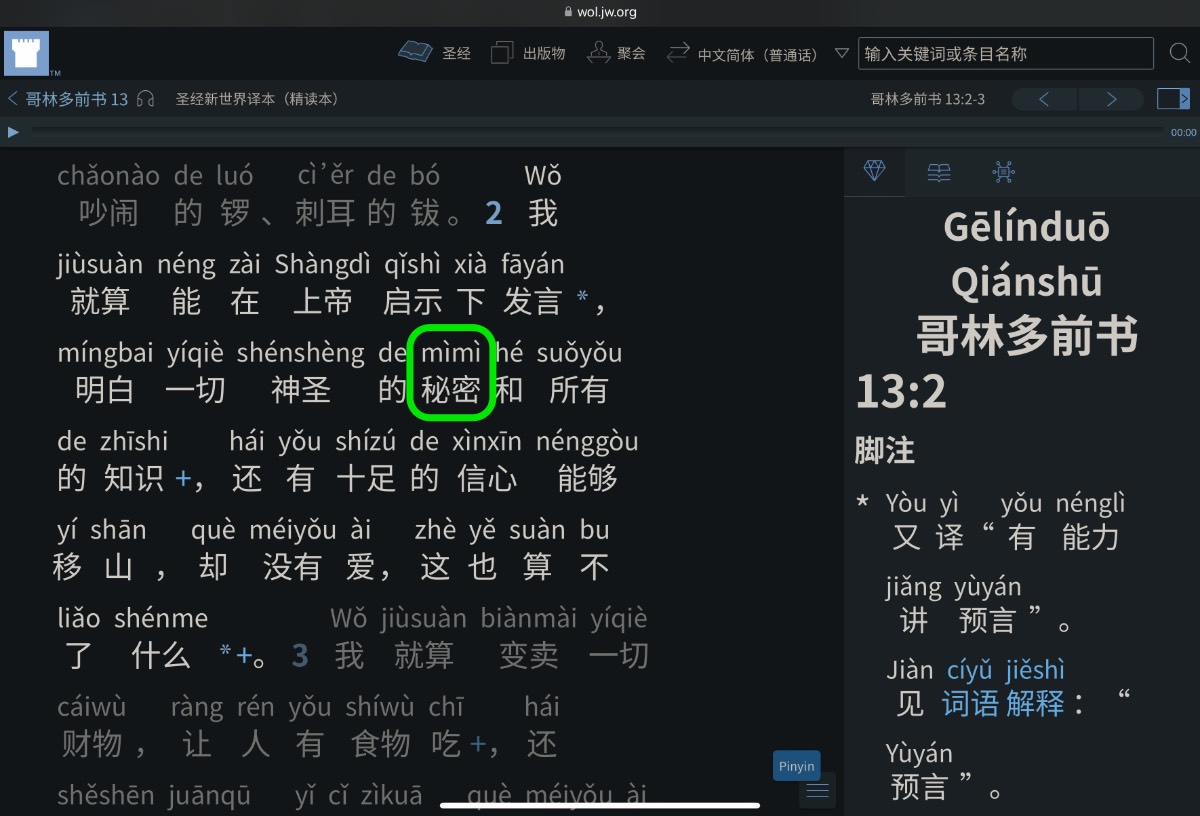
(Dark mode for the Watchtower ONLINE LIBRARY (WOL) website, as shown in the above image, can be enabled in the Safari web browser by using the Noir Safari extension.)
While the two morphemes in “mìmì (mì·mì {[is] secret} · {[is] dense → [[is] intimate; close] → [[is] secret; confidential]} [(thing)] → [[is] secret; confidential; clandestine | secret [(thing)]] 秘密 秘/祕密)” sound the same, they are different morphemes, with different meanings. The first one, “mì+ ({secret (n)} [→ [secretary (abbr.)]] | {[is] secret; mysterious; difficult to understand; obscure} [→ [[is] seldom seen; rare]] | {keep sth. secret; hold sth. back} [→ [block; obstruct]] 秘 秘/祕)”, here means “secret” (used as an adjective). Interestingly, this “mì ({secret (n)} [→ [secretary (abbr.)]] | {[is] secret; mysterious; difficult to understand; obscure} [→ [[is] seldom seen; rare]] | {keep sth. secret; hold sth. back} [→ [block; obstruct]] 秘 秘/祕)” also appears in “mìshū+ (mì·shū secret · documents (person) → [secretary] 秘书 秘書)”, which means “secretary”, and it can be used as an abbreviation for “secretary”. (Yes, in both English and Mandarin, the word for “secretary” is based on the word for “secret”. So, be nice to office secretaries, congregation secretaries, etc. everywhere, since they are literally keepers of secrets!)
The second morpheme in “mìmì (mì·mì {[is] secret} · {[is] dense → [[is] intimate; close] → [[is] secret; confidential]} [(thing)] → [[is] secret; confidential; clandestine | secret [(thing)]] 秘密 秘/祕密)”, “mì+ ({[is] dense; thick} [[→ [[is] intimate; close] [→ [[is] secret; confidential]]] | [→ [[is] fine; meticulous]]] 密)”, literally means “dense; thick”, and can effectively mean “intimate; close”. (Compare the English expression “thick as thieves”.) That meaning, in turn, can effectively mean “secret” (used as an adjective), which is how it is used in “mìmì (mì·mì {[is] secret} · {[is] dense → [[is] intimate; close] → [[is] secret; confidential]} [(thing)] → [[is] secret; confidential; clandestine | secret [(thing)]] 秘密 秘/祕密)”. Another expression in which it’s used that way is “mìmǎ+ (mì·mǎ {dense → [intimate] → [secret]} · {sth. indicating a number} → [cipher; code | password; PIN] 密码 密碼)”, which can mean “code”. For example, the Mandarin Was Life Created? brochure uses “yíchuán (yí·chuán {leaving behind} · {passing on} → [genetic] 遗传 遺傳) mìmǎ (mì·mǎ {dense → [intimate] → [secret]} · {sth. indicating a number} → [code] 密码 密碼)” to translate “genetic code”. (Compare: English WOL, CHS+Pīnyīn (Pīn·yīn {Piecing Together of} · Sounds → [Pinyin] 拼音) WOL, Pīnyīn (Pīn·yīn {Piecing Together of} · Sounds → [Pinyin] 拼音) Plus.)
Exotic East Syndrome
Speaking of secrets, some may be fascinated by the seemingly secret knowledge of the Chinese characters. However, 1 Corinthians 13:2 tells us that even understanding “all the sacred secrets and all knowledge” means nothing if one does not have love, and while Chinese characters may seem alluringly secret and mysterious to those looking on from outside the culture, they certainly are not sacred. Only things from God are sacred, and Chinese characters are the unnecessarily complex, haphazardly designed, highly imperfect products of mere imperfect humans.
And if I have the gift of prophecy and understand all the sacred secrets and all knowledge, and if I have all the faith so as to move mountains, but do not have love, I am nothing.
—1 Corinthians 13:2.
Regarding this tendency of some to exoticize Chinese characters and other aspects of Chinese culture, the MEotW post on “jī‐tóng‐yā‐jiǎng ((jī chicken 鸡 雞/鷄)‐(tóng {together with} 同 同/仝)‐(yā duck 鸭 鴨)‐(jiǎng speaking 讲 講) → [people not understanding each other because of speaking different languages (from Cantonese)])” pointed out:
Western-educated publishers learning a Chinese language may unwittingly go along with the Western worldly tendency to exoticize things related to China. (John DeFrancis, in his book The Chinese Language: Fact and Fantasy (p. 37), calls this “Exotic East Syndrome”.) They may be content with—or even enjoy—the alluring veil of mystery and mystique surrounding certain things related to China and Chinese culture. Thus, they don’t seek to learn about and understand deeper truths about such things, that may pierce through this obscuring veil, and burst this bubble.—Compare 2 Corinthians 3:14, including the margin note.
Secrets and Identities
It is of course possible for one to have a balanced approach to Chinese characters, in which love moves one to seek to acquire whatever knowledge of characters is needed to serve effectively in the Chinese field that one is in. Many take the approach of using a system like Pīnyīn (Pīn·yīn {Piecing Together of} · Sounds → [Pinyin] 拼音) when they can, and learning to use characters when they have to. However, regarding how personally and emotionally important to them their knowledge of the secrets of Chinese characters has become to some people, the article “Pīnyīn (Pīn·yīn {Piecing Together of} · Sounds → [Pinyin] 拼音) Was Plan A” said:
In addition to those who feel that phasing out the Hànzì would be a regrettable cultural loss, I have also noticed that there are some for whom knowledge of Hànzì is a matter of pride and self-identity. They are proud of knowing the Hànzì as they do, and they view their knowledge of the Hànzì as part of what makes them who they are, as something that distinguishes them from those who don’t know the Hànzì. Such ones may defend the Hànzì to the point of irrationality in the face of a more accessible alternative that would make them and their hard-earned knowledge of Hànzì less “special”, that would threaten to render worthless all of the blood, sweat, and tears they have invested into grappling with these “Chinese puzzles”. It’s as if they are saying, “That’s not fair! If I had to go through all this bitter hard work to learn characters before I could read and write Chinese, then everyone else has to too!”
…
…during the 2014 Stanford Commencement address, Bill Gates said:
If we have optimism, but we don’t have empathy, then it doesn’t matter how much we master the secrets of science, we’re not really solving problems—we’re just working on puzzles.
Mr. Gates’ above observation applies to the subject at hand in that while many enjoy trying to solve the puzzles presented by Chinese characters, and while many also enjoy being known for being good at solving these puzzles, empathy should move us to recognize that there are much bigger issues involved than just our personal enjoyment or glorification.
Yes, when even some worldly people can recognize the above points, we Christians should recognize even more the need to show love and empathy rather than being proud, self-glorifying, self-justifying, and self-serving. Also, we should be actively and determinedly following the course of true Christian love and empathy rather than just going along with others who are proud, self-glorifying, self-justifying, and self-serving. We should especially do so when we have scriptures such as this to guide us:
Knowledge puffs up, but love builds up.—1 Corinthians 8:1.
Love and AI
As touched on in the MEotW post on “réngōng+ (rén·gōng human · work → [artificial] 人工) zhìnéng+ (zhì·néng intelligence · ability → [intelligence] 智能)”, lately there has been much discussion in the media about the recent developments in AI (artificial intelligence). AI systems can now be given access to lots and lots of human knowledge, but I don’t think anyone can reasonably claim that modern AI systems have been taught to have love the way the Bible says we need to have love. And so, many continue to worry about AIs falling out of alignment with humans and maybe even harming humans, maybe even to the point of extinction. Yes, as God’s Word pointed out long ago in 1 Corinthians 13:2, if one has much knowledge, even of secrets, but does not have love (Greek: a·gaʹpe), it is ultimately of no benefit. Indeed, without love to guide its use, that knowledge could actually be used to bring great harm!