bùzú+
(bù·zú
sectional · {ethnic group} →[tribe]
部族) ← Tap/click to show/hide the “flashcard”
Appendix A2 of the English New World Translation of the Holy Scriptures (Study Edition), entitled “Features of This Revision”, discusses vocabulary changes that have been made in the current revision, words that have been translated differently than before. As noted in various entries in the excellent resource Referenced Theo. Expressions (RTE), Appendix A2 of the current Mandarin version of the New World Translation Bible (nwtsty) correspondingly discusses words that have been translated differently in the current revision of the Mandarin NWT Bible, compared to how they had been translated before.
Since we base what we say in Jehovah’s service on his Word the Bible, the vocabulary used in it—and the way those vocabulary words are translated—should be reflected in how we speak in our ministry, at our meetings, etc. So, it is beneficial for us Mandarin field language learners to be familiar with the latest thinking from the organization on how Bible terms should be translated into Mandarin.
Adding Context
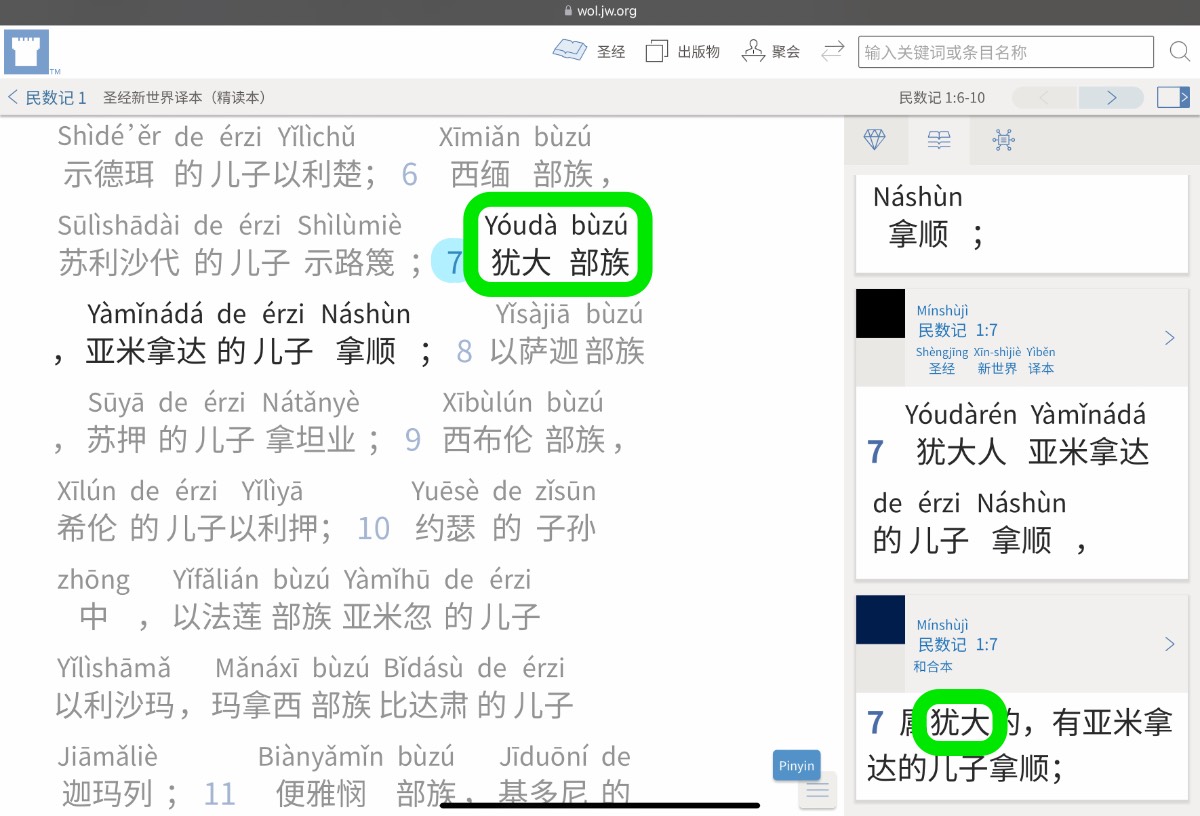
In past Mandarin Bible translations, a name like “Yóudà
(Judah
犹大
猶大)” might be used to refer to a man, a tribe, a nation, etc., and this could cause readers to be confused. So, the current Mandarin version of the New World Translation Bible (nwtsty) translates such names more clearly, for example using “Yóudà
(Judah
犹大
猶大)bùzú+
(bù·zú
sectional · {ethnic group} →[tribe]
部族)” to mean “the tribe of Judah”, using “Yóudà
(Judah
犹大
猶大)guó
(nation
国
國)” to mean “the nation of Judah”, using “Yóudà
(Judah
犹大
猶大)dìqū
(dì·qū
land · region
地区
地區)” to mean “the land of Judah”, etc.—Mínshùjì
(Mín·shù·jì
{The People} · Numbers · Record →[Numbers]
民数记
民數記)1:7; Lièwángjì Shàng
((Liè·wáng·jì
{Series of} · Kings · Record
列王纪
列王紀)
(Shàng
Upper
上)
→[1 Kings])13:1; Níxīmǐjì
(Níxīmǐ·jì
Nehemiah · Record
尼希米记
尼希米記)11:3.
By the way, the “bù
(part; section [→ [unit; ministry; department; board]] | [mw for large books, films, machines, vehicles, etc.]
部)” in “bùzú
(bù·zú
sectional · {ethnic group} →[tribe]
部族)” (this week’s MEotW) is also the one that appears in the well-known expression “bùfen
(bù·fen
part; section · component; share; part; portion
部分)”.
Solving “The Homophone Problem”
A section of the article “Pīnyīn
(Pīn·yīn
{Piecing Together} · Sounds →[Pinyin]
拼音)Was Plan A” addresses the common contention that Pīnyīn
(Pīn·yīn
{Piecing Together} · Sounds →[Pinyin]
拼音) is not suitable as a writing system for Mandarin because of the high number of homophones in Mandarin:
Some may object, saying that there are so many homophones in Chinese that the characters are needed to tell them apart from each other. (A homophone is a word that has the same pronunciation as another word, but that has a different meaning from it.) However, consider: When people are just speaking Mandarin, with no characters in sight to help them, do they have problems understanding each other because of all the homophones? Can blind Mandarin-speakers, who cannot see characters, still “see” what people mean when those people speak Mandarin? Native Mandarin-speakers have confirmed to me that no, homophones are not a significant problem in spoken Mandarin—people can use the context and understand each other okay. So, people can use the context and understand each other okay when using Pīnyīn too, since Pīnyīn directly represents the sound of spoken Mandarin.
…
…other ways [besides resorting to characters] to alleviate the problem. Those other ways could include:
Including as much clarifying context in the written language as is necessary, as is done in the spoken language
Reducing the number of homophones by
Adding syllables to existing homophones
The above-described practice used in the current Mandarin NWT, of adding expressions like “bùzú
(bù·zú
sectional · {ethnic group} →[tribe]
部族)” to expressions like “Yóudà
(Judah
犹大
猶大)”, is an example of adding context, and also an example of reducing the number of expressions that sound the same by adding syllables to existing expressions that sound the same, to clarify what means what without resorting to the homophone-enabling crutch that is the characters. In fact, in this case, disambiguation by using different characters is not an option anyway because “Yóudà
(Judah
犹大
猶大)” must be written with the same characters whether it means “the man named Judah”, “the tribe of Judah”, “the nation of Judah”, etc. Theoretically, one might contemplate the possibility of using different characters to represent “Judah” depending on whether it refers to “the man named Judah”, “the tribe of Judah”, “the nation of Judah”, etc., but that way lies even madder madness than the madness that already is the Chinese characters!
tíbǐ+
(tí·bǐ
{carry (hanging down from the hand) → [raise; lift]} · pen; pencil; {writing brush} [→ [start writing; write]]
提笔
提筆)‐wàng+
(forget
忘)‐zì+
(character
字) ← Tap/click to show/hide the “flashcard”
This week’s MEotW, “tíbǐ
(tí·bǐ
{carry (hanging down from the hand) → [raise; lift]} · pen; pencil; {writing brush} [→ [start writing; write]]
提笔
提筆)‐wàng
(forget
忘)‐zì
(character
字)”, is generally translated as “character amnesia”. Its literal meaning well describes what it’s like to experience it—you pick up your pen, pencil, brush, etc. to write a certain Chinese character and you…just…can’t…remember how to write it. This can happen with complex, rarely used characters, but it can also happen with fairly commonly used characters, and even with characters you’re sure you once knew well.
It occurs to me that while “tíbǐ
(tí·bǐ
{carry (hanging down from the hand) → [raise; lift]} · pen; pencil; {writing brush} [→ [start writing; write]]
提笔
提筆)‐wàng
(forget
忘)‐zì
(character
字)” literally refers to forgetting a character while trying to write it by hand, and while “character amnesia” is similarly defined as forgetting how to write certain characters, people also often forget characters—and thus fail to recognize them—when they are just reading. There doesn’t seem to be a corresponding common Mandarin expression for this, though, probably because it is generally harder to write than it is to read, and so forgetting a character while engaged in the harder task of writing is generally a more significant emotional event compared to forgetting a character when reading.
It Happens to Chinese People Too
It’s also worth noting that “tíbǐ
(tí·bǐ
{carry (hanging down from the hand) → [raise; lift]} · pen; pencil; {writing brush} [→ [start writing; write]]
提笔
提筆)‐wàng
(forget
忘)‐zì
(character
字)” is an expression that Chinese people do apply to themselves—it doesn’t just describe a problem that only other people experience while learning a language typically written with Chinese characters. Chinese people are also only human, so it is ultimately practically impossible for them too to learn and continue to remember how to write (or even “just” read) all the over 100,000 existing Chinese characters as well as the theoretically unlimited number of Chinese characters that could be invented in the future, even if they have spent, and are continuing to spend, their entire lives trying to do so.
While the government of China considers someone who can recognize “just” 2,000 characters to be literate, the truth is that even those who are considered literate by this standard can surprisingly often be unable to read or write relatively common characters that they once knew, never mind obscure characters that they never learned.
One example of even relatively highly literate native Mandarin speakers having trouble remembering how to write a not terribly uncommon character is related in David Moser’s well-known essay “Why Chinese Is So…Hard”, which has a section devoted to character amnesia:
this phonetic aspect of the language doesn’t really become very useful until you’ve learned a few hundred characters, and even when you’ve learned two thousand, the feeble phoneticity of Chinese will never provide you with the constant memory prod that the phonetic quality of English does.
Which means that often you just completely forget how to write a character. Period. If there is no obvious semantic clue in the radical, and no helpful phonetic component somewhere in the character, you’re just sunk. And you’re sunk whether your native language is Chinese or not; contrary to popular myth, Chinese people are not born with the ability to memorize arbitrary squiggles. In fact, one of the most gratifying experiences a foreign student of Chinese can have is to see a native speaker come up a complete blank when called upon to write the characters for some relatively common word. You feel an enormous sense of vindication and relief to see a native speaker experience the exact same difficulty you experience every day.
This is such a gratifying experience, in fact, that I have actually kept a list of characters that I have observed Chinese people forget how to write. (A sick, obsessive activity, I know.) I have seen highly literate Chinese people forget how to write certain characters in common words like “tin can”, “knee”, “screwdriver”, “snap” (as in “to snap one’s fingers”), “elbow”, “ginger”, “cushion”, “firecracker”, and so on. And when I say “forget”, I mean that they often cannot even put the first stroke down on the paper. Can you imagine a well-educated native English speaker totally forgetting how to write a word like “knee” or “tin can”? Or even a rarely-seen word like “scabbard” or “ragamuffin”? I was once at a luncheon with three Ph.D. students in the Chinese Department at Peking University, all native Chinese (one from Hong Kong). I happened to have a cold that day, and was trying to write a brief note to a friend canceling an appointment that day. I found that I couldn’t remember how to write the character 嚔, as in da penti 打喷嚔 “to sneeze”. I asked my three friends how to write the character, and to my surprise, all three of them simply shrugged in sheepish embarrassment. Not one of them could correctly produce the character. Now, Peking University is usually considered the “Harvard of China”. Can you imagine three Ph.D. students in English at Harvard forgetting how to write the English word “sneeze”?? Yet this state of affairs is by no means uncommon in China.
Truly, the phenomenon of tíbǐ
(tí·bǐ
{carry (hanging down from the hand) → [raise; lift]} · pen; pencil; {writing brush} [→ [start writing; write]]
提笔
提筆)‐wàng
(forget
忘)‐zì
(character
字) is nothing to sneeze at! (Sorry, I couldn’t help it 😜.)
Carrying on, this YouTube video from Asian Boss shows how some people on the streets of Shanghai fared when asked to write some Chinese characters. (One of the interviewees uses “tíbǐ
(tí·bǐ
{carry (hanging down from the hand) → [raise; lift]} · pen; pencil; {writing brush} [→ [start writing; write]]
提笔
提筆)‐wàng
(forget
忘)‐zì
(character
字)” at around 7:10.)
A few nights ago, my Mandarin congregation had a Memorial meeting that went well overall. However, there was a momentary hiccup that I think we Chinese field publishers can learn from.
The speaker who gave the talk is a fluent, eloquent native Mandarin speaker originally from mainland China, and he is one of the best Mandarin speakers in a city of several Mandarin congregations. In fact, he was one of the instructors in the very first official Mandarin class ever held in this country. However, while reading a scripture from his paper Bible as he was giving the Memorial talk, he, of all people, just…got…stuck…on…a…Chinese…character…. He struggled with it for what felt like quite a while, and eventually, a young brother who was serving as an attendant at the side of the stage approached and gave him a hint, and he was able to carry on.
For Real, It’s Not You
Yes, from considering both the basic design of the Chinese characters writing system as well as real-life experiences like the ones related above, it is evident that the objective truth is that the Chinese characters writing system is by its very nature fundamentally unfit for human use. So, the blame for the all-too-real phenomenon of even relatively highly literate people surprisingly often forgetting characters while reading or writing should be squarely placed on the Chinese characters writing system, not on the imperfect humans whom it should serve, but for whom it so often causes huge problems instead.
It is thus unfortunate, not admirable, that many still cling to the problematic Chinese characters writing system because of tradition, pride, cultural inertia, apathy, inability to walk away from sunk costs, etc. Such ones simply accept tíbǐ
(tí·bǐ
{carry (hanging down from the hand) → [raise; lift]} · pen; pencil; {writing brush} [→ [start writing; write]]
提笔
提筆)‐wàng
(forget
忘)‐zì
(character
字) as “normal” rather than recognize it as the institutionalized inhuman madness that it is, while dismissing as madness and heresy any suggestion of using a human-appropriate alphabetic writing system like Pīnyīn
(Pīn·yīn
{Piecing Together of} · Sounds →[Pinyin]
拼音) to read and write Mandarin.
New Technology Is Not the Problem
Of course, these days, many people hardly ever write characters by hand anymore. Indeed, many would say that’s the problem! Instead of staying in practice with their handwriting, now, to write something in Mandarin using characters, people generally type Pīnyīn
(Pīn·yīn
{Piecing Together of} · Sounds →[Pinyin]
拼音) with a keyboard and then select the characters they want from the ones their computer or mobile device presents to them in response to their typing. (In such settings, Pīnyīn
(Pīn·yīn
{Piecing Together of} · Sounds →[Pinyin]
拼音) is like the assistant who does the real work while the big boss, the characters writing system, gets all the credit and recognition, even if many individual characters don’t get recognized when they need to be!)
However, is it really fair to blame the fine new technology for people getting out of practice with the old ways? Consider that if we were to continue with this line of thinking, we could then say that pen/pencil/brush/etc. and paper should in turn be villified for making people forget how to engrave stone tablets! Really, though, people in general got so used to enjoying the advantages of writing on paper compared to having to carve into stone tablets that they didn’t consider it much of a loss that eventually few were able to do the latter. Similarly, few people now lament that with the ubiquity of cars, not many people are now able to ride horses—most people are too busy enjoying their cars to worry about that.
Indeed, rather than blaming keyboards and computing devices for the phenomenon of tíbǐ
(tí·bǐ
{carry (hanging down from the hand) → [raise; lift]} · pen; pencil; {writing brush} [→ [start writing; write]]
提笔
提筆)‐wàng
(forget
忘)‐zì
(character
字), some feel that keyboards and computing devices have helped to alleviate the problem. This is because even if they tíbǐ
(tí·bǐ
{carry (hanging down from the hand) → [raise; lift]} · pen; pencil; {writing brush} [→ [start writing; write]]
提笔
提筆)‐wàng
(forget
忘)‐zì
(characters
字) when they are trying to type Chinese characters, they feel they can hope in and rely on the visual designs of the characters they want to help them “know them when they see them” when they pop up in response to the Pīnyīn
(Pīn·yīn
{Piecing Together of} · Sounds →[Pinyin]
拼音) that they type, making handwriting of characters unnecessary in most situations.
The Actual Problem, the Actual Solution
The thing is, the actual fundamental problem that leads to tíbǐ
(tí·bǐ
{carry (hanging down from the hand) → [raise; lift]} · pen; pencil; {writing brush} [→ [start writing; write]]
提笔
提筆)‐wàng
(forget
忘)‐zì
(character
字) is that while “know it when you see it” may be how the visually oriented characters must work (when they work), that’s not the primary way that human language works. With human language overall, speech is actually primary, not writing, so it’s really more important in the grand scheme of things for us—including and especially in our preaching and teaching work—to be able to “know it when we hear it”.
While using the unnecessarily complex and inhumanly numerous visually oriented Chinese characters for this is like trying to put a spiky, sharp-edged object in a round hole, the simple and elegant phonetically oriented Pīnyīn
(Pīn·yīn
{Piecing Together of} · Sounds →[Pinyin]
拼音) writing system is a great fit for “know it when you hear it”. If you know how an expression should sound and you know the easy-to-learn-and-remember Pīnyīn
(Pīn·yīn
{Piecing Together of} · Sounds →[Pinyin]
拼音) writing system, you’re all set—no danger of tíbǐ
(tí·bǐ
{carry (hanging down from the hand) → [raise; lift]} · pen; pencil; {writing brush} [→ [start writing; write]]
提笔
提筆)‐wàng
(forget
忘)‐zì
(character
字)!
Of course, you may still encounter occasional situations in which Pīnyīn
(Pīn·yīn
{Piecing Together of} · Sounds →[Pinyin]
拼音) is not an option, and you can’t avoid reading or writing characters. In such situations, all you can do is just do your best. When you can use Pīnyīn
(Pīn·yīn
{Piecing Together of} · Sounds →[Pinyin]
拼音), though, don’t let pride, prejudice, etc. prevent you from making good use of it to completely sidestep the very real problem of tíbǐ
(tí·bǐ
{carry (hanging down from the hand) → [raise; lift]} · pen; pencil; {writing brush} [→ [start writing; write]]
提笔
提筆)‐wàng
(forget
忘)‐zì
(character
字)!
bǎilàn+
(bǎi·làn
{place; arrange → [assume; put on (air of) | exhibit; display]} · {being rotten; decayed; spoiled | worn out; broken; ragged; crappy | mushy}
摆烂
擺爛) ← Tap/click to show/hide the “flashcard”
In 2022, this week’s MEotW, “bǎilàn
(bǎi·làn
{place; arrange → [assume; put on (air of) | exhibit; display]} · {being rotten; decayed; spoiled | worn out; broken; ragged; crappy | mushy}
摆烂
擺爛)”, gained popularity among some young people in China as an expression that represents their approach to life in view of the difficult, even seemingly hopeless work culture, societal expectations, etc. that they are faced with. “Bǎilàn
(Bǎi·làn
{place; arrange → [assume; put on (air of) | exhibit; display]} · {being rotten; decayed; spoiled | worn out; broken; ragged; crappy | mushy}
摆烂
擺爛)” represents a progression beyond “tǎngpíng
(tǎng·píng
lie; recline · {[to be] flat}
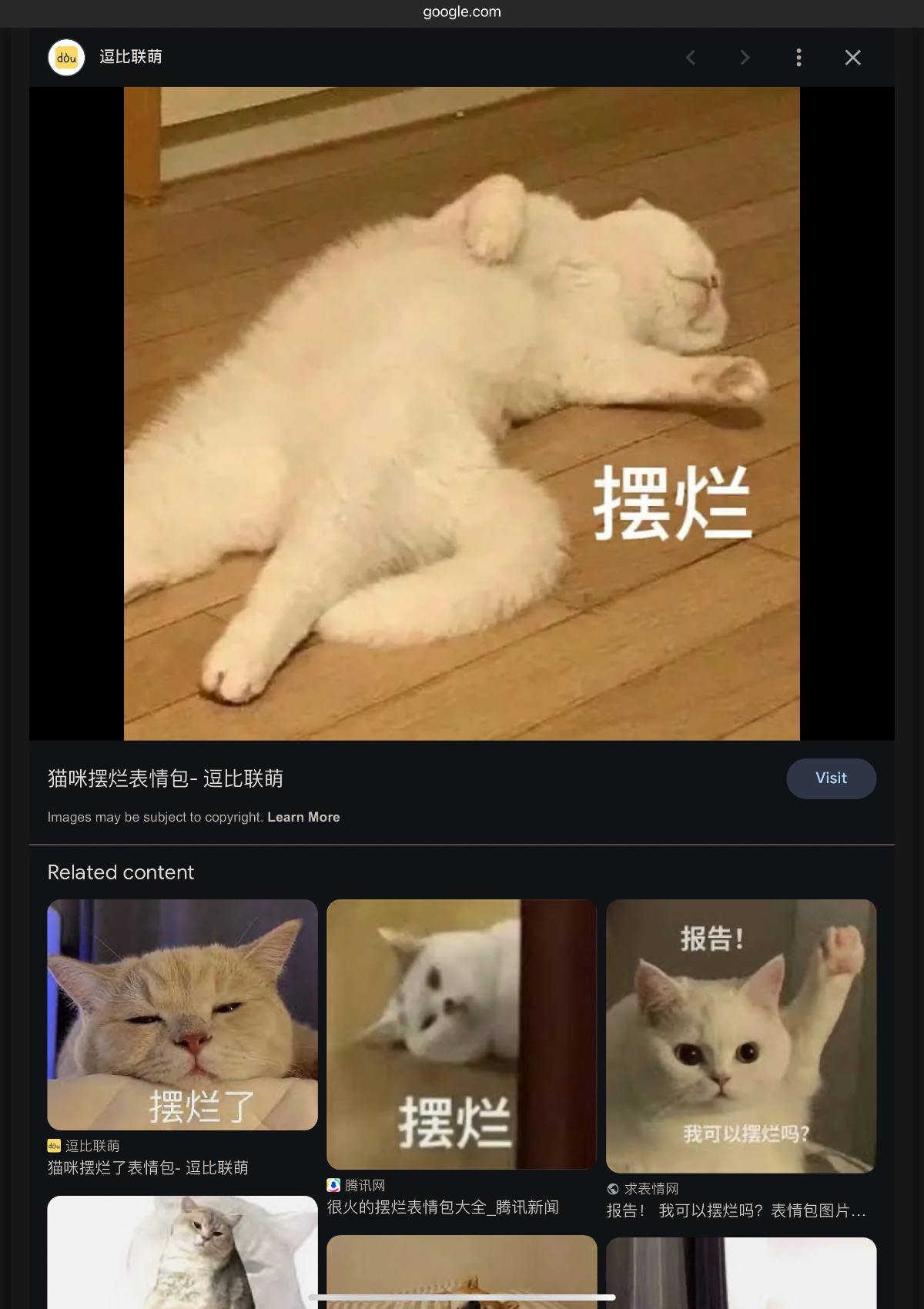
躺平)”, a past MEotW—just compare the cats!
Some image results from searching for “摆烂” (“bǎilàn
(bǎi·làn
{place; arrange → [assume; put on (air of) | exhibit; display]} · {being rotten; decayed; spoiled | worn out; broken; ragged; crappy | mushy}
摆烂
擺爛)”) on Google
Reports from Around the Internet
Here are some of the many media reports about this expression:
In recent days, this phrase – and more previously ‘tang ping’ (lying flat, 躺平), which means rejecting gruelling competition for a low desire life – gained popularity as severe competition and high social expectations prompted many young Chinese to give up on hard work.
But bai lan has a more worrying layer in the way it is being used by young people in China: to actively embrace a deteriorating situation, rather than trying to turn it around.
…
Prof Mary Gallagher, director of the Centre for Chinese Studies at the University of Michigan, says ‘bai lan’ is not necessarily a sentiment unique to China. “It is a bit like the ‘slacker’ generation in America in the 1990s. And like ‘tang ping’ last year, it is also a rejection against the ultra-competitiveness of today’s Chinese society.”
…
More than 18% of young Chinese people aged between 16 and 24 were jobless in April – the highest since the official record began. “Hard to find a job after graduation this year? Fine, I’ll just bai lan – stay at home and watch TV all day,” wrote one netizen who struggled to find work, despite China’s top leader urged young people to fight for the future.
One by one, Chinese youths began to opt out of a system where additional effort no longer tracked additional rewards. In fact, the system was so overheated, rewards often decreased with added effort.
“When guys got together in the past, all they talked about were girls. Now, all they do is talk about how great it is to be single. Is this societal progression or regression?”
It’s been popular locally in Taiwan for quite a bit longer and across the Chinese basketball internet “擺爛” has been the unofficial translation for “tanking” – which is when a bad team stinks on purpose
For a really deep dive into “bǎilàn
(bǎi·làn
{place; arrange → [assume; put on (air of) | exhibit; display]} · {being rotten; decayed; spoiled | worn out; broken; ragged; crappy | mushy}
摆烂
擺爛)”, check out this extended video news report from CNA, an English language news network based in Singapore:
“Letting It Rot” in the Mandarin Field?
Perhaps we can apply “bǎilàn
(bǎi·làn
{place; arrange → [assume; put on (air of) | exhibit; display]} · {being rotten; decayed; spoiled | worn out; broken; ragged; crappy | mushy}
摆烂
擺爛)” to how some may be resigned to being “crappy”, or at best mediocre, at the language-related aspects of being in the Mandarin field.
Some Mandarin field language learners have noticed that after an initial period of progress, they—and perhaps some/many of their fellow workers—may have plateaued, or leveled out in how good they are with the Mandarin language. Instead of moving on to a reasonable level of fluency or mastery, they may have gotten stuck for a long time at a “crappy” or at best mediocre level.
They may be resigned to this situation, or they may even actively embrace it, perhaps reasoning that the Great Wall of Characters is what it is, or that Mandarin just sounds too different from what they’re used to (e.g., with its tones), or that they personally just don’t have the intelligence or the talent to do any better. They may thus quit trying to do any better, or they may even quit the Mandarin field altogether. Such ones have effectively chosen to “bǎilàn+
(bǎi·làn
{arrange → [exhibit]} · {being crappy}
摆烂
擺爛)” with regard to their Mandarin and their service in the Mandarin field.
Can we do better than to “bǎilàn
(bǎi·làn
{arrange → [exhibit]} · {being crappy}
摆烂
擺爛)” when faced with the Great Wall of Characters?
Note, though, that changing to focus on first principles of language rather than sticking to played out traditional learning methods can provide fuel and energy for progress beyond being “crappy” or just mediocre at using the Mandarin language in your service to Jehovah God and your Mandarin-speaking neighbours. For example, while traditional Chinese culture dictates that Mandarin learners must focus on learning the extraordinarily and unnecessarily complex Chinese characters, first principles of language–as illuminated by linguistics, the scientific study of language—hold that SPEECH is actually the primary aspect of any human language, not writing, even if that writing is as traditionally and culturally entrenched as Chinese characters are. Indeed, I can personally testify that I have found that changing focus from the traditionally mandated crazy-complex characters to Mandarin SPEECH, with the help of the simple and elegant Pīnyīn
(Pīn·yīn
{Piecing Together} · Sounds →[Pinyin]
拼音)writing system, is working to help me make noticeable ongoing progress in how much Mandarin I understand, and in how much I speak and sound like a native speaker of Mandarin.
Of course, such progress is personally satisfying, but as Jehovah’s dedicated servants and fellow workers, we should be even more concerned about how Jehovah views our efforts. Here are a couple of scriptures that may help us to understand Jehovah’s view of unnecessarily “crappy” or mediocre ‘sacrifices of praise’ (Hebrews 13:15) that some may offer in the Mandarin field:
6 “‘A son honors a father, and a servant his master. So if I am a father, where is the honor due me? And if I am a master, where is the fear due me?’ Jehovah of armies says to you priests who are despising my name.
“‘But you say: “How have we despised your name?”’
7 “‘By presenting polluted food on my altar.’
“‘And you say: “How have we polluted you?”’
“‘By saying: “The table of Jehovah is something to be despised.” 8 And when you present a blind animal as a sacrifice, you say: “It is nothing bad.” And when you present a lame animal or a sick one: “It is nothing bad.”’”
“Try presenting them, please, to your governor. Will he be pleased with you or receive you with favor?” says Jehovah of armies.
9 “And now, please, appeal to God, that he may show us favor. With such offerings from your own hand, will he receive any of you with favor?” says Jehovah of armies.
15 ‘I know your deeds, that you are neither cold nor hot. I wish you were cold or else hot. 16 So because you are lukewarm and neither hot nor cold, I am going to vomit you out of my mouth. 17 Because you say, “I am rich and have acquired riches and do not need anything at all,” but you do not know that you are miserable and pitiful and poor and blind and naked, 18 I advise you to buy from me gold refined by fire so that you may become rich, and white garments so that you may become dressed and that the shame of your nakedness may not be exposed, and eyesalve to rub in your eyes so that you may see.
We should also remember that moving beyond “crappiness” or mediocrity in our Mandarin can help us to be more able to give spiritual help to the people in the Mandarin field who looking for something beyond the crappiness and mediocrity of this old system of things, something beyond the selfish, materialistic, and ultimately meaningless rat race promoted by Satan’s world. These people need the good news of God’s Kingdom, and they need people like us to share it with them in a language that they will understand and respond to from the heart.—Mark 6:34.