Categories
Culture Current Events History Language Learning Names Science Technology

Hāmǐjíduōdùn

Hāmǐjíduōdùn+ (Armageddon 哈米吉多顿 哈米吉多頓) 👈🏼 Tap/click to show/hide the “flashcard”

[Notes: Tap/click on a Pīnyīn (Pīn·yīn {Piecing Together of} · Sounds → [Pinyin] 拼音) expression to reveal its “flashcard”; tap/click on a “flashcard” or its Pīnyīn (Pīn·yīn {Piecing Together of} · Sounds → [Pinyin] 拼音) expression to hide the “flashcard”. 📖 📄 ➕ icons mean 📖 Reveal All, 📄 Reveal Advanced, and ➕ Reveal + Symbols re all the “flashcards” in the heading, paragraph, etc. that they are placed at the beginning of.]

[As part of a series of posts about some common myths about Chinese characters, this reposting of the post on “Hāmǐjíduōdùn (Armageddon 哈米吉多顿 哈米吉多頓) discusses the Ideographic Myth.]

[The first time this post was posted], jw.org was featuring an article with the following title:

English:

Will Armageddon Begin in Israel?—What Does the Bible Say?

Mandarin:

📖 📄 📘 Hāmǐjíduōdùn (Armageddon 哈米吉多顿 哈米吉多頓) Dàzhàn (Dà·zhàn {Big → [Great]} · War 大战 大戰) Huì (Will) zài (in 在) Yǐsèliè (Israel 以色列) Bàofā+ (Bào·fā Explode · {Issue Forth} → [Erupt] 爆发 爆發) ma ([? ptcl for “yes/no” questions])? Shèngjīng (Shèng·jīng (the) Holy · Scriptures → [the Bible] 圣经 聖經) de (’s 的) Guāndiǎn (Guān·diǎn {Looking At → [View]} · Point → [Viewpoint] 观点 觀點) Shì (Is 是) Shénme (Shén·me What · [suf] 什么 什/甚麼)?

This week’s MEotW is “Hāmǐjíduōdùn (Armageddon 哈米吉多顿 哈米吉多頓)”, the Mandarin syllables of which were obviously chosen first because of how much they sound like the English word “Armageddon” (and perhaps the original Hebrew word from which that came), not because of the meanings of the supposedly ideographic Chinese characters used to write them out (“Exhale Rice Lucky Much Pausing”??? 🤷🏻).

This emphasizes to us that when it comes to human language, SPEECH is primary—SOUNDS are the primary medium for transmitting meaning, and a writing system that transmits meaning purely with its visual symbols, without any dependency on speech sounds, is not a thing. However, this erroneous concept is so prevalent that there’s a name for it: The Ideographic Myth.

Several past MEotW posts have mentioned in passing the Ideographic Myth concerning Chinese characters, so it’s about time this blog took a deeper dive into this subject. Below are some selected excerpts from the chapter “The Ideographic Myth”, of the book The Chinese Language: Fact and Fantasy, by John DeFrancis, along with some commentary.


the concept of written symbols conveying their message directly to our minds, thus bypassing the restrictive intermediary of speech

This is a definition of the concept of “ideographic” writing.

Aren’t Chinese characters a sophisticated system of symbols that similarly convey meaning without regard to sound? Aren’t they an ideographic system of writing?

The answer to these questions is no. Chinese characters are a phonetic, not an ideographic, system of writing…There never has been, and never can be, such a thing as an ideographic system of writing.

Indeed, Chinese characters are always used to represent some language’s speech, are they not? They can be used to represent the speech of multiple languages, but they are not used in any way in which they do not represent the speech of any language, are they? There are no Chinese characters that have no spoken pronunciation in any language, are there? So, while some may find the idea of Chinese characters being an ideographic writing system fascinating, in real-life, actual use, Chinese characters are a phonetic writing system representing a language’s speech sounds (which do the actual representing of meanings)—Chinese characters are not an ideographic writing system directly representing meanings.

Origin of the Myth

The concept of Chinese writings as a means of conveying ideas without regard to speech took hold as part of the chinoiserie fad among Western intellectuals that was stimulated by the generally highly laudatory writings of Catholic missionaries from the sixteenth to the eighteenth centuries.

It was not acquaintance with Chinese but decipherment of Egyptian hieroglyphic writing following Napoleon’s conquests in North Africa that led to the coining of several expressions related to the ideographic idea.

Decipherment of this script had long been impeded by the notion that it was symbolic of ideas, particularly mystical or spiritual ones. It was not just the discovery of the famous Rosetta Stone, with its bilingual text in three scripts (Hieroglyphic Egyptian, Demotic Egyptian, and Greek) that made this possible. As Gordon (1968:24) stresses: “The decipherment of Hieroglyphic Egyptian required the replacement of the deep-seated notion of symbolism by the correct view that the main (though not the only) feature of the script is phonetic.”

Champollion’s success in deciphering the Egyptian script was due to his recognition of its phonetic aspect.

The rebus idea seems obvious to us since we use it in children’s games, but it actually constitutes a stupendous invention, an act of intellectual creation of the highest order—a quantum leap forward beyond the stage of vague and imprecise pictures to a higher stage that leads into the ability to represent all the subtleties and precision expressible in spoken language. Writing is now directly, clearly, firmly related to language: to speech. If there was ever any question whether a symbol had a sound attached to it, this now receives a positive answer. In the earliest form known to us, the character for “wheat” was borrowed to represent the word “come” precisely because both were pronounced in the same way.

What is crucial is to recognize that the diverse forms perform the same function in representing sound. To see that writing has the form of pictures and to conclude that it is pictographic is correct in only one sense—that of the form, but not the function, of the symbols. We can put it this way:

QUESTION: When is a pictograph not a pictograph?

ANSWER: When it represents a sound.

The use of the pictograph for “wheat” to represent the homophonous word ləg (“come”) transformed the function of the symbol from pictographic depiction of an object to syllabic representation of a sound. This change in function has been the essential development marking the emergence of all true systems of writing, including Chinese.

Sinological Contribution to the Myth

The fact that some Chinese pictographs have not undergone a change in form parallel to the change in function has tended to obscure the significance of the change that did take place. As a result, the phonetic aspect of Chinese writing is minimized by many people, even specialists in the field.

The error of exaggerating the pictographic and hence semantic aspect of Chinese characters and minimizing if not totally neglecting the phonetic aspect tends to fix itself very early in the minds of many people, both students of Chinese and the public at large, because their first impression of the characters is likely to be gained by being introduced to the Chinese writing system via some of the simplest and most interesting pictographs…. Unless a determined effort is made to correct this initial impression, it is likely to remain as an article of faith not easily shaken by subsequent exposure to different kinds of graphs.

Myth vs. Reality

A limited number of pictographic or semantic characters…cannot be considered indicative of full systems of nonphonetic writing that can function like ordinary orthographies to express nearly everything we can express in spoken language. The fact is that such a full system of nonphonetic writing has never existed. The system of Chinese characters, the Sumerian, Accadian, and Hittite cuneiform systems, and the Egyptian hieroglyphic system were none of them complete systems of semantic writing.

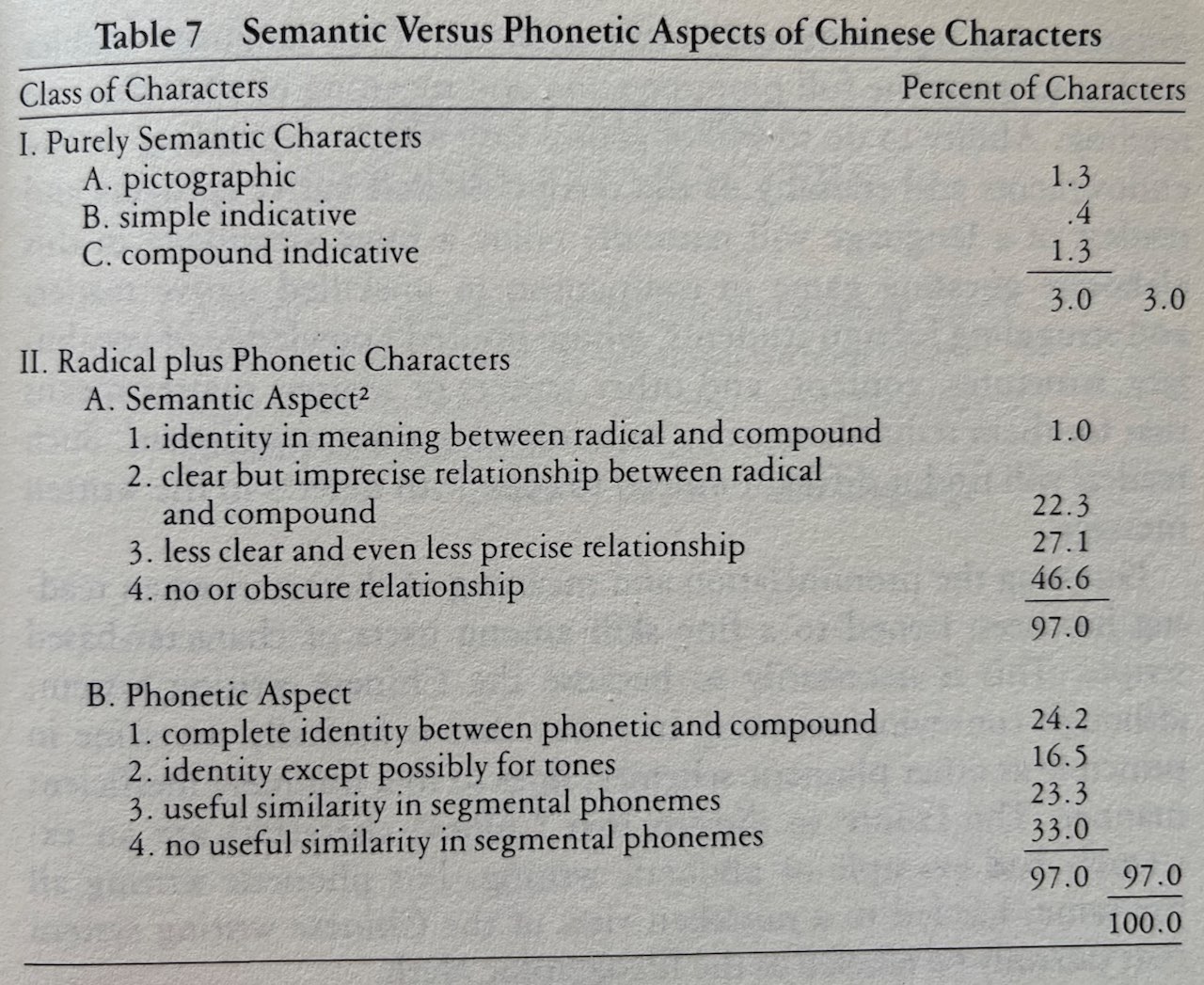
How limited is the number of pictographic or semantic characters, like “人”, “口”, “山”, etc., as opposed to the number of characters with some phonetic component related to pronunciation? This table from p. 129 of the book The Chinese Language: Fact and Fantasy says that only about 3% of all Chinese characters are purely pictographic or semantic:

Table 7 Semantic Versus Phonetic Aspects of Chinese Characters, p. 129, _The Chinese Language: Fact and Fantasy_

This myth, it is apparent, exists in two aspects. Both must be rejected. The first is that the Chinese characters constitute an existing system of ideographic writing. This has been shown to be factually untrue. The second aspect is the validity of the ideographic concept itself. I believe it to be completely untenable because there is no evidence that people have the capacity to master the enormous number of symbols that would be needed in a written system that attempts to convey thought without regard to sound, which means divorced from spoken language. …But while it is possible for a writing system to have many individual “ideographs” or “ideograms”, it is not possible to have a whole writing system based on the ideographic principle. Alphabetic writing requires mastery of several dozen symbols that are needed for phonemic representation. Syllabic writing requires mastery of what may be several hundred or several thousand symbols that are needed for syllabic representation. Ideographic writing, however, requires mastery of the tens of thousands or hundreds of thousands of symbols that would be needed for ideographic representation of words or concepts without regard to sound. A bit of common sense should suggest that unless we supplement our brains with computer implants, ordinary mortals are incapable of such memory feats.

Indeed, how many concepts exist, or could potentially come into existence as they get invented? That’s how many symbols an actual ideographic writing system would need to have. Obviously, even if such a system could be made to exist, it would be unusable by actual imperfect humans. Even Chinese characters, which “only” number somewhere over 100,000, are not numerous enough to be an actual ideographic writing system, and Chinese characters are already inhumanly complex and numerous.

Objections to the Term “Ideographic”

We need to go further and throw out the term itself.

Chinese characters represent words (or better, morphemes), not ideas, and they represent them phonetically, for the most part, as do all real writing systems despite their diverse techniques and differing effectiveness in accomplishing the task.

Both terms [“logographic” and “ideographic”] are inadequate and misleading because they fail to indicate that the process of getting from graph to word/morpheme involves the phonetic aspect of the latter and because this failure leaves the way open to the idea that we get from graph to word/morpheme by means of some nonphonetic, in a word, “ideographic”, approach. Only the adoption of some such term as “morphosyllabic”, which calls attention to the phonetic aspect, can contribute to dispelling the widespread misunderstanding of the nature of Chinese writing.

Chinese characters being a “morphosyllabic” writing system means that “each character is pronounced as a single syllable and represents a single morpheme* (smallest unit of language SOUND with meaning)—a Chinese character does NOT bypass language sounds to directly represent an idea.


So, every time you hear in Mandarin a name like “Hāmǐjíduōdùn (Armageddon 哈米吉多顿 哈米吉多頓) that came from another language, and is made up in Mandarin of syllables that make no sense except that they sound like the name in the original language, remember that the Ideographic Myth is just that—a myth!

As worshippers of the one true God Jehovah, we carefully avoid spiritual idolatry, realizing that no visible idol or image can be allowed to replace the invisible, almighty Spirit Jehovah as the object of our worship. Similarly, us Chinese field language learners must also carefully avoid the linguistic idolatry of considering visible Chinese characters to be direct representations of meaning in Chinese languages, when the truth is that in human languages, including Chinese languages, meaning is primarily transmitted via invisible speech.


* John DeFrancis, The Chinese Language: Fact and Fantasy (Honolulu: University of Hawaii Press, 1984), p. 125. ^

Categories
Culture History Language Learning Science Theocratic

tiān‐yī‐wúfèng

tiān‐yī‐wúfèng+ ((tiān [(is)] heavenly 天)‐(yī garment 衣)‐(wú·fèng without · seams 无缝 無縫) [[is] flawless]) 👈🏼 Tap/click to show/hide the “flashcard”

[Notes: Tap/click on a Pīnyīn (Pīn·yīn {Piecing Together of} · Sounds → [Pinyin] 拼音) expression to reveal its “flashcard”; tap/click on a “flashcard” or its Pīnyīn (Pīn·yīn {Piecing Together of} · Sounds → [Pinyin] 拼音) expression to hide the “flashcard”. 📖 📄 ➕ icons mean 📖 Reveal All, 📄 Reveal Advanced, and ➕ Reveal + Symbols re all the “flashcards” in the heading, paragraph, etc. that they are placed at the beginning of.]

We in the Mandarin field should keep in mind that many Mandarin-speaking people were taught to believe in evolution, and thus tend to not believe in God. The Shēngmìng Láizì Chuàngzào Ma? ((Shēngmìng Life 生命) (Lái·zì Came · From 来自 來自) (Chuàng·zào Initiating · {Making, Creating} → [Creating] 创造 創造) (Ma [? ptcl for “yes/no” questions])? [Was Life Created? (lc)]) (Was Life Created? (lc)) brochure and the Shēngmìng de Qǐyuán—Zhíde Sīkǎo de Wǔ Ge Wèntí ((Shēngmìng Life 生命) (de ’s 的) (Qǐ·yuán {Rising → [Starting]} · Source → [Origin] 起源/原)—(Zhí·de Worth · Getting → [Worth] 值得) (Sī·kǎo {Thinking About} · Examining 思考) (de ’s 的) (Wǔ Five 五) (Ge [mw]個/个) (Wèn·tí Asking · Subjects → [Questions] 问题 問題) [The Origin of Life—Five Questions Worth Asking (lf)]) (The Origin of Life—Five Questions Worth Asking (lf)) brochure were originally published back in 2010, but they are still considered current publications, and relatively recently, the English version of the Was Life Created? brochure was updated to the December 2022 Printing, and the Mandarin version of it was updated to the February 2023 Printing. So, it would be good for us to consider some of the expressions used in the Mandarin versions of the Was Life Created? and Origin of Life brochures, which can be so helpful when discussing the fundamentally important question of whether life was created.

“Very Fortunate” Indeed!

This week’s MEotW, which appears in the first paragraph of the section of the Mandarin Was Life Created? brochure entitled “Shēngjī+ (Shēng·jī Life · {Mechanism → [Being Organic]} → [Life] 生机 生機)Bóbó (Bó·bó Flourishing · Flourishing 勃勃) de (’s 的) Dìqiú (Dì·qiú Earth · Globe 地球) (“The Living Planet”), is “tiān‐yī‐wúfèng ((tiān [(is)] heavenly 天)‐(yī garment 衣)‐(wú·fèng without · seams 无缝 無縫) [[is] flawless])”:

English:

Life on earth could never exist were it not for a series of very fortunate “coincidences,”

Mandarin (WOL; Pīnyīn (Pīn·yīn {Piecing Together of} · Sounds → [Pinyin] 拼音) Plus)

📖 📄 Dìqiú (Dì·qiú earth · globe 地球) zài (in 在) hěn (very 很) duō (many 多) fāngmiàn (fāng·miàn {directions → [sides]} · faces → [aspects] 方面) dōu ({all of them} 都)qiǎohé+ (qiǎo·hé {being coincidental → [coincidentally]} · {closing → [matching]} → [coincidental] 巧合)de (-ly 地) pèihe (pèi·he matches · {closes → [accords]} → [is suitable] 配合) de (getting 得) tiān‐yī‐wúfèng+ ((tiān (to be) heavenly 天)‐(yī garment 衣)‐(wú·fèng without · seams 无缝 無縫) [to be flawless]), yào (if 要)bu ((it) not 不)shì ({would be} 是) zhèyàng (zhè·yàng this · {form → [way]} 这样 這樣), dìqiú (dì·qiú earth · globe 地球) shang (upon 上) gēnběn (gēn·běn {root (of a plant)} · {root or stem of a plant} → [basically] 根本) jiù (then 就) (not 不) kěnéng (could 可能) yǒu (have 有) shēngmìng (life 生命).

Where the English Was Life Created? brochure speaks of the “coincidences” that made life possible on earth as “very fortunate” (a bit of British understatement?), the Mandarin Was Life Created? brochure effectively says these “coincidences” made earth “suitable for life to a miraculously/superhumanly flawless extent”. In the process of doing so, it evokes the long-standing Chinese cultural concept of “Tiān+ (Heaven [→ [God]] 天),” or Heaven.

“Let Me Reintroduce You to…”

As the Lasting Peace brochure (English, Mandarin) helps us understand, this concept of “Tiān+ (Heaven [→ [God]] 天) is a kind of conceptual bridge back to a time when historical records show that the Chinese worshipped one supreme deity:

WHO IS GOD?

TO THE Chinese, the concept of God, or Shang-di (literally “Emperor above”), is both foreign and abstract. Most people worship heaven and earth, spirits and demons, ancestors and other humans. Interestingly, however, according to Chinese historical records, between three and four thousand years ago, during the Xia and Shang dynasties, the Chinese were already worshipping one supreme deity. The book The Religious History of China explains that they “reckoned that between heaven and earth there was a principal God who stood supreme and had absolute control over all things. . . . This supreme deity came to be called Di, or Shang-di, during the Shang Dynasty, and was known as Tien [heaven], or Tien-di [Emperor in Heaven], during the Zhou Dynasty [11th century to 256 B.C.E.].” Thus, the ancient Chinese believed in the existence of a Supreme Sovereign of the universe.

During the Spring and Autumn period (c. 722-481 B.C.E.) and the Warring States period (c. 480-221 B.C.E.), Confucianism and Taoism gained ascendancy. Influenced by these two schools of thought, the worship of Shang-di was gradually replaced by the abstract idea of reverence for Tien. By the Han dynasty (202 B.C.E.–221 C.E.), under the dominance of Confucianism, the Chinese became engrossed in moral culture and social order, and the concept of Shang-di suffered another setback. With the spread of Buddhism into China, the Chinese no longer held to the belief of a Creator who is in control of the universe, but they accepted Heaven, or Providence, as the first cause of all things. Since then, the concept of God, or Shang-di, has become something completely foreign to most Chinese.

Who, then, really is God? The Bible shows that God is not a force or law of nature that governs the operation of all things in the universe. Nor is he Tien, which is venerated by many Chinese. Rather, God is a living spirit who has feelings and personality traits. He is the almighty and omniscient Sovereign of the Universe, and his love is boundless. Not only has he created all things but he also has a definite purpose for mankind—that we worship him with love and live forever on this beautiful earth in lasting peace and happiness.

(PDF files with 3-line material covering the Mandarin version of the above quotation from the Lasting Peace brochure can be downloaded from here (iPad-Letter-A4) or here (XLP-iPhone-A5). (Pīnyīn (Pīn·yīn {Piecing Together of} · Sounds → [Pinyin] 拼音) Plus material for the Lasting Peace brochure is in the works, but is not quite ready to be posted yet.) The short link for Chinese field language-learning links for the Lasting Peace brochure is: Lasting Peace Brochure Links (tiandi.info/pc).)

Use of this week’s MEotW in the Mandarin Was Life Created? brochure reflects good insight into what can help us to reach the hearts of the Chinese people we meet in the Mandarin field, as we reintroduce them to the “Supreme Sovereign of the universe” whom they once recognized and worshipped.


For convenience:

The direct link for the current-generation Pīnyīn (Pīn·yīn {Piecing Together of} · Sounds → [Pinyin] 拼音) Plus resource for the Was Life Created? brochure is:

The short link for Chinese field language-learning links for the Was Life Created? brochure is:

More Pīnyīn (Pīn·yīn {Piecing Together of} · Sounds → [Pinyin] 拼音) and Pīnyīn (Pīn·yīn {Piecing Together of} · Sounds → [Pinyin] 拼音) Plus web material based on the Mandarin Was Life Created? brochure will be made available in the Pīnyīn (Pīn·yīn {Piecing Together of} · Sounds → [Pinyin] 拼音) Plus web resource as time allows.

Categories
Culture Experiences History Language Learning Technology Theocratic

cùnbù‐bù‐lí

cùnbù+ (cùn·bù {Ch. inch (3⅓ cm) → [tiny]} · step 寸步)+ (not 不)+ (leave; {part/depart [from]}; {[is] away/apart/distant/far apart from}離/离) 👈🏼 Tap/click to show/hide the “flashcard”

[Notes: Tap/click on a Pīnyīn (Pīn·yīn {Piecing Together of} · Sounds → [Pinyin] 拼音) expression to reveal its “flashcard”; tap/click on a “flashcard” or its Pīnyīn (Pīn·yīn {Piecing Together of} · Sounds → [Pinyin] 拼音) expression to hide the “flashcard”. 📖 📄 ➕ icons mean 📖 Reveal All, 📄 Reveal Advanced, and ➕ Reveal + Symbols re all the “flashcards” in the heading, paragraph, etc. that they are placed at the beginning of.]

Rather than dismissively thinking to ourselves that the songs produced by the organization are “just songs”, we should remember that the slave class takes seriously its responsibility to provide spiritual food to God’s people, and so it is going to make sure that the lyrics in its songs are spiritually correct, while also being emotionally moving.—Ezekiel 33:32; Matthew 24:45.

Not Deviating an Inch

“cùnbù‐bù‐lí” _Pīnyīn_ Plus info, Song 161 (music+_Pīnyīn_), on iPhone 13 mini (landscape orientation)

This week’s MEotW in the unofficial Pīnyīn (Pīn·yīn {Piecing Together of} · Sounds → [Pinyin] 拼音) Plus resource “Sing Out Joyfully” Bk. (Pīnyīn+Music, Pīnyīn Plus, Web)

This week’s MEotW, “cùnbù (cùn·bù {Ch. inch (3⅓ cm) → [tiny]} · step 寸步) (not 不) (leave; {part/depart [from]}; {[is] away/apart/distant/far apart from}離/离)”, comes from the chorus of song 161, which is entitled “To Do Your Will Is My Delight” in English and “Wǒ (I 我) Lèyú (Lè·yú {Am Happy} · to 乐于 樂於) Zūnxíng (Zūn·xíng {Abide by} · {Walk → [Do]} 遵行) Nǐ de ((Nǐ You 你) (de ’s 的) [Your]) Zhǐyì (Zhǐ·yì Will · {Meaning → [Will]} → [Will] 旨意) in Mandarin:

English:

To do your will is my delight.
I give you all my strength and might.
This joy I feel; this joy is real.
I will walk on in your light.

Mandarin (WOL, Pīnyīn (Pīn·yīn {Piecing Together of} · Sounds → [Pinyin] 拼音) Plus):

📖 📄 (I 我) lèyú (lè·yú {am happy} · to 乐于 樂於) zūnxíng (zūn·xíng {abide by} · {walk → [do]} 遵行) (your 你) zhǐyì (zhǐ·yì will · {meaning → [will]} → [will] 旨意)!”
Chíshǒu (Chí·shǒu {to hold → [to support]} · {to defend → [to abide by]} → [to hold fast to] 持守) zhēnlǐ (zhēn·lǐ true · reasoning → [the truth] 真理), cùnbù (cùn·bù {Ch. inch (3⅓ cm) → [tiny]} · step 寸步) (not 不) ({to depart}離/离),
Gānxīn (Gān·xīn {to be (of) sweet → [to be of willing]} · heart → [to be willing] 甘心) lèyì (lè·yì {to be (of) happy} · {meaning → [intention]} → [to be willing] 乐意 樂意), wúwèi (wú·wèi {to be without} · {fearing of} 无畏 無畏) jiānxīn (jiān·xīn {(things being) arduous} · {(things being) hot (in taste) → [(things being) hard]} → [hardships] 艰辛 艱辛),
Jìn ({to expend to the limit}) quánlì (quán·lì whole · strength 全力), zài‐suǒ‐bùxī ((zài in 在)‐(suǒ place 所)‐(bù·xī not · {to cherish → [to stint]} 不惜) [not to balk]).

While not being a direct translation, “Chíshǒu (Chí·shǒu {to hold → [to support]} · {to defend → [to abide by]} → [to hold fast to] 持守) zhēnlǐ (zhēn·lǐ true · reasoning → [the truth] 真理), cùnbù (cùn·bù {Ch. inch (3⅓ cm) → [tiny]} · step 寸步) (not 不) ({to depart}離/离) seems to correspond with “I will walk on in your light” in the above example. For those who are interested, a more literal translation of “Chíshǒu (Chí·shǒu {to hold → [to support]} · {to defend → [to abide by]} → [to hold fast to] 持守) zhēnlǐ (zhēn·lǐ true · reasoning → [the truth] 真理), cùnbù (cùn·bù {Ch. inch (3⅓ cm) → [tiny]} · step 寸步) (not 不) ({to depart}離/离) would be “to hold fast to the truth, (even) a step of an inch not to depart (from it)”. To get even further into the weeds, while the expression “cùn ({Ch. inch (3⅓ cm)} [→ [inch | very little/short; small; tiny]] 寸) that is used above is now often used to mean the British Imperial inch (2.54 cm), it actually originally referred to the Chinese inch (3⅓ cm). Either way, a “cùnbù+ (cùn·bù {Ch. inch (3⅓ cm) → [tiny]} · step 寸步) is a tiny step indeed.

Regarding the other morphemes in “cùnbù (cùn·bù {Ch. inch (3⅓ cm) → [tiny]} · step 寸步) (not 不) (leave; {part/depart [from]}; {[is] away/apart/distant/far apart from}離/离)”, it may be helpful to note that the “bù”+ (step; pace (v or n) [→ [condition; situation; state]] 步) in “cùnbù” (cùn·bù {Ch. inch (3⅓ cm) → [tiny]} · step 寸步) also appears in the well-known expressions “bùzhòu” (bù·zhòu step · {to be trotted} → [step; move; measure; phase] 步骤 步驟) and “jìnbù+ (jìn·bù {advancing [of]} · steps → [progress[ing]; advancing; improvement] 进步 進步)”, and that this “lí” (leave; {part from}; {[is] away/apart/distant/far apart from}離/离) is the one in “líkāi (lí·kāi leave · {to be opened [from] → [away [from]; apart [from]; clear [of]]} 离开 離開).”

Musical Notation 🎼 and the Mandarin Field

In this post about a Mandarin expression found in our songbook, another subject that I want to touch on is: Is musical notation 🎼 too hard to be worth the trouble of producing it and using it? Are fewer and fewer people able to read it? I was fortunate enough to have been taught how to read musical notation in school. I have never thought of musical notation as being particularly difficult to use (it’s much easier to learn than characters, which many unquestioningly try to learn), and I find that it helps me to sing Kingdom songs more correctly (according to the intended melody, message, etc.) and more confidently more of the time. However, I am aware that not everyone in the Mandarin field has the same experience with musical notation. For example, a while ago, an older brother told me that he didn’t know how to read musical notation. Also, some people in the Mandarin field may have been affected by how education systems in this old world have been facing significant challenges relating to providing music education for younger ones.

Regardless of how the world may be failing in many cases to equitably provide good music education, Jehovah’s organization has pointed out that music is important in Jehovah’s worship. For example, not long ago, a Meeting Workbook said:

Music can have a powerful influence on the mind and body. Singing is an important part of our worship of Jehovah.

In accordance with the importance of music in Jehovah’s worship, Mandarin field language learners used to have available to them official material from the organization containing musical notation with Pīnyīn (Pīn·yīn {Piecing Together of} · Sounds → [Pinyin] 拼音) in the lyrics. However, perhaps at least partially because of the technical difficulty and costliness of producing material with musical notation and both Chinese characters and Pīnyīn (Pīn·yīn {Piecing Together of} · Sounds → [Pinyin] 拼音) in the lyrics, as of this writing, there is no official material currently available from the organization that shows Pīnyīn (Pīn·yīn {Piecing Together of} · Sounds → [Pinyin] 拼音) and musical notation on the same page or screen.

Screenshot of Sis. Margarita Königer and others using official _Pīnyīn_ _Sing to Jehovah_ songbooks with musical notation

A screenshot from an official video, of Sis. Margarita Königer and others using official Pīnyīn (Pīn·yīn {Piecing Together of} · Sounds → [Pinyin] 拼音) Sing to Jehovah songbooks with musical notation

The organization continues to publish official songbook material for different languages in general that contains musical notation, so it evidently still considers musical notation to generally be worthwhile to produce. It continues to produce official material for the current songbook that uses musical notation along with lyrics rendered only in Chinese characters, without Pīnyīn (Pīn·yīn {Piecing Together of} · Sounds → [Pinyin] 拼音), and it has even produced official material that uses jiǎnpǔ+ (jiǎn·pǔ simple · {register or record for reference → [musical notation]} → [numbered musical notation] 简谱 簡譜) (a kind of musical notation also known as numbered musical notation) and Chinese characters.

For those who find it helpful in their Mandarin field activities to put musical notation together with Pīnyīn (Pīn·yīn {Piecing Together of} · Sounds → [Pinyin] 拼音), the unofficial Pīnyīn (Pīn·yīn {Piecing Together of} · Sounds → [Pinyin] 拼音) Plus resource “Sing Out Joyfully” Bk. (Pīnyīn+Music, Pīnyīn Plus, Web) exists and is continuing to be improved. As shown in the screenshot near the beginning of this post, this resource aids Mandarin field language learners by breaking with tradition and featuring lyrics in the musical notation that are only in relatively large-print Pīnyīn (Pīn·yīn {Piecing Together of} · Sounds → [Pinyin] 拼音) by default—characters are relegated to Pīnyīn (Pīn·yīn {Piecing Together of} · Sounds → [Pinyin] 拼音) Plus “flashcards” that are added as time allows.

Unlike the traditionally-used but unnecessarily extraordinarily complex characters that need to be accompanied by Pīnyīn (Pīn·yīn {Piecing Together of} · Sounds → [Pinyin] 拼音) before many are able to read them, Pīnyīn (Pīn·yīn {Piecing Together of} · Sounds → [Pinyin] 拼音) itself is a simple, elegant alphabetical full writing system for Mandarin that is easy to learn and remember. Also, it is no harder to typeset than other alphabetical writing systems with diacritics, such as the writing systems now used for French, Czech, Vietnamese, etc.*

In its Tips: section at the bottom of its home page, the “Sing Out Joyfully” Bk. (Pīnyīn+Music, Pīnyīn Plus, Web) resource contains these links that some may find helpful:


For convenience:

The direct link for the Pīnyīn (Pīn·yīn {Piecing Together of} · Sounds → [Pinyin] 拼音) Plus resource for the “Sing Out Joyfully” book is:

The short link for Chinese field language-learning links for the “Sing Out Joyfully” book is:

More Pīnyīn (Pīn·yīn {Piecing Together of} · Sounds → [Pinyin] 拼音) and Pīnyīn (Pīn·yīn {Piecing Together of} · Sounds → [Pinyin] 拼音) Plus web material based on the Mandarin “Sing Out Joyfully” book will be made available in the Pīnyīn (Pīn·yīn {Piecing Together of} · Sounds → [Pinyin] 拼音) Plus web resource as time allows.


* Thanks to ongoing advancements in personal computing hardware and software, producing material that contains things like musical notation and Pīnyīn (Pīn·yīn {Piecing Together of} · Sounds → [Pinyin] 拼音) text at reasonable cost is quicker and easier than ever. At this time, production of the musical notation in the “Sing Out Joyfully” Bk. (Pīnyīn+Music, Pīnyīn Plus, Web) resource begins in free open source software called MuseScore Studio, running on a Mac. Pīnyīn (Pīn·yīn {Piecing Together of} · Sounds → [Pinyin] 拼音) text for the lyrics in the musical notation is entered using macOS’s ABC – Extended input source (keyboard layout). (Just using Pīnyīn (Pīn·yīn {Piecing Together of} · Sounds → [Pinyin] 拼音) text only here simplifies things so much compared to having to somehow input characters with Pīnyīn (Pīn·yīn {Piecing Together of} · Sounds → [Pinyin] 拼音) ruby text!) When it’s ready, the musical notation for a song is exported from MuseScore Studio into SVG format, which is a plain text format that allows for the inclusion of links that activate Pīnyīn (Pīn·yīn {Piecing Together of} · Sounds → [Pinyin] 拼音) Plus flashcards on webpages. The coding for the SVG links is currently done using the text editor BBEdit, in which editing large text files is quite performant. For Pīnyīn (Pīn·yīn {Piecing Together of} · Sounds → [Pinyin] 拼音) Plus web material production in general, my current favourite tool is Nova, but such web material can be produced in any application suitable for web development, such as Visual Studio Code, etc. ^