jiāng‐xīn‐bǐ‐xīn+ ((jiāng take 将 將)‐(xīn heart 心)‐(bǐ {to compare} 比)‐(xīn heart[s] 心) → [be empathetic; put oneself in sb. else’s shoes; feel for another/others]) 👈🏼 Tap/click to show/hide the “flashcard”
[Notes: Tap/click on a Pīnyīn (Pīn·yīn {Piecing Together of} · Sounds → [Pinyin] 拼音) expression to reveal its “flashcard”; tap/click on a “flashcard” or its Pīnyīn (Pīn·yīn {Piecing Together of} · Sounds → [Pinyin] 拼音) expression to hide the “flashcard”. 📖 📄 ➕ icons mean 📖 Reveal All, 📄 Reveal Advanced, and ➕ Reveal + Symbols re all the “flashcards” in the heading, paragraph, etc. that they are placed at the beginning of.]
Rather than dismissively thinking to ourselves that the songs produced by the organization are “just songs”, we should remember that the slave class takes seriously its responsibility to provide spiritual food to God’s people, and so it is going to make sure that the lyrics in its songs are spiritually correct, while also being emotionally moving.—Ezekiel 33:32; Matthew 24:45.
Comparing Hearts

This week’s MEotW in the unofficial Pīnyīn (Pīn·yīn {Piecing Together of} · Sounds → [Pinyin] 拼音) Plus resource “Sing Out Joyfully” Bk. (Pīnyīn+Music, Pīnyīn Plus, Web)
This week’s MEotW, “jiāng‐xīn‐bǐ‐xīn ((jiāng take 将 將)‐(xīn heart 心)‐(bǐ {to compare} 比)‐(xīn heart[s] 心) → [be empathetic; put oneself in sb. else’s shoes; feel for another/others])”, comes from the first verse of song 163, this year’s convention song, which is entitled “Happy Are These Eyes” in English and “Wǒ de ((Wǒ Me 我) (de ’s 的) → [My]) Yǎnjing (Yǎn·jing Eyes’ · Eyeballs → [Eyes] 眼睛) Duōme (Duō·me {(How) Much} · [suf] → [How] 多么 多麼) Yǒufú (Yǒu·fú Have · Blessings → [Are Happy] 有福)” in Mandarin:
With a humble heart, he would pray.
He was kind to all and ready to forgive.
Mandarin (WOL, Pīnyīn (Pīn·yīn {Piecing Together of} · Sounds → [Pinyin] 拼音) Plus):
📖 📄 ➕ Dǎogào (Dǎo·gào (when) praying · {requesting | telling} → [(when) praying] 祷告 禱告) yào ((we) must 要) qiānbēi (qiān·bēi {be modest} · {be low} → [be humble] 谦卑 謙卑) yào ((we) must 要) zhēnxīn (zhēn·xīn {be (of) true} · hearts → [be sincere] 真心);
Lèyì (Lè·yì {be (of) happy} · {meaning → [intention]} → [be willing] 乐意 樂意) yuánliàng (yuán·liàng {to pardon} · {to forgive} 原谅 原諒) rén (people 人), nǔlì (nǔ·lì exert · strength 努力) jiāng‐xīn‐bǐ‐xīn ((jiāng {to take} 将 將)‐(xīn heart 心)‐(bǐ {to compare} 比)‐(xīn hearts 心) → [to be empathetic]).
While not being a direct translation, “jiāng‐xīn‐bǐ‐xīn ((jiāng {to take} 将 將)‐(xīn heart 心)‐(bǐ {to compare} 比)‐(xīn hearts 心) → [to be empathetic])” seems to correspond with “was kind to all” in the above example. A more literal translation of “jiāng‐xīn‐bǐ‐xīn ((jiāng {to take} 将 將)‐(xīn heart 心)‐(bǐ {to compare} 比)‐(xīn hearts 心) → [to be empathetic])” as used above would be “to take heart to compare hearts”. Effectively, this is a rather poetic way to say “to be empathetic”.
Other Mandarin expressions related to empathy include:
- tǐxù+ (tǐ·xù {bodily → [personally]} · pity; {sympathize [with]} [→ [empathize with]] 体恤 體恤)
- tǐxù zhī xīn+ ((tǐ·xù {bodily → [personally]} · pitying; sympathizing [→ [empathizing]] 体恤 體恤) (zhī ’s 之) (xīn heart 心) → [empathy])
- tóngqíng+ (tóng·qíng {(have the) same} · feeling (as) → [sympathize with; show/have sympathy/empathy for] 同情)
- tóngqíng‐xīn+ ((tóng·qíng {(having the) same} · feeling 同情)‐(xīn heart 心) → [sympathy; fellow feeling; compassion; empathy])
- liánxù+ (lián·xù sympathizing · pitying [→ [[having] compassion]] 怜恤 憐恤)
Empathy and Mandarin Field Language Learning
The importance of empathy with regard to Mandarin field language learning is emphasized in the below excerpt from the article “Pīnyīn (Pīn·yīn {Piecing Together of} · Sounds → [Pinyin] 拼音) Was Plan A”:
Yes, Pīnyīn was Plan A, but China unfortunately let the proud, self-serving B players have their way.
Is that the way we as Jehovah’s people should be? Shouldn’t godly, self-sacrificing love move us to do what’s best for others rather than fulfilling the imperfect human instinct for being self-glorifying, self-justifying, and self-serving? Are we showing pride in the name of love?
In this, I agree with Zhōu Ēnlái (周恩来/周恩來, Zhou Enlai), the first Premier of the People’s Republic of China, who agreed with Lǐ Zhúchén (李烛尘/李燭塵, Li Zhuchen), who said,
Every time the question of the reform of Chinese characters is brought up, somebody raises an objection, or even stubbornly opposes it for this or that reason. Some say that the characters are not difficult. I will say that such a person is like one who, as soon as his wounds are healed, forgets the pain he suffered. …If he will but recall his bitter experience in learning characters, and consider the interests of the children and the illiterates by placing himself in their place, he will not dissent or object so strongly. [This was actually said regarding opposition to the simplification of the characters, but the principle applies to opposition to Pīnyīn as well.—W. W.]
More recently, one commenter pointed out:
It takes a very grown-up person to say “I did this the hard way, but child, I want you to do it the easy way, for the greater good.”
Also, during the 2014 Stanford Commencement address, Bill Gates said:
If we have optimism, but we don’t have empathy, then it doesn’t matter how much we master the secrets of science, we’re not really solving problems—we’re just working on puzzles.
Mr. Gates’ above observation applies to the subject at hand in that while many enjoy trying to solve the puzzles presented by Chinese characters, and while many also enjoy being known for being good at solving these puzzles, empathy should move us to recognize that there are much bigger issues involved than just our personal enjoyment or glorification.
Yes, when even some worldly people can recognize the above points, we Christians should recognize even more the need to show love and empathy rather than being proud, self-glorifying, self-justifying, and self-serving. Also, we should be actively and determinedly following the course of true Christian love and empathy rather than just going along with others who are proud, self-glorifying, self-justifying, and self-serving. We should especially do so when we have scriptures such as this to guide us:
Knowledge puffs up, but love builds up.—1 Corinthians 8:1.
Musical Notation 🎼 and the Mandarin Field
In this post about a Mandarin expression found in our songbook, another subject that I want to touch on is: Is musical notation 🎼 too hard to be worth the trouble of producing it and using it? Are fewer and fewer people able to read it? I was fortunate enough to have been taught how to read musical notation in school. I have never thought of musical notation as being particularly difficult to use (it’s much easier to learn than characters, which many unquestioningly try to learn), and I find that it helps me to sing Kingdom songs more correctly (according to the intended melody, message, etc.) and more confidently more of the time. However, I am aware that not everyone in the Mandarin field has the same experience with musical notation. For example, a while ago, an older brother told me that he didn’t know how to read musical notation. Also, some people in the Mandarin field may have been affected by how education systems in this old world have been facing significant challenges relating to providing music education for younger ones.
Regardless of how the world may be failing in many cases to equitably provide good music education, Jehovah’s organization has pointed out that music is important in Jehovah’s worship. For example, not long ago, a Meeting Workbook said:
Music can have a powerful influence on the mind and body. Singing is an important part of our worship of Jehovah.
In accordance with the importance of music in Jehovah’s worship, Mandarin field language learners used to have available to them official material from the organization containing musical notation with Pīnyīn (Pīn·yīn {Piecing Together of} · Sounds → [Pinyin] 拼音) in the lyrics. However, perhaps at least partially because of the technical difficulty and costliness of producing material with musical notation and both Chinese characters and Pīnyīn (Pīn·yīn {Piecing Together of} · Sounds → [Pinyin] 拼音) in the lyrics, as of this writing, there is no official material currently available from the organization that shows Pīnyīn (Pīn·yīn {Piecing Together of} · Sounds → [Pinyin] 拼音) and musical notation on the same page or screen.
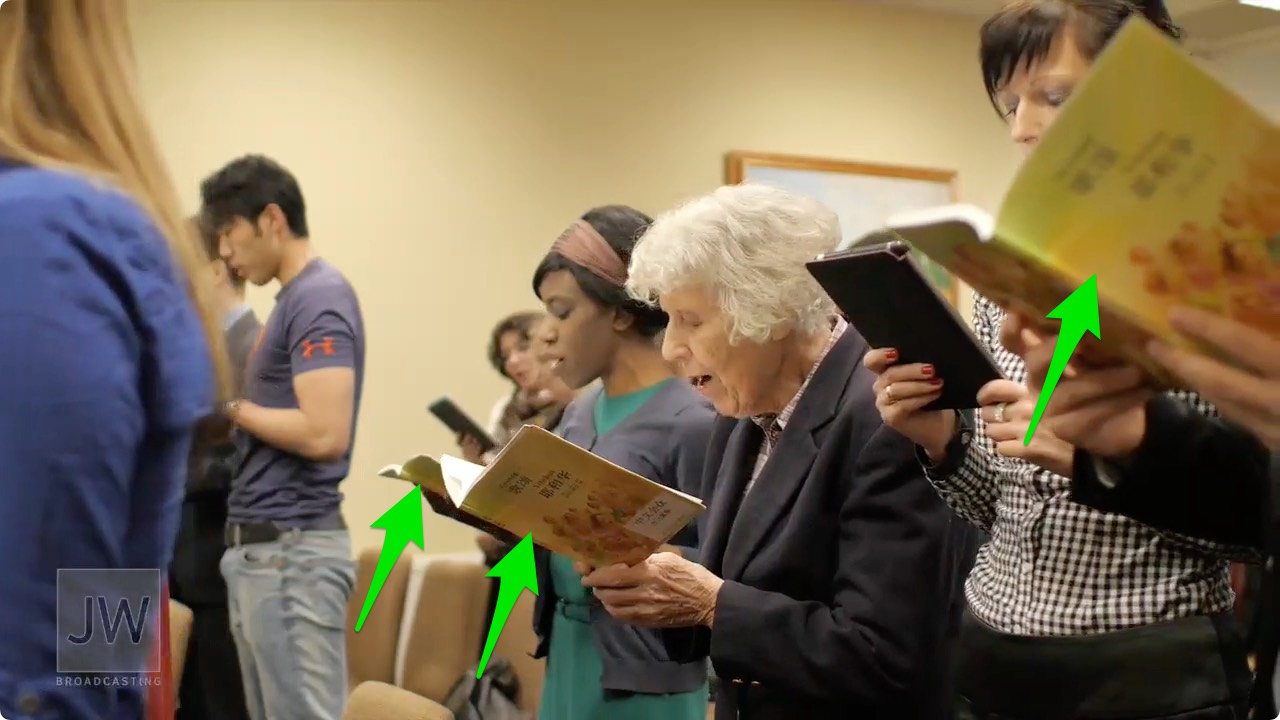
A screenshot from an official video, of Sis. Margarita Königer and others using official Pīnyīn (Pīn·yīn {Piecing Together of} · Sounds → [Pinyin] 拼音) Sing to Jehovah songbooks with musical notation
The organization continues to publish official songbook material for different languages in general that contains musical notation, so it evidently still considers musical notation to generally be worthwhile to produce. It continues to produce official material for the current songbook that uses musical notation along with lyrics rendered only in Chinese characters, without Pīnyīn (Pīn·yīn {Piecing Together of} · Sounds → [Pinyin] 拼音), and it has even produced official material that uses jiǎnpǔ+ (jiǎn·pǔ simple · {register or record for reference → [musical notation]} → [numbered musical notation] 简谱 簡譜) (a kind of musical notation also known as numbered musical notation) and Chinese characters.
For Jehovah’s official organization, continuing to produce musical notation with lyrics rendered in Chinese characters but discontinuing production of musical notation that includes Pīnyīn (Pīn·yīn {Piecing Together of} · Sounds → [Pinyin] 拼音) lyrics when it becomes necessary to conserve time and effort makes sense, when we consider that the primary focus of Jehovah’s official organization is to provide spiritual instruction, not language instruction, even though language instruction can provide significant practical help to people seeking to learn or teach sprititual truths. (Another reminder of this primary focus is the recent discontinuation of the JW Language app.) The way the world is, with its deeply embedded traditions and prejudices, people whose mother tongue is Mandarin—and who thus learn spiritual truths best in Mandarin—mainly still use Chinese characters as their “mother writing system”, even as the game-changing practical benefits of Pīnyīn (Pīn·yīn {Piecing Together of} · Sounds → [Pinyin] 拼音) are obvious to unprejudiced Mandarin language learners.
And, even as the organization has continued to add Pīnyīn (Pīn·yīn {Piecing Together of} · Sounds → [Pinyin] 拼音) ruby text to much of its Mandarin material, in recognition of the value of these practical benefits—even people who have been learning characters since childhood occasionally, perhaps even regularly, suffer from character amnesia, due to the inhuman complexity and number of the characters, and also, there are actually tens of millions of Chinese people who are still illiterate regarding the characters—it seems that when faced with the prospect of producing a version of the current songbook with musical notation, characters, and Pīnyīn (Pīn·yīn {Piecing Together of} · Sounds → [Pinyin] 拼音) ruby text, those in charge, perhaps remembering how difficult and time-consuming it was to do so for the previous songbook, felt that it would just be too much this time.
For those who find it helpful in their Mandarin field activities to put musical notation together with Pīnyīn (Pīn·yīn {Piecing Together of} · Sounds → [Pinyin] 拼音), the unofficial Pīnyīn (Pīn·yīn {Piecing Together of} · Sounds → [Pinyin] 拼音) Plus resource “Sing Out Joyfully” Bk. (Pīnyīn+Music, Pīnyīn Plus, Web) exists and is continuing to be improved. As shown in the screenshot near the beginning of this post, this resource aids Mandarin field language learners by breaking with tradition and featuring lyrics in the musical notation that are only in relatively large-print Pīnyīn (Pīn·yīn {Piecing Together of} · Sounds → [Pinyin] 拼音) by default—characters are relegated to Pīnyīn (Pīn·yīn {Piecing Together of} · Sounds → [Pinyin] 拼音) Plus “flashcards” that are added as time allows.
Unlike the traditionally-used but unnecessarily extraordinarily complex characters that need to be accompanied by Pīnyīn (Pīn·yīn {Piecing Together of} · Sounds → [Pinyin] 拼音) before many are able to read them, Pīnyīn (Pīn·yīn {Piecing Together of} · Sounds → [Pinyin] 拼音) itself is a simple, elegant alphabetical full writing system for Mandarin that is easy to learn and remember. Also, it is no harder to typeset than other alphabetical writing systems with diacritics, such as the writing systems now used for French, Czech, Vietnamese, etc.*
In its Tips: section at the bottom of its home page, the “Sing Out Joyfully” Bk. (Pīnyīn+Music, Pīnyīn Plus, Web) resource contains these links that some may find helpful:
- Watchtower article about the “Sing Out Joyfully” book, with basic advice on how to improve our singing:
- Resources for learning how to read musical notation 🎼:
For convenience:
The direct link for the Pīnyīn (Pīn·yīn {Piecing Together of} · Sounds → [Pinyin] 拼音) Plus resource for the “Sing Out Joyfully” book is:
The short link for Chinese field language-learning links for the “Sing Out Joyfully” book is:
More Pīnyīn (Pīn·yīn {Piecing Together of} · Sounds → [Pinyin] 拼音) and Pīnyīn (Pīn·yīn {Piecing Together of} · Sounds → [Pinyin] 拼音) Plus web material based on the Mandarin “Sing Out Joyfully” book will be made available in the Pīnyīn (Pīn·yīn {Piecing Together of} · Sounds → [Pinyin] 拼音) Plus web resource as time allows.
* Thanks to ongoing advancements in personal computing hardware and software, producing material that contains things like musical notation and Pīnyīn (Pīn·yīn {Piecing Together of} · Sounds → [Pinyin] 拼音) text at reasonable cost is quicker and easier than ever. At this time, production of the musical notation in the “Sing Out Joyfully” Bk. (Pīnyīn+Music, Pīnyīn Plus, Web) resource begins in free open source software called MuseScore Studio, running on a Mac. Pīnyīn (Pīn·yīn {Piecing Together of} · Sounds → [Pinyin] 拼音) text for the lyrics in the musical notation is entered using macOS’s ABC – Extended input source (keyboard layout). (Just using Pīnyīn (Pīn·yīn {Piecing Together of} · Sounds → [Pinyin] 拼音) text only here simplifies things so much compared to having to somehow input characters with Pīnyīn (Pīn·yīn {Piecing Together of} · Sounds → [Pinyin] 拼音) ruby text!) When it’s ready, the musical notation for a song is exported from MuseScore Studio into SVG format, which is a plain text format that allows for the inclusion of links that activate Pīnyīn (Pīn·yīn {Piecing Together of} · Sounds → [Pinyin] 拼音) Plus flashcards on webpages. (These SVG links are a bit more involved to produce than “regular” web Pīnyīn (Pīn·yīn {Piecing Together of} · Sounds → [Pinyin] 拼音) Plus material, but at least the procedure for doing so is consistent and dependable, unlike Chinese characters, which have no consistent, dependable system regarding how they are designed compared to how they are pronounced.) The coding for the SVG links is currently done using the text editor BBEdit, in which editing large text files is quite performant. For Pīnyīn (Pīn·yīn {Piecing Together of} · Sounds → [Pinyin] 拼音) Plus web material production in general, my current favourite tool is Nova, but such web material can be produced in any application suitable for web development, such as Visual Studio Code, etc. ^