yíyì+ (yí·yì {(having) one} · intention → [stubbornly] 一意)‐gūxíng+ (gū·xíng {orphaned → [alone]} · {go; walk → [do]} → [cling to one’s own course; insist on having one’s own way] 孤行) ← Tap/click to show/hide the “flashcard”
Appendix A2 of the English New World Translation of the Holy Scriptures (Study Edition), entitled “Features of This Revision”, discusses vocabulary changes that have been made in the current revision, words that have been translated differently than before. As noted in various entries in the excellent resource Referenced Theo. Expressions (RTE), Appendix A2 of the current Mandarin version of the New World Translation Bible (nwtsty) correspondingly discusses words that have been translated differently in the current revision of the Mandarin NWT Bible, compared to how they had been translated before.
Since we base what we say in Jehovah’s service on his Word the Bible, the vocabulary used in it—and the way those vocabulary words are translated—should be reflected in how we speak in our ministry, at our meetings, etc. So, it is beneficial for us Mandarin field language learners to be familiar with the latest thinking from the organization on how Bible terms should be translated into Mandarin.
Communication and Love
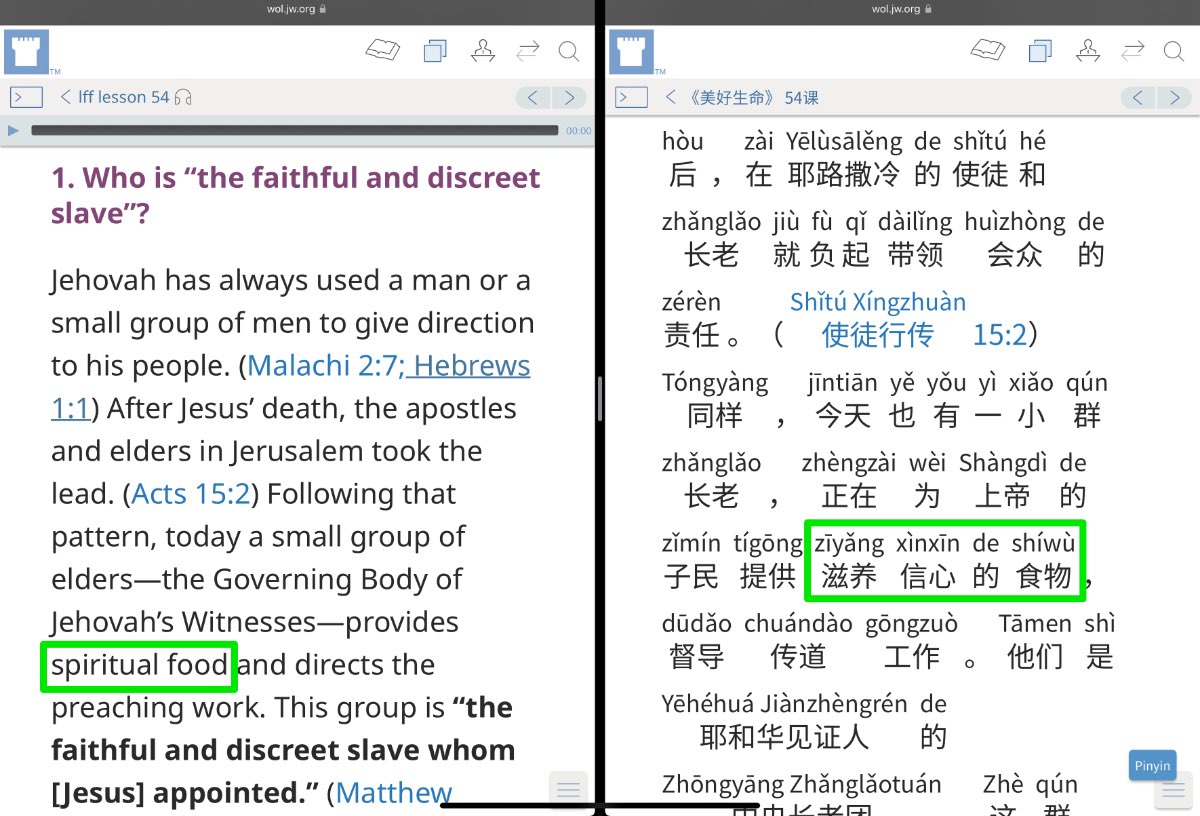
Appendix A2 of the current Mandarin version of the New World Translation Bible (nwtsty) mentions that one of the goals for this version was to reduce the number of hard-to-recognize, hard-to-read Chinese characters used, and to replace them with more commonly used characters. One example it provides is that “gāngbì+ (gāng·bì {[is] firm} · {[is] wilful} 刚愎 剛愎)‐zìyòng (zì·yòng {[is] self-·applying} → [[is] opinionated] 自用)” was changed to this week’s MEotW, “yíyì (yí·yì {(having) one} · intention → [stubbornly] 一意)‐gūxíng (gū·xíng {orphaned → [alone]} · {go; walk → [do]} → [cling to one’s own course; insist on having one’s own way] 孤行)”.—2 Timothy 3:4.
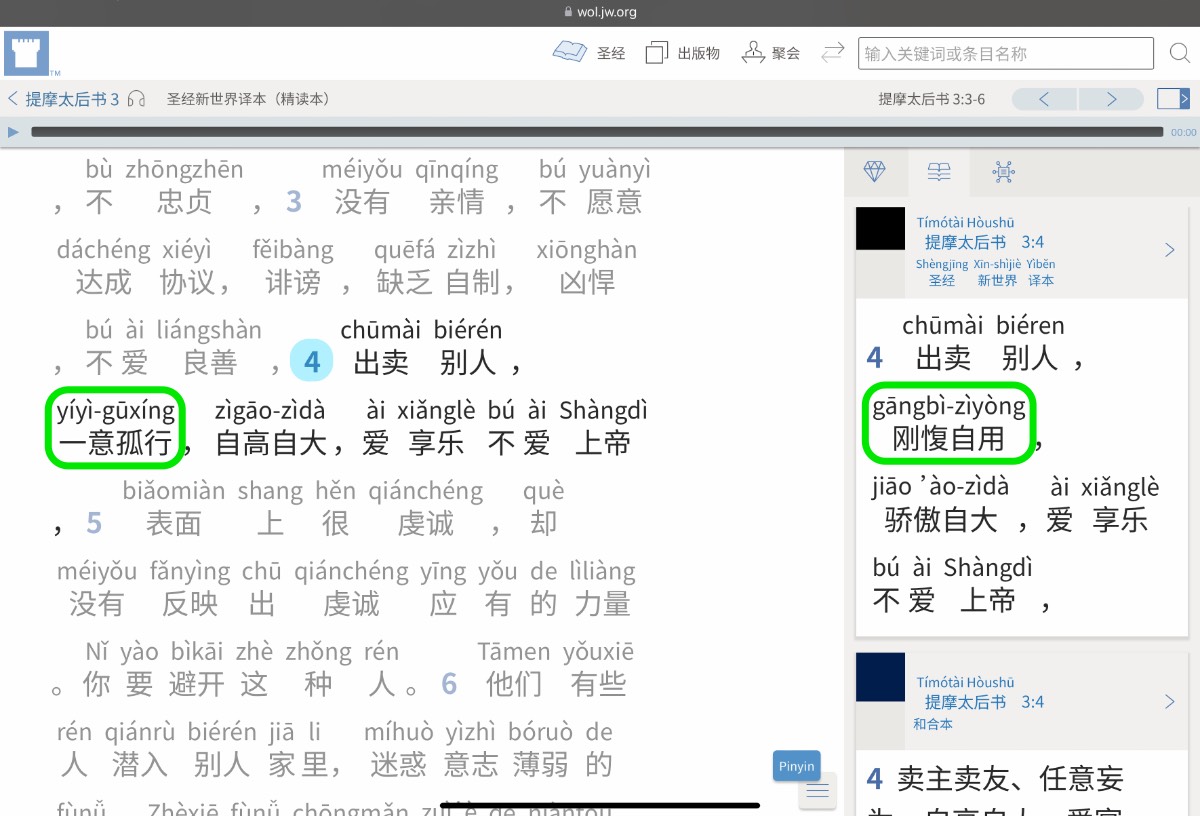
In this case, a relatively unfamiliar, hard-to-parse expression was replaced with a different one that conveys the intended meaning, while being more familiar and easier to understand. This helpful simplification reminds us that the ultimate goal of language should be to communicate, not to show off one’s knowledge of hard words or whatever. And, as the September 1, 1991 Watchtower emphasizes, good communication is motivated by unselfish love:
Christian communication especially needs to be effective because it has as its goal the reaching of people’s hearts with the truth from God’s Word so that, hopefully, they will act on what they learn. Uniquely, it is motivated by unselfishness, by love.
Yes, as 1 Corinthians 8:1 says:
Knowledge puffs up, but love builds up.
More Understandable Alternate Expressions
As discussed in the article “Pīnyīn (Pīn·yīn {Piecing Together of} · Sounds → [Pinyin] 拼音) Was Plan A”, Zhōu Yǒuguāng ((Zhōu {Circumference; Circle (surname)} 周 周/週) (Yǒu·guāng Has · Light 有光) (Chinese linguist, etc., known as “the father of Pīnyīn”)) (Wikipedia article), who led the team that designed Pīnyīn (Pīn·yīn {Piecing Together of} · Sounds → [Pinyin] 拼音), pointed out that assigning alternate expressions with different pronunciations is a good way to address Mandarin’s so-called homophone problem. (Homophones are words that have the same pronunciation, but different meanings.)
From the examples referred to in the Mandarin NWT Appendix A2, we can see that assigning alternate expressions can also be a good way to address the problem of excessively hard-to-recognize or hard-to-understand expressions. Rather than being attached to the idea that particular characters are required to represent certain meanings, as perhaps suggested by the Ideographic Myth, the translators of the Mandarin NWT Bible recognized that representing easily understandable speech is the true priority for God’s people.—1 Corinthians 14:8–11.
So, let us not be yíyì (yí·yì {(having) one} · intention → [stubbornly] 一意)‐gūxíng (gū·xíng {orphaned → [alone]} · {walking → [doing]} → [clinging to one’s own course] 孤行), insisting that the new translated expressions in the current Mandarin NWT are not as good as the old expressions, or clinging to old, erroneous ideas like “Pīnyīn (Pīn·yīn {Piecing Together of} · Sounds → [Pinyin] 拼音) could never work as a writing system for Mandarin because characters are needed to deal with all the homophones in Mandarin.”