kèchéng+ (kè·chéng lessons · procedure → [course; curriculum] 课程 課程) ← Tap/click to show/hide the “flashcard”
[Notes: Tap/click on a Pīnyīn (Pīn·yīn {Piecing Together} · Sounds → [Pinyin] 拼音) expression to reveal its “flashcard”; tap/click on a “flashcard” or its Pīnyīn (Pīn·yīn {Piecing Together} · Sounds → [Pinyin] 拼音) expression to hide the “flashcard”. 📖 📄 ➕ icons mean 📖 Reveal All, 📄 Reveal Advanced, and ➕ Reveal + Symbols re all the “flashcards” in the heading, paragraph, etc. that they are placed at the beginning of.]
As covered in the recent MEotW post on “āijiā‐āihù+ ((āi·jiā {one after another} · households 挨家)‐(āi·hù {one after another} · doors 挨户 挨戶) → [door[-/ ]to[-/ ]door; house[-/ ]to[-/ ]house])”, on September 1, we Jehovah’s Witnesses resumed house-to-house preaching. It is appropriate, then, that as of this writing, jw.org is featuring the article “What Is the Bible Study Course Offered by Jehovah’s Witnesses?”. The Mandarin version of this article makes use of the expression “kèchéng (kè·chéng lessons · procedure → [course; curriculum] 课程 課程)”, perhaps preceded by “Shèngjīng+ (Shèng·jīng Holy · Scriptures → [Bible] 圣经 聖經)”, to correspond with the English expressions “Bible study course”, “Bible study program”, “Bible study”, “study”, “course”, “Bible course”, “Bible lessons” (from the title of the referenced Enjoy Life Forever!—Introductory Bible Lessons brochure), “study course”, “Bible study lessons”, and “lessons”.
Interestingly, “[Shèngjīng (Shèng·jīng Holy · Scriptures → [Bible] 圣经 聖經)] yánjiū (yán·jiū {grinding → [studying]} · {studying carefully} → [study] 研究)”, an expression that has long been used in the past to mean “[Bible] study”, does not appear at all in the above-mentioned article.
Related Expressions
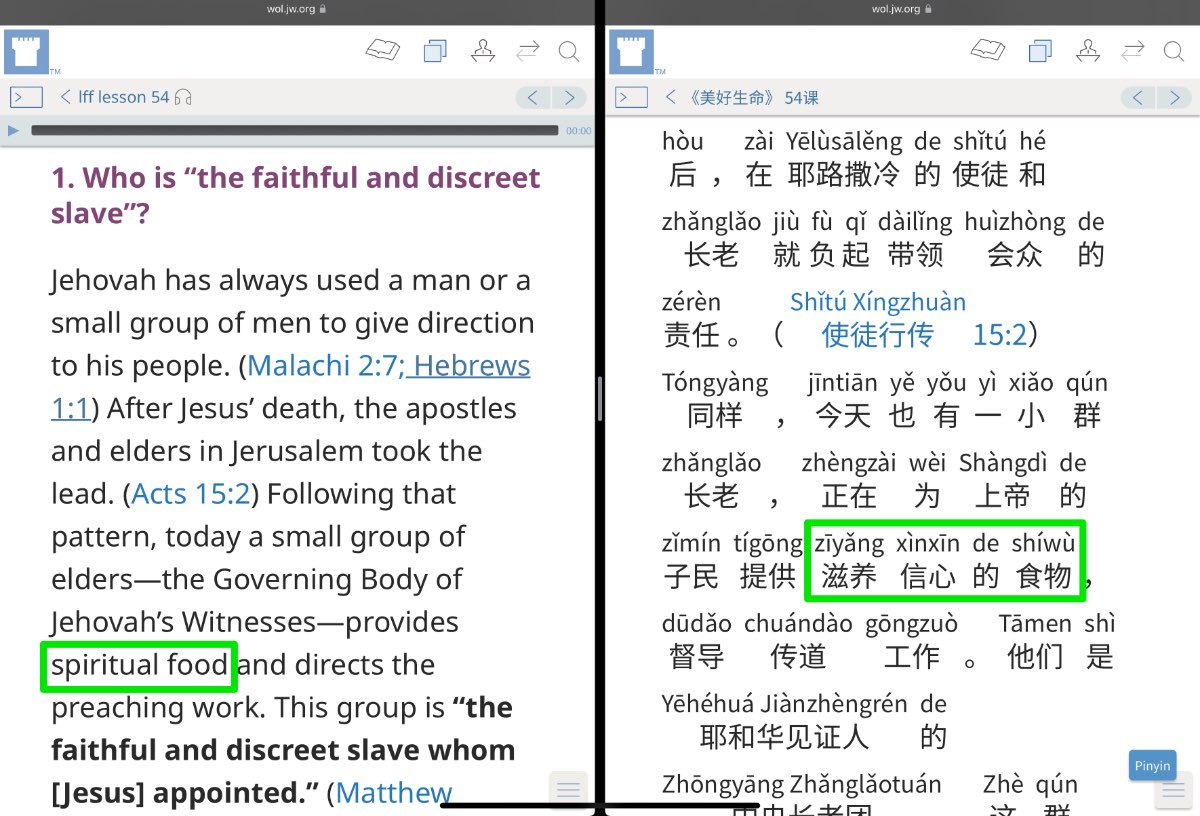
The “kè+ (subject; course; class | lesson 课 課)” in “kèchéng (kè·chéng lessons · procedure → [course; curriculum] 课程 課程)” may be familiar to those who have used the Mandarin versions of publications like the Good News brochure and the Enjoy Life Forever! brochure/book, since that is the Mandarin word used to correspond with the English word “lesson”. For example, “Lesson 10” is “Dì‐10 ((Dì [pref to form ordinal numbers] 第)‐(Shí Ten 10) → [10th]) Kè+ (Lesson 课 課)”.
Besides “kèchéng (kè·chéng lessons · procedure → [course; curriculum] 课程 課程)”, another word that “kè (subject; course; class | lesson 课 課)” appears in is “kèběn+ (kè·běn {course | lessons} · {root or stem → [mw for books, etc.]} → [textbook; coursebook] 课本 課本)”, which the above-mentioned article uses in reference to the Enjoy Life Forever! book that is now officially recommended for use on Bible studies. (Interestingly, the English version of the article does not use the word “textbook”, which is the main dictionary definition for “kèběn (kè·běn {course | lessons} · {root or stem → [mw for books, etc.]} → [textbook; coursebook] 课本 課本)”. It does, though, refer to the Enjoy Life Forever! book as an “interactive Bible course”. So, “coursebook” may be a better match for “kèběn (kè·běn {course | lessons} · {root or stem → [mw for books, etc.]} → [textbook; coursebook] 课本 課本)” in this case.)
As for the second morpheme in “kèchéng (kè·chéng lessons · procedure → [course; curriculum] 课程 課程)”, it is also used, perhaps unexpectedly, in “gōngchéng+ (gōng·chéng work · {procedure → [journey]} → [engineering | [engineering/work] project] 工程)” and in “gōngchéngshī+ (gōng·chéng·shī {work · {procedures → [journeys]} → [engineering]} · {master → [skilled person; expert; specialist]} → [engineer] 工程师 工程師)”.
Usage Examples
Here are a couple of examples of “kèchéng (kè·chéng lessons · procedure → [course; curriculum] 课程 課程)” in use, taken from the above-mentioned article:
English:
Our Bible study program can help you to:
- Have a happy life
- Become God’s friend
- Learn what the Bible promises for the future
Mandarin:
📖 📄 ➕ Wǒmen de ((Wǒ·men us · [pl] 我们 我們) (de ’s 的) → [our]) Shèngjīng (Shèng·jīng Holy · Scriptures → [Bible] 圣经 聖經) kèchéng (kè·chéng lessons · procedure → [course] 课程 課程) kěyǐ (kě·yǐ can · [suf] 可以) bāngzhù (help 帮助 幫助) nǐ (you 你):
- 📖 📄 ➕ Guò ({to pass} 过 過) kuàilè (happy 快乐 快樂) de (’s 的) shēnghuó (shēng·huó life · living 生活)
- 📖 📄 ➕ Gēn (with 跟) Shàngdì (Shàng·dì Above’s · {Emperor → [God]} → [God] 上帝) jiànlì (jiàn·lì {to build} · {to make to stand} → [to establish] 建立) yǒuyì+ (yǒu·yì friendly · friendship → [friendship] 友谊 友誼)
- 📖 📄 ➕ Liǎojiě+ (Liǎo·jiě {to understand} · {to untie → [to solve]} → [to understand] 了解 了/瞭解) Shèngjīng (Shèng·jīng (the) Holy · Scriptures → [the Bible] 圣经 聖經) gěi (gives 给 給) rén (people 人) de (’s 的) xīwàng (xī·wàng hoping · {gazing (into the distance) → [hoping]} → [hope] 希望)
English:
These interactive lessons answer some of life’s most important questions.
Mandarin:
📖 📄 ➕ Zhèige (Zhèi·ge this · [mw] 这个 這個) hùdòng+ (hù·dòng {each other} · moving → [interactive] 互动 互動) shì (type 式) Shèngjīng (Shèng·jīng Holy · Scriptures → [Bible] 圣经 聖經) kèchéng (kè·chéng lessons · procedure → [course] 课程 課程) huì (will 会 會) huídá (huí·dá {circle back} · {to answer} 回答) yìxiē (yì·xiē one · {indefinite number of} → [some] 一些) zhòngyào (zhòng·yào weighty · important 重要) wèntí (wèn·tí asking · subjects → [questions] 问题 問題).
For convenience:
The direct link for the Pīnyīn (Pīn·yīn {Piecing Together of} · Sounds → [Pinyin] 拼音)+ resource for the Enjoy Life Forever! brochure is:
The short link for Chinese field language-learning links for the Enjoy Life Forever! brochure is: