Categories
Culture Experiences Language Learning Science Technology Theocratic

dòngnù

dòngnù (dòng·nù {have moved} · anger; rage; fury → [get angry; lose temper; fly into a rage] 动怒 動怒) 👈🏼 Tap/click to show/hide the “flashcard”

[Notes: Tap/click on a Pīnyīn (Pīn·yīn {Piecing Together of} · Sounds → [Pinyin] 拼音) expression to reveal its “flashcard”; tap/click on a “flashcard” or its Pīnyīn (Pīn·yīn {Piecing Together of} · Sounds → [Pinyin] 拼音) expression to hide the “flashcard”. 📖 📄 📘 icons mean 📖 Reveal All, 📄 Reveal Advanced, and 📘 Reveal None re all the “flashcards” in the heading, paragraph, etc. that they are placed at the beginning of.]

I have long especially liked 1 Corinthians 13. It contains counsel on what really does and doesn’t matter in life, an extensive description and definition of the most important kind of love, and a sublime discussion about the need to become complete, mature, as a person. As these apply to life in general, so too do they apply to our lives as Mandarin field language learners.

As Mandarin field language learners, it can benefit us greatly to consider what we can learn from 1 Corinthians 13, and along the way, we can also consider some of the Mandarin expressions used in that chapter in the current version of the Mandarin New World Translation Bible (nwtsty).

Moved to Anger

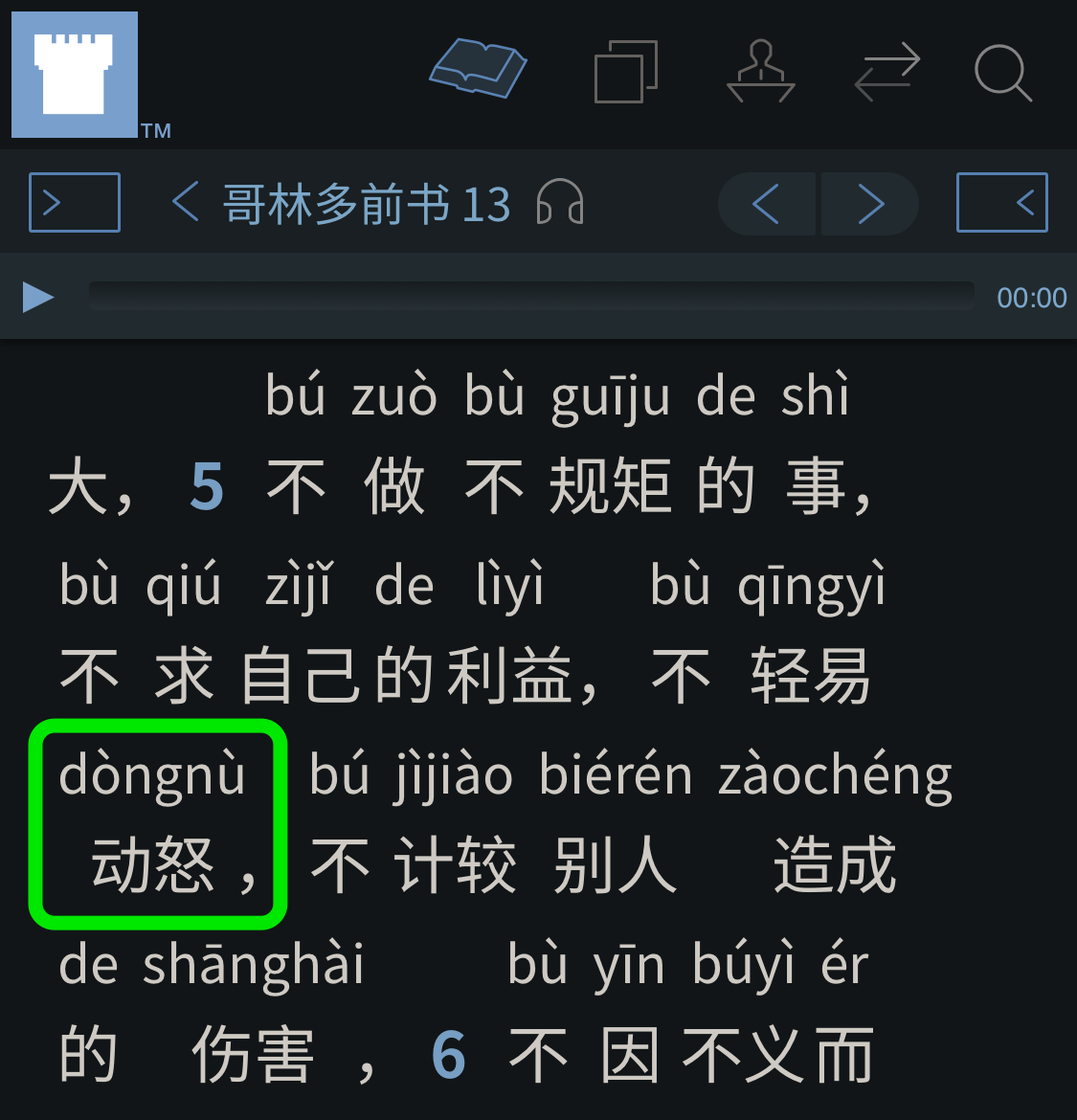
This week’s MEotW, “dòngnù (dòng·nù {have moved} · anger; rage; fury → [get angry; lose temper; fly into a rage] 动怒 動怒)”, is used in verse 5 (WOL) of 1 Corinthians 13:

Screenshot of “_dòngnù_” in 1 Co. 13:5 (nwtsty, CHS+_Pīnyīn_ WOL)

(Dark mode for the Watchtower ONLINE LIBRARY (WOL) website, as shown in the above image, can be enabled in the Safari web browser by using the Noir Safari extension. Other web browsers may also have extensions with similar functionality.)

For comparison, here are the current English and Pīnyīn (Pīn·yīn {Piecing Together of} · Sounds → [Pinyin] 拼音) Plus renderings of 1 Corinthians 13:5:

English:

does not behave indecently, does not look for its own interests, does not become provoked. It does not keep account of the injury.

Pīnyīn (Pīn·yīn {Piecing Together of} · Sounds → [Pinyin] 拼音) Plus:

📖 📄 📘 (not 不) zuò ({does do} 做) (not 不) guīju (guī·ju (following) {dividers → [rules]} · {carpenter’s squares → [regulations]} → [following established standards] 规矩 規矩) de ( 的) shì (things 事), (not 不) qiú ({does seek} 求) zìjǐ (self 自己) de (’s 的) lìyì (lì·yì {sharpening → [advantage]} · benefit → [benefit] 利益), (not 不) qīngyì (qīng·yì lightly · easily 轻易 輕易) dòngnù (dòng·nù {does have moved} · anger → [does get angry] 动怒 動怒), (not 不) jìjiào (jì·jiào {does count} · {does dispute about} 计较 計較) biéren (bié·ren other · people 别人 別人) zàochéng (zào·chéng {have created} · {to come to be} 造成) de (’s 的) shānghài (injuring → [injury] 伤害 傷害),

In the example above, the Mandarin phrase “bù (not 不) qīngyì (qīng·yì lightly · easily 轻易 輕易) dòngnù (dòng·nù {does have moved} · anger → [does get angry] 动怒 動怒) corresponds with the English phrase “does not become provoked”. As for the morphemes in “dòngnù (dòng·nù {have moved} · anger; rage; fury → [get angry; lose temper; fly into a rage] 动怒 動怒)”, they literally mean “have moved anger/rage/fury”, and effectively mean “get angry; lose one’s temper; fly into a rage”.

Angrily Holding On to Tradition

I remember more than one Mandarin field language learner who reacted angrily when I suggested that using Pīnyīn (Pīn·yīn {Piecing Together of} · Sounds → [Pinyin] 拼音) more and deemphasizing characters would help them progress in learning Mandarin. Rather than appreciating the evident truth of what I was saying, or being thankful that I was trying to help them, they seemed offended and upset that I had dared to suggest something so out of step with the human traditions that they had been taught all their lives, and, perhaps, indignant that I had, in their estimation, dismissed and invalidated the blood, sweat, and tears that they had personally invested for years and years into the long, hard, bitter struggle that is learning characters.

On the one hand, some may say that such reactions are only human, but on the other hand, the words of 1 Corinthians 13:5 that love “does not become provoked” show that actually, such ones are not completely acting out of Christian love when they react that way. As the Insight book says:

Love “does not become provoked.” It does not look for an occasion or an excuse for provocation. It is not moved to outbursts of anger, which is a work of the flesh. (Ga 5:19, 20) One having love is not easily offended by what others say or do. He is not afraid that his personal “dignity” may be injured.

Happily, not all Mandarin field language learners react as mentioned above. Rather than reacting out of personal indignation, cultural pride, traditionalism, and chauvinism, or the tribalism of the embattled few in “the club” who have long endured together the difficult burdens of dealing with the unnecessarily extraordinarily complex characters, even some long-time Mandarin field language learners who have worked hard for a long time to learn characters listen humbly to the information I share with them about the linguistic truths that apply to our Mandarin field language learning, and are appreciative that these truths help to set them free from the unnecessary burdens imposed by mere human tradition.—John 8:32.

Categories
Culture History Language Learning Names Technology

fántǐ‐zì

fántǐ (fán·tǐ complicated; complex; difficult · {body → [style] → [typeface; font]} → [traditional Chinese] 繁体 繁體) (characters 字) 👈🏼 Tap/click to show/hide the “flashcard”

[This is a reposting of a post that was originally posted on November 30, 2020. I took the opportunity to flesh out the original post and this repost with additional material.]

For a long, long, long time, Chinese characters were just Chinese characters. Then, in 1956, the Communist government of mainland China issued what came to be known as the First Chinese Character Simplification Scheme (a second round of Chinese character simplification was later attempted and ultimately rescinded), and official simplified Chinese characters came into the world. (Some characters had been unofficially simplified and used for various purposes, both everyday and artistic, before that.)

Name?

To distinguish these newfangled official simplified Chinese characters from the Chinese characters that had existed before, and that continue to be used by many people in many parts of the world, retronyms were coined to refer to these pre-existing Chinese characters, just as the term “acoustic guitar” was coined to refer to a regular non-electric guitar after electric guitars came along.

In the English-speaking world, the pre-official simplification characters have come to be called “traditional Chinese characters”, as opposed to the “simplified Chinese characters”. In the Chinese-speaking world, as is true of many things regarding Chinese characters, the situation is…complicated. Wikipedia summarizes the situation thusly:

Traditional Chinese characters (the standard characters) are called several different names within the Chinese-speaking world. The government of Taiwan officially calls traditional Chinese characters standard characters or orthodox characters (traditional Chinese: 正體字; simplified Chinese: 正体字; pinyin: zhèngtǐzì; Zhuyin Fuhao: ㄓㄥˋ ㄊㄧˇ ㄗˋ).[source] However, the same term is used outside Taiwan to distinguish standard, simplified and traditional characters from variant and idiomatic characters.[source]

In contrast, users of traditional characters outside Taiwan, such as those in Hong Kong, Macau and overseas Chinese communities, and also users of simplified Chinese characters, call them complex characters (traditional Chinese: 繁體字; simplified Chinese: 繁体字; pinyin: fántǐzì; Zhuyin Fuhao: ㄈㄢˊ ㄊㄧˇ ㄗˋ). Users of simplified characters sometimes informally refer to them as “old characters” (Chinese: 老字; pinyin: lǎozì; Zhuyin Fuhao: ㄌㄠˇ ㄗˋ).

Users of traditional characters also sometimes call them “full Chinese characters” (traditional Chinese: 全體字; simplified Chinese: 全体字; pinyin: quántǐ zì; Zhuyin Fuhao: ㄑㄩㄢˊ ㄊㄧˇ ㄗˋ) to distinguish them from simplified Chinese characters.

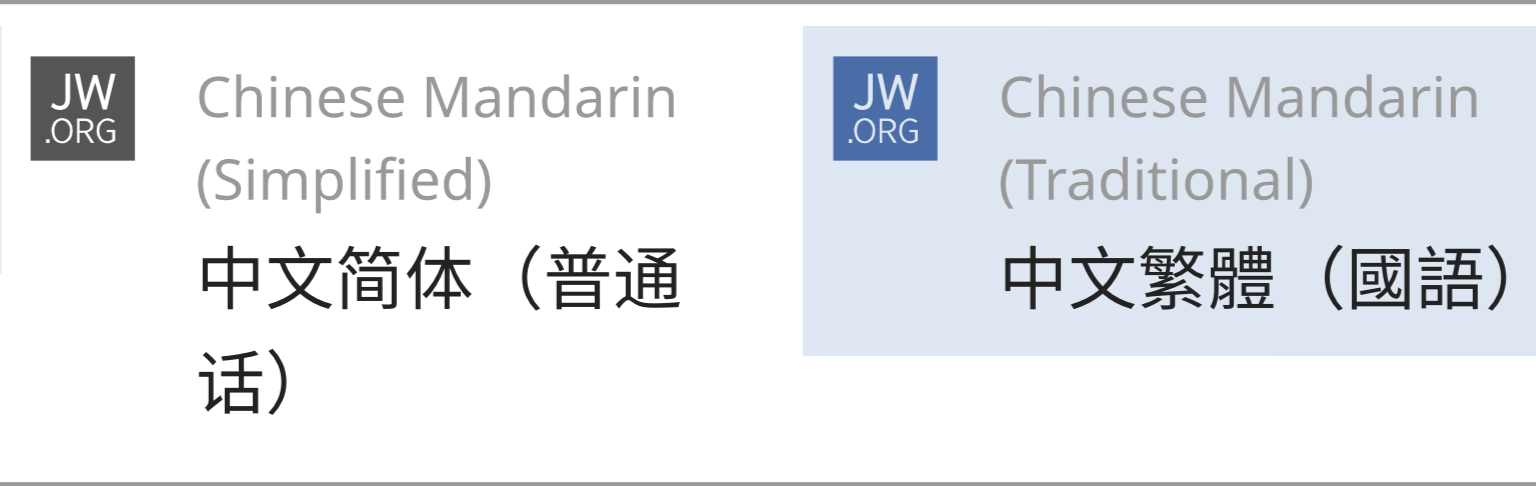
In my experience in the Chinese fields in Canada, I have always heard traditional Chinese characters referred to using this week’s MEotW, “fántǐ (fán·tǐ complicated; complex; difficult · {body → [style] → [typeface; font]} → [traditional Chinese] 繁体 繁體) (characters 字)”. For reference, this is also the term used on jw.org when referring to Mandarin written using traditional Chinese characters:

jw.org referring to Mandarin written using traditional Chinese characters

jw.org refers to traditional Chinese characters as “fántǐ (fán·tǐ complicated; complex; difficult · {body → [style] → [typeface; font]} → [traditional Chinese] 繁体 繁體)” characters.

Beloved by Traditionalists and Purists, But Complicated

Many feel that traditional characters are the best characters of all, since, in their estimation, the official simplified characters have lost some of the heart and soul of characters. As a symbolic example, some point to how the simplified character for “love”, “爱”, omits the “heart” radical (“心”), which is appropriately in the traditional character for “love”, “愛”.

Yes, as the above post mentions, the obvious, glaring issue with traditional characters is—aggravated by the fact that there are tens of thousands of them—their extreme, extraordinary complexity, the result of their problematically complex basic nature, along with thousands of years of accumulated occasionally arbitrary design decisions and developmental cruft. For example, note the below excerpt from p. 82 of the book The Chinese Language: Fact and Fantasy, by John DeFrancis:

In the case of the rendition for the huáng meaning “sturgeon” we have two variants, one written with the “yellow” phonetic and the other with the “emperor” phonetic, both combined with the semantic element for “fish”:

魚 “fish”
鱑 “fish” + huáng “yellow” = huáng “sturgeon”
鰉 “fish” + huáng “emperor” = huáng “sturgeon”

While etymological research might succeed in clarifying the basis for some of the variation, in many cases, as one specialist in Chinese paleography concludes, “it is simply a matter of the whim of the writer” (Barnard 1978:203).

Scribal whim goes far to explain a diversity bordering on chaos in the forms of the Chinese characters as they evolved in the Shang dynasty and during the long years of political and administrative disunity in the Zhou dynasty (ca. 1028–221 B.C.). The situation was aggravated by the fact that characters were created by writers living in different historical periods, which inevitably meant changes in sounds over the years, and speaking different dialects, which inevitably affected their choice of phonetic elements in the creation of new characters.

Their inherent extraordinary complexity, exacerbated by an accumulated millennia-long history of design decisions made on a whim, out-of-date phonetic elements, etc., causes especially the traditional characters, and even the (moderately) simplified characters, to be extremely difficult for us imperfect humans to learn and to remember. This has lead to character amnesia and the Great Wall of unfamiliar characters being real things, even among those who have been studying characters for decades. How complex can traditional characters get? Theoretically, there is no upper limit!

The extreme, extraordinary complexity of traditional characters undoubtedly contributed greatly to illiteracy having been widespread in China for much of its history. Even for those who are privileged to be able to devote the extraordinary amount of time and effort needed to learn traditional characters, it’s a long, hard slog, compared to learning a comparatively simple and compact alphabetical writing system. It’s little wonder, then, that there have been serious, concerted efforts to simplify and even replace traditional Chinese characters.

Categories
Culture Language Learning Technology Theocratic

lìyì

lìyì (lì·yì {sharpening → [advantage; benefit; gain | profit; interest]} · benefit; advantage; profit → [benefit; profit] 利益) 👈🏼 Tap/click to show/hide the “flashcard”

[Notes: Tap/click on a Pīnyīn (Pīn·yīn {Piecing Together of} · Sounds → [Pinyin] 拼音) expression to reveal its “flashcard”; tap/click on a “flashcard” or its Pīnyīn (Pīn·yīn {Piecing Together of} · Sounds → [Pinyin] 拼音) expression to hide the “flashcard”. 📖 📄 📘 icons mean 📖 Reveal All, 📄 Reveal Advanced, and 📘 Reveal None re all the “flashcards” in the heading, paragraph, etc. that they are placed at the beginning of.]

I have long especially liked 1 Corinthians 13. It contains counsel on what really does and doesn’t matter in life, an extensive description and definition of the most important kind of love, and a sublime discussion about the need to become complete, mature, as a person. As these apply to life in general, so too do they apply to our lives as Mandarin field language learners.

As Mandarin field language learners, it can benefit us greatly to consider what we can learn from 1 Corinthians 13, and along the way, we can also consider some of the Mandarin expressions used in that chapter in the current version of the Mandarin New World Translation Bible (nwtsty).

“Lookin’ Out for #1”?

This week’s MEotW, “lìyì (lì·yì {sharpening → [advantage; benefit; gain | profit; interest]} · benefit; advantage; profit → [benefit; profit] 利益)”, is used in verse 5 (WOL) of 1 Corinthians 13:

Screenshot of “_lìyì_” in 1 Co. 13:5 (nwtsty, CHS+_Pīnyīn_ WOL)

(Dark mode for the Watchtower ONLINE LIBRARY (WOL) website, as shown in the above image, can be enabled in the Safari web browser by using the Noir Safari extension. Other web browsers may also have extensions with similar functionality.)

For comparison, here are the current English and Pīnyīn (Pīn·yīn {Piecing Together of} · Sounds → [Pinyin] 拼音) Plus renderings of 1 Corinthians 13:5:

English:

does not behave indecently, does not look for its own interests, does not become provoked. It does not keep account of the injury.

Pīnyīn (Pīn·yīn {Piecing Together of} · Sounds → [Pinyin] 拼音) Plus:

📖 📄 📘 (not 不) zuò ({does do} 做) (not 不) guīju (guī·ju (following) {dividers → [rules]} · {carpenter’s squares → [regulations]} → [following established standards] 规矩 規矩) de ( 的) shì (things 事), (not 不) qiú ({does seek} 求) zìjǐ (self 自己) de (’s 的) lìyì (lì·yì {sharpening → [advantage]} · benefit → [benefit] 利益), (not 不) qīngyì (qīng·yì lightly · easily 轻易 輕易) dòngnù (dòng·nù {does have moved} · anger → [does get angry] 动怒 動怒), (not 不) jìjiào (jì·jiào {does count} · {does dispute} 计较 計較) biéren (bié·ren other · people 别人 別人) zàochéng (zào·chéng {have created} · {to come to be} 造成) de (’s 的) shānghài (injuring → [injury] 伤害 傷害),

The “lì (sharpen [→ [do good [for/to]; be beneficial [for/to]]] | sharpened [→ [sharp | favourable; advantageous; good; beneficial; smooth; convenient]] | sharpening [→ [advantage; benefit; gain | profit; interest]] 利) in “lìyì (lì·yì {sharpening → [advantage; benefit; gain | profit; interest]} · benefit; advantage; profit → [benefit; profit] 利益) literally means “sharpening”, and can effectively mean “advantage; benefit; gain”. Similarly, the “yì (benefit; good; advantage; profit; increase | beneficial; profitable | {to increase; to benefit} 益) in “lìyì (lì·yì {sharpening → [advantage; benefit; gain | profit; interest]} · benefit; advantage; profit → [benefit; profit] 利益) means “benefit; advantage; profit”. We can see then, why in 1 Corinthians 13:5 in the current English and Mandarin versions of the New World Translation Bible, “bù (not 不) qiú ({does seek} 求) zìjǐ (self 自己) de (’s 的) lìyì (lì·yì {sharpening → [advantage]} · benefit → [benefit] 利益) corresponds with the English phrase “does not look for its own interests”.

In this regard, true Christian love is completely opposite from the norm in Satan’s world, which is the kind of self-interest and lovelessness that’s expressed by this excerpt from the lyrics of the song “Lookin’ Out for #1”:

Every night is a different game
We gotta work for our fortune and fame
Success is a ladder, take a step at a time
And the people will remember your name

Yes, I found out all the tricks of the trade
And that’s there’s only one way you’re gonna get things done
I found out the only way to the top
Is looking out for number one
And that’s me, I’m looking out for number one

Not Looking For Our Own Interests in the Mandarin Field

Unlike the self-seeking people of Satan’s world, Mandarin field language learners who seek to show Christian love must not view their language learning and ministry as just a game, nor should they be seeking fortune and fame, or success as defined by the world. And rather than wanting people to remember their names, they seek to proclaim Jehovah’s name. Rather than trying to get to the top, they try to help Mandarin-speaking people to get everlasting life. Yes, rather than looking out for number one (themselves), they exert themselves and make sacrifices to help others as spiritual rescue workers, and they seek to glorify, not themselves, but rather, Jehovah, as admonished by our recently introduced song “Give Jehovah Glory”.

To help us gain insight on how well we are doing when it comes to not looking for our own interests in the Mandarin field, we could consider the following:

  • If we are exerting ourselves to learn the traditionally used but exceedingly complex Chinese characters, how much of our motivation is to be more able to help Mandarin-speaking people more effectively and glorify Jehovah more clearly and eloquently, and how much is it to glorify ourselves in the eyes of tradition-loving advocates of worldly Chinese culture?
  • Are we resistant to Pīnyīn (Pīn·yīn {Piecing Together of} · Sounds → [Pinyin] 拼音) because it doesn’t have the same worldly cultural glamour and prestige as the characters do, or do we value it because of how it can help us to more quickly, easily, and effectively glorify Jehovah and give spiritual help to Mandarin-speaking people?
  • This year’s convention program helps us to further appreciate the kind of person Jesus showed himself to be when he was on earth. As Jesus’ Christian followers, we seek to follow his example, including his example in showing love that “does not look for its own interests”.
    • From what we have learned about Jesus, if he were on earth today and serving in the Mandarin field, would he be impressed by the glorious, prestigious traditions of worldly Chinese culture, such as those involving Chinese characters? Would he be okay with allowing such human traditions to make it much more difficult than necessary to glorify Jehovah in Mandarin and give spiritual help to Mandarin-speaking people? Considering how he viewed the Sabbath traditions of the first-century Jews, which only unnecessarily oppressively burdened people one day a week, how would he view today’s human-mandated traditions involving Chinese characters, which unnecessarily oppressively burden his followers in the Mandarin field every single day?John 5:16, 17; 41–44.