Categories
Culture History Language Learning Science Theocratic

tiān‐yī‐wúfèng

tiān‐yī‐wúfèng ((tiān [(is)] heavenly 天)‐(yī garment 衣)‐(wú·fèng without · seams 无缝 無縫) [[is] flawless]) 👈🏼 Tap/click to show/hide the “flashcard”

[Notes: Tap/click on a Pīnyīn (Pīn·yīn {Piecing Together of} · Sounds → [Pinyin] 拼音) expression to reveal its “flashcard”; tap/click on a “flashcard” or its Pīnyīn (Pīn·yīn {Piecing Together of} · Sounds → [Pinyin] 拼音) expression to hide the “flashcard”. 📖 📄 📘 icons mean 📖 Reveal All, 📄 Reveal Advanced, and 📘 Reveal None re all the “flashcards” in the heading, paragraph, etc. that they are placed at the beginning of.]

We in the Mandarin field should keep in mind that many Mandarin-speaking people were taught to believe in evolution, and thus tend to not believe in God. The Shēngmìng Láizì Chuàngzào Ma? ((Shēngmìng Life 生命) (Lái·zì Came · From 来自 來自) (Chuàng·zào Initiating · {Making, Creating} → [Creating] 创造 創造) (Ma [? ptcl for “yes/no” questions])? [Was Life Created? (lc)]) (Was Life Created? (lc)) brochure and the Shēngmìng de Qǐyuán—Zhíde Sīkǎo de Wǔ Ge Wèntí ((Shēngmìng Life 生命) (de ’s 的) (Qǐ·yuán {Rising → [Starting]} · Source → [Origin] 起源/原)—(Zhí·de Worth · Getting → [Worth] 值得) (Sī·kǎo {Thinking About} · Examining 思考) (de ’s 的) (Wǔ Five 五) (Ge [mw]個/个) (Wèn·tí Asking · Subjects → [Questions] 问题 問題) [The Origin of Life—Five Questions Worth Asking (lf)]) (The Origin of Life—Five Questions Worth Asking (lf)) brochure were originally published back in 2010, but they are still considered current publications, and relatively recently, the English version of the Was Life Created? brochure was updated to the December 2022 Printing, and the Mandarin version of it was updated to the February 2023 Printing. So, it would be good for us to consider some of the expressions used in the Mandarin versions of the Was Life Created? and Origin of Life brochures, which can be so helpful when discussing the fundamentally important question of whether life was created.

“Very Fortunate” Indeed!

This week’s MEotW, which appears in the first paragraph of the section of the Mandarin Was Life Created? brochure entitled “Shēngjī (Shēng·jī Life · {Mechanism → [Being Organic]} → [Life] 生机 生機)Bóbó (Bó·bó Flourishing · Flourishing 勃勃) de (’s 的) Dìqiú (Dì·qiú Earth · Globe 地球) (“The Living Planet”), is “tiān‐yī‐wúfèng ((tiān [(is)] heavenly 天)‐(yī garment 衣)‐(wú·fèng without · seams 无缝 無縫) [[is] flawless])”:

English:

Life on earth could never exist were it not for a series of very fortunate “coincidences,”

Mandarin (WOL; Pīnyīn (Pīn·yīn {Piecing Together of} · Sounds → [Pinyin] 拼音) Plus)

📖 📄 📘 Dìqiú (Dì·qiú earth · globe 地球) zài (in 在) hěn (very 很) duō (many 多) fāngmiàn (fāng·miàn {directions → [sides]} · faces → [aspects] 方面) dōu ({all of them} 都)qiǎohé (qiǎo·hé {being coincidental → [coincidentally]} · {closing → [matching]} → [coincidental] 巧合)de (-ly 地) pèihe (pèi·he matches · {closes → [accords]} → [is suitable] 配合) de (getting 得) tiān‐yī‐wúfèng ((tiān (to be) heavenly 天)‐(yī garment 衣)‐(wú·fèng without · seams 无缝 無縫) [to be flawless]), yào (if 要)bu ((it) not 不)shì ({would be} 是) zhèyàng (zhè·yàng this · {form → [way]} 这样 這樣), dìqiú (dì·qiú earth · globe 地球) shang (upon 上) gēnběn (gēn·běn {root (of a plant)} · {root or stem of a plant} → [basically] 根本) jiù (then 就) (not 不) kěnéng (could 可能) yǒu (have 有) shēngmìng (life 生命).

Where the English Was Life Created? brochure speaks of the “coincidences” that made life possible on earth as “very fortunate” (a bit of British understatement?), the Mandarin Was Life Created? brochure effectively says these “coincidences” made earth “suitable for life to a miraculously/superhumanly flawless extent”. In the process of doing so, it evokes the long-standing Chinese cultural concept of “Tiān (Heaven [→ [God]] 天),” or Heaven.

“Let Me Reintroduce You to…”

As the Lasting Peace brochure (English, Mandarin) helps us understand, this concept of “Tiān (Heaven [→ [God]] 天) is a kind of conceptual bridge back to a time when historical records show that the Chinese worshipped one supreme deity:

WHO IS GOD?

TO THE Chinese, the concept of God, or Shang-di (literally “Emperor above”), is both foreign and abstract. Most people worship heaven and earth, spirits and demons, ancestors and other humans. Interestingly, however, according to Chinese historical records, between three and four thousand years ago, during the Xia and Shang dynasties, the Chinese were already worshipping one supreme deity. The book The Religious History of China explains that they “reckoned that between heaven and earth there was a principal God who stood supreme and had absolute control over all things. . . . This supreme deity came to be called Di, or Shang-di, during the Shang Dynasty, and was known as Tien [heaven], or Tien-di [Emperor in Heaven], during the Zhou Dynasty [11th century to 256 B.C.E.].” Thus, the ancient Chinese believed in the existence of a Supreme Sovereign of the universe.

During the Spring and Autumn period (c. 722-481 B.C.E.) and the Warring States period (c. 480-221 B.C.E.), Confucianism and Taoism gained ascendancy. Influenced by these two schools of thought, the worship of Shang-di was gradually replaced by the abstract idea of reverence for Tien. By the Han dynasty (202 B.C.E.–221 C.E.), under the dominance of Confucianism, the Chinese became engrossed in moral culture and social order, and the concept of Shang-di suffered another setback. With the spread of Buddhism into China, the Chinese no longer held to the belief of a Creator who is in control of the universe, but they accepted Heaven, or Providence, as the first cause of all things. Since then, the concept of God, or Shang-di, has become something completely foreign to most Chinese.

Who, then, really is God? The Bible shows that God is not a force or law of nature that governs the operation of all things in the universe. Nor is he Tien, which is venerated by many Chinese. Rather, God is a living spirit who has feelings and personality traits. He is the almighty and omniscient Sovereign of the Universe, and his love is boundless. Not only has he created all things but he also has a definite purpose for mankind—that we worship him with love and live forever on this beautiful earth in lasting peace and happiness.

(PDF files with 3-line material covering the Mandarin version of the above quotation from the Lasting Peace brochure can be downloaded from here (iPad-Letter-A4) or here (XLP-iPhone-A5). (Pīnyīn (Pīn·yīn {Piecing Together of} · Sounds → [Pinyin] 拼音) Plus material for the Lasting Peace brochure is in the works, but is not quite ready to be posted yet.) The short link for Chinese field language-learning links for the Lasting Peace brochure is: Lasting Peace Brochure Links (tiandi.info/pc).)

Use of this week’s MEotW in the Mandarin Was Life Created? brochure reflects good insight into what can help us to reach the hearts of the Chinese people we meet in the Mandarin field, as we reintroduce them to the “Supreme Sovereign of the universe” whom they once recognized and worshipped.


For convenience:

The direct link for the current-generation Pīnyīn (Pīn·yīn {Piecing Together of} · Sounds → [Pinyin] 拼音) Plus resource for the Was Life Created? brochure is:

The short link for Chinese field language-learning links for the Was Life Created? brochure is:

More Pīnyīn (Pīn·yīn {Piecing Together of} · Sounds → [Pinyin] 拼音) and Pīnyīn (Pīn·yīn {Piecing Together of} · Sounds → [Pinyin] 拼音) Plus web material based on the Mandarin Was Life Created? brochure will be made available in the Pīnyīn (Pīn·yīn {Piecing Together of} · Sounds → [Pinyin] 拼音) Plus web resource as time allows.
Categories
Culture Language Learning Science

jítǐ zhǔyì

jítǐ zhǔyì ((jí·tǐ gathered; collected · {body [→ [style; form]]} → [collective] 集体 集體) (zhǔ·yì master · meaning → [-ism] 主义 主義) [collectivism; community spirit]) ← Tap/click to show/hide the “flashcard”

Generally speaking, Western societies are considered to be relatively individualistic, while Eastern societies, like Chinese ones, are considered to be relatively collectivistic, emphasizing the collective, or group, over the individual. This week’s MEotW, “jítǐ zhǔyì ((jí·tǐ gathered; collected · {body [→ [style; form]]} → [collective] 集体 集體) (zhǔ·yì master · meaning → [-ism] 主义 主義) [collectivism; community spirit])”, seems to be the main Mandarin expression referring to such collectivism. (The MEotW post on “kǒngbù huódòng ((kǒng·bù fearing · terror → [terrorist] 恐怖) (huó·dòng living · moving → [activities] 活动 活動) [terrorism; terrorist activities]) contains a brief discussion about some other Mandarin -isms.)

Differences and Possible Causal Factors

While researching this post, I came across a scientific paper that has some interesting information about individualism and collectivism, including some information about measurable regional variations in collectivism that have been found across the Chinese mainland. Here is a quotation from it, regarding individualism and collectivism in general:

The distinction between individualism and collectivism captures important differences in how the relationship between self and others is constructed, as well as whether the individual or the group is understood as the basic unit of analysis (Cross et al., 2011; Hofstede, 2001; Markus & Kitayama, 1991, 2010; Oyserman et al., 2002; Triandis, 1995). People living in individualistic cultural contexts (e.g., the United States and the United Kingdom) tend to pay more attention to the achievement of their own goals and their own uniqueness. They have clear boundaries with others and pursue well-being or life satisfaction by sharing feelings and achieving personal success. In contrast, people living in collectivistic cultural contexts (e.g., China, Japan, and Korea) tend to be more concerned about maintaining harmonious relations with in-group members, and the boundaries between themselves and these others are much less firm. This distinction is reflected in cognition, perception, memory, cultural products, and even brain function (Morling, 2016; Nisbett & Masuda, 2003; Oyserman et al., 2002; Zhu et al., 2007). Many explanations for these differences have been proposed, including cultural heritage (Ma et al., 2016), modernity (Inglehart & Baker, 2000), climato-economic theory (Van de Vliert et al., 2013), the subsistence system (Uskul et al., 2008), the historical risk of infectious disease (Fincher et al., 2008), and geographic and relational mobility (Oishi, 2010).

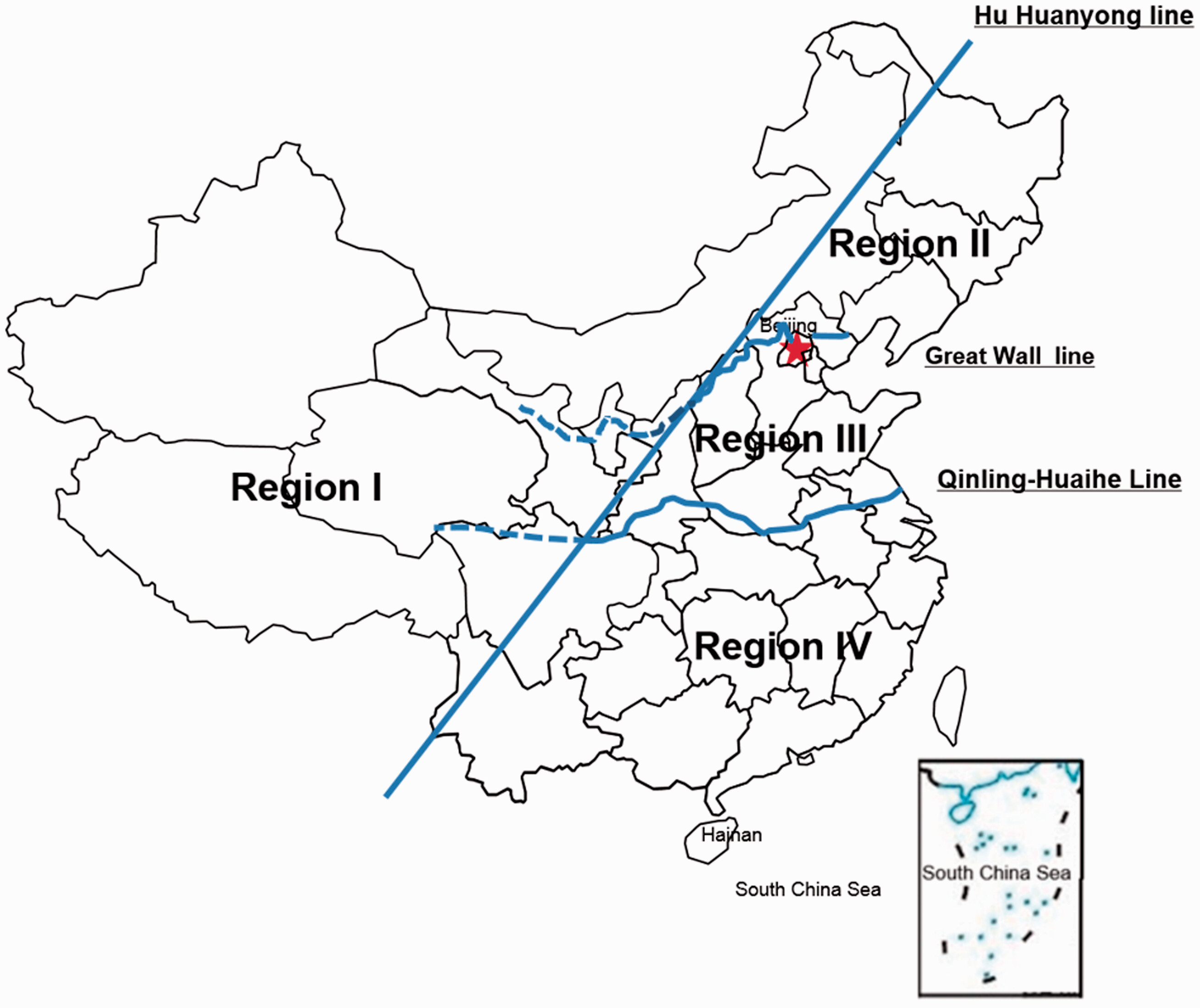
Later in the paper, the authors divide China into four regions, and present a table listing some factors that may have contributed to the varying degrees of collectivism in those regions.

Triple-Line Framework of variations within China.

Table 1. Ecological Factor Differences Among the Four Regions.

Region I Region II Region III Region IV
Collectivism Lowest Lower Higher Highest
Climate Harsh Harsh Comfortable Comfortable
Water Less Enough Less Enough
Rainfall <400 mm 400–800 mm 400–800 mm >800 mm
Subsistence
system
Herder Wheat or herder/wheat-blended Wheat Rice
Voluntary
settlement
No Yes No No
Population
density
Low Low High High

Pluses and Minuses

Collectivistic societies can have certain good aspects, as expressed by this example sentence from the entry for “xūntáo (xūn·táo {cure (meat/etc.) with smoke} · {mould (as with clay)} → [influence positively; nurture; edify; train] 熏陶 熏/薰陶) in Pleco’s built-in dictionary:

Zài jítǐ zhǔyì jīngshén de xūntáo xià, háizimen hùxiāng guānxīn, hùxiāng bāngzhù. [Word division was edited.]

Nurtured in the spirit of collectivism, the children care for each other and help each other.

However, recently, some research has come out that shows that some negative ways of thinking, feeling, and acting are more likely to be displayed by those in collectivistic societies.

To clarify, here is a definition of “zero-sum” :

Of any system where all gains are offset by exactly equal losses.

So, a zero-sum game or system is one in which another must lose for one to win—no win-win situations. That means that if you hold zero-sum beliefs, as, according to the studies referred to in the above post, collectivists are more likely to do, then you will think that any goodness that’s enjoyed by someone else is goodness that’s no longer available to you.

Zero-sum thinking makes it difficult to have true empathy for others who are suffering, and it makes it difficult to follow the Bible counsel at Romans 12:15:

Rejoice with those who rejoice; weep with those who weep.

Collectivism and the Obsession with Chinese Characters

It seems, then, that there is a connection between collectivism and China’s obsessive refusal so far to move on from Chinese characters to more reasonable and modern writing systems like Pīnyīn (Pīn·yīn {Piecing Together of} · Sounds → [Pinyin] 拼音). Consider this excerpt from my article “Pīnyīn (Pīn·yīn {Piecing Together of} · Sounds → [Pinyin] 拼音) Was Plan A”:

In addition to those who feel that phasing out the Hànzì [Chinese characters] would be a regrettable cultural loss, I have also noticed that there are some for whom knowledge of Hànzì is a matter of pride and self-identity. They are proud of knowing the Hànzì as they do, and they view their knowledge of the Hànzì as part of what makes them who they are, as something that distinguishes them from those who don’t know the Hànzì. Such ones may defend the Hànzì to the point of irrationality in the face of a more accessible alternative that would make them and their hard-earned knowledge of Hànzì less “special”, that would threaten to render worthless all of the blood, sweat, and tears they have invested into grappling with these “Chinese puzzles”. It’s as if they are saying, “That’s not fair! If I had to go through all this bitter hard work to learn characters before I could read and write Chinese, then everyone else has to too!”

Self-Identity and Balanced Self-Love

Self-identity is one thing that can particularly be a struggle for those raised in collectivistic societies, since the self is relatatively often neglected in such societies. It’s perhaps not surprising then, that, as mentioned above, in the relatively collectivistic Chinese societies, with their relative paucity, or scarcity, of more healthy ways to build and maintain self-identity, so many have such an unhealthy, obsessive attachment to Chinese characters, as something to desperately hang their neglected self-identities on.

As Jehovah’s organization has commented, for us to follow well the command at Matthew 19:19 to “love your neighbor as yourself”, we must first love ourselves in a healthy way. Also, while Romans 12:3 telling each of us “not to think more of himself than it is necessary to think, but to think so as to have a sound mind” is mainly an admonition against the overly self-important thinking that individualistic societies can tend to promote, it also shows that it is necessary to think a certain amount of ourselves to have a balanced, sound mind.

In turn, it seems that our developing a balanced, healthy view of ourselves can contribute to our avoiding things like zero-sum thinking, and to our developing a balanced, healthy view of Chinese characters. From that balanced, healthy place, we can be free to develop a balanced, healthy view of the possible alternative of Pīnyīn (Pīn·yīn {Piecing Together of} · Sounds → [Pinyin] 拼音), which could empower us to serve Jehovah and help others in the Mandarin field as well as we ought to be able to.