Categories
Culture History Language Learning Names Science Technology

Yànwén

Yànwén (Yàn·wén {Proverb (Korean: Vernacular)} · Writing → [Hangul/Hankul (modern Korean writing system)] 谚文 諺文) ← Tap/click to show/hide the “flashcard”

This week’s MEotW is “Yànwén (Yàn·wén {Proverb (Korean: Vernacular)} · Writing → [Hangul/Hankul (modern Korean writing system)] 谚文 諺文)”, which seems to be the most commonly used Mandarin expression referring to the modern Korean writing system. In English, we refer to this writing system as “Hangul” or “Hankul”, depending on which romanization system we prefer.

The Korean text “Joseongeul” and “Hangeul,” written in Hangul, the native Korean script.

The Korean text “Joseongeul” and “Hangeul,” written in Hangul, the native Korean script. [source]
Creative Commons Attribution-ShareAlike License logo metalslick

“…By Any Other Name”

One of the first things I noticed while researching this topic is that Korean, English, and Mandarin each have multiple names for the modern Korean writing system. Here is Wikipedia’s summary of its names in Korean and in English:

Official names

The Korean alphabet was originally named Hunminjeong’eum (훈민정음) by King Sejong the Great in 1443.[source] Hunminjeong’eum (훈민정음) is also the document that explained logic and science behind the script in 1446.

The name hangeul (한글) was coined by Korean linguist Ju Si-gyeong in 1912. The name combines the ancient Korean word han (한), meaning great, and geul (글), meaning script. The word han is used to refer to Korea in general, so the name also means Korean script.[source] It has been romanized in multiple ways:

  • Hangeul or han-geul in the Revised Romanization of Korean, which the South Korean government uses in English publications and encourages for all purposes.
  • Han’gŭl in the McCune–Reischauer system, is often capitalized and rendered without the diacritics when used as an English word, Hangul, as it appears in many English dictionaries.
  • hān kul in the Yale romanization, a system recommended for technical linguistic studies.

North Koreans call the alphabet Chosŏn’gŭl (조선글), after Chosŏn, the North Korean name for Korea.[source] A variant of the McCune–Reischauer system is used there for romanization.

Other names

Until the mid-20th century, the Korean elite preferred to write using Chinese characters called Hanja. They referred to Hanja as jinseo (진서/真書) meaning true letters. Some accounts say the elite referred to the Korean alphabet derisively as ‘amkeul (암클) meaning women’s script, and ‘ahaetgeul (아햇글) meaning children’s script, though there is no written evidence of this.[source]

Supporters of the Korean alphabet referred to it as jeong’eum (정음/正音) meaning correct pronunciation, gungmun (국문/國文) meaning national script, and eonmun (언문/諺文) meaning vernacular script.[source]

In addition to all the above, some dictionaries, including the ABC Chinese-English Dictionary, use the English name “onmun” to refer to the modern Korean writing system. This is apparently derived from the Korean name “eonmun (언문/諺文)”, mentioned in the last paragraph of the above quote. Speaking of “eonmun (언문/諺文)”, the Chinese characters used to write it are the same as the Traditional characters used to write this week’s MEotW “Yànwén (Yàn·wén {Proverb (Korean: Vernacular)} · Writing → [Hangul/Hankul (modern Korean writing system)] 谚文 諺文)”, indicating that this is where this Mandarin expression came from.

Speaking of “Yànwén (Yàn·wén {Proverb (Korean: Vernacular)} · Writing → [Hangul/Hankul (modern Korean writing system)] 谚文 諺文)”, as mentioned at the beginning of this post, this seems to be the expression most commonly used in Mandarin to mean “Hangul”—it is, for example, the main expression used to refer to Hangul in the Mandarin version of an Awake! article about Hangul. Also used in that Mandarin version of that Awake! article—once—to refer to Hangul is the expression “Hánwén (Hán·wén Korean · Writing → [Hangul/Hankul (modern Korean writing system)] 韩文 韓文)”. Another Mandarin expression referring to the modern Korean writing system is “Cháoxiǎn Zìmǔ ((Cháo·xiǎn {Royal/Imperial Court [→ [Dynasty]]} · Rare → [North Korea | Chosŏn (Tw pron.: Cháoxiān)] 朝鲜 朝鮮) (Zì·mǔ Word · Mothers → [Letters (of an Alphabet) [→ [Alphabet]]] 字母) [Hangul/Hankul (modern Korean writing system) (name used in North Korea)])”, which corresponds to the Korean expression “Chosŏn’gŭl (조선글)”, mentioned above. (“Cháoxiǎn (Cháo·xiǎn {Royal/Imperial Court [→ [Dynasty]]} · Rare → [North Korea | Chosŏn; [Great] Joseon [State] (Tw pron.: Cháoxiān)] 朝鲜 朝鮮) corresponds to Chosŏn”, the Korean name for North Korea—these two expressions are in fact written with the same Chinese characters.)

An Exceptionally Phonetic Writing System

In the linguistics podcast Lingthusiasm, in the episode entitled “Writing is a Technology”, linguist Gretchen McCulloch said the following about Hangul:

“But Korean’s really cool.” The thing that’s cool about it from a completely biased linguist perspective is that the writing system of Korean, Hangul, the script, is not just based on individual sounds or phonemes, it’s actually at a more precise level based on the shape of the mouth and how you configure the mouth in order to make those particular sounds. There’s a lot of, okay, here are these closely related sounds – let’s say you make them all with the lips – and you just add an additional stroke to make it this other related sound that you make with the lips. Between P and B and M, which are all made with the lips, those symbols have a similar shape. It’s not an accident. It’s very systematic between that and the same thing with T and D and N. Those have a similar shape because they have this relationship. It’s very technically beautiful from an analysis of language perspective.

[Note that the above quote alludes to the featural aspect of Hangul. The term “featural” refers to distinctive features, which are components of speech such as nasality, aspiration, voicing, place of articulation, etc. which are subphonemic, that is, below the level of phonemes. In his book Visible Speech: The Diverse Oneness of Writing Systems, pp. 196–198, John DeFrancis concludes that while Hangul has a featural aspect, and while it is an ingenious system of phonemic representation, it is not a featural writing system.]

Regarding how precisely Hangul represents the sounds of Korean speech, the above-mentioned Awake! article says:

In Korean schools there are no spelling contests! Why not? Because Hankul represents the sounds of Korean speech so accurately that writing them down correctly as you hear them presents no challenge.

Elsewhere, that Awake! article also explains how Hangul systematically represents the sounds of Korean syllables:

All Korean syllables consist of two or three parts: an initial sound, a middle sound (a vowel or vowels) and, usually, an ending sound. Words are made up of one or more syllables. Each syllable is written inside an imaginary box, as shown below. The initial sound (a consonant or the silent ㅇ) is written at the top or upper left. If the middle vowel is vertically shaped, it is written to the right of the initial sound, while horizontally shaped vowels are written under it. Letters may also be doubled, adding stress, and multiple vowels may be compressed and written alongside each other. If the syllable has a final consonant, it always appears in the bottom position. In this way, thousands of different syllables can be represented with Hankul.

I don’t speak or read Korean, but from what I can gather from information like the above quotes, it seems that Hangul is like Pīnyīn (Pīn·yīn {Piecing Together of} · Sounds → [Pinyin] 拼音) (“Piecing Together of Sounds”), but for Korean.

The Hangul of Mandarin?

If Hangul is like Pīnyīn (Pīn·yīn {Piecing Together of} · Sounds → [Pinyin] 拼音) for Korean, then conversely, Pīnyīn (Pīn·yīn {Piecing Together of} · Sounds → [Pinyin] 拼音) is like Hangul for Mandarin, at least when it comes to what is accomplished by its technical design—both systems systematically represent the individual phonemes (distinct speech sounds that can distinguish one word from another) of the language it was designed for.

Another thing that Hangul and Pīnyīn (Pīn·yīn {Piecing Together of} · Sounds → [Pinyin] 拼音) have in common is that they have both been bitterly opposed and ridiculed by supporters of Chinese characters. Even though it was sponsored by King Sejong of the Korean Yi dynasty, Hangul was opposed by scholars, etc. who were invested in the more complex Chinese characters, the Hànzì (Hàn·zì {Han (Chinese)} · Characters 汉字 漢字) (or the Hanja, as the Koreans call them), and even though Hangul was created way back in the 1440s, the above-mentioned Awake! article says that “more than 400 years elapsed before the Korean government declared that Hankul could be used in official documents.” That was in 1894, and it would not be until 1949 in North Korea and the 1970s in South Korea that Hangul was promoted to become the dominant writing system in these places.

Pīnyīn (Pīn·yīn {Piecing Together of} · Sounds → [Pinyin] 拼音) was promoted by Máo Zédōng ((Máo Hair (surname) 毛) (Zé·dōng Marsh · East 泽东 澤東) (the founder of the People’s Republic of China)) and other early movers and shakers in modern China as a full writing system that was intended to eventually replace the Chinese characters, but when Pīnyīn (Pīn·yīn {Piecing Together of} · Sounds → [Pinyin] 拼音) was officially adopted by the PRC in 1958, it was not as a full writing system with equal status to that of the Chinese characters. (A scenario like that, with two writing systems for the same language, is known as digraphia.) (By the way, like Hangul and Zhōngguó (Zhōng·guó Central · Nation → [Chinese] 中国 中國) Mángwén (Máng·wén Blind · Writing → [Braille] 盲文) (中国盲文/中國盲文, Chinese Braille), Pīnyīn (Pīn·yīn {Piecing Together of} · Sounds → [Pinyin] 拼音)—designed along similar principles as those other two systems—is indeed a full writing system, not just a pronunciation aid.) As with Hangul, scholars, etc. who were heavily invested in the Chinese characters wouldn’t stand for that. Even as late as 2001, China’s Law on the Standard Spoken and Written Chinese Language of the People’s Republic of China said that in China, Pīnyīn (Pīn·yīn {Piecing Together of} · Sounds → [Pinyin] 拼音) is officially just “the tool of transliteration and phonetic notation”.

If Hangul took hundreds of years to become the dominant writing system in Korea, even with the added nationalistic motivation of it having been invented in Korea to be used instead of the characters invented in China, then Pīnyīn (Pīn·yīn {Piecing Together of} · Sounds → [Pinyin] 拼音) could take even longer to become the dominant writing system for Mandarin, if it ever does, and if this old system were hypothetically allowed to last that long—the supporters of invented-in-China Chinese characters are even more proudly and stubbornly resistant to the idea of changing away from Chinese characters in China itself.

At this rate, the current government of China, as long as it lasts, will probably never explicitly officially approve of using Pīnyīn (Pīn·yīn {Piecing Together of} · Sounds → [Pinyin] 拼音) as a full writing system for Mandarin in China, even if it’s just as an alternative to the characters instead of as a total replacement for them. Even if it actually wanted to do so, even this government would hesitate to approve of something like this that would probably be opposed by many of the people of China. (As a historic comparison, in 1977, the PRC promulgated a second round of simplified Chinese characters, but this was rescinded in 1986 following widespread opposition.)

Your Own Personal Hangul for Mandarin?

However, while that may be the situation with the proud worldly nation of China, what about each of us Mandarn field language learners, as individuals who are dedicated to Jehovah God and not to any worldly human culture? Especially if we don’t live in China, under the authority of the current government of China, we are free to choose for ourselves to use Pīnyīn (Pīn·yīn {Piecing Together of} · Sounds → [Pinyin] 拼音) as a full writing system for Mandarin and thus be fully empowered by its simplicity and elegance to serve Jehovah better, as long as we don’t allow ourselves to be shackled by mere human tradition, or by peer pressure.

Even in China itself, people should take into account that Article 18 of the above-mentioned Law on the Standard Spoken and Written Chinese Language of the People’s Republic of China says, in part:

The “Scheme for the Chinese Phonetic Alphabet” [Pīnyīn (Pīn·yīn {Piecing Together of} · Sounds → [Pinyin] 拼音)] is the unified norm of the Roman letters for transliterating the names of Chinese people and places as well as Chinese documents and is used in the realms where it is inconvenient to use the Chinese characters or where the Chinese characters cannot be used.

Technically, it could be said that the extraordinarily complex and inhumanly numerous Chinese characters are by their very nature inconvenient, and that when one does not know or remember some or all of the Chinese characters, “the Chinese characters cannot be used” in those situations…

The above-mentioned Awake! article mentions this historical milestone involving Hangul:

Finally, there was a Bible in Korean that could be read by nearly anyone​—even by women and children who had never had the opportunity to learn Chinese characters.

Many Mandarin field language learners, and literally tens of millions of Chinese people around the world as well, have also not learned Chinese characters. Will there ever be a Bible that uses Pīnyīn (Pīn·yīn {Piecing Together of} · Sounds → [Pinyin] 拼音) as its main writing system, and not just as a small-print pronunciation aid for the Chinese characters? Perhaps time will tell.

Categories
Culture Experiences History Science Theocratic

jiéle hūn

jiéle hūn ((jié·le {tied (a knot of)} · {to completion} 结了 結了) (hūn marrying → [marriage] 婚) [[got] married]) ← Tap/click to show/hide the “flashcard”

[Notes: Tap/click on a Pīnyīn (Pīn·yīn {Piecing Together of} · Sounds → [Pinyin] 拼音) expression to reveal its “flashcard”; tap/click on a “flashcard” or its Pīnyīn (Pīn·yīn {Piecing Together of} · Sounds → [Pinyin] 拼音) expression to hide the “flashcard”. 📖 📄 📘 icons mean 📖 Reveal All, 📄 Reveal Advanced, and 📘 Reveal None re all the “flashcards” in the heading, paragraph, etc. that they are placed at the beginning of.]

A few years back, I wrote up a brief web page listing reasons for producing Pīnyīn (Pīn·yīn {Piecing Together of} · Sounds → [Pinyin] 拼音), etc. material for the Imitate (ia) book. Some, especially some who grew up in the West, may have felt that this book is made up of “just stories”, and ones that they were already quite familiar with, at that. However, we must remember that Chinese Bible students may often have a different perspective regarding the Bible accounts that are made to come to life in the Imitate book. As that web page said:

  • Many Chinese people in the world have not been exposed to Bible accounts the way many Westerners have.
  • Also, I have heard that some, perhaps many, Chinese Bible students tend to approach their Bible studies like intellectual exercises for accumulating chōuxiàng (abstract) head knowledge as if for a school exam, rather than as training for their hearts for their own real lives.

Later, the web page touches on how some of the real-world benefits of good storytelling like that found in the Imitate book involve empathy:

    • The actress Natalie Portman once said, “I love acting. I think it’s the most amazing thing to be able to do. Your job is practicing empathy. You walk down the street imagining every person’s life.”
  • The Imitate book helps build Bible students’ empathy towards Bible characters, which in turn helps Bible students realize that others would feel empathy towards them as well if they imitated these Bible characters—not everyone will just think they’re crazy, like many worldly friends or family members might think.

While even fictional stories can have the benefits described in the links and the quote above, true stories from the Bible can have even greater benefits, including spiritual ones.

Besides the Imitate book, another book from Jehovah’s organization that relates Bible accounts is the Learn From the Bible (lfb) book. The letter from the Governing Body in this book says that, similarly to the Imitate book, the Learn From the Bible book also “brings the Bible accounts to life and captures the feelings of those depicted”, while, unlike the Imitate book, it “tells the story of the human family from creation onward”. While the Learn From the Bible book is especially suitable for children, the letter from the Governing Body in this book says that “it can also be used to help adults who desire to learn more about the Bible”. So, it would be good to consider on this blog some of the expressions used in the Mandarin Learn From the Bible book.

Moses Tied the Knot

This week’s MEotW, “jiéle hūn ((jié·le {tied (a knot of)} · {to completion} 结了 結了) (hūn marrying → [marriage] 婚) [[got] married]), appears at the beginning of Lesson 18 of the Mandarin Learn From the Bible book, which is entitled “Ránshāo (Rán·shāo Ignited · {to Be Burning} 燃烧 燃燒) de (’s 的) Jīngjí‐Cóng ((Jīng·jí Brambles · Thorns 荆棘 荊棘)‐(Cóng Clump) [Bush]) (“The Burning Bush”):

English:

Moses lived in Midian for 40 years. He got married and had children.

Mandarin:

📖 📄 📘 Móxī (Moses 摩西) zài (in 在) Mǐdiàn (Midian 米甸) shēnghuóle (shēnghuó·le lived · {to completion} 生活了) 40 nián (years年/秊), (he 他) jiéle hūn ((jié·le {tied (a knot of)} · {to completion} 结了 結了) (hūn marrying → [marriage] 婚) [got married]), (also 也) yǒule (yǒu·le had · {to completion} 有了) háizi (hái·zi children · [suf for nouns] 孩子).

The Mandarin Learn From the Bible book here uses “jiéle hūn ((jié·le {tied (a knot of)} · {to completion} 结了 結了) (hūn marrying → [marriage] 婚) [[got] married]) to correspond with the English expression “got married”. “Jiéle hūn ((Jié·le {tied (a knot of)} · {to completion} 结了 結了) (hūn marrying → [marriage] 婚) [[got] married]) is the past participle of “jiéhūn (jié·hūn {tie (a knot of)} · {marrying → [marriage]} → [marry; get married] 结婚 結婚), which corresponds to “get married” in English. Interestingly, while in English “tie the knot” can mean “get married”, “jiéhūn (jié·hūn {tie (a knot of)} · {marrying → [marriage]} → [marry; get married] 结婚 結婚) literally means “tie (a/the) knot of marrying”.

Morphemic Breakdown

The “jié ({tie [(a knot of)]}; knit; weave; [→ [congeal; form; forge; cement | join together; bind; connect; unite | settle; conclude]] | {tying (of a knot)} → [knot | (electrical) junction | node | written guarantee; affidavit; bond]) in “jiéle hūn ((jié·le {tied (a knot of)} · {to completion} 结了 結了) (hūn marrying → [marriage] 婚) [[got] married]) basically means “to tie”, and based on that, it can have a variety of effective meanings in different contexts. For example, a common expression in which it appears is “jiéguǒ (jié·guǒ {tied (into a knot) → [formed]} · fruit → [result | as a result] 结果 結果)”, which literally means “tied (into a knot) (i.e., formed) fruit”, and which effectively means “result”, or “as a result”.

As for the “hūn (wedding; marrying; {getting married} [→ [marriage; wedding]] 婚) in “jiéle hūn ((jié·le {tied (a knot of)} · {to completion} 结了 結了) (hūn marrying → [marriage] 婚) [[got] married]), it’s basically a verb that means “to wed” or “to marry”. It’s often used as a verbal noun, or gerundial noun, as it is in “hūnyīn (hūn·yīn {marrying → [marriage]} · marriage → [marriage; matrimony] 婚姻).

What About the “Le”?

Okay, but what about the “le (-ed | {to completion} | [(at the end of a phrase/sentence) indicates a change] 了) in “jiéle hūn ((jié·le {tied (a knot of)} · {to completion} 结了 結了) (hūn marrying → [marriage] 婚) [[got] married])? The ABC Chinese-English Dictionary, edited by John DeFrancis and Victor H. Mair, among others, says that when “le (-ed | {to completion} | [(at the end of a phrase/sentence) indicates a change] 了) is used this way, it’s an aspect marker. What’s that? The ABC Chinese-English Dictionary explains it like this:

A.M. (Aspect Marker, Tǐbiāojì 体标记).

Aspect means the stage of completion of an action. Chinese usually uses verbal suffixes as a means of indicating this information. Examples of Chinese aspect include the:

(i) durative (action in progress, much like ‘-ing’ in English), e.g., zhe in kànzhe ‘is watching’;

(ii) perfective (completed action), e.g., le in ànle wǔ ge diànyǐng, ‘saw five movies’; and

(iii) experiential (much like the ‘ever’ in the question ‘Have you ever . . . ?’), e.g., guo in jiànguo tā ‘have met him before’.

Note that aspect is not the same thing as tense. Tense refers to when the action takes place relative to when the utterance is actually spoken, and so at most any language can have only three tenses: past, present and future. Aspect, on the other hand, can occur in any tense, so that even completed action can be spoken of in the

(a) past, e.g., Tā zuótiān dàole Běijn̄g ‘He arrived in Beijing yesterday’;

(b) present, e.g., Tā xiànzài dàole Běijīng ‘He has now arrived in Beijing’; or

(c) future, e.g., Tā míngtiān zhèige shíhou yǐjing dàole Běijīng ‘He will already have arrived in Beijing by this time tomorrow’.

(See also M.P. for usage of le as a sentence-final particle.)

(“M.P.” is this dictionary’s abbreviation for “modal particle”, which is what “le (-ed | {to completion} | [(at the end of a phrase/sentence) indicates a change] 了) is when it’s at the end of a phrase or sentence (and thus followed immediately by a punctuation mark). More information on modal particles can be found on this list that’s in alphabetical order.)

When Should There Be a Space Before “Le”?

Different publications follow different rules about when to put a space before “le (-ed | {to completion} | [(at the end of a phrase/sentence) indicates a change] 了) when it appears in Pīnyīn (Pīn·yīn {Piecing Together of} · Sounds → [Pinyin] 拼音) text. Even the PRC government’s official national standard (actually, it’s a set of recommendations) for Pīnyīn (Pīn·yīn {Piecing Together of} · Sounds → [Pinyin] 拼音) orthography, GB/T 16159-2012, is not as clear, precise, and thorough as one might wish in this regard. (GB/T 16159-2012 is discussed in more detail in the MEotW post on “diǎnliàng (diǎn·liàng {dot → [light (v); ignite]} · {to be bright} [→ [illuminate; shine light on]] 点亮 點亮)”.)

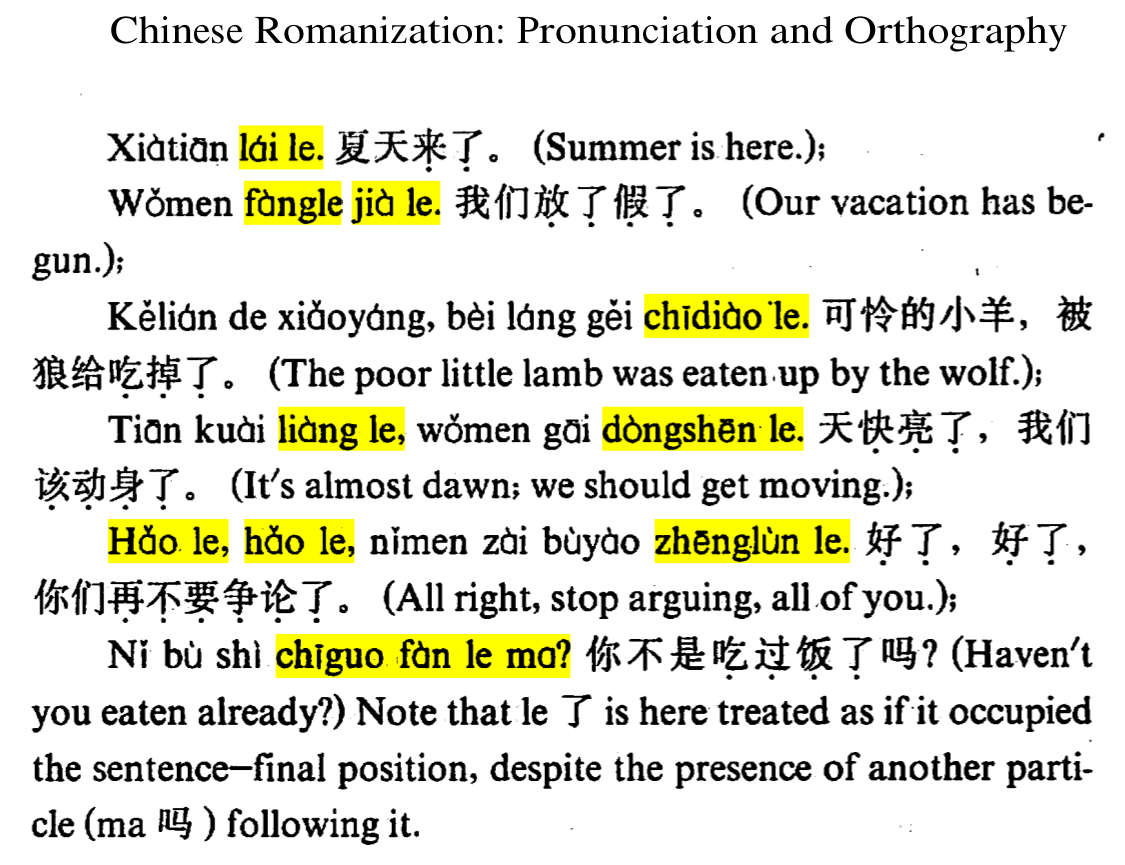
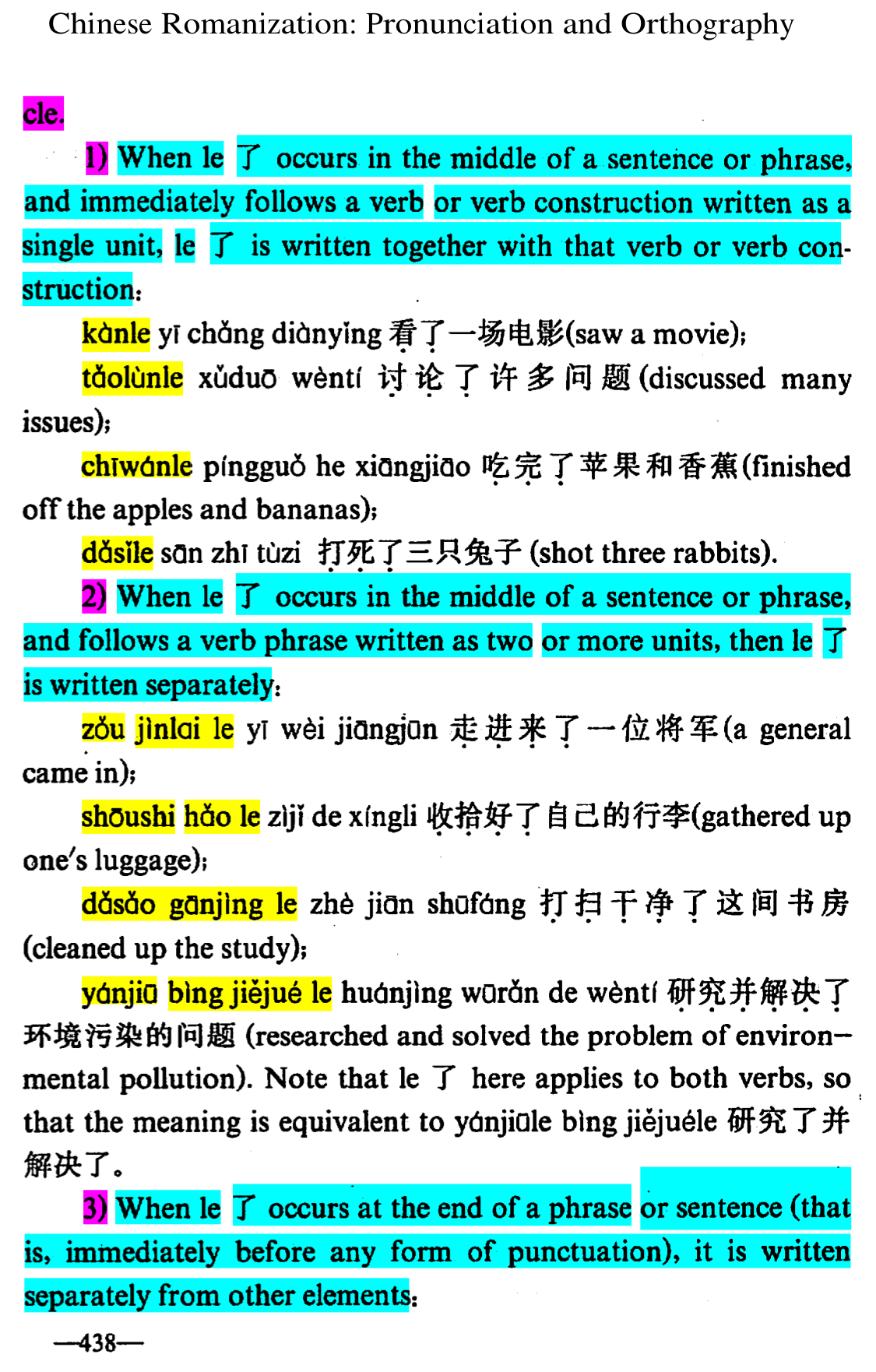
When it comes to when to put a space before “le (-ed | {to completion} | [(at the end of a phrase/sentence) indicates a change] 了) in Pīnyīn (Pīn·yīn {Piecing Together of} · Sounds → [Pinyin] 拼音) text, Pīnyīn (Pīn·yīn {Piecing Together of} · Sounds → [Pinyin] 拼音) Plus material follows the guidelines put forth in this excerpt (available from this page on pinyin.info) from the book Chinese Romanization: Pronunciation and Orthography, by Yin Binyong and Mary Felley:

_Pīnyīn_ orthography rules for “le (了)”, 1st page, from the book _Chinese Romanization: Pronunciation and Orthography_

_Pīnyīn_ orthography rules for “le (了)”, 2nd page, from the book _Chinese Romanization: Pronunciation and Orthography_

_Pīnyīn_ orthography rules for “le (了)”, 3rd page, from the book _Chinese Romanization: Pronunciation and Orthography_

(The highlights were added by me. Note that this book calls “le (-ed | {to completion} | [(at the end of a phrase/sentence) indicates a change] 了), as used in “jiéle hūn ((jié·le {tied (a knot of)} · {to completion} 结了 結了) (hūn marrying → [marriage] 婚) [[got] married])”, a “tense particle”, or a “tense-marking particle”. Also, its term for “modal particle” is “mood particle”.)


For convenience:

The direct link for the Pīnyīn (Pīn·yīn {Piecing Together of} · Sounds → [Pinyin] 拼音) Plus resource for the Learn From the Bible book is:

The short link for Chinese field language-learning links for the Learn From the Bible book is:

More Pīnyīn (Pīn·yīn {Piecing Together of} · Sounds → [Pinyin] 拼音) and Pīnyīn (Pīn·yīn {Piecing Together of} · Sounds → [Pinyin] 拼音) Plus web material based on the Mandarin Learn From the Bible book will be made available in the Pīnyīn (Pīn·yīn {Piecing Together of} · Sounds → [Pinyin] 拼音) Plus web resource as time allows.

Categories
Culture History Theocratic

rénkǒu

rénkǒu (rén·kǒu people · {mouths of} → [population; number of people in a family] 人口) ← Tap/click to show/hide the “flashcard”

Lesson 05, point 6 of the Yǒngyuǎn Xiǎngshòu Měihǎo de Shēngmìng—Hùdòng Shì Shèngjīng Kèchéng ((Yǒng·yuǎn Eternally · {Far (in Time)} 永远 永遠) (Xiǎng·shòu Enjoy · Receive 享受) (Měi·hǎo Beautiful · Good 美好) (de ’s 的) (Shēngmìng Life 生命)—(Hù·dòng {Each Other} · Moving → [Interactive] 互动 互動) (Shì (Type 式) (Shèng·jīng Holy · Scriptures → [Bible] 圣经 聖經) (Kè·chéng Lessons · Procedure → [Course] 课程 課程) [Enjoy Life Forever!—An Interactive Bible Course (lff)]) (Enjoy Life Forever! (lff)) book contains an illustration depicting the unparalleled availability of God’s Word the Bible. One of the illustration’s captions says the following:

English:

Nearly 100% of the world’s population have access to the Bible in a language they understand

Mandarin:

📖 📄 📘 Chà‐bu‐duō ((Chà {falling short of by} 差)‐(bu not 不)‐(duō much 多) [nearly]) 100% ((bǎi {(one) hundred} 百) (fēn dividings → [parts] 分) (zhī {(among) them} 之) (bǎi {(one) hundred} 百) [one hundred percent (of)]) shìjiè (shì·jiè {generation → [world]} · extent’s → [world’s] 世界) rénkǒu (rén·kǒu people · {mouths of} → [population] 人口) dōu (even 都) néng (can 能) yòng (use 用) tāmen (tā·men he/she · [pl] → [they] 他们 他們) míngbai (míng·bai understand · clearly 明白) de (’s 的) yǔyán (yǔ·yán language · {(type of) speech} 语言 語言) dúdào (dú·dào {to read} · {arriving at} 读到 讀到) Shèngjīng (Shèng·jīng (the) Holy · Scriptures → [the Bible] 圣经 聖經)

While “rénkǒu (rén·kǒu people · {mouths of} → [population; number of people in a family] 人口)”, this week’s MEotW, is used above to mean “population”, as it is often used, one of the definitions for this expression in the highly regarded ABC Chinese-English Dictionary is “mouths to feed”. This lends credence to the hypothesis that perhaps the morphemes included in “rénkǒu (rén·kǒu people · {mouths of} → [population; number of people in a family] 人口)” reflect that historically the governments of China have viewed their population as mouths that need to be fed, since this has often been a big challenge, to the point of famine. Contrast this view to the perhaps more Western and modern cultural focus of a nation’s population as its potential human assets. (Of course, humans who are assets also need to be fed, so a balanced approach would give sufficient weight to both aspects.)

Eating or Being “Eaten”?

It may be that historically the governments of China have had feeding the people as one of their primary concerns, however, ironically, it’s also the case that archaeologists have found evidence of human sacrifice in ancient China, which involves ancient Chinese society “eating” individual members of its population. How much human sacrifice are we talking about? One web article that I found speaks of exceptionally large scale human sacrifice in ancient China, comparable in scale to the human sacrifice practiced in the ancient Mayan culture:

While the phenomenon of ritual human killings have been present in many societies throughout history [source], the types of human sacrifice that were practiced by ancient Chinese and pre-Colombian Mesoamerican cultures…were exceptional in terms of the sheer number of people sacrificed, the frequency at which it was done, and the high degree of formalization of their sacrificial rituals. Large-scale, systematic human sacrifice functioned as important political and religious spectacles in [the] Shang dynasty.[source]

Another web article that I found gives us some estimated numbers:

Prior worked revealed an extraordinary number of ritual human sacrifices were conducted during the Shang dynasty, which spanned from the 16th century B.C. to the 11th century B.C. It is the earliest dynasty in China for which archaeologists have evidence. For instance, sacrificial pits are common across the entire site of the last Shang capital, Yinxu, which researchers discovered in 1928 in central China’s Henan Province. Scientists have estimated that over the course of about 200 years, more than 13,000 people were sacrificed in Yinxu, usually males ages 15 to 35, and that on average, each sacrificial ritual there likely claimed at least 50 human victims. The biggest sacrifice found so far killed at least 339 people.

As the MEotW post on “xīshēng (xī·shēng {sacrifice (n or v) | sacrificial} · {[(as with a)] domestic animal} → [sacrifice] 牺牲 犧牲)” noted:

It’s interesting to note, though, that an Internet search for “ancient China sacrifices” will turn up many references to human sacrifices in ancient China, as there were in ancient Canaan—let us be careful not to think more highly of worldly Chinese history and culture than they actually deserve!

A Metaphorically Cannibalistic Society

Speaking of Chinese society “eating” people, Lǔ Xùn ((Lǔ Stupid; Rash (surname)) (Xùn Fast; Quick; Swift 迅) (pen name of Zhōu Shùrén, the greatest Chinese writer of the 20th cent. and a strong advocate of alphabetic writing)), recognized as China’s greatest 20th century writer, wrote a short story called “Kuángrén Rìjì ((Kuáng·rén Mad·man’s 狂人) (Rì·jì {Sun’s → [Day’s]} · Record → [Diary] 日记 日記) [Diary of a Madman (short story by Lǔ Xùn)])” (“Diary of a Madman”) which uses this as a metaphor. Wikipedia provides the following summary concerning this metaphor:

The story is not just a depiction of a man suffering from mental illness with the delusion of being eaten but rather a symbol of the cannibalistic nature of Chinese customs and society wrapped up in the veneer of Confucianism. The story progresses with the appearance of imagery such as that of a dog, which symbolizes cannibalism and a certain “slave mentality”.[source]

The metaphor of “eating people” symbolises the oppressive and feudalistic social structure and values entrenched within Chinese culture.[source] The madman represents the “awakened” individual who re-gains his individuality and refuses to abide by the traditional and harmful cultural norms society,[source] with the neighbors whom he believes to want to devour him representing Chinese society in general. …

Because China was built upon and continued to be informed by Confucian morality and principles over long stretches of history, concepts such as democracy, individualism, natural rights and freedom of thought did not exist and were therefore difficult to take root within the Chinese psyche. Lu Xun remarked that “[we] Chinese have always been a bit arrogant –unfortunately it is never “individual arrogance” but without exception “collective and patriotic arrogance”.[source]

Lǔ Xùn ((Lǔ Stupid; Rash (surname)) (Xùn Fast; Quick; Swift 迅) (pen name of Zhōu Shùrén, the greatest Chinese writer of the 20th cent. and a strong advocate of alphabetic writing)) ends “Kuángrén Rìjì ((Kuáng·rén Mad·man’s 狂人) (Rì·jì {Sun’s → [Day’s]} · Record → [Diary] 日记 日記) [Diary of a Madman (short story by Lǔ Xùn)])” (“Diary of a Madman”) with this appeal:

📖 📄 📘 Jiùjiù (Jiù·jiù save · save 救救 救/捄救/捄) háizi (hái·zi (the) children · [suf for nouns] 孩子)

(Save the children…)

(The original text of “Kuángrén Rìjì ((Kuáng·rén Mad·man’s 狂人) (Rì·jì {Sun’s → [Day’s]} · Record → [Diary] 日记 日記) [Diary of a Madman (short story by Lǔ Xùn)])” (“Diary of a Madman”) can be found here. An English translation can be found here.)

Chinese Characters and Life and Death

Besides being one of China’s greatest writers, Lǔ Xùn ((Lǔ Stupid; Rash (surname)) (Xùn Fast; Quick; Swift 迅) (pen name of Zhōu Shùrén, the greatest Chinese writer of the 20th cent. and a strong advocate of alphabetic writing)) was also a strong proponent of alphabetic writing over Chinese characters. An English translation of an article he wrote on this subject can be found here. In this article, he wrote:

Latinization has another advantage: one can write fast. The Americans say, “Time is money.” But I think that time is life. To squander other people’s time for no reason is, in fact, no different than robbing and murdering them.

Indeed, since time is life, by unnecessarily taking such extraordinary amounts of time to learn and remember, Chinese characters make themselves part of the Chinese traditions that take away life from people. In this regard, one of the web articles quoted above mentioned a connection that’s been found between the earliest Chinese characters and human sacrifice:

Yinxu is also home to the earliest known writing in China, in the form of oracle bone inscriptions. Diviners carved these questions on turtle shells or ox bones, addressing the king’s concerns and ranging from personal issues such as unsettling toothaches to state matters such as crop failures. These inscriptions also recorded the king’s ritual activities, such as human sacrifices to the ruler’s ancestors or the gods.

Yes, it’s literally true that Chinese characters have been involved with taking life away from Chinese people since their very beginning! Additionally, regarding our life-saving preaching and teaching work today, my article “Pīnyīn (Pīn·yīn {Piecing Together} · Sounds → [Pinyin] 拼音) Was Plan A says:

Concerning the obstacles presented by Chinese characters, the great Chinese writer Lǔ Xùn, who passed away in 1936, reportedly said, “Hànzì bú miè, Zhōngguó bì wáng.” (“汉字不灭,中国必亡。/ 漢字不滅,中國必亡。” “If Chinese characters are not abolished, China will certainly die.”) True, with the simplification of the characters, the assistance of Pīnyīn, and the extra hard work put forth by the Chinese people to “tough out” the extra technical burdens presented by the characters, it now seems unlikely from a worldly viewpoint that the use of characters will cause the nation of China to die (although we know it will die at Armageddon, and its culture’s influence will eventually fade away completely after that). However, how sad it would be if many Chinese people died unnecessarily because the ongoing obstacles presented by Chinese characters hindered our efforts to reach their hearts with the life-saving message from God’s Word.

Indeed, how many Chinese people will ultimately end up getting sacrificed on the altar of worldly Chinese culture and tradition?

Who’s a Madman?

Speaking of madmen and Chinese writing, today, many would consider it mad to use an alphabetical system like Pīnyīn (Pīn·yīn {Piecing Together} · Sounds → [Pinyin] 拼音) to write Mandarin Chinese, instead of the traditionally entrenched Chinese characters. However, remember that Jesus’ relatives thought that he had “gone out of his mind”, when in fact their minds were stuck in their traditional worldview while Jesus was showing people the way forward. (Mark 3:21) Now, we look back and think the people who had the opportunity to be taught by Jesus in person but passed on it were crazy!

A couple of million years or so into the new system, if we ever think about it at all, we’ll also undoubtedly think it was crazy that so many people thought that a writing system that had been around for just a few millennia was impressively old, and we’ll also undoubtedly think it was crazy that so many people thought that everyone involved should always use an unnecessarily convoluted and time-consuming writing system like Chinese characters for an urgent life-saving work when a much easier-to-learn and much easier-to-use writing system like Pīnyīn (Pīn·yīn {Piecing Together} · Sounds → [Pinyin] 拼音) was available.


For convenience:

The direct link for the current generation Pīnyīn (Pīn·yīn {Piecing Together of} · Sounds → [Pinyin] 拼音) Plus resource for the Enjoy Life Forever! book is:

The short link for Chinese field language-learning links for the Enjoy Life Forever! book is:

More Pīnyīn (Pīn·yīn {Piecing Together of} · Sounds → [Pinyin] 拼音) and Pīnyīn (Pīn·yīn {Piecing Together of} · Sounds → [Pinyin] 拼音) Plus web material based on the Mandarin Enjoy Life Forever! book will be made available in the Pīnyīn (Pīn·yīn {Piecing Together of} · Sounds → [Pinyin] 拼音) Plus web resource as time allows.