Categories
Theocratic

ānníng

ānníng+ ({being peaceful}; {being tranquil} 安宁 安寧) ← Tap/click to show/hide the “flashcard”

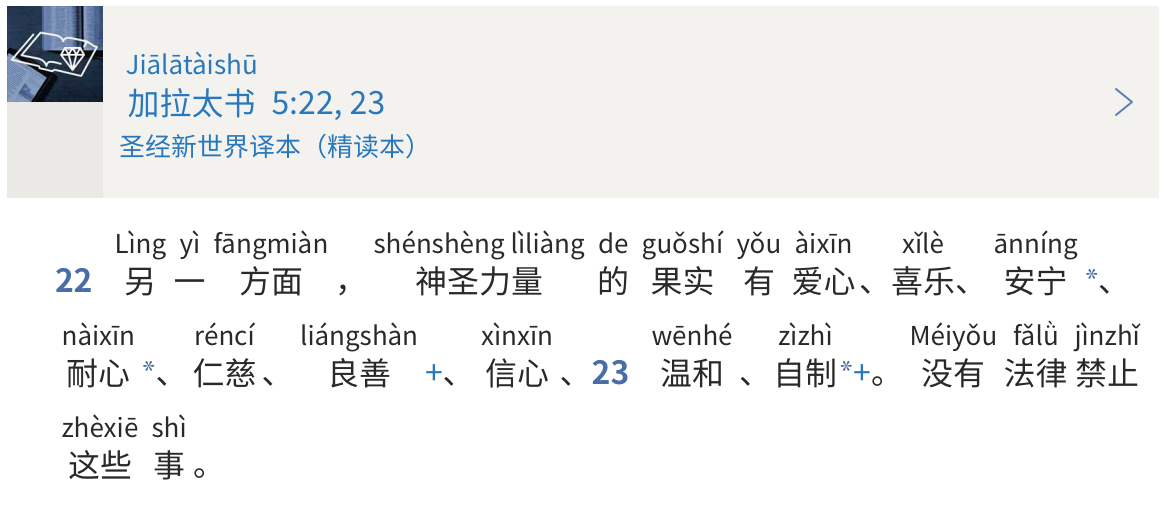
The third part of the fruitage of the spirit listed is peace.— Jiālātàishū (Jiālātài·shū Galatia · Book → [Galatians] 加拉太书 加拉太書) 5:22, 23.

Galatians 5:22, 23 (WOL nwtsty-CHS+Pīnyīn)

As shown above, the current Mandarin version of the New World Translation Bible (nwtsty) translates the English word “peace” using this week’s MEotW, “ānníng ({being peaceful}; {being tranquil} 安宁 安寧)”.

Inner Peace, to Be Precise

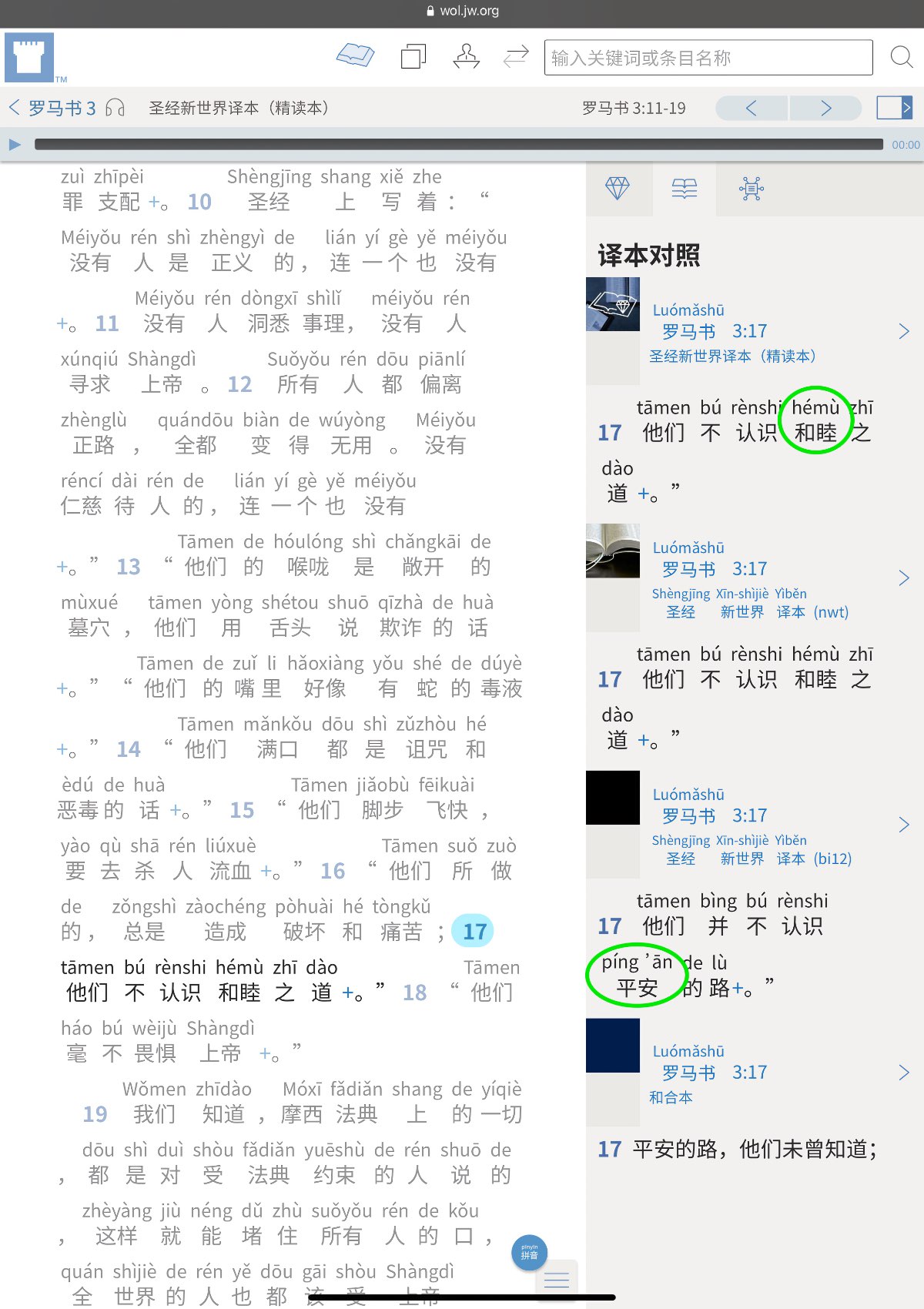
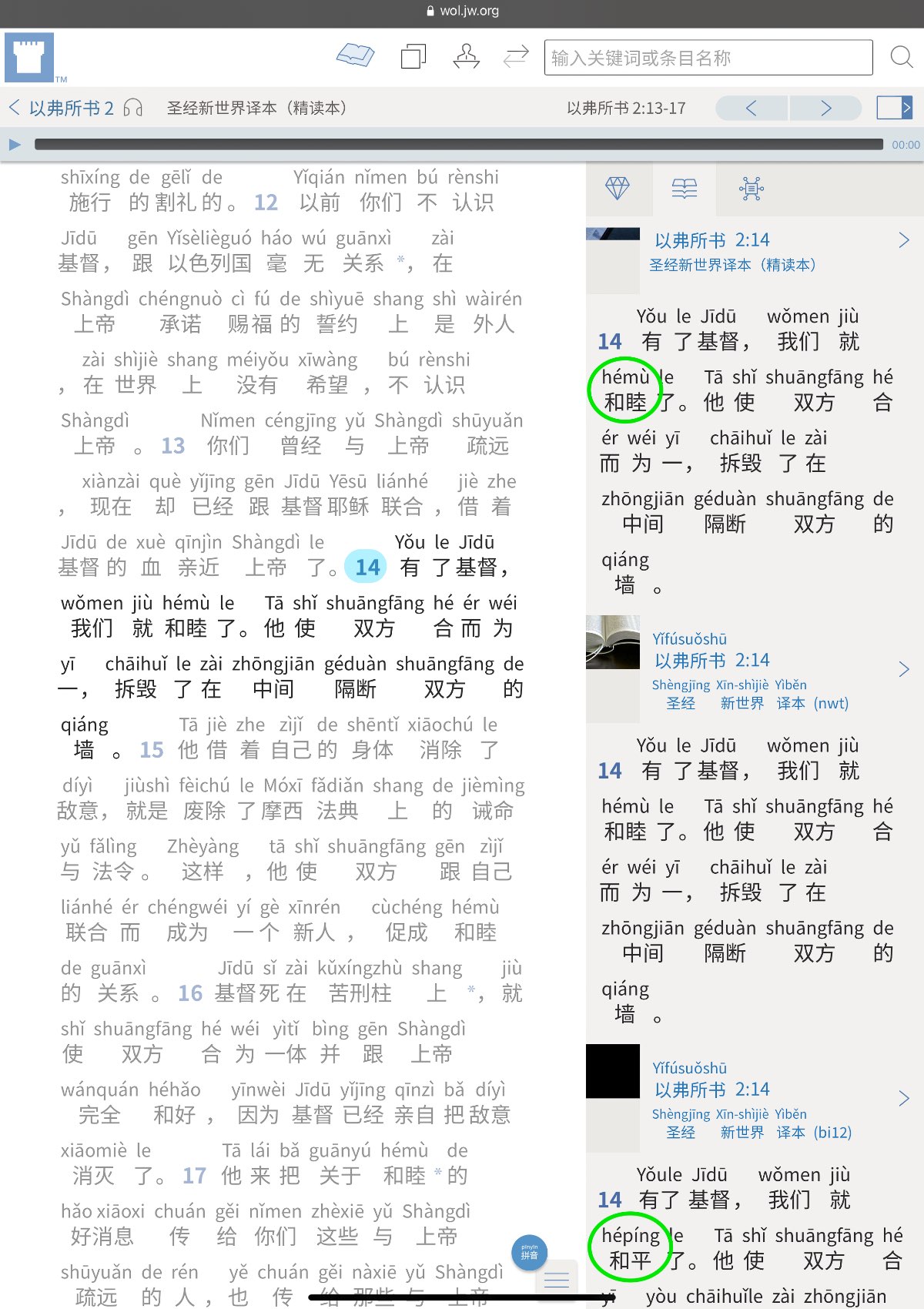
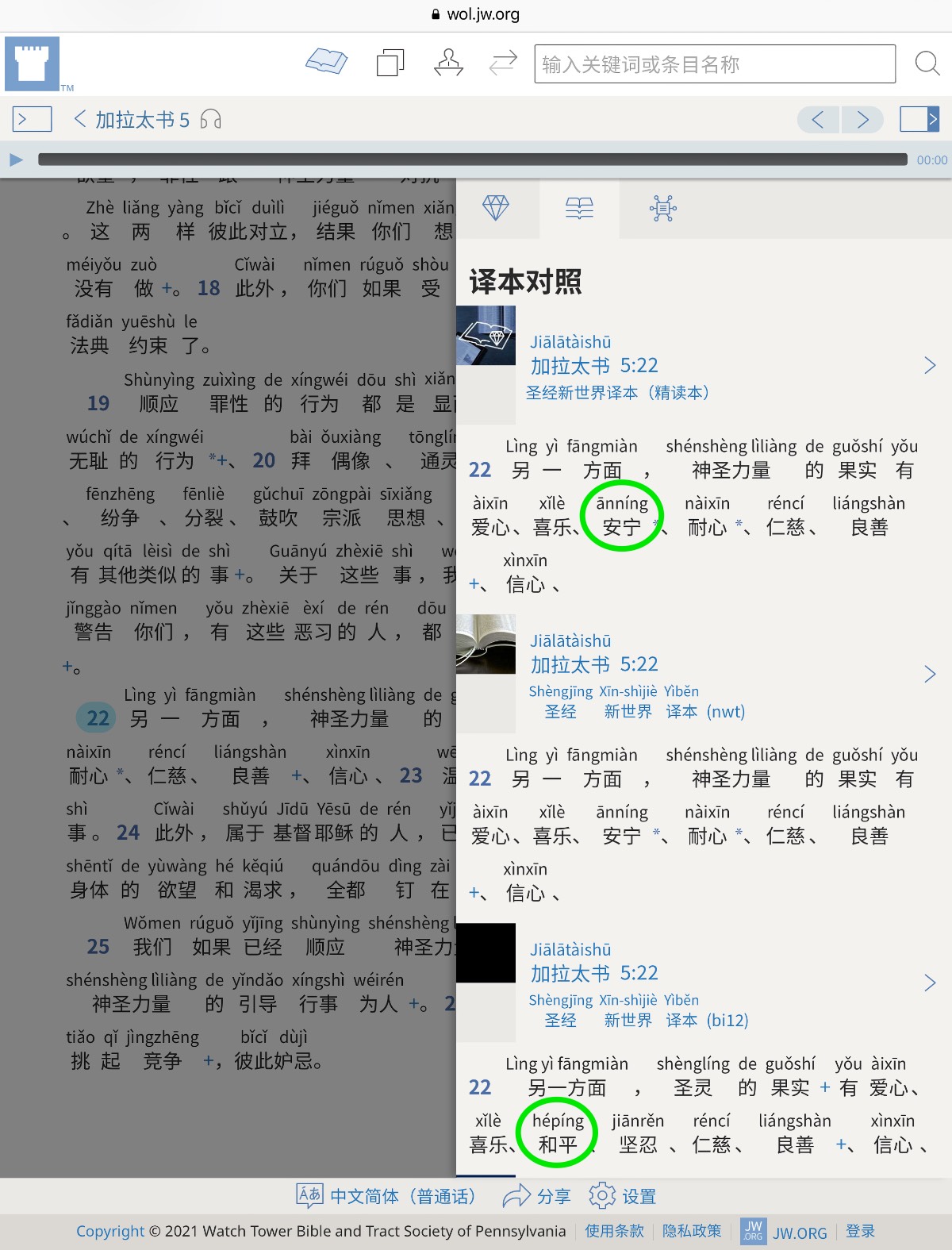
Using the handy Parallel Translations (Yìběn (Yì·běn Translated · {Roots → [Editions]} → [Translations] 译本 譯本) Duìzhào+ (Duì·zhào {Facing → [Comparing]} · {Illuminating → [Comparing/Contrasting]} → [Comparing/Contrasting] 对照 對照) in Mandarin) feature of the Watchtower ONLINE LIBRARY, we can see that the current Mandarin version of the New World Translation Bible (nwtsty) translates the English word “peace” in Galatians 5:22 differently than the previous major revision (bi12) did:

Galatians 5:22, 23 (WOL CHS Parallel Translations)

Why was “ānníng ({being peaceful}; {being tranquil} 安宁 安寧)” selected to be used in Galatians 5:22 in the current version of the Mandarin NWT Bible, when the previous major revision used “hépíng (peace | {[is] peaceful} (nwtsty-CHS Appx. A2 says this term mainly refers to an absence of war or conflict) 和平)” there? Appendix A2 of the current Mandarin version of the New World Translation Bible (nwtsty) explains that “hépíng (peace | {[is] peaceful} (nwtsty-CHS Appx. A2 says this term mainly refers to the absence of war or conflict) 和平)” mainly refers to the absence of war or conflict. However, even in a situation in which there is no hépíng (peace | {[is] peaceful} (nwtsty-CHS Appx. A2 says this term mainly refers to the absence of war or conflict) 和平), God’s holy spirit can still help people to maintain the spiritual quality of ānníng ({being peaceful}; {being tranquil} 安宁 安寧) in their hearts—inner peace.

For some more information on “ānníng ({being peaceful}; {being tranquil} 安宁 安寧)” and how it is used in the current Mandarin NWT Bible, see the entry for it in the Cíyǔ Jiěshì+ ((Cí·yǔ Terms · Words 词语 詞語) (Jiě·shì {Untyings → [Solvings]} · Explainings 解释 解釋) [Glossary]) (Simplified Chinese with optional Pīnyīn (Pīn·yīn {Piecing Together} · Sounds → [Pinyin] 拼音)) in the Watchtower ONLINE LIBRARY.

Categories
Culture Language Learning Languages Science

yǔzú

yǔzú+ (yǔ·zú language · {ethnic group → [group of things with common characteristics] → [group]} 语族 語族) ← Tap/click to show/hide the “flashcard”

While “language family” seems to be a commonly accepted linguistic term, there does not seem to be universal consensus on what terms to use for subdivisions of language families. This is suggested by the wording used in the Wikipedia article on language families, under the subheading “Structure of a family”:

Language families can be divided into smaller phylogenetic units, conventionally referred to as branches of the family because the history of a language family is often represented as a tree diagram. A family is a monophyletic unit; all its members derive from a common ancestor, and all attested descendants of that ancestor are included in the family. …

Some taxonomists restrict the term family to a certain level, but there is little consensus in how to do so. Those who affix such labels also subdivide branches into groups, and groups into complexes.

So, it seems that one common—but not universal—language classification scheme is:

  • family > branch > group > complex…

In contrast, noted American sinologist and University of Pennsylvania Professor of East Asian Languages and Civilizations Victor H. Mair, in his article “The Classification of Sinitic Languages: What Is ‘Chinese’?” (p. 749), sets out a slightly different language classification scheme:

  • family > group > branch > language > dialect

The Mandarin Word for “Language Group”

Regardless of whether we consider language families to be first subdivided into branches or into groups, an accepted and acceptable Mandarin translation for “language group” is this week’s MEotW, “yǔzú (yǔ·zú language · {ethnic group → [group of things with common characteristics] → [group]} 语族 語族)”, as Prof. Mair confirms in the article (p. 747) mentioned above.

If “ (clan; race; tribe; {ethnic group}; nationality [→ [class or group of things or people with common characteristics]] 族)” seems familiar, perhaps that is because it occurs in some fairly well-known scriptures. For example, the 2019 Edition of the Mandarin New World Translation Bible translates “every nation and tribe and tongue and people” in Revelation 14:6 as “měi (every 每) ge ([mw]個/箇/个) guózú+ (guó·zú national · {ethnic group} → [nation] 国族 國族), bùzú+ (bù·zú sectional · {ethnic group} → [tribe] 部族), yǔyán (yǔ·yán language · {(type of) speech} 语言 語言), (and 和) mínzú+ (mín·zú {(of) people} · {ethnic group} → [people] 民族)”.

The Mandarin Word for “Language Branch”

For reference, the Mandarin word for “language branch” is “yǔzhī+ (yǔ·zhī language · branch 语支 語支)”, as Prof. Mair confirms in the article (p. 747) mentioned above.

It’s interesting to note that according to Prof. Mair’s article (p. 737) mentioned above, not only are Mandarin and Cantonese separate languages (not just “dialects”), it would be more accurate to consider them to be in separate language branches, as defined by the language classisification scheme he uses:

Cantonese and Mandarin are separate languages. Cantonese is not a ‘dialect’ of Mandarin or of Hanyu, and it is grossly erroneous to refer to it as such. Since Cantonese and Mandarin are separate languages (or, perhaps more accurately, separate branches), it is wrong to refer to them as ‘dialects.’ The same holds for Hokkien, Shanghainese, and so forth.

That Mandarin and Cantonese should really be considered to be in separate language branches emphasizes to us politically neutral Mandarin field language learners that we must not repeat or be misled by the politically motivated erroneous assertion that Mandarin, Cantonese, Shanghainese, etc. are just dialects of “Chinese”. That might be even more wrong than saying that English, French, Spanish, etc. are just dialects of “European”!

Categories
History Languages

Huáyǔ

Huáyǔ+ (Huá·yǔ {Magnificent; Splendid; Flowery; Florescent → [Chinese]} · Language → [(Modern Standard) Mandarin (term commonly used in Singapore)] 华语 華語) ← Tap/click to show/hide the “flashcard”

This is the expression commonly used in Singapore to refer to (Modern Standard) Mandarin.

The “Huá+ (magnificent; splendid; flowery; florescent [→ [Chinese]])” in “Huáyǔ (Huá·yǔ {Magnificent; Splendid; Flowery; Florescent → [Chinese]} · Language → [(Modern Standard) Mandarin (term commonly used in Singapore)] 华语 華語)” is, incidentally, the “huá (magnificent; splendid; flowery; florescent [→ [Chinese]])” in “Yēhéhuá (Jehovah 耶和华 耶和華)”, in which it is mainly used for its sound. “Huá (magnificent; splendid; flowery; florescent [→ [Chinese]])” seems to have a root meaning of “flower” or “flowery”, and is used in several expressions to mean “China” or “Chinese”. In addition to “Huáyǔ (Huá·yǔ {Magnificent; Splendid; Flowery; Florescent → [Chinese]} · Language → [(Modern Standard) Mandarin (term commonly used in Singapore)] 华语 華語)”, some other examples are:

  • Zhōnghuá+ (Zhōng·huá Central · Flower → [China] 中华 中華)
  • Zhōnghuá Rénmín Gònghé Guó+ ((Zhōng·huá Central · Flower → [China] 中华 中華) (Rén·mín People’s 人民) (Gònghé Guó (Gòng·hé Shared · Harmony → [Republic] 共和) (Guó Nation) → [Republic]) [People’s Republic of China])
  • Zhōnghuá Mínguó+ ((Zhōng·huá Central · Flower → [China] 中华 中華) (Mín·guó People’s · Nation 民国 民國) [Republic of China (Taiwan)])
  • Huárén+ (Huá·rén {Magnificent; Splendid; Flowery; Florescent → [Chinese]} · {People | Person[s] | Man/Men} 华人 華人)
  • Huáqiáo+ (Huá·qiáo {Magnificent; Splendid; Flowery; Florescent → [Chinese]} · {Living Abroad (People/Person[s])} → [overseas Chinese people/person[s]] 华侨 華僑)

Wikipedia summarizes that “huá (magnificent; splendid; flowery; florescent [→ [Chinese]])” used in connection with China is short for “Huáxià+ (Huá·xià Magnificent; Splendid; Flowery; Florescent · {Summer → [Xià (Dynasty)]} → [historical concept representing the Chinese nation and civilization] 华夏 華夏)”, an expression that dates back millennia:

Huaxia is a historical concept representing the Chinese nation and civilization
Huaxia refers to a confederation of tribes—living along the Yellow River—who were the ancestors of what later became the Han ethnic group in China[source][source]. During the Warring States (475–221 BCE), the self-awareness of the Huaxia identity developed and took hold in ancient China.[source]
The term Huaren (華人) for a Chinese person is an abbreviation of Huaxia with ren (人, person).[source] Huaren in general is used for people of Chinese ethnicity, in contrast to Zhongguoren (中國人) which usually (but not always) refers to citizens of China.[source] Although some may use Zhongguoren to refer to the Chinese ethnicity, such usage is not accepted by some in Taiwan.[source] In overseas Chinese communities in countries such as Singapore and Malaysia, Huaren or Huaqiao (overseas Chinese) is used as they are not citizens of China.[source][source]

Interestingly, since “huá (magnificent; splendid; flowery; florescent [→ [Chinese]])” can mean “flower”, and since the roots of referring to Chinese people as “Huárén (Huá·rén {Magnificent; Splendid; Flowery; Florescent → [Chinese]} · {People | Person[s] | Man/Men} 华人 華人)” go back millennia, that means that Chinese people were “flower people” long before the hippies of the West were!

Unfortunately, politics sometimes raises its ugly head in language matters, and so it is worth noting that in some situations, there may be political implications of using “Huáyǔ (Huá·yǔ {Magnificent; Splendid; Flowery; Florescent → [Chinese]} · Language → [(Modern Standard) Mandarin (term commonly used in Singapore)] 华语 華語)” or one of the other ways to refer to (Modern Standard) Mandarin in Mandarin. For more information, see these posts on the excellent Language Log blog:

Posts on this Mandarin Expression of the Week blog about other Mandarin expressions used to refer to (Modern Standard) Mandarin can be viewed using the link for the Mandarin tag.