Categories
Culture Current Events

Liánhé Guó

Liánhé Guó ((Lián·hé United · {Closed → [Joined]} 联合 聯合) (Guó Nations) [United Nations]) ← Tap/click to show/hide the “flashcard”

On February 24, 2022, Russia sent significant military forces into Ukraine, resulting in the largest scale open warfare in Europe since World War II. The jw.org article “Russia Invades Ukraine”, which discusses this subject, includes a quote from the secretary-general of the United Nations, and we may on occasion want to talk about the United Nations in the Mandarin field. So, this week’s MEotW is “Liánhé Guó ((Lián·hé United · {Closed → [Joined]} 联合 聯合) (Guó Nations) [United Nations])”, the Mandarin expression corresponding to “United Nations”.

It can be noted from the Pīnyīn (Pīn·yīn {Piecing Together} · Sounds → [Pinyin] 拼音) Plus information for “Liánhé Guó ((Lián·hé United · {Closed → [Joined]} 联合 聯合) (Guó Nations) [United Nations])” (tap/click on a Pīnyīn (Pīn·yīn {Piecing Together} · Sounds → [Pinyin] 拼音) expression in this blog to show/hide its Pīnyīn (Pīn·yīn {Piecing Together} · Sounds → [Pinyin] 拼音) Plus information) that the morpheme ({close; shut [with]} [→ [join; combine [with] | accord [with]; conform [to]; suit; agree [with] | be fitting | be equal [to] | be proper; be appropriate | be matching [with]]] 合)” that’s in it in this case literally means “closed”, and effectively means “joined”—when two or more things are closed together, they are joined together, and thus united.

Avoiding Mental Indigestion

Another thing that may be noted about the rendering “Liánhé Guó ((Lián·hé United · {Closed → [Joined]} 联合 聯合) (Guó Nations) [United Nations])” is that it has a space between “Liánhé (Lián·hé United · {Closed → [Joined]} 联合 聯合)” and “Guó (Nations)”, whereas this expression is often rendered as the single word “Liánhéguó (Lián·hé·guó United · {Closed → [Joined]} · Nations → [United Nations] 联合国 聯合國)”. In this blog and in other resources that contain Pīnyīn (Pīn·yīn {Piecing Together} · Sounds → [Pinyin] 拼音) Plus material, such added spaces are included in certain expressions so that they are easier to parse (mentally digest and separate into meaningful parts) and read.

Regarding differing Pīnyīn (Pīn·yīn {Piecing Together} · Sounds → [Pinyin] 拼音) renderings, the MEotW post for “diǎnliàng (diǎn·liàng {dot → [light (v); ignite]} · {to be bright} [→ [illuminate; shine light on]] 点亮 點亮)” said:

Regarding standards and conventions, even officially recommended ones, for things like language and writing, views and practices vary in different places, and at different times.

When it comes to Pīnyīn (Pīn·yīn {Piecing Together} · Sounds → [Pinyin] 拼音), another factor to keep in mind is that due primarily to cultural prejudice, Pīnyīn (Pīn·yīn {Piecing Together} · Sounds → [Pinyin] 拼音) has simply not been used much overall, relatively speaking, especially as a full writing system on its own. So, it has not really gone through much of the process of receiving the widely agreed upon tweaks and refinements that a system typically receives as it gets tried out and put to extensive use by many people.

As a relatively “young” alphabetical writing system, Pīnyīn (Pīn·yīn {Piecing Together} · Sounds → [Pinyin] 拼音) can often benefit from following the example of a more “experienced” alphabetical writing system like the English writing system. It seems reasonable to conclude that this is the case with “Liánhé Guó ((Lián·hé United · {Closed → [Joined]} 联合 聯合) (Guó Nations) [United Nations])” following the word separation example of “United Nations”. In contrast, “Liánhéguó (Lián·hé·guó United · {Closed → [Joined]} · Nations → [United Nations] 联合国 聯合國)” is kind of like “Unitednations”—significantly harder to decipher and read.

The above-mentioned MEotW post concludes:

In the end, what matters most re how anything is written is not just what is officially recommended or what happens to be popular among changing, imperfect humans. Rather, what matters most is what really works best to accomplish the goal of writing: To communicate to readers. This is especially true when God-honouring and life-saving Bible truths need to be communicated. So, this blog and the other Pīnyīn (Pīn·yīn {Piecing Together} · Sounds → [Pinyin] 拼音) Plus resources will continue to seek to render Pīnyīn (Pīn·yīn {Piecing Together} · Sounds → [Pinyin] 拼音) in ways that maximize how clearly, easily, effectively, and appropriately it communicates with readers.

Related Mandarin Expressions

Here are some related Mandarin expressions that may also be useful to know regarding this situation with Ukraine:

  • Běi Dàxī Yáng Gōngyuē Zǔzhī ((Běi North 北) (Dà·xī {Big → [Great]} · Western → [Atlantic] 大西) (Yáng Ocean 洋) (Gōng·yuē International · Treaty → [Treaty] 公约 公約) (Zǔ·zhī Organized · Woven (System) → [Organization] 组织 組織) [North Atlantic Treaty Organization (NATO)])
    • Běiyuē (Běi·yuē North · Treaty → [NATO (abbr. for Běi Dàxī Yáng Gōngyuē Zǔzhī)] 北约 北約)
  • Ōuzhōu Liánméng ((Ōu·zhōu {European (abbr. for Ōuluóbā)} · Continent → [European (abbr. for Ōuluóbā Zhōu)] 欧洲 歐洲) (Lián·méng United · Union → [Union] 联盟 聯盟) [European Union (EU)])
    • Ōuméng (Ōu·méng {European (abbr. for Ōuluóbā Zhōu, Ōuzhōu)} · {Union (abbr. for Liánméng)} → [EU (abbr. for Ōuzhōu Liánméng)] 欧盟 歐盟)
Categories
Current Events

xīwàng

xīwàng (xī·wàng hoping · {gazing (into the distance [at]) → [hoping; expecting]} [→ [hope; wishing]] 希望) ← Tap/click to show/hide the “flashcard”

On February 24, 2022, Russia sent significant military forces into Ukraine, resulting in the largest scale open warfare in Europe since World War II. Knowing certain Mandarin expressions will help us in the Mandarin field as we hear about and talk about Ukraine in the time ahead.

Two articles about this situation that have been featured on jw.org are “Russia Invades Ukraine” and “Refugee Crisis​—Millions Flee Ukraine”. In the Mandarin versions of those articles, “xīwàng (xī·wàng hoping · {gazing (into the distance [at]) → [hoping; expecting]} [→ [hope; wishing]] 希望)”, this week’s MEotW, is used to correspond with the English word “hope”.

Hopeful Examples

Here are some examples of how “xīwàng (xī·wàng hoping · {gazing (into the distance [at]) → [hoping; expecting]} [→ [hope; wishing]] 希望)” is used in the above-mentioned articles:

English:

Why can you be hopeful about the future?

Mandarin:

📖 📄 📘 Wèishénme (Wèi·shén·me for · what · [suf] → [why] 为什么 為什/甚麼) (you 你) kěyǐ (kě·yǐ can · [suf] 可以) duì (towards) wèilái (wèi·lái {(what) is not yet} · come → [the future] 未来 未來) chōngmǎn (chōng·mǎn {be filled} · {full with} 充满 充滿) xīwàng (xī·wàng hoping · {gazing (into the distance) → [hoping]} → [hope] 希望)?

English:

Where can refugees turn for hope?

Mandarin:

📖 📄 📘 Nànmín (Nàn·mín calamity · {persons of a certain occupation} → [refugees] 难民 難民) de ( 的) zhēnzhèng (zhēn·zhèng true · proper 真正) xīwàng (xī·wàng hoping · {gazing (into the distance) → [hoping]} → [hope] 希望)

English:

Besides giving refugees a sure hope for the future, the Bible can help with the challenges that they face now.

Mandarin:

📖 📄 📘 Shèngjīng (Shèng·jīng (the) Holy · Scriptures → [the Bible] 圣经 聖經) búdàn (bú·dàn not · only 不但) gěi (gives) tāmen (tā·men him/her · [pl] → [them] 他们 他們) (one 一) ge ([mw]個/个) wěnquè (wěn·què {firm → [sure]} · {real → [sure]} 稳确 穩確) de (’s 的) xīwàng (xī·wàng hoping · {gazing (into the distance) → [hoping]} → [hope] 希望), hái (also) bāngzhù (helps 帮助 幫助) tāmen (tā·men him/her · [pl] → [them] 他们 他們) miànduì (miàn·duì faces · {to be directed at} → [to face] 面对 面對) yǎnqián (yǎn·qián eyes · before → [now] 眼前) de (’s 的) nántí (nán·tí difficult · topics → [problems] 难题 難題).

Hoping and Wishing

Besides being used to correspond with “hope”, “xīwàng (xī·wàng hoping · {gazing (into the distance [at]) → [hoping; expecting]} [→ [hope; wishing]] 希望)” is also used in recent official material to correspond to “want” or “wish”. For instance, lesson 04 point 1 of the Enjoy Life Forever! book contains this example:

English:

Jehovah wants us to know his name.

Mandarin:

📖 📄 📘 Yēhéhuá (Jehovah 耶和华 耶和華) xīwàng (xī·wàng {hopes for} · {gazes (into the distance) for → [hopes for]} → [wishes for] 希望) wǒmen (wǒ·men us · [pl] 我们 我們) zhīdào (zhī·dào {to know} · {(the) way (of)} → [to know] 知道) tā de ((tā him 他) (de ’s 的) [his]) míngzi (míng·zi name · word → [name] 名字).

Gazing into the Distance

One may note from the Pīnyīn (Pīn·yīn {Piecing Together} · Sounds → [Pinyin] 拼音) Plus information for “xīwàng (xī·wàng hoping · {gazing (into the distance [at]) → [hoping; expecting]} [→ [hope; wishing]] 希望)” that the morphemewàng ({gaze into the distance [→ [hope; expect; look forward]]}; {look over}; observe望/朢)” that’s used in it literally means “gaze into the distance”. Thus, it should come as no surprise that it’s also the “wàng ({gaze into the distance [→ [hope; expect; look forward]]}; {look over}; observe望/朢)” used in “Shǒuwàngtái (Shǒu·wàng·tái {Guarding → [Keeping Watch]} · {Gazing into the Distance} · Platform → [The Watchtower] 守望台 守望臺/台)”.

Categories
Culture History Theocratic

Jìniàn Jùhuì

Jìniàn Jùhuì ((Jì·niàn Remembering · {Thinking Of} → [Commemorating] 记/纪念 記/紀念) (Jùhuì Meeting 聚会 聚會) [[the] Memorial]) ← Tap/click to show/hide the “flashcard”

The page on jw.org entitled “Memorial of Jesus’ Death” invites people to this year’s Memorial, which as of this writing is fast approaching.

Appearing in the title of the Mandarin version of that page is this week’s MEotW, “Jìniàn Jùhuì ((Jì·niàn Remembering · {Thinking Of} → [Commemorating] 记/纪念 記/紀念) (Jùhuì Meeting 聚会 聚會) [[the] Memorial])”, which corresponds to “Memorial”, or “the Memorial”.

Note that in this post, “Jìniàn Jùhuì ((Jì·niàn Remembering · {Thinking Of} → [Commemorating] 记/纪念 記/紀念) (Jùhuì Meeting 聚会 聚會) [[the] Memorial])” is capitalized, rather than being rendered in all lowercase letters. Why has this been done? The answer involves another question: Is Pīnyīn (Pīn·yīn {Piecing Together} · Sounds → [Pinyin] 拼音) just a pronunciation aid or actually a full writing system?

To Be or Not to Be…a Full Writing System?

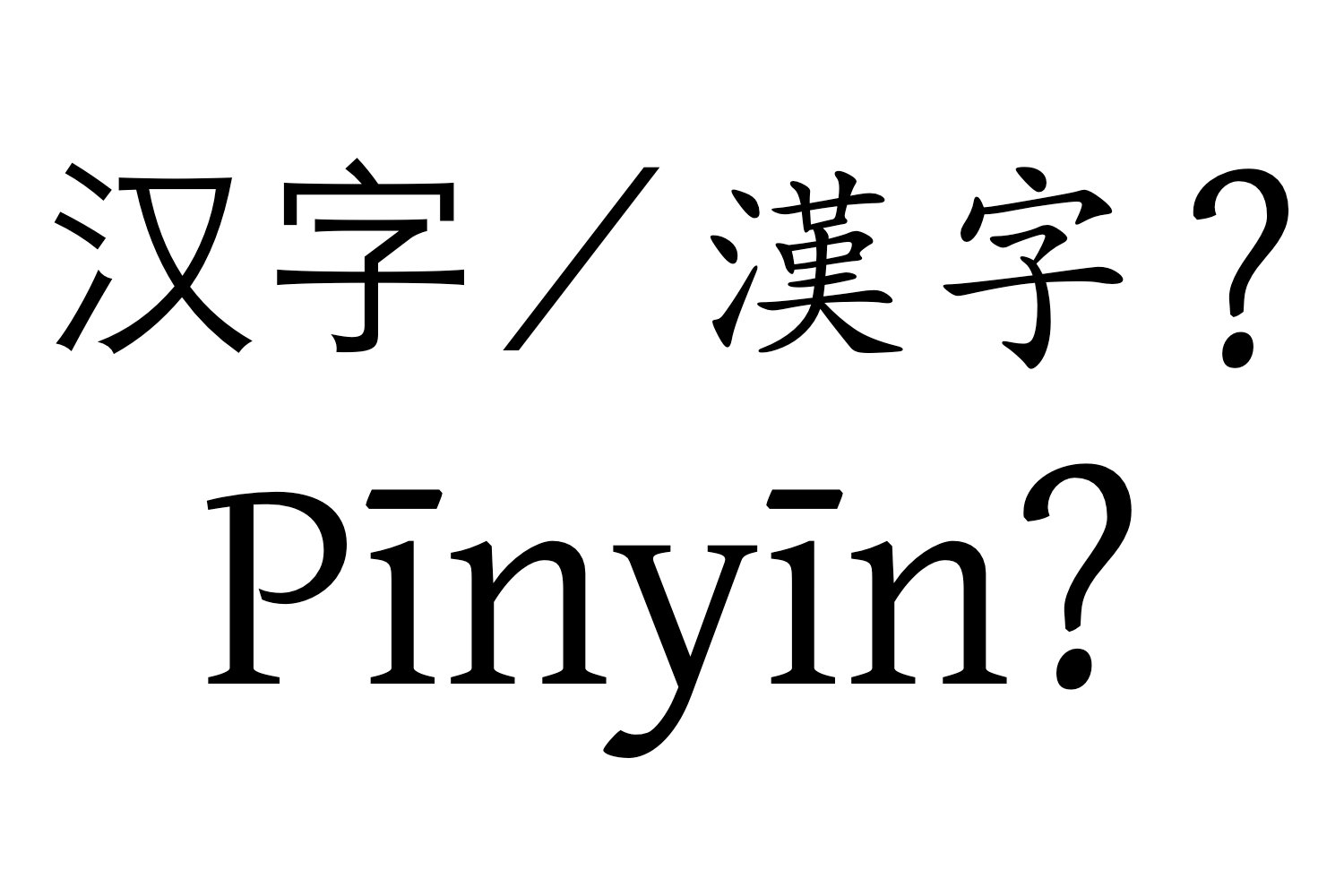
汉字 / 漢字? Pīnyīn?

The article “Pīnyīn (Pīn·yīn {Piecing Together} · Sounds → [Pinyin] 拼音) Was Plan A” explains that Pīnyīn (Pīn·yīn {Piecing Together} · Sounds → [Pinyin] 拼音) was originally meant by Máo Zédōng ((Máo Hair (surname) 毛) (Zé·dōng Marsh · East 泽东 澤東) (the founder of the People’s Republic of China)) and some of the other early movers and shakers of the People’s Republic of China to eventually replace Chinese characters. (Yes, seriously—it’s April, but we Jehovah’s Witnesses don’t make April Fools’ jokes!) Even though in this case cultural pride, tradition, and inertia have been allowed in the Mandarin-speaking part of the world to leave no room for innovation and progress, the fact remains that Pīnyīn (Pīn·yīn {Piecing Together} · Sounds → [Pinyin] 拼音) was intended by design to work as a full writing system. That it actually does so is shown in the scholarly paper “Two Steps Toward Digraphia in China”, and in the article “Pīnyīn (Pīn·yīn {Piecing Together} · Sounds → [Pinyin] 拼音) Is a Good, Workable Writing System on Its Own”.

R-E-S-P-E-C-T

Since Pīnyīn (Pīn·yīn {Piecing Together} · Sounds → [Pinyin] 拼音) is a full writing system like English is, there is good reason to consider it appropriate to capitalize Pīnyīn (Pīn·yīn {Piecing Together} · Sounds → [Pinyin] 拼音) words similarly to how English words are capitalized. Of course, there are different style guides with different rules regarding how and what to capitalize in English, especially when it comes to titles, but at the very least, any particular piece of writing should generally stick to whatever capitalization style has been chosen for it. (Hopefully it’s a good one.)

Unfortunately, in the part of the world that uses written Mandarin, Pīnyīn (Pīn·yīn {Piecing Together} · Sounds → [Pinyin] 拼音) is generally relegated to being just a pronunciation aid—it is not given the respect and dignity of being recognized as a full writing system, even though, as discussed above, it linguistically qualifies as one. Thus, Pīnyīn (Pīn·yīn {Piecing Together} · Sounds → [Pinyin] 拼音) is generally not capitalized in the world, if it is used at all. In contrast, Pīnyīn (Pīn·yīn {Piecing Together} · Sounds → [Pinyin] 拼音) Plus material gives Pīnyīn (Pīn·yīn {Piecing Together} · Sounds → [Pinyin] 拼音) the respect it has earned—it uses Pīnyīn (Pīn·yīn {Piecing Together} · Sounds → [Pinyin] 拼音) as its default main writing system and carefully follows the capitalization example of the official English version of the Mandarin material it is based on. E.g., since “God’s Kingdom” is rendered in the official English material with capital letters at the beginnings of its words, the Pīnyīn (Pīn·yīn {Piecing Together} · Sounds → [Pinyin] 拼音) Plus material follows suit with “Shàngdì (Shàng·dì Above’s · {Emperor → [God]} → [God] 上帝) de (’s 的) Wángguó (Wáng·guó King’s · Nation → [Kingdom] 王国 王國)”.

So, since “the Memorial” is capitalized in the organization’s official English material, such as the English version of the article “Memorial of Jesus’ Death” on jw.org, “Jìniàn Jùhuì ((Jì·niàn Remembering · {Thinking Of} → [Commemorating] 记/纪念 記/紀念) (Jùhuì Meeting 聚会 聚會) [[the] Memorial])” is capitalized in this post and in other material containing Pīnyīn (Pīn·yīn {Piecing Together} · Sounds → [Pinyin] 拼音) Plus material.

The Precedent of Punctuation

Is it “beneath” the Chinese world to follow the example of English when it comes to the capitalization of the alphabet it uses? Well, the Chinese world has followed Western writing style examples before, with punctuation. As the MEotW post on “diǎnliàng (diǎn·liàng {dot → [light (v); ignite]} · {to be bright} [→ [illuminate; shine light on]] 点亮 點亮)” pointed out:

Chinese writing in the past didn’t have punctuation, and now it has punctuation largely modeled after European punctuation. (For reference: Chinese punctuation – Wikipedia, Q&A: When were punctuation marks first used? – HistoryExtra, history – When was punctuation introduced into Chinese? – Chinese Language Stack Exchange)