bùzú
(bù·zú
sectional · {ethnic group} →[tribe]
部族) ← Tap/click to show/hide the “flashcard”
Appendix A2 of the English New World Translation of the Holy Scriptures (Study Edition), entitled “Features of This Revision”, discusses vocabulary changes that have been made in the current revision, words that have been translated differently than before. As noted in various entries in the excellent resource Referenced Theo. Expressions (RTE), Appendix A2 of the current Mandarin version of the New World Translation Bible (nwtsty) correspondingly discusses words that have been translated differently in the current revision of the Mandarin NWT Bible, compared to how they had been translated before.
Since we base what we say in Jehovah’s service on his Word the Bible, the vocabulary used in it—and the way those vocabulary words are translated—should be reflected in how we speak in our ministry, at our meetings, etc. So, it is beneficial for us Mandarin field language learners to be familiar with the latest thinking from the organization on how Bible terms should be translated into Mandarin.
Adding Context
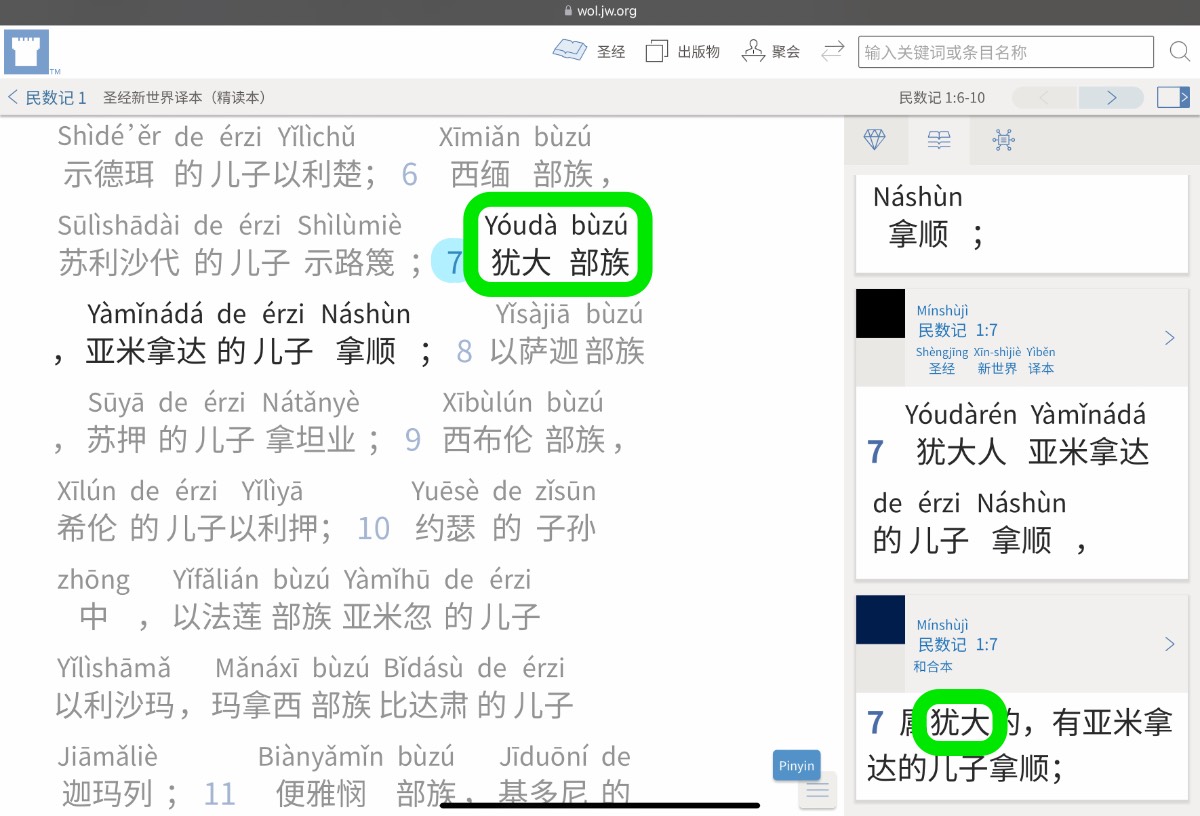
In past Mandarin Bible translations, a name like “Yóudà
(Judah
犹大
猶大)” might be used to refer to a man, a tribe, a nation, etc., and this could cause readers to be confused. So, the current Mandarin version of the New World Translation Bible (nwtsty) translates such names more clearly, for example using “Yóudà
(Judah
犹大
猶大)bùzú
(bù·zú
sectional · {ethnic group} →[tribe]
部族)” to mean “the tribe of Judah”, using “Yóudà
(Judah
犹大
猶大)guó
(nation
国
國)” to mean “the nation of Judah”, using “Yóudà
(Judah
犹大
猶大)dìqū
(dì·qū
land · region
地区
地區)” to mean “the land of Judah”, etc.—Mínshùjì
(Mín·shù·jì
{The People} · Numbers · Record →[Numbers]
民数记
民數記)1:7; Lièwángjì Shàng
((Liè·wáng·jì
{Series of} · Kings · Record
列王纪
列王紀)
(Shàng
Upper
上)
→[1 Kings])13:1; Níxīmǐjì
(Níxīmǐ·jì
Nehemiah · Record
尼希米记
尼希米記)11:3.
By the way, the “bù
(part; section [→ [unit; ministry; department; board]] | [mw for large books, films, machines, vehicles, etc.]
部)” in “bùzú
(bù·zú
sectional · {ethnic group} →[tribe]
部族)” (this week’s MEotW) is also the one that appears in the well-known expression “bùfen
(bù·fen
part; section · component; share; part; portion
部分)”.
Solving “The Homophone Problem”
A section of the article “Pīnyīn
(Pīn·yīn
{Piecing Together} · Sounds →[Pinyin]
拼音)Was Plan A” addresses the common contention that Pīnyīn
(Pīn·yīn
{Piecing Together} · Sounds →[Pinyin]
拼音) is not suitable as a writing system for Mandarin because of the high number of homophones in Mandarin:
Some may object, saying that there are so many homophones in Chinese that the characters are needed to tell them apart from each other. (A homophone is a word that has the same pronunciation as another word, but that has a different meaning from it.) However, consider: When people are just speaking Mandarin, with no characters in sight to help them, do they have problems understanding each other because of all the homophones? Can blind Mandarin-speakers, who cannot see characters, still “see” what people mean when those people speak Mandarin? Native Mandarin-speakers have confirmed to me that no, homophones are not a significant problem in spoken Mandarin—people can use the context and understand each other okay. So, people can use the context and understand each other okay when using Pīnyīn too, since Pīnyīn directly represents the sound of spoken Mandarin.
…
…other ways [besides resorting to characters] to alleviate the problem. Those other ways could include:
Including as much clarifying context in the written language as is necessary, as is done in the spoken language
Reducing the number of homophones by
Adding syllables to existing homophones
The above-described practice used in the current Mandarin NWT, of adding expressions like “bùzú
(bù·zú
sectional · {ethnic group} →[tribe]
部族)” to expressions like “Yóudà
(Judah
犹大
猶大)”, is an example of adding context, and also an example of reducing the number of expressions that sound the same by adding syllables to existing expressions that sound the same, to clarify what means what without resorting to the homophone-enabling crutch that is the characters. In fact, in this case, disambiguation by using different characters is not an option anyway because “Yóudà
(Judah
犹大
猶大)” must be written with the same characters whether it means “the man named Judah”, “the tribe of Judah”, “the nation of Judah”, etc. Theoretically, one might contemplate the possibility of using different characters to represent “Judah” depending on whether it refers to “the man named Judah”, “the tribe of Judah”, “the nation of Judah”, etc., but that way lies even madder madness than the madness that already is the Chinese characters!
dìqū
(dì·qū
land · area; district; region [→ [territory]]
地区
地區) ← Tap/click to show/hide the “flashcard”
Appendix A2 of the English New World Translation of the Holy Scriptures (Study Edition), entitled “Features of This Revision”, discusses vocabulary changes that have been made in the current revision, words that have been translated differently than before. As noted in various entries in the excellent resource Referenced Theo. Expressions (RTE), Appendix A2 of the current Mandarin version of the New World Translation Bible (nwtsty) correspondingly discusses words that have been translated differently in the current revision of the Mandarin NWT Bible, compared to how they had been translated before.
Since we base what we say in Jehovah’s service on his Word the Bible, the vocabulary used in it—and the way those vocabulary words are translated—should be reflected in how we speak in our ministry, at our meetings, etc. So, it is beneficial for us Mandarin field language learners to be familiar with the latest thinking from the organization on how Bible terms should be translated into Mandarin.
The Land of…
Past versions of the Mandarin NWT Bible added “Dì
(Land (of)
地)” after the names of lands, as in “Āijí
(Egypt
埃及)Dì
(Land (of)
地)” (“the Land of Egypt”). However, that isn’t the usual way to render the names of lands in Mandarin Chinese, resulting in readers finding such renderings unnatural.
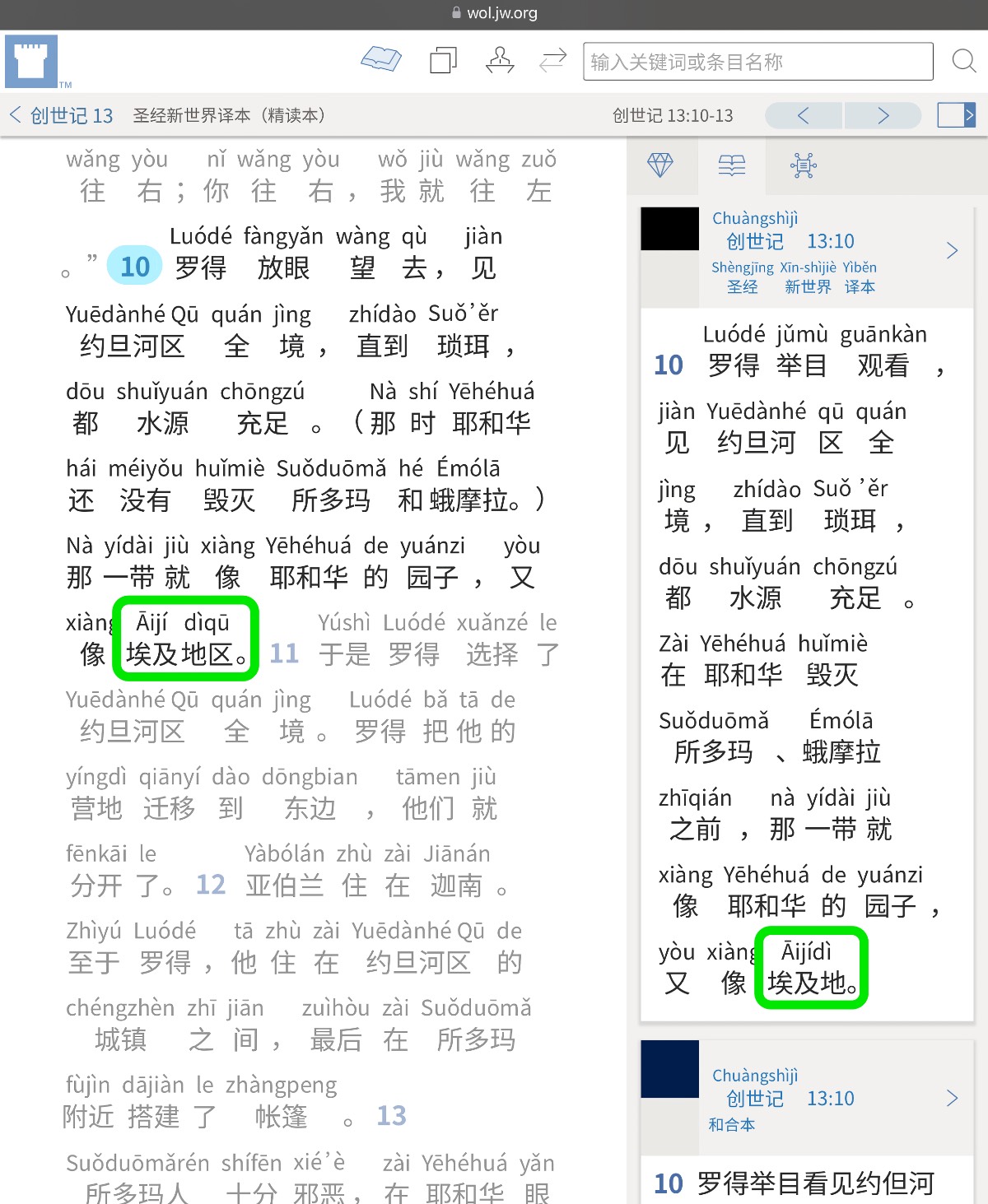
So, the current Mandarin version of the NWT Bible (nwtsty) now renders the names of lands differently. For example, “Āijí
(Egypt
埃及)Dì
(Land (of)
地)” is now rendered as “Āijí
(Egypt
埃及)Dìqū
(Dì·qū
Land · Region (of)
地区
地區)”, as can be seen at Genesis 13:10:
The Territory of…
Incidentally, “dìqū
(dì·qū
land · area; district; region [→ [territory]]
地区
地區)” has also long been the expression used in Mandarin groups and congregations to refer to the “territory” that a group or congregation carries out the preaching work in. As with the English expression “territory”, one could speak of a congregation’s “dìqū
(dì·qū
land · region → [territory]
地区
地區)” as a whole, or of a particular “dìqū
(dì·qū
land · region → [territory]
地区
地區)” within that whole that, say, a car group of publishers is working.
yīnyì
(yīn·yì
sound · translating →[transcribing | transcription]
音译
音譯) ← Tap/click to show/hide the “flashcard”
Appendix A2 of the English New World Translation of the Holy Scriptures (Study Edition), entitled “Features of This Revision”, discusses vocabulary changes that have been made in the current revision, words that have been translated differently than before. As noted in various entries in the excellent resource Referenced Theo. Expressions (RTE), Appendix A2 of the current Mandarin version of the New World Translation Bible (nwtsty) correspondingly discusses words that have been translated differently in the current revision of the Mandarin NWT Bible, compared to how they had been translated before.
Since we base what we say in Jehovah’s service on his Word the Bible, the vocabulary used in it—and the way those vocabulary words are translated—should be reflected in how we speak in our ministry, at our meetings, etc. So, it is beneficial for us Mandarin field language learners to be familiar with the latest thinking from the organization on how Bible terms should be translated into Mandarin.
Units of Measurement
Appendix A2 of the current Mandarin version of the New World Translation Bible (nwtsty) points out that in previous editions of the Mandarin New World Translation, basically metric system units of measurement were used, although sometimes units from the original language were used. However, the whole number metric measurements that were considered best to use in the main text generally ended up being inexact conversions from the original measurements. Also, some metric units of measurement are named differently in different places. For example, some places use “mǐ
(metre
米)” to mean “metre”, while other places use “gōngchǐ
(gōng·chǐ
{collective → [metric]} · {Chinese foot (⅓ of a metre)} →[metre]
公尺)”. So, the current version of the Mandarin NWT in most scriptures uses the original language units of measurement through what in Mandarin is called “yīnyì
(yīn·yì
sound · translating →[transcribing | transcription]
音译
音譯)”, and in footnotes it provides the metric equivalents and perhaps other information.
What does “yīnyì
(yīn·yì
sound · translating →[transcribing | transcription]
音译
音譯)” involve? Some Chinese-English dictionaries say that this word is used to mean either “transliterate”/“transliteration” or “transcribe”/“transcription”. What’s the difference? Is there a difference?
[Note on terminology: “Writing system” and “script” are synonymous, while an “orthography” is a “set of conventions [connected to a writing system/script] for writing a language, including norms of spelling, capitalization, emphasis, hyphenation, punctuation, and word breaks”.]
Transliteration is a type of conversion of a text from one script to another that involves swapping letters (thus trans- + liter-) in predictable ways
Transliteration is not primarily concerned with representing the sounds of the original but rather with representing the characters, ideally accurately and unambiguously.
Systematic transliteration is a mapping from one system of writing into another, typically grapheme to grapheme [e.g., letter to letter]. Most transliteration systems are one-to-one, so a reader who knows the system can reconstruct the original spelling.
Echoing the above quote, the academic paper “Two Steps Toward Digraphia in China” (Sino-Platonic Paper Number 134), by Xieyan Hincha, provides this rigorous definition of transliteration:
By transliteration is meant the letter-by-letter conversion of a text written in an alphabet into another alphabetical script, if necessary using diacritical marks, in such a way that the text can be correctly converted back into the original text by means of a transliteration table.
Transcription in the linguistic sense is the systematic representation of spoken language in written form.
There are two main types of linguistic transcription. Phonetic transcription focuses on phonetic and phonological properties of spoken language. Systems for phonetic transcription thus furnish rules for mapping individual sounds or phones to written symbols. Systems for orthographic transcription, by contrast, consist of rules for mapping spoken words onto written forms as prescribed by the orthography of a given language. Phonetic transcription operates with specially defined character sets, usually the International Phonetic Alphabet. [emphasis added]
The above-mentioned academic paper “Two Steps Toward Digraphia in China” also provides a rigorous definition for transcription, which seems to specifically refer to phonetic transcription, as referred to in the Wikipedia quote above:
It is time to ask what exactly is a transcription system. It is a graphic system whose elements unambiguously represent the sounds of a spoken language. The transcription can be narrow or broad: in both cases one graphic symbol represents in principle precisely one single sound.
“There is Too Much…Let Me Sum Up”
To sum up, basically transliteration refers to mapping from one writing system to another writing system, while transcription refers to mapping from a language’s sounds to a graphic system like the IPA (phonetic transcription), or to a writing system with an orthography (orthographic transcription).
Thus, I would say that it’s not really appropriate to use “yīnyì
(yīn·yì
sound · translating →[transcribing | transcription]
音译
音譯)”—which literally means “sound translating”—to mean “transliterate” or “transliteration”. From the literal meanings of its morphemes, “yīnyì
(yīn·yì
sound · translating →[transcribing | transcription]
音译
音譯)” is a much better fit for meaning “transcribe” or “transcription”, which refer to mapping the sounds of a language to a graphic system or a writing system.
Going back to Appendix A2 of the current Mandarin version of the NWT Bible, when it says that this version in most scriptures yīnyì
(yīn·yì
sound · translates →[transcribes]
音译
音譯) (transcribes) the original language’s units of measurement, that means that it uses Chinese characters/Pīnyīn
(Pīn·yīn
{Piecing Together} · Sounds →[Pinyin]
拼音) to represent (as well as they can) how these units of measurement sounded in the original language. For example, the original language unit of measurement translated into English as “seah measure” is translated into Mandarin as “xìyà
({seah (measure)}
细亚
細亞)”.—2 Kings 7:1 (English/Mandarin).
Besides offering definitions of transliteration and transcription, the academic paper “Two Steps Toward Digraphia in China” mentioned above also discusses whether these terms apply to Pīnyīn
(Pīn·yīn
{Piecing Together} · Sounds →[Pinyin]
拼音). Here are a couple of quotes:
In the case of Chinese characters, ISO has established that a transliteration between Chinese characters and Pīnyīn
(Pīn·yīn
{Piecing Together} · Sounds →[Pinyin]
拼音) is impossible: the supposedly more than 40,000 (“ideo-phonographic”) characters cannot be represented by the 26 letters of the Latin alphabet. There is no doubt about that. This clearly shows that Hànyǔ
(Hàn·yǔ
{Han (Chinese)} · Language → [(Modern Standard) Mandarin]
汉语
漢語)Pīnyīn
(Pīn·yīn
{Piecing Together} · Sounds →[Pinyin]
拼音)Fāng’àn
(Fāng’·àn
{Direction → [Method]} · {Long, Narrow Table or Desk → [Plan]}
方案) is not a transliteration system, because it does not fulfill all the criteria of a transliteration system.
If Hànyǔ
(Hàn·yǔ
{Han (Chinese)} · Language → [(Modern Standard) Mandarin]
汉语
漢語)Pīnyīn
(Pīn·yīn
{Piecing Together} · Sounds →[Pinyin]
拼音)Fāng’àn
(Fāng’·àn
{Direction → [Method]} · {Long, Narrow Table or Desk → [Plan]}
方案) were a transcription system, this table would contain three state-prescribed violations of the transcription principle, namely: y+i, y+in, and y+ing. In all three of these cases, two letters represent one sound. The same is true when writing y+u and w+u. This rule does not concern phonetic transcription; rather, it is an orthographic rule: in these cases <y> and <w> are artificial and arbitrary initial symbols. But phonetically these are not consonants. Consequently, in this respect Hànyǔ
(Hàn·yǔ
{Han (Chinese)} · Language → [(Modern Standard) Mandarin]
汉语
漢語)Pīnyīn
(Pīn·yīn
{Piecing Together} · Sounds →[Pinyin]
拼音)Fāng’àn
(Fāng’·àn
{Direction → [Method]} · {Long, Narrow Table or Desk → [Plan]}
方案) is not a transcription system.
The above quote explains that Pīnyīn
(Pīn·yīn
{Piecing Together} · Sounds →[Pinyin]
拼音) does not qualify as a phonetic transcription system. However, it shows that Pīnyīn
(Pīn·yīn
{Piecing Together} · Sounds →[Pinyin]
拼音) has orthographic rules connected to it, meaning it could be used for orthographic transcription…
No, Could It Be?
So, this academic paper concludes that Pīnyīn
(Pīn·yīn
{Piecing Together} · Sounds →[Pinyin]
拼音) is not a system for transliterating Chinese characters, nor is it a system for phonetically transcribing Mandarin speech. What is it, then? The paper comes to this conclusion:
As is well known, the Chinese leadership refuses to recognize Hànyǔ
(Hàn·yǔ
{Han (Chinese)} · Language → [(Modern Standard) Mandarin]
汉语
漢語)Pīnyīn
(Pīn·yīn
{Piecing Together} · Sounds →[Pinyin]
拼音) as a script and to permit digraphia [the state of having two standard scripts, Chinese characters and Pīnyīn
(Pīn·yīn
{Piecing Together} · Sounds →[Pinyin]
拼音)]. But scientific facts demonstrate that Hànyǔ
(Hàn·yǔ
{Han (Chinese)} · Language → [(Modern Standard) Mandarin]
汉语
漢語)Pīnyīn
(Pīn·yīn
{Piecing Together} · Sounds →[Pinyin]
拼音)Fāng’àn
(Fāng’·àn
{Direction → [Method]} · {Long, Narrow Table or Desk → [Plan]}
方案), including its orthography, is a writing system for Chinese. [emphasis added]