Categories
Culture Language Learning Science

duōyú

duōyú (duō·yú {(too) much/many} · surplus; excess → [unnecessary; surplus; superfluous; uncalled-for; redundant | excessive] 多余 多餘) ← Tap/click to show/hide the “flashcard”

Following on from last week’s MEotW post that discussed unnecessary ceremony, this week’s MEotW is “duōyú (duō·yú {(too) much/many} · surplus; excess → [unnecessary; surplus; superfluous; uncalled-for; redundant | excessive] 多余 多餘), which means “unnecessary; surplus; superfluous; uncalled-for; redundant”, or “excessive”.

Here are the usage examples for this expression provided by the Pleco app’s built-in dictionary:

📖 📄 📘 Shāndiào (Shān·diào delete · {to be dropped → [away]} 删掉 刪掉) duōyú (duō·yú {(too) many} · excess → [superfluous] 多余 多餘) de ( 的) cíyǔ (cí·yǔ words · expressions 词语 詞語)

cut out superfluous words and phrases

📖 📄 📘 Zài (in 在) jíshì (jí·shì {gathered (things) → [country market]} · market → [country market] 集市) shang (upon 上) chūshòu (chū·shòu {put out} · {to sell} 出售) duōyú (duō·yú {(too) many} · surplus → [surplus] 多余 多餘) de (’s 的) nóng (farming) chǎnpǐn (chǎn·pǐn {given birth to → [produced]} · products 产品 產品)

sell surplus farm products in the market

📖 📄 📘 Shìshí (Shì·shí matters · {being solid} → [facts] 事实 事實) zhèngmíng (zhèng·míng proved · {to be clear} 证明 證明) wǒmen de ((wǒ·men us · [pl] 我们 我們) (de ’s 的) [our]) dānxīn (dān·xīn {carryings on a shoulder pole → [bearings of (heavy)]} · hearts → [worryings] 担/耽心 擔/耽心) shì (were 是) duōyú (duō·yú {(too) many} · excess → [uncalled-for] 多余 多餘) de (’s 的).

Facts proved that our worries were uncalled-for.

Speaking of “unnecessary”…

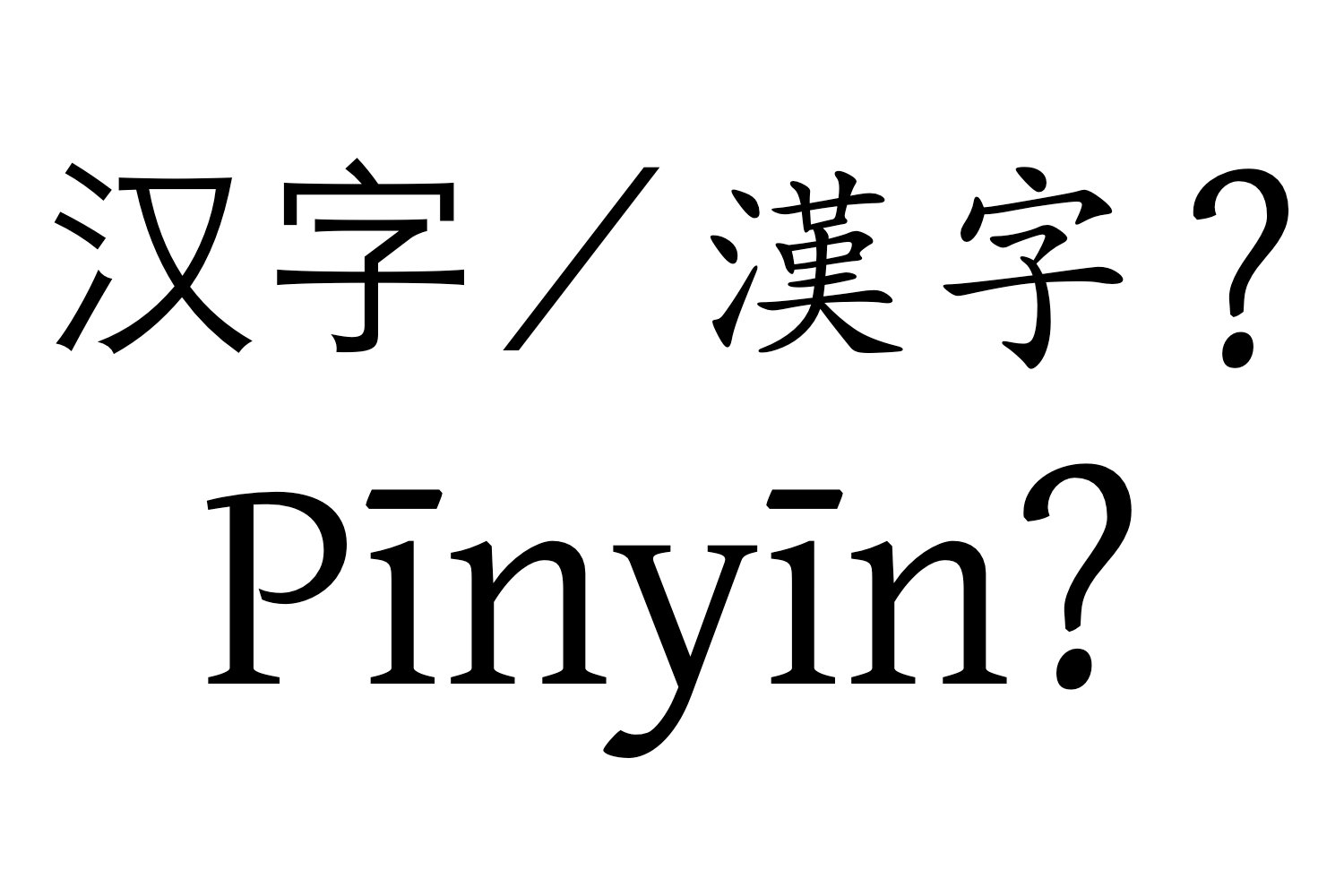
Are Chinese Characters Necessary?

This question may be downright heretical to Chinese culture purists, who would say things like “Of course characters are necessary!” and “Chinese culture without the characters would be inconceivable, just inconceivable! Yes, that would be totally and utterly inconceivable!”

If one’s goal is to fit in with the current Chinese world, especially if one is living in a place where the characters are used in everyday life, government services, etc., then of course one will need to know at least some characters, eventually. But, does that mean that Chinese characters should be the primary focus of Mandarin field language learners from day one?

Both modern linguistics (language science) and God’s Word the Bible itself testify against this. A basic principle of modern linguistics is that speech is primary, not writing, and at 1 Corinthians 14:8–11, the Bible emphasizes the primary importance of understandable speech, not even mentioning writing when it does so:

8 For if the trumpet sounds an indistinct call, who will get ready for battle? 9 In the same way, unless you with the tongue use speech that is easily understood, how will anyone know what is being said? You will, in fact, be speaking into the air. 10 It may be that there are many kinds of speech in the world, and yet no kind is without meaning. 11 For if I do not understand the sense of the speech, I will be a foreigner to the one speaking, and the one speaking will be a foreigner to me.

So, while the characters seem necessary from the point of view of traditional worldly Chinese culture that’s intent on glorifying and perpetuating itself, someone whose primary goals in learning Mandarin are to praise Jehovah and to reach the hearts of Mandarin-speakers with the good news of the Kingdom should really primarily focus on understanding Mandarin speech and speaking Mandarin understandably, from the very beginning:

Your first linguistic goal should be to “utter speech easily understood.” [emphasis added] (1 Corinthians 14:8-11) Though people may be tolerant, mistakes or a heavy accent may distract them from listening to your message. Giving attention to proper pronunciation and grammar right from the start will prevent you from forming bad habits that are hard to break.
“Serving With a Foreign-Language Congregation”, in the March 15, 2006 Watchtower.

A Simple, Elegant, Effective Alternative

The above quote also appears in the article “SPEECH is Top Priority, Not Characters”, which contains other information as well showing why it is that characters and their visual extravagances and traditional complexities are often duōyú (duō·yú {(too) much} · excess → [excessive] 多余 多餘) for Mandarin field language learners. Here is an excerpt:

Publishers need to learn to understand Mandarin speech to benefit spiritually from Mandarin meetings, because the talks, comments, etc. at such meetings are made of Mandarin speech, not characters. In fact, focusing on characters makes this problem worse because it makes learning Mandarin speech harder and slower. At the very least, it distracts from learning Mandarin speech.

In contrast, the simple, elegant Pīnyīn (Pīn·yīn {Piecing Together of} · Sounds → [Pinyin] 拼音) writing system handily does the job of representing Mandarin speech in written form without the unnecessary complexities and ceremonial baggage of the characters. When you do need to use a writing system for Mandarin, then, use Pīnyīn (Pīn·yīn {Piecing Together of} · Sounds → [Pinyin] 拼音) when you can, and just use characters when you have to. Seriously, doing so is not inconceivable!

Categories
Culture Language Learning Names Technology Theocratic

Yēsū Xīshēng Jìniàn Jùhuì

Yēsū (Jesus’ 耶稣 耶穌)
Xīshēng (Xī·shēng {Sacrifice (n)} · {(as with a) Domestic Animal} → [Sacrifice] 牺牲 犧牲)
Jìniàn Jùhuì ((Jì·niàn Remembering · {Thinking Of} → [Commemorating] 记/纪念 記/紀念) (Jùhuì Meeting 聚会 聚會) [Memorial]) 👈🏼 Tap/click to show/hide the “flashcard”

This year’s Memorial is scheduled for this week, so this week’s MEotW is “Yēsū (Jesus’ 耶稣 耶穌) Xīshēng (Xī·shēng {Sacrifice (n)} · {(as with a) Domestic Animal} → [Sacrifice] 牺牲 犧牲) Jìniàn Jùhuì ((Jì·niàn Remembering · {Thinking Of} → [Commemorating] 记/纪念 記/紀念) (Jùhuì Meeting 聚会 聚會) [Memorial]). This is currently the official way to translate “the Memorial of Jesus’ death” into Mandarin, as can be seen by comparing the English and Mandarin pages for the Memorial on jw.org.

It’s worth noting that this is a simple, straightforward, functional translation, free of unnecessary sentimentality or ceremony. As one dictionary puts it, “ceremony”, in this case, refers to:

The formalities observed on some solemn or important public or state occasion in order to render it more imposing or impressive: as, the ceremony of crowning a king, or of laying a foundation-stone; the ceremony of inaugurating the President of the United States.

Indeed, for those of us who appreciate Jesus’ ransom sacrifice, the Memorial is about this appreciation, not about ceremony or empty or showy rituals.

What Price Ceremony?

The matter of unnecessary ceremony reminds me of something I heard in a podcast a while ago:

Here is a clip of the podcast referred to in the tweet above, in which Mr. Cohen speaks of the core goal to make Swift ceremony-free:

As the above tweet also mentions, Chinese characters have oodles and gobs of unnecessary, time-and-energy-consuming ceremony, especially compared to the simple, straightforward, and elegant Pīnyīn (Pīn·yīn {Piecing Together of} · Sounds → [Pinyin] 拼音) writing system. And, echoing Mr. Cohen’s observation that ceremony can weigh programmers down and rob them of the joy that they could otherwise feel when coding, many have found that the unnecessary, traditionally mandated complexity and ceremonial baggage of Chinese characters can weigh down Mandarin learners and take away much of the joy that they should be able to feel from learning how to really communicate with Mandarin-speaking people.

Is it appropriate for us to look at the Chinese characters writing system through the same lens that we use to look at a technological system like the Swift programming language? It really is, because while the Chinese characters writing system is indeed a matter of culture, all writing systems are simultaneously technologies, applications of skills and knowledge for practical purposes.

Categories
Theocratic

qiāndòng

qiāndòng (qiān·dòng {lead along}; pull · {to be moved} → [affect; influence; produce a change] 牵动 牽動) ← Tap/click to show/hide the “flashcard”

[Notes: Tap/click on a Pīnyīn (Pīn·yīn {Piecing Together of} · Sounds → [Pinyin] 拼音) expression to reveal its “flashcard”; tap/click on a “flashcard” or its Pīnyīn (Pīn·yīn {Piecing Together of} · Sounds → [Pinyin] 拼音) expression to hide the “flashcard”. 📖 📄 📘 icons mean 📖 Reveal All, 📄 Reveal Advanced, and 📘 Reveal None re all the “flashcards” in the heading, paragraph, etc. that they are placed at the beginning of.]

One of the publications that is now recommended to be used on Bible studies is the Yǒngyuǎn Xiǎngshòu Měihǎo de Shēngmìng—Hùdòng Shì Shèngjīng Kèchéng ((Yǒng·yuǎn Eternally · {Far (in Time)} 永远 永遠) (Xiǎng·shòu Enjoy · Receive 享受) (Měi·hǎo Beautiful · Good 美好) (de ’s 的) (Shēngmìng Life 生命)—(Hù·dòng {Each Other} · Moving → [Interactive] 互动 互動) (Shì (Type 式) (Shèng·jīng Holy · Scriptures → [Bible] 圣经 聖經) (Kè·chéng Lessons · Procedure → [Course] 课程 課程) [Enjoy Life Forever!—An Interactive Bible Course (lff)]) (Enjoy Life Forever! (lff)) book. This week’s MEotW, “qiāndòng (qiān·dòng {lead along}; pull · {to be moved} → [affect; influence; produce a change] 牵动 牽動), appears in lesson 07, point 2 of this book:

Screenshot of “qiāndòng” in _Enjoy Life Forever!_ bk. lesson 07, point 2 (CHS+_Pīnyīn_ WOL)

The Pīnyīn (Pīn·yīn {Piecing Together of} · Sounds → [Pinyin] 拼音) Plus material for the context in which “qiāndòng (qiān·dòng {lead along}; pull · {to be moved} → [affect; influence; produce a change] 牵动 牽動) occurs is as follows:

📖 📄 📘 (you 你) zhīdào (zhī·dào {did know} · {(the) way (of it)} → [did know] 知道) ma ([? ptcl for “yes/no” questions])? Wǒmen (Wǒ·men we · [pl] 我们 我們) zuò (do 做) de (’s 的) shì (things 事) huì (will) qiāndòng (qiān·dòng pull · {to be moved} → [affect] 牵动 牽動) Yēhéhuá (Jehovah 耶和华 耶和華) de (’s 的) xīn (heart 心).

For comparison, here is the corresponding English sentence:

And did you know that Jehovah is affected by the way we act?

It seems that this is the first time that “qiāndòng (qiān·dòng {lead along}; pull · {to be moved} → [affect; influence; produce a change] 牵动 牽動) has appeared in one of the publications recommended by the organization for use on Bible studies. It has been used in official publications to represent how music can move people, and as shown above, it’s good to know as a word that expresses how Jehovah’s heart can be moved by what we do.

“Jehovah Was Holding My Hand”

The “qiān ({lead along (by holding the hand, etc.)}; pull) in “qiāndòng (qiān·dòng {lead along}; pull · {to be moved} → [affect; influence; produce a change] 牵动 牽動) means “lead along (by holding the hand, etc.); pull”, and it also appears in the expression “qiānqile (qiān·qi·le {lead along (by holding the hand, etc.)}; pulled · {to be rising → [up]} · {to completion | [indicates a change]} 牵起了 牽起了), which is used in the video for lesson 09, point 6 of the Enjoy Life Forever! book:

Screenshot of scene using “qiānqile”, from the video linked to in the _Enjoy Life Forever!_ bk. lesson 09, point 6

📖 📄 📘 Yēhéhuá (Jehovah 耶和华 耶和華) hǎoxiàng (hǎo·xiàng {well → [very much]} · {was like} 好像/象) qiānqile (qiān·qi·le {leading along (by holding the hand, etc.)} · {to be rising → [up]} · [indicates a change] 牵起了 牽起了) wǒ de ((wǒ me 我) (de ’s 的) [my]) shǒu (hand 手),

The corresponding English text is:

Jehovah was holding my hand,

Moving

After watching the above-mentioned video, you might very well feel moved, and if you can speak Mandarin, you might say:

📖 📄 📘 (I 我) tīngdào (tīng·dào heard · {arriving at} 听到 聽到) zhèige (zhèi·ge this · [mw] 这个 這個) jīnglì (jīng·lì {gone through (thing)} · experience → [experience] 经历 經歷) zhīhòu (zhī·hòu ’s · {after (that)} 之后 之後), hěn ({very much} 很) gǎndòng (gǎn·dòng feel · moved 感动 感動).

The “dòng (move [→ [stir | arouse | change; alter]]) in “gǎndòng (gǎn·dòng feeling · moved | {make to feel} · {to be moved} 感动 感動), used above, is the same one that is used in “qiāndòng (qiān·dòng {lead along}; pull · {to be moved} → [affect; influence; produce a change] 牵动 牽動).

This “dòng (move [→ [stir | arouse | change; alter]]), which basically means “move”, also appears in a variety of other Mandarin expressions, such as:

  • tuīdòng (tuī·dòng push · {to be moving} 推动 推動)
  • dòngjī (dòng·jī moving · intention → [motive; motivation; intention] 动机 動機)
  • huódòng (huó·dòng living · moving → [activities] | {to be living → [to be moving]} · {to move} 活动 活動)
  • dòngcí (dòng·cí moving · word → [verb] 动词 動詞)
  • dòngwù (dòng·wù moving · thing → [animal] 动物 動物)
  • yùndòng (yùn·dòng carrying; transporting · moving → [exercising | sports; athletics; exercise | motion; movement | movement; campaign; drive] 运动 運動)
  • zhǔdòng (zhǔ·dòng {(being) master} · moving → [taking the initiative] 主动 主動)

This “dòng (move [→ [stir | arouse | change; alter]]) was also discussed in the MEotW post on “hùdòng (hù·dòng mutually; {[(with)] each other} · moving → [interacting; interaction; interactive] 互动 互動).


For convenience:

The direct link for the current generation Pīnyīn (Pīn·yīn {Piecing Together of} · Sounds → [Pinyin] 拼音) Plus resource for the Enjoy Life Forever! book is:

The short link for Chinese field language-learning links for the Enjoy Life Forever! book is:

More Pīnyīn (Pīn·yīn {Piecing Together of} · Sounds → [Pinyin] 拼音) and Pīnyīn (Pīn·yīn {Piecing Together of} · Sounds → [Pinyin] 拼音) Plus web material based on the Mandarin Enjoy Life Forever! book will be made available in the Pīnyīn (Pīn·yīn {Piecing Together of} · Sounds → [Pinyin] 拼音) Plus web resource as time allows.