Categories
Culture Language Learning Languages Science

yǔxì

yǔxĂŹ+ (yǔ·xĂŹ language · {tied (things) → [system; family]} èŻ­çł» èȘžçł») ← Tap/click to show/hide the “flashcard”

[This is a reposting of a post that was originally posted on February 8, 2021. It discusses the important basic issue of how Mandarin should be classified as a language, a subject about which much political and cultural propaganda has unfortunately been spread.]

[A past] MEotW post mentioned that English and Spanish are generally considered by modern linguists to be in the Indo-European language family. This concept of a language family is used in modern linguistic genealogical (or genetic) language classification:

A language family is a group of languages related through descent from a common ancestral language or parental language, called the proto-language of that family. The term “family” reflects the tree model of language origination in historical linguistics, which makes use of a metaphor comparing languages to people in a biological family tree
Linguists therefore describe the daughter languages within a language family as being genetically related.[source]

The Mandarin Translation

As confirmed by American sinologist and University of Pennsylvania Professor of East Asian Languages and Civilizations Victor H. Mair in his article “The Classification of Sinitic Languages: What Is ‘Chinese’?” (p. 747), an accepted and acceptable Mandarin translation for “language family” is “yǔxĂŹ (yǔ·xĂŹ language · {tied (things) → [system; family]} èŻ­çł» èȘžçł»)”, this week’s MEotW.

The “yǔ+ (language; speech | saying; proverb | words; expression | speak; say èŻ­ èȘž)” in “yǔxĂŹ (yǔ·xĂŹ language · {tied (things) → [system; family]} èŻ­çł» èȘžçł»)” means “language”, particularly, the speech of a language, which modern linguists (language scientists) recognize to be the primary aspect of a language.

“XĂŹ ({tied [(things)]} [→ [system; series | family]] çł»)”, as used in “yǔxĂŹ (yǔ·xĂŹ language · {tied (things) → [system; family]} èŻ­çł» èȘžçł»)”, literally means “tied [(things)]”, and effectively means “system”, “series”, or “family”. Note that in this usage, the character â€œçł»â€ is the same in both simplified and traditional forms. Looking up the character â€œçł»â€ in the dictionary can get tricky, because the simplified character â€œçł»â€ can correspond to the traditional characters â€œçł»â€, “係”, and also “çč«â€, all of which have different, though sometimes related, meanings. This is an example of the complexities and vagaries of characters in general, and of how simplified and traditional characters relate to each other, as mentioned in the MEotW post on “jiǎntǐ (jiǎn·tǐ simplified · {body → [style] → [typeface; font]} → [simplified Chinese] çź€äœ“ ç°Ąé«”) zĂŹ (characters 歗)”.

BTW, an interesting other usage of “xĂŹ ({tied [(things)]} [→ [system; series | family]] çł»)” is in “YĂ­n HĂ©+ ((YĂ­n Silver 银 銀) (HĂ© River æČł) → [Milky Way]) XĂŹ+ ({Tied (Things)} → [System] → [Galaxy] çł»)”, in which “xĂŹ ({tied [(things)]} [→ [system; series | family]] çł»)” effectively means “galaxy”.

Pinwheel Galaxy

The Pinwheel Galaxy, another kind of xĂŹ ({tied [(things)]} [→ [system; series | family]] çł»)

The Mandarin Connection Is
Complicated

We have discussed that English and Spanish are generally considered by modern linguists to be in different groups in the Indo-European language family. How about Mandarin? What is Mandarin’s place in its language family tree?

Unfortunately, the answer to this seemingly simple question is complicated, by at least two major factors.

One complicating factor is that scientific genetic (or genealogical) language classification itself is not a fully worked out thing. The EncyclopĂŠdia Britannica put it this way:

So far, most of the languages of the world have been grouped only tentatively into families, and many of the classificatory schemes that have been proposed will no doubt be radically revised as further progress is made.

Another complicating factor was mentioned in the MEotW post on “fāngyĂĄn (fāng·yĂĄn {direction → [place]} · speech → [topolect; dialect (common but misleading translation)] æ–č蚀)”:

China’s central government is highly motivated to convince people that China is one unified political and cultural entity which should thus be governed by one central government—them

Yes, there is an excess of politics and its propaganda when it comes to the language situation in China, perhaps resulting in a relative dearth of actual scientific research into that situation. Additionally, pervasive political and cultural pressures tend to induce unscientific distortions and self-censorship in whatever research does get done. In his article mentioned above (p. 749), Prof. Mair describes the situation this way:

The contentious, non-scientific nature of the debate over the SLG/F [Sinitic (Chinese) Language Group/Family] is manifest in the circumlocutions used to designate its constituent members: “speech forms,” “varieties,” “styles,” “regionalects,” “dialects” (no matter how far up or down the taxonomic scale one may go), and so forth. At the same time, scholars openly admit that the main reasons why they do not use normal linguistic terminology (family, group, branch, language, dialect) in dealing with the SLG/F are due to sociopolitical and cultural factors. The fallacy of such a bizarre approach is evident when one considers that all nations have special sociopolitical and cultural circumstances, yet an impartial analytical outlook does not allow such circumstances to interfere with pure linguistic research.

The Mandarin Connection—A Common View

In view of the complications mentioned above, what can be said at this time about Mandarin’s place in its language family tree?

At this time, it seems to be traditionally accepted that there is a Sino-Tibetan language family, and that Mandarin is a language (some would unscientifically say “dialect”) in the Sinitic branch of this language family.

It should be noted, however, that even the Wikipedia article on the Sino-Tibetan language family says that there is not yet convincing evidence that the Sino- and Tibetan parts of this hypothetical language family are actually connected in the way that would justify considering them to be together in the same language family:

Several low-level subgroups have been securely reconstructed, but reconstruction of a proto-language for the family as a whole is still at an early stage, so the higher-level structure of Sino-Tibetan remains unclear. Although the family is traditionally presented as divided into Sinitic (i.e. Chinese) and Tibeto-Burman branches, a common origin of the non-Sinitic languages has never been demonstrated.

The Mandarin Connection—Prof. Mair’s View

From my research so far, I have come to consider Prof. Mair, mentioned above, to be the most knowledgeable and trustworthy living authority I know of on the language situation in China.1 The following are some points he made in a relatively recent article, mentioned above, on how Sinitic (Chinese) languages like Mandarin should be classified:

If efforts to link Sinitic with other major language groups continue to be as unconvincing as they have been to date, it may well be that Sinitic will end up being classified as a family unto itself. Because it remains to be determined whether Sinitic is a group or a family, I provisionally style it the Sinitic Language Group/Family (SLG/F). (p. 737)

Cantonese and Mandarin are separate languages. Cantonese is not a ‘dialect’ of Mandarin or of Hanyu, and it is grossly erroneous to refer to it as such. Since Cantonese and Mandarin are separate languages (or, perhaps more accurately, separate branches), it is wrong to refer to them as ‘dialects.’ The same holds for Hokkien, Shanghainese, and so forth. (p. 737)

I
remain agnostic [non-committal] about whether the SLG/F is actually a family unto itself or whether it is more or less closely linked to some other group(s)─such as Tibeto-Burman or Austronesian─in a family (p. 745)

The scientific classification of languages should not be held hostage to extra-linguistic political and cultural prejudices. (p. 746)

In the scientific classification of modern Sinitic languages, as much as possible, data should be drawn from the strikingly different spoken varieties, not from standard written forms. Writing is a second-order linguistic phenomenon. Since most speakers of Sinitic throughout prehistory and history have been illiterate, the nonessentiality of writing for the existence of the SLG/F is self-evident. (pp. 746–747)

The classification of the SLG/F, both internally and externally, is still in the beginning stages; much difficult work remains to be done. (p. 750)

‘Chinese’, ‘dialect’, and other terms in broad popular usage should be employed with extreme caution in technical discussions of the countless varieties of speech forms that currently exist and that have existed at various periods and places during the past in the East Asian Heartland (EAH) and Extended East Asian Heartland (EEAH) (p. 750)

There is an urgent need for the classification of the SLG/F, but this cannot be accomplished satisfactorily without precise, linguistically justifiable terminology. (p. 751)

The people of China have a right to conceive and speak of the languages of their country however they wish; linguists of the world have a duty to study the languages of China according to universal principles. If linguists abandon their scientific duty, the current chaos and lack of consensus concerning the nature of Sinitic will continue, much to the detriment of our understanding not only of the languages of China, but to linguistics as a whole. (p. 751)

Be Wary of What You May Hear About Mandarin

So, as we seek to learn Mandarin, let us keep in mind that while others—including well-meaning ones who are sincerely sharing what they themselves learned—may tell us certain things about Mandarin and how it relates to other varieties of speech, some of what they tell us may not be scientifically verified truth. More research needs to be done in some areas. Also, unfortunately, we need to be wary of the abundant political and cultural propaganda that has been spread about Mandarin and about the language situation in China in general.

1. American linguist, sinologist, author of Chinese language textbooks, lexicographer of Chinese dictionaries, and Professor Emeritus of Chinese Studies at the University of HawaiÊ»i at Mānoa John DeFrancis was also an exceptionally knowledgeable and trustworthy authority on the language situation in China. Sadly, he passed away in 2009. He did leave behind many excellent writings, though. I highly recommend his book The Chinese Language: Fact and Fantasy (Honolulu: University of Hawaii Press, 1984). ^
Categories
Culture History Language Learning Languages Names Science

Yuùyǔ

YuĂšyǔ+ (YuÚ·yǔ Yue · Language [→ [Cantonese]] çČ€èŻ­ çČ”èȘž) ← Tap/click to show/hide the “flashcard”

This week’s MEotW, “YuĂšyǔ (YuÚ·yǔ Yue · Language [→ [Cantonese]] çČ€èŻ­ çČ”èȘž)”, is a term that over the years one may occasionally have come across in the Chinese fields. For example, it used to be used on publication download pages on jw.org, where it has been replaced by a term that is more familiar to many: “GuǎngdƍnghuĂ  (Guǎng·dƍng·huĂ  {Wide · East → [Canton]} · Speech → [Cantonese speech/language] ćčżäžœèŻ ć»Łæ±è©±)” (“Cantonese”).

The Language(s)

Regarding “YuĂšyǔ (YuÚ·yǔ Yue · Language [→ [Cantonese]] çČ€èŻ­ çČ”èȘž)”, the Wikipedia article on Yue Chinese provides this summary:

Yue (Cantonese pronunciation: [jyːt̚˚]) is a branch of the Sinitic languages primarily spoken in Southern China, particularly in the provinces of Guangdong and Guangxi (collectively known as Liangguang).

The term Cantonese is often used to refer to the whole branch, but linguists prefer to reserve the name Cantonese for the variety used in Guangzhou (Canton), Wuzhou (Ngchow), Hong Kong and Macau, which is the prestige dialect of the group. Taishanese, from the coastal area of Jiangmen (Kongmoon) located southwest of Guangzhou, was the language of most of the 19th-century emigrants from Guangdong to Southeast Asia and North America. Most later migrants have been speakers of Cantonese.

Yue varieties are not mutually intelligible with other varieties of Chinese,[source] and they are not mutually intelligible within the Yue family either.[source]

This Wikipedia page also cites Ethnologue as saying that the number of native speakers worldwide of YuĂšyǔ (YuÚ·yǔ Yue · Language [→ [Cantonese]] çČ€èŻ­ çČ”èȘž) was recently about “86 million (2022)[source]”. That’s not as many as Mandarin has (no other language/language branch currently has as many native speakers as Mandarin does), but that’s still a lot of people.

Regarding how Cantonese relates to other Chinese speech varieties, note the following excerpt from the MEotW post on “yǔzĂș (yǔ·zĂș language · {ethnic group → [group of things with common characteristics] → [group]} èŻ­æ— èȘžæ—)”:

It’s interesting to note that according to Prof. [Victor H.] Mair’s article (p. 737) mentioned above, not only are Mandarin and Cantonese separate languages (not just “dialects”), it would be more accurate to consider them to be in separate language branches, as defined by the language classisification scheme he uses:

Cantonese and Mandarin are separate languages. Cantonese is not a ‘dialect’ of Mandarin or of Hanyu, and it is grossly erroneous to refer to it as such. Since Cantonese and Mandarin are separate languages (or, perhaps more accurately, separate branches), it is wrong to refer to them as ‘dialects.’ The same holds for Hokkien, Shanghainese, and so forth.

That Mandarin and Cantonese should really be considered to be in separate language branches emphasizes to us politically neutral Mandarin field language-learners that we must not repeat or be misled by the politically motivated erroneous assertion that Mandarin, Cantonese, Shanghainese, etc. are just dialects of “Chinese”. That might be even more wrong than saying that English, French, Spanish, etc. are just dialects of “European”!

Some Geography

To clarify regarding some of the places related to “YuĂšyǔ (YuÚ·yǔ Yue · Language [→ [Cantonese]] çČ€èŻ­ çČ”èȘž)”:

  • Guǎngdƍng+ (Guǎng·dƍng Wide · East → [Guangdong (Canton) Province] ćčżäžœ ć»Łæ±)
  • Guǎngzhƍu+ (Guǎng·zhƍu Wide · Prefecture → [Guangzhou (Canton (city))] ćčżć·ž 滣淞)
    • This is the capital city of Guǎngdƍng (Guǎng·dƍng Wide · East → [Guangdong (Canton) Province] ćčżäžœ ć»Łæ±) province.
  • GuǎngxÄ«+ (Guǎng·xÄ« Wide · West → [Guangxi (Guangxi Zhuang Autonomous Region)] ćčżè„ż ć»Łè„ż)
    • This is an autonomous region that’s located just to the west of Guǎngdƍng (Guǎng·dƍng Wide · East → [Guangdong (Canton) Province] ćčżäžœ ć»Łæ±).

Some History

This summary from the Wikipedia article on Baiyue provides us with some historical background:

The Baiyue, Hundred Yue, or simply Yue, were various ethnic groups who inhabited the regions of Southern China and Northern Vietnam during the 1st millennium BC and 1st millennium AD.[source][source][source] They were known for their short hair, body tattoos, fine swords, and naval prowess.


The Yue tribes were gradually displaced or assimilated into Chinese culture as the Han empire expanded into what is now Southern China and Northern Vietnam.[source][source][source][source] Many modern southern Chinese dialects bear traces of substrate languages[citation needed] originally spoken by the ancient Yue. Variations of the name are still used for the name of modern Vietnam [YuĂšnĂĄn+ (YuÚ·nĂĄn Yue · South → [Vietnam] è¶Šć—)], in Zhejiang-related names including Yue opera, the Yue Chinese language, and in the abbreviation for Guangdong.


The modern term “Yue” (traditional Chinese: è¶Šă€çČ”; simplified Chinese: è¶Šă€çČ€; pinyin: YuĂš; Cantonese Jyutping: Jyut6; Wade–Giles: YĂŒeh4; Vietnamese: Việt; Early Middle Chinese: Wuat) comes from Old Chinese *ÉąÊ·at.[source] It was first written using the pictograph 戉 for an axe (a homophone), in oracle bone and bronze inscriptions of the late Shang dynasty (c. 1200 BC), and later as 越.[source]

Is Cantonese Only Spoken?

Native Cantonese speakers I have known, like those in the Cantonese congregation that I used to be in, would tell me that the Cantonese we spoke was spoken Chinese, and that the Chinese in the official publications of the time, which was different in some ways from spoken Cantonese, was written Chinese. However, as I gained more knowledge about the history and the language situation of China, I came to understand that actually, the Chinese writing in the publications we were using was Mandarin, which was used because Mandarin-speaking people had gained political power in China, resulting in Chinese publications generally being published in Mandarin—it wasn’t a matter of spoken and written Chinese being different, but rather, of Cantonese and Mandarin being different.

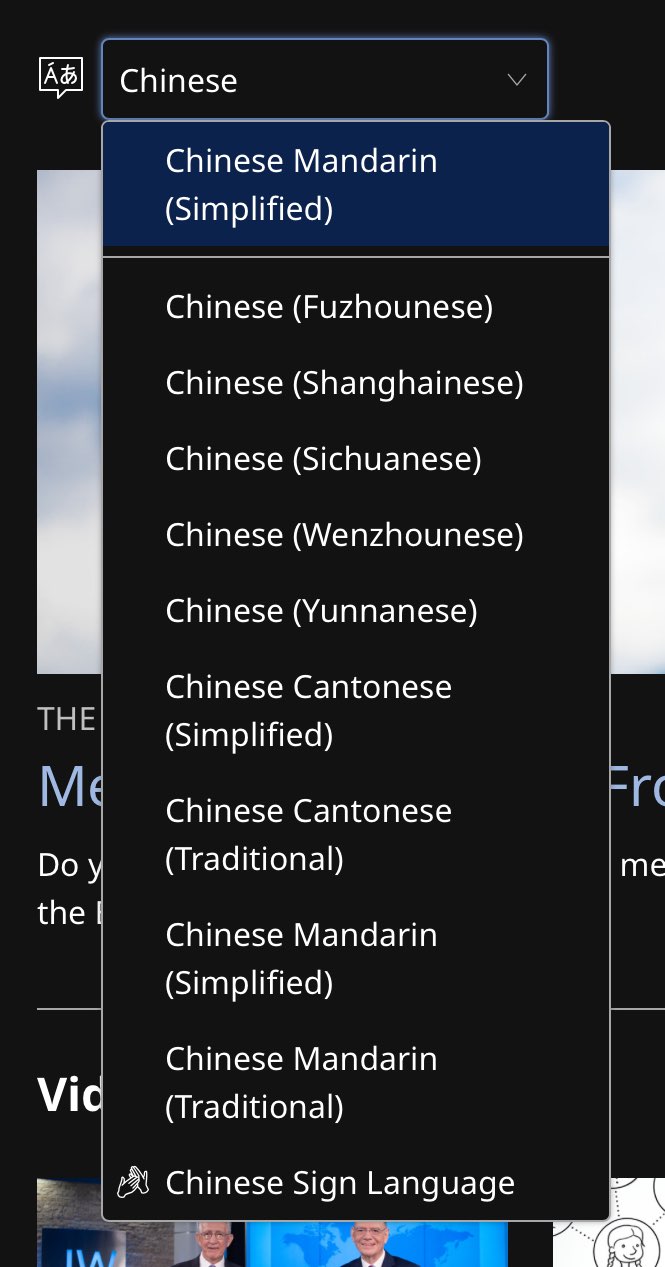
Eventually, the organization came to also publish publications written in other Chinese varieties in addition to Mandarin. As of this writing, searching for “Chinese” on jw.org results in the following options, which includes Cantonese options:

Chinese varieties on jw.org as of 2024-04-14

Something to Remember

This week’s MEotW, “YuĂšyǔ (YuÚ·yǔ Yue · Language [→ [Cantonese]] çČ€èŻ­ çČ”èȘž)”, reminds us that while the central government of China wants everyone to just think of China as one monolithic political entity that should be governed by them, the central government, modern China actually is made up of many different parts. If it wasn’t for QĂ­n ShǐhuĂĄng ((QĂ­n {Qin (dynasty)} ç§Š) (Shǐ·huĂĄng Beginning · Emperor 構皇) (the founder of the QĂ­n dynasty and the first emperor of China)) (Wikipedia article), who (rather forcefully) united several warring states and became the first emperor of China, China could have ended up like modern Europe, with its several independent nations.

These different parts of modern China, that in an alternate timeline could have become independent nations, each have their own history, including their own linguistic history—just like modern France, Spain, Germany, etc. have historically had their own mutually unintelligible languages, modern Guǎngdƍng (Guǎng·dƍng Wide · East → [Guangdong (Canton) Province] ćčżäžœ ć»Łæ±), ShĂ nghǎi (ShĂ ng·hǎi Upon · {the Sea} → [Shanghai] 䞊攷), FĂșjiĂ n (FĂș·jiĂ n {Blessing (abbr. for the city name FĂșzhƍu)} · {Established (abbr. for the city name JiĂ nzhƍu)} → [Fujian (Province)] 犏ć»ș), etc. also have historically had their own mutually unintelligible languages, even if China’s central government would like everyone to just (erroneously) call them dialects of “Chinese”. This reality of China’s many mutually unintelligible languages is being emphasized, not for any political purpose, but rather, to help us language learners in the Chinese fields to be equipped with the truth as we try to make practical progress in learning and using Chinese languages to spread our God-honouring and life-saving message.

Categories
Culture Experiences History Language Learning

jī‐tĂłng‐yā‐jiǎng

jī‐tĂłng‐yā‐jiǎng+ ((jÄ« chicken 鞥 雞/鷄)‐(tĂłng {together with} 㐌 㐌/仝)‐(yā duck éž­ 鎚)‐(jiǎng speaking èźČ èŹ›) → [people not understanding each other because of speaking different languages (from Cantonese)]) ← Tap/click to show/hide the “flashcard”

[Yes, this expression comes from Cantonese, but the above Mandarin version does appear in Mandarin dictionaries, so it qualifies as a Mandarin expression!]

Recently, while out to dinner with one of the first families to serve in the local Cantonese congregation, along with the circuit overseer serving the local Chinese circuit and his wife, the subject came up of how Mandarin and Cantonese are actually different languages, not just dialects of the same language.

Chickens Talking with Ducks

The wife of the circuit overseer asked what the difference is between a language and a dialect. So, I proceeded to explain something that is emphasized by American sinologist and University of Pennsylvania Professor of East Asian Languages and Civilizations Victor H. Mair, that a primary way accepted by most linguists to distinguish a language from a dialect is mutual intelligibility, as is discussed in this excerpt from the MEotW post on “fāngyĂĄn (fāng·yĂĄn {direction → [place]} · speech → [topolect; dialect (common but misleading translation)] æ–č蚀)”:

It has been said that “a language is a dialect with an army and navy”, but in his article Professor Mair gives us a more linguistically correct and useful way to distinguish between a language and a dialect:

Regardless of the imprecision of lay usage, we should strive for a consistent means of distinguishing between language and dialect. Otherwise we might as well use the two terms interchangeably. That way lies chaos and the collapse of rational discourse. Mutual intelligibility [emphasis added] is normally accepted by most linguists as the only plausible criterion for making the distinction between language and dialect in the vast majority of cases. Put differently, no more suitable, workable device for distinguishing these two levels of speech has yet been proposed. If there are to be exceptions to the useful principle of mutual intelligibility, there should be compelling reasons for them. Above all, exceptions should not be made the rule.

What is mutual intelligibility? Simply put, in linguistics, two or more speech varieties are said to be mutually intelligible if they are “able to be understood by one another’s speakers”. For example, if one person only knows English, and another person only knows Spanish, they can’t really understand each other if they try to talk to each other—English and Spanish are not mutually intelligible, and are suitably recognized as being different languages, not just different dialects of “European”.

Similarly, if one person only knows Mandarin, and another person only knows Cantonese, they can’t really understand each other if they try to talk to each other—Mandarin and Cantonese are not mutually intelligible. So, while they may be “fāngyĂĄn+ (fāng·yĂĄn {direction → [place]} · {(patterns of) speech} æ–č蚀)”, linguistically, Mandarin and Cantonese should really be considered to be different languages, not just different dialects of “Chinese”.

Indeed, I have heard people use this week’s MEotW, “jī‐tĂłng‐yā‐jiǎng+ ((jÄ« chicken 鞥 雞/鷄)‐(tĂłng {together with} 㐌 㐌/仝)‐(yā duck éž­ 鎚)‐(jiǎng speaking èźČ èŹ›) → [people not understanding each other because of speaking different languages (from Cantonese)])”, to specifically describe Mandarin-speakers and Cantonese-speakers trying to talk to each other, and not understanding each other. 🐓 🩆

After I explained the gist of the above, one of the daughters of the family at the dinner—who had been labouring for decades under the misconception that Mandarin and Cantonese are just dialects and that someone who knows one can easily learn the other—said, “Now I don’t feel like an idiot.”

Uncommon Knowledge?

It could be said that ones such as this family and this circuit overseer and his wife, who have all worked so hard and served for so long in the Chinese language fields, should already have known such a basic thing about the Chinese languages. However, the following things are unfortunately true:

  • Even publishers who are learning a language to serve in that language’s field generally consider such linguistic (language science) knowledge to be specialized technical knowledge that is beyond what they need to learn, and possibly beyond what they could even comprehend.
  • Western-educated publishers learning a Chinese language may unwittingly go along with the Western worldly tendency to exoticize things related to China. (John DeFrancis, in his book The Chinese Language: Fact and Fantasy (p. 37), calls this “Exotic East Syndrome”.) They may be content with—or even enjoy—the alluring veil of mystery and mystique surrounding certain things related to China and Chinese culture. Thus, they don’t seek to learn about and understand deeper truths about such things, that may pierce through this obscuring veil, and burst this bubble.—Compare 2 Corinthians 3:14, including the margin note.
  • The central ruling authorities of China have long actively promoted the scientifically incorrect idea that the different varieties of speech in China are just dialects of the one Chinese language. This idea is political propaganda supporting the idea that it’s good for there to be central ruling authorities in China.
  • Traditional worldly Chinese language instructors and others who are knowledgeable about Chinese languages and Chinese characters are eager to promote and perpetuate the traditional thinking about Chinese languages and characters, that they have invested so much time and effort in, and that they are so proud of.
  • Chinese-educated publishers who are already steeped in the traditional ideas about Chinese languages, Chinese characters, etc., and who are thus lauded and deferred to as experts by other publishers, may be eager to simply unquestioningly pass on the cultural knowledge and ideas that they were taught, and that they are lauded and respected for.
  • With so much misinformation “in the air”, including from trusted authority figures, “everyone knows” that there is one Chinese language, with dialects that include Mandarin, Cantonese, etc. Since “everyone knows” this, it’s easy to just go along with it, especially in an Eastern culture like the Chinese culture that emphasizes conforming to the group. As Eastern cultures, Japanese, Korean, etc. cultures are similar in this respect, so publishers from those cultural backgrounds may also tend to just go along with what “everyone knows” about there being just one Chinese language that has various dialects.—Ephesians 2:2.
  • The Bible makes it clear that Satan the Devil is “a liar and the father of the lie”. It also describes him as “the great dragon
who is misleading the entire inhabited earth”. So, while we can only speculate about the details of what strings are purposely pulled in the spirit realm by Satan and his demons as opposed to what human folly they simply passively observe, we can be sure that Satan is delighted with all the ways in which people are misled in and about the Chinese culture, in which the dragon is considered a positive, revered symbol.—John 8:44; Revelation 12:9.

So, for reasons such as the above, even the basic linguistic truth that Mandarin, Cantonese, Shanghainese, etc. actually function as different languages is unfortunately not yet common knowledge among those serving in the Chinese fields. As the saying goes, which some say is a Chinese proverb, “error will travel over half the globe, while truth is pulling on her boots”.

Jesus said, though, that true worshippers worship “with spirit and truth”, and that “the truth will set you free”. With regard to Chinese languages, Chinese characters, etc., the truth about them can even set one free from unnecessarily feeling like an “idiot”, as the sister mentioned above so eloquently put it, because of labouring under all the political propaganda, traditions, and other kinds of misinformation and wrong thinking that unfortunately surround Chinese languages, Chinese characters, etc.—John 4:23; 8:32.

Huge Worldwide Effects

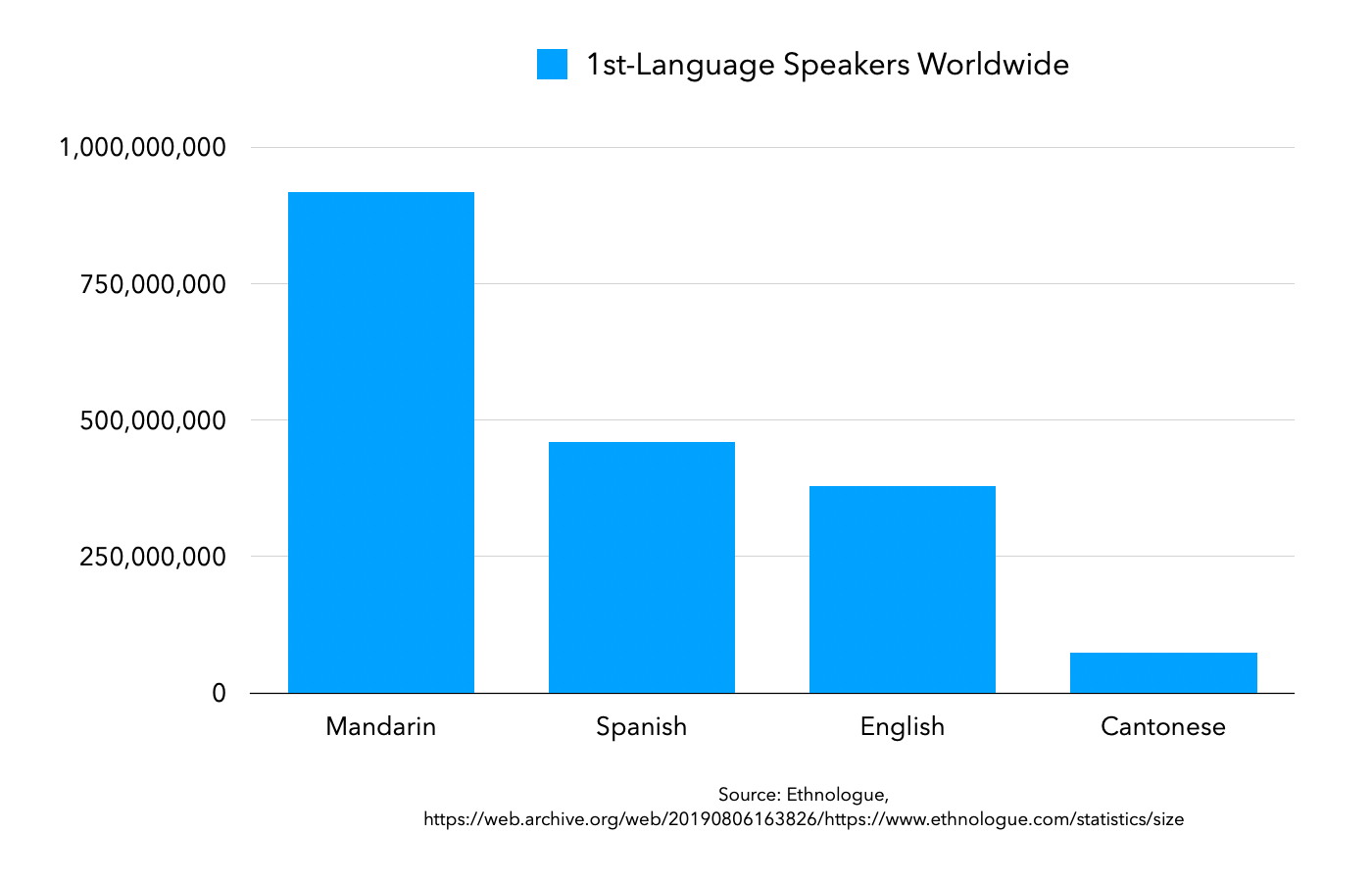
In addition to being hugely freeing for individual language learners, spreading the truth about the Chinese languages, Chinese characters, etc. is also important on a larger scale, since the worldwide Mandarin field, for one, is the largest language field in the world, and probably the largest language field that has ever existed in human history. For comparison, according to Ethnologue, a resource on world languages, the worldwide Mandarin field (those worldwide whose mother tongue is Mandarin) is about twice the size of the second largest worldwide language field, the Spanish field, and it’s about two and a half times the size of the third largest worldwide language field, the English field. Allowing various untruths to continue to divert and bog down the language-learning efforts of those who come to help in the worldwide Mandarin field can have incalculable overall negative effects on the preaching work in this enormous field.

Chart: Languages by First-Language Speakers—2019

So, even as we hang on to Bible truth, let us also hang on to the linguistic truths that we learn, and let us do what we can to share them with our fellow workers in the vast worldwide Chinese fields.