Categories
Culture History Language Learning Names Technology

jiǎntǐ‐zì

jiǎntǐ (jiǎn·tǐ simplified · {body → [style] → [typeface; font]} → [simplified Chinese] 简体 簡體) (characters 字) 👈🏼 Tap/click to show/hide the “flashcard”

[This is a reposting of a post that was originally posted on December 7, 2020. I took the opportunity to flesh out the original post and this repost with additional material.]

For a long, long, long time, Chinese characters were just Chinese characters. Then, in 1956, the Communist government of mainland China issued what came to be known as the First Chinese Character Simplification Scheme (a second round of Chinese character simplification was later attempted and ultimately rescinded), and official simplified Chinese characters came into the world. (Some characters had been unofficially simplified and used for various purposes, both everyday and artistic, before that.)

On the matter of what simplified Chinese characters are called in Mandarin, Wikipedia provides this summary:

Simplified Chinese characters may be referred to by their official name above [(简化字; jiǎnhuàzì)[source]] or colloquially (简体字; jiǎntǐzì). In its broadest sense, the latter term refers to all characters that have undergone simplifications of character “structure” or “body”[source], some of which have existed for millennia alongside regular, more complicated forms. On the other hand, the official name refers to the modern systematically simplified character set, which (as stated by then-Chairman Mao Zedong in 1952) includes not only structural simplification but also substantial reduction in the total number of standardized Chinese characters.[source]

For reference, this is the term used on jw.org when referring to Mandarin written using simplified Chinese characters:
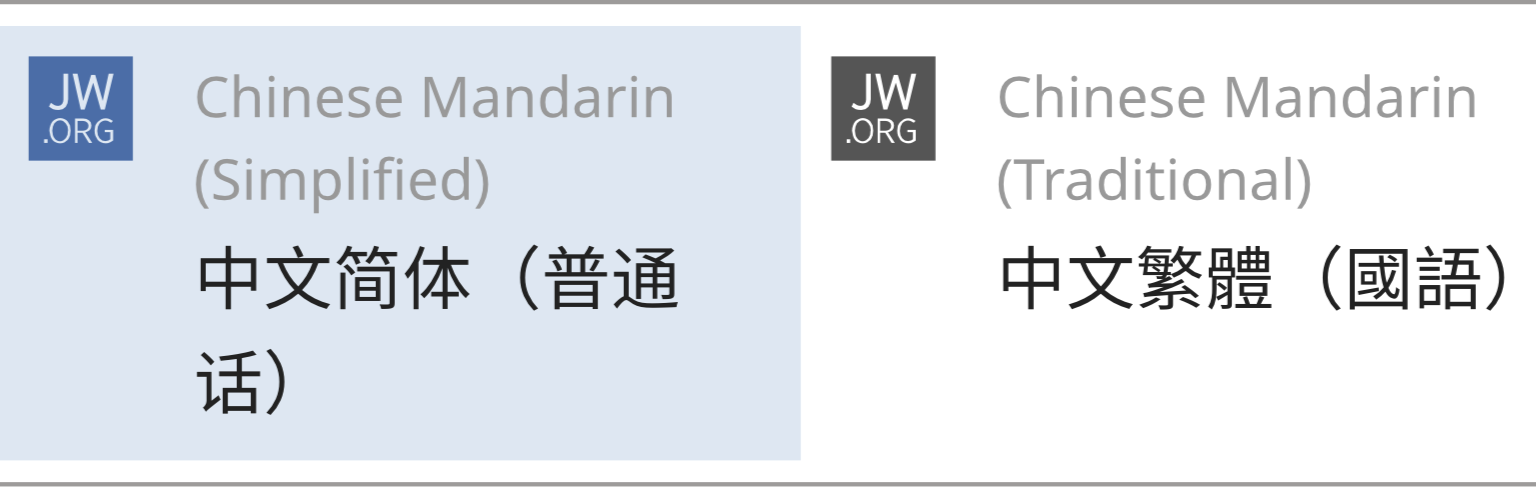
jw.org referring to Mandarin written using simplified Chinese characters

jw.org refers to simplified Chinese characters as “jiǎntǐ (jiǎn·tǐ simplified · {body → [style] → [typeface; font]} → [simplified Chinese] 简体 簡體) characters.

The Great Simplified vs. Traditional Debate

While it seems obvious that simpler is generally better, there is actually much, much debate about the pros and cons of simplified characters vs. traditional characters, as discussed in these articles:

The following posts summarize how many feel about traditional and simplified characters:

Standards and Compromises

While the simplified characters themselves are indeed easier to learn and remember compared to the traditional characters, for many, they have become another set of characters in addition to the traditional characters that has to be learned and remembered. (There is, at least, some overlap between the two systems. Where do they overlap? That is yet more information that has to be learned and remembered…) And while simplified characters have been simplified, they are still characters, and characters are inherently extraordinarily complex and hard to learn and remember.
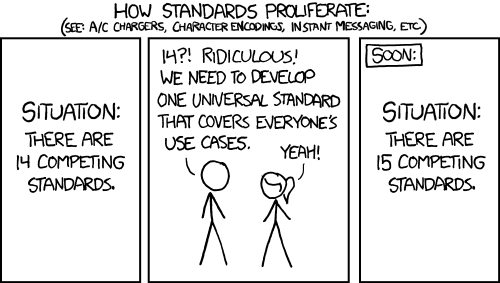
xkcd: Standards

Creative Commons Attribution-NonCommercial Licence logo Randall Munroe [source]

The simplified characters became a new standard that many have had to learn in addition to that of the traditional characters.

While Pīnyīn (Pīn·yīn {Piecing Together of} · Sounds → [Pinyin] 拼音) is also a different system to be learned and remembered, it is in a whole different league compared to any system of Chinese characters when it comes to ease of learning and remembering. One of the scholars who helped create Hangul (or Hankul), the Korean alphabet, said of it: “The wise can learn it in one morning, and even the unwise can learn it in ten days.” Being also a phonetic alphabet, Pīnyīn (Pīn·yīn {Piecing Together of} · Sounds → [Pinyin] 拼音) can be reasonably said to be in the same ballpark (with the added advantage that the Latin alphabet letters used in Pīnyīn (Pīn·yīn {Piecing Together of} · Sounds → [Pinyin] 拼音) are already familiar to many people)—downright revolutionary compared to the years (decades?) required to learn even simplified characters.

Simplified characters are thus a compromise that mainland China, Singapore, etc. have settled on—simpler than traditional characters, but perhaps thus not as good at being characters. Meanwhile, they are still characters, still having many of the complexities and vagaries of characters. They fall short of the fundamental reform envisioned by Máo Zédōng ((Máo Hair (surname) 毛) (Zé·dōng Marsh · East 泽东 澤東) (the founder of the People’s Republic of China)) (Wikipedia article), Lǔ Xùn ((Lǔ Stupid; Rash (surname)) (Xùn Fast; Quick; Swift 迅) (pen name of Zhōu Shùrén, the greatest Chinese writer of the 20th cent. and a strong advocate of alphabetic writing)) (Wikipedia article), and others, that would have involved eventually moving on from any kind of characters to alphabetic writing.

Letter from Máo Zédōng endorsing a transition from Chinese characters to alphabetic writing

A letter written by Máo Zédōng ((Máo Hair (surname) 毛) (Zé·dōng Marsh · East 泽东 澤東) (the founder of the People’s Republic of China)) endorsing “a basic reform” involving a transition from Chinese characters to alphabetic writing1


1. John DeFrancis, The Chinese Language: Fact and Fantasy (Honolulu: University of Hawaii Press, 1984), p. ii. ^
Categories
Culture Current Events Language Learning Science

bǎilàn

bǎilàn (bǎi·làn {place; arrange → [assume; put on (air of) | exhibit; display]} · {being rotten; decayed; spoiled | worn out; broken; ragged; crappy | mushy} 摆烂 擺爛) ← Tap/click to show/hide the “flashcard”

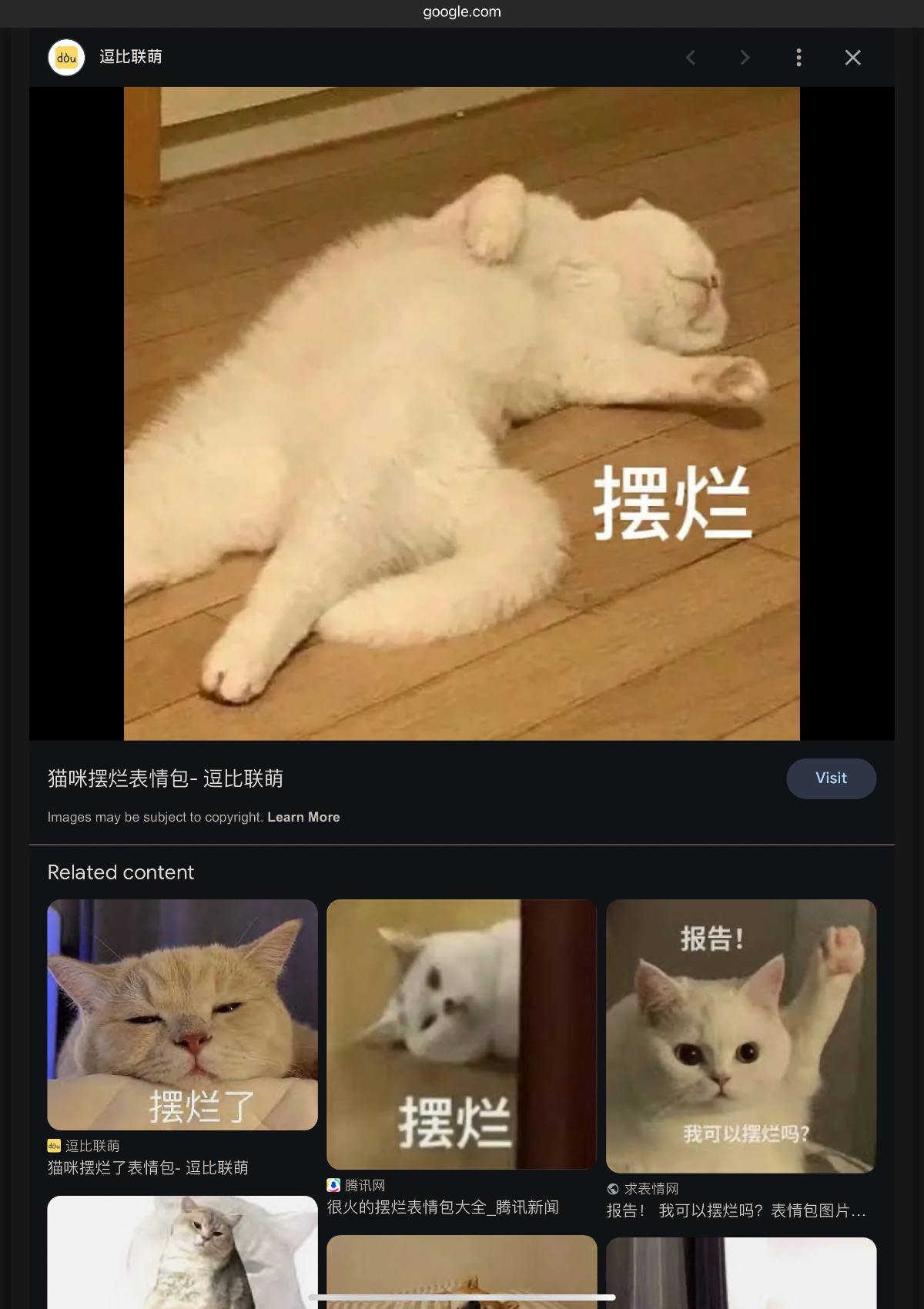
In 2022, this week’s MEotW, “bǎilàn (bǎi·làn {place; arrange → [assume; put on (air of) | exhibit; display]} · {being rotten; decayed; spoiled | worn out; broken; ragged; crappy | mushy} 摆烂 擺爛)”, gained popularity among some young people in China as an expression that represents their approach to life in view of the difficult, even seemingly hopeless work culture, societal expectations, etc. that they are faced with. “Bǎilàn (Bǎi·làn {place; arrange → [assume; put on (air of) | exhibit; display]} · {being rotten; decayed; spoiled | worn out; broken; ragged; crappy | mushy} 摆烂 擺爛)” represents a progression beyond “tǎngpíng (tǎng·píng lie; recline · {[to be] flat} 躺平)”, a past MEotW—just compare the cats!

Screenshot of some image results from searching for “摆烂” (“bǎilàn”) on Google

Some image results from searching for “摆烂” (bǎilàn (bǎi·làn {place; arrange → [assume; put on (air of) | exhibit; display]} · {being rotten; decayed; spoiled | worn out; broken; ragged; crappy | mushy} 摆烂 擺爛)) on Google

Reports from Around the Internet

Here are some of the many media reports about this expression:

The rise of ‘bai lan’: why China’s frustrated youth are ready to ‘let it rot’ | China | The Guardian

Here are some quotes from the above article:

In recent days, this phrase – and more previously ‘tang ping’ (lying flat, 躺平), which means rejecting gruelling competition for a low desire life – gained popularity as severe competition and high social expectations prompted many young Chinese to give up on hard work.

But bai lan has a more worrying layer in the way it is being used by young people in China: to actively embrace a deteriorating situation, rather than trying to turn it around.

Prof Mary Gallagher, director of the Centre for Chinese Studies at the University of Michigan, says ‘bai lan’ is not necessarily a sentiment unique to China. “It is a bit like the ‘slacker’ generation in America in the 1990s. And like ‘tang ping’ last year, it is also a rejection against the ultra-competitiveness of today’s Chinese society.”

More than 18% of young Chinese people aged between 16 and 24 were jobless in April – the highest since the official record began. “Hard to find a job after graduation this year? Fine, I’ll just bai lan – stay at home and watch TV all day,” wrote one netizen who struggled to find work, despite China’s top leader urged young people to fight for the future.

Language Log » “Let it rot”

For a really deep dive into “bǎilàn (bǎi·làn {place; arrange → [assume; put on (air of) | exhibit; display]} · {being rotten; decayed; spoiled | worn out; broken; ragged; crappy | mushy} 摆烂 擺爛)”, check out this extended video news report from CNA, an English language news network based in Singapore:

“Letting It Rot” in the Mandarin Field?

Perhaps we can apply “bǎilàn (bǎi·làn {place; arrange → [assume; put on (air of) | exhibit; display]} · {being rotten; decayed; spoiled | worn out; broken; ragged; crappy | mushy} 摆烂 擺爛)” to how some may be resigned to being “crappy”, or at best mediocre, at the language-related aspects of being in the Mandarin field.

Some Mandarin field language learners have noticed that after an initial period of progress, they—and perhaps some/many of their fellow workers—may have plateaued, or leveled out in how good they are with the Mandarin language. Instead of moving on to a reasonable level of fluency or mastery, they may have gotten stuck for a long time at a “crappy” or at best mediocre level.

They may be resigned to this situation, or they may even actively embrace it, perhaps reasoning that the Great Wall of Characters is what it is, or that Mandarin just sounds too different from what they’re used to (e.g., with its tones), or that they personally just don’t have the intelligence or the talent to do any better. They may thus quit trying to do any better, or they may even quit the Mandarin field altogether. Such ones have effectively chosen to “bǎilàn (bǎi·làn {arrange → [exhibit]} · {being crappy} 摆烂 擺爛)” with regard to their Mandarin and their service in the Mandarin field.

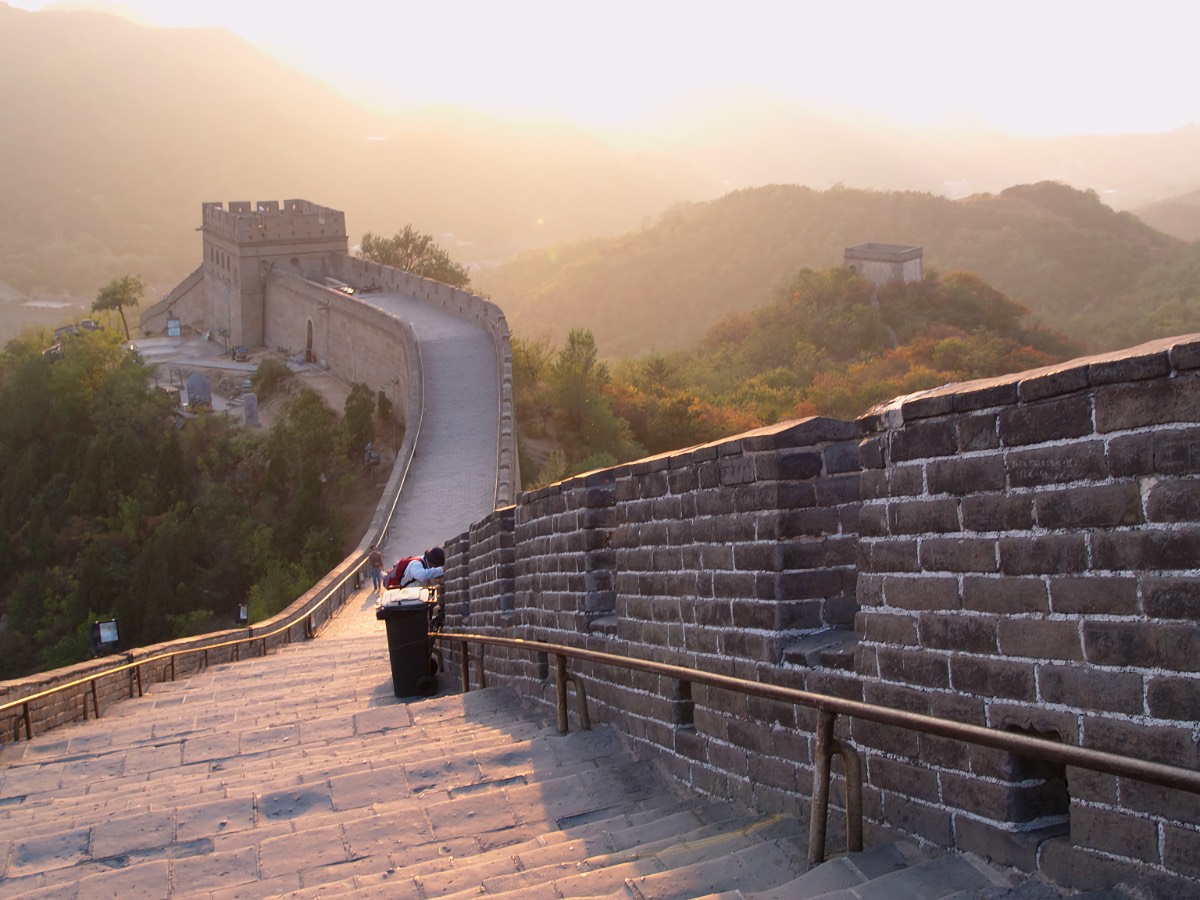
The Great Wall of China

Can we do better than to bǎilàn (bǎi·làn {arrange → [exhibit]} · {being crappy} 摆烂 擺爛) when faced with the Great Wall of Characters?

Note, though, that changing to focus on first principles of language rather than sticking to played out traditional learning methods can provide fuel and energy for progress beyond being “crappy” or just mediocre at using the Mandarin language in your service to Jehovah God and your Mandarin-speaking neighbours. For example, while traditional Chinese culture dictates that Mandarin learners must focus on learning the extraordinarily and unnecessarily complex Chinese characters, first principles of language–as illuminated by linguistics, the scientific study of language—hold that SPEECH is actually the primary aspect of any human language, not writing, even if that writing is as traditionally and culturally entrenched as Chinese characters are. Indeed, I can personally testify that I have found that changing focus from the traditionally mandated crazy-complex characters to Mandarin SPEECH, with the help of the simple and elegant Pīnyīn (Pīn·yīn {Piecing Together} · Sounds → [Pinyin] 拼音) writing system, is working to help me make noticeable ongoing progress in how much Mandarin I understand, and in how much I speak and sound like a native speaker of Mandarin.

Of course, such progress is personally satisfying, but as Jehovah’s dedicated servants and fellow workers, we should be even more concerned about how Jehovah views our efforts. Here are a couple of scriptures that may help us to understand Jehovah’s view of unnecessarily “crappy” or mediocre ‘sacrifices of praise’ (Hebrews 13:15) that some may offer in the Mandarin field:

6 “‘A son honors a father, and a servant his master. So if I am a father, where is the honor due me? And if I am a master, where is the fear due me?’ Jehovah of armies says to you priests who are despising my name.

“‘But you say: “How have we despised your name?”’

7 “‘By presenting polluted food on my altar.’

“‘And you say: “How have we polluted you?”’

“‘By saying: “The table of Jehovah is something to be despised.” 8 And when you present a blind animal as a sacrifice, you say: “It is nothing bad.” And when you present a lame animal or a sick one: “It is nothing bad.”’”

“Try presenting them, please, to your governor. Will he be pleased with you or receive you with favor?” says Jehovah of armies.

9 “And now, please, appeal to God, that he may show us favor. With such offerings from your own hand, will he receive any of you with favor?” says Jehovah of armies.

Malachi 1:6–9.

15 ‘I know your deeds, that you are neither cold nor hot. I wish you were cold or else hot. 16 So because you are lukewarm and neither hot nor cold, I am going to vomit you out of my mouth. 17 Because you say, “I am rich and have acquired riches and do not need anything at all,” but you do not know that you are miserable and pitiful and poor and blind and naked, 18 I advise you to buy from me gold refined by fire so that you may become rich, and white garments so that you may become dressed and that the shame of your nakedness may not be exposed, and eyesalve to rub in your eyes so that you may see.

Revelation 3:15–18.

We should also remember that moving beyond “crappiness” or mediocrity in our Mandarin can help us to be more able to give spiritual help to the people in the Mandarin field who looking for something beyond the crappiness and mediocrity of this old system of things, something beyond the selfish, materialistic, and ultimately meaningless rat race promoted by Satan’s world. These people need the good news of God’s Kingdom, and they need people like us to share it with them in a language that they will understand and respond to from the heart.—Mark 6:34.

Categories
Culture History

báihuà

báihuà (bái·huà {white → [colloquial; vernacular]} · speech [→ [writing based on vernacular speech]] 白话 白話) ← Tap/click to show/hide the “flashcard”

As mentioned in last week’s MEotW on “chéngyǔ (chéng·yǔ {(sth. that) has become} · saying → [set phrase (typically of 4 characters); idiom] 成语 成語)”, Literary Chinese was the standard style of writing in China for a long, long time. Since language naturally changes as time goes by, though, the way people actually talked became more and more different from Literary Chinese.

Eventually, starting about a century ago, in the early 1920s, written vernacular Chinese, or báihuà (bái·huà {white → [colloquial; vernacular]} · speech [→ [writing based on vernacular speech]] 白话 白話)—this week’s MEotW—began replacing Literary Chinese in literary works, and it eventually became the standard style of writing for Modern Standard Mandarin.

A Literary Turning Point

The Wikipedia article on written vernacular Chinese provides this summary regarding this literary turning point:

Jin Shengtan, who edited several novels in vernacular Chinese in the 17th century, is widely regarded as the pioneer of literature in the vernacular style. However, it was not until after the May Fourth Movement in 1919 and the promotion by scholars and intellectuals such as pragmatist reformer Hu Shih, pioneering writer Chen Hengzhe, leftist Lu Xun, Chen Duxiu, and leftist Qian Xuantong that vernacular Chinese, or Bai hua, gained widespread importance. In particular, The True Story of Ah Q by Lu Xun is generally accepted as the first modern work to fully utilize the vernacular language.[source]

The Wikipedia article on the May Fourth Movement adds the following:

In Chinese literature, the May Fourth Movement is regarded as the watershed after which the use of the vernacular language (baihua) gained currency over and eventually replaced the use of Literary Chinese in literary works. Intellectuals were driven toward expressing themselves using the spoken tongue under the slogan 我手写我口 [ (my 我) shǒu (hand 手) xiě (writes) (my 我) kǒu ({mouth(’s utterances)} 口)] (‘my hand writes [what] my mouth [speaks]’), although the change was actually gradual: Hu Shih had already argued for the use of the modern vernacular language in literature in his 1917 essay “Preliminary discussion on literary reform” (文学改良刍议), while the first short story written exclusively in the vernacular language, The True Story of Ah Q by Lu Xun, was not published until 1921.

Punctuation! Arabic Numerals!

Interestingly, the Wikipedia article on written vernacular Chinese, quoted above, goes on to make the following claim about what came along with this change to the vernacular style:

Along with the growing popularity of vernacular writing in books in this period was the acceptance of punctuation, modeled after that used in Western languages (traditional Chinese literature was almost entirely unpunctuated), and the use of Arabic numerals.

The above claim about how it came to be that we now benefit from punctuation in modern Chinese writings is repeated in the separate Wikipedia article on Chinese punctuation:

Although there was a long native tradition of textual annotation to indicate the boundaries of sentences and clauses, the concept of punctuation marks being a mandatory and integral part of the text was only adapted in the written language during the 20th century due to Western influence.

A quick web search also turned up this post on the Chinese Language Stack Exchange website, part of which says:

I have seen some old Chinese books. The words flowed from top to bottom on the page and there was no punctuation.

We can be thankful that báihuà (bái·huà {white → [colloquial; vernacular]} · speech [→ [writing based on vernacular speech]] 白话 白話) (along with, apparently, punctuation and Arabic numerals) replaced Literary Chinese as the standard style of writing for Mandarin, just as I’m sure that the English-speakers among us are thankful that the standard written English of today is no longer the written English of Shakespeare or that of the King James Version of the Bible.

How About Cantonese, Shanghainese, Etc.?

Báihuà (Bái·huà {white → [colloquial; vernacular]} · speech [→ [writing based on vernacular speech]] 白话 白話) not only became the standard style of writing for Modern Standard Mandarin, but due to China’s particular language and political situation, it also became the standard style of writing for speakers of Cantonese and of other Chinese languages, as Wikipedia points out:

Since the early 1920s, this modern vernacular form has been the standard style of writing for speakers of all varieties of Chinese throughout mainland China, Taiwan, Malaysia and Singapore

As someone who was in the Cantonese field for a long time before joining the Mandarin field, I can attest to the fact that years ago in the Cantonese field, we would use official publications that were actually in written Mandarin, with its different vocabulary, etc., because báihuà (bái·huà {white → [colloquial; vernacular]} · speech [→ [writing based on vernacular speech]] 白话 白話), the standard writing style in the Chinese world, is based on Mandarin.

Recently, though, Jehovah’s organization has carried on in the direction gone in by báihuà (bái·huà {white → [colloquial; vernacular]} · speech [→ [writing based on vernacular speech]] 白话 白話), of having writing reflect how people actually talk, by making available publications in which the writing is based on spoken Cantonese, in addition to the existing publications using written Mandarin. (Publications in which the writing is based on other spoken Chinese languages are also available.) This is in harmony with a basic principle regarding how God designed and created humans to use language, which, as linguists have figured out, is that speech is primary and writing is secondary.

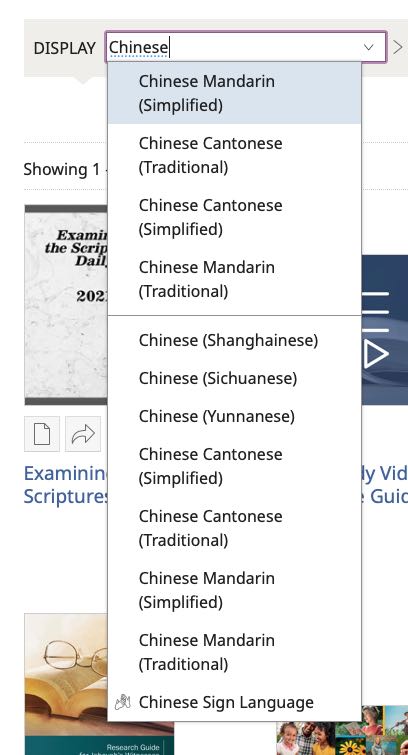
Different kinds of written Chinese on jw.org

Publications are available on jw.org in writing based on different Chinese languages, to better match how people actually talk in those languages.