Categories
Current Events Theocratic

shìjiè hépíng

shìjiè (shì·jiè {generation → [world]} · extent → [world] 世界)
hépíng (hé·píng {being (together) with (one another)} · {being flat, level, even} → [peace (nwtsty-CHS Appx. A2 says this term mainly refers to the absence of war or conflict)] 和平) 👈🏼 Tap/click to show/hide the “flashcard”

[Notes: Tap/click on a Pīnyīn (Pīn·yīn {Piecing Together of} · Sounds → [Pinyin] 拼音) expression to reveal its “flashcard”; tap/click on a “flashcard” or its Pīnyīn (Pīn·yīn {Piecing Together of} · Sounds → [Pinyin] 拼音) expression to hide the “flashcard”. 📖 📄 📘 icons mean 📖 Reveal All, 📄 Reveal Advanced, and 📘 Reveal None re all the “flashcards” in the heading, paragraph, etc. that they are placed at the beginning of.]

At the time of this writing, jw.org was featuring the No. 1 2026 issue of The Watchtower, the theme of which is “Is World Peace Possible?”. By comparing the English version of this issue with the Mandarin version, we can see that the organization is using this week’s MEotW, “shìjiè (shì·jiè {generation → [world]} · extent → [world] 世界) hépíng (hé·píng {being (together) with (one another)} · {being flat, level, even} → [peace (nwtsty-CHS Appx. A2 says this term mainly refers to the absence of war or conflict)] 和平)”, to translate the English expression “world peace” into Mandarin:

English:

Is World Peace Possible?

World peace is possible. In fact, it is a certainty—but not in the way you might expect.

Mandarin:

📖 📄 📘 Shìjiè (Shì·jiè {Generation → [World]} · Extent → [World] 世界) Hépíng (Hé·píng {Being (Together) with (One Another)} · {Being Flat, Level, Even} → [Peace (nwtsty-CHS Appx. A2 says this term mainly refers to the absence of war or conflict)] 和平) Zhǐshì (Zhǐ·shì Only · Is 只是) Mèng ({a Dream}) Ma ([? ptcl for “yes/no” questions])?

📖 📄 📘 Shìjiè (Shì·jiè {generation → [world]} · extent → [the world] 世界) yídìng (yí·dìng {(with) one} · {setting fixedly} → [definitely] 一定) huì (will) hépíng (hé·píng {be (together) with (one another)} · {be flat, level, even} → [be peaceful (nwtsty-CHS Appx. A2 says this term mainly refers to the absence of war or conflict)] 和平), dàn (but 但) shíxiàn (shí·xiàn (it) {solidly → [really]} · {will appear} → [(it) will come true] 实现 實現) de (’s 的) fāngshì (fāng·shì direction · style → [way] 方式) yěxǔ (yě·xǔ {on the whole} · maybe 也许 也許) shì ({will be} 是) (you 你) xiǎng‐budào ((xiǎng {thinking of} 想)‐(bu·dào not · {are arriving at} 不到) [are not expecting]) de ({’s (way)} 的)!

A Specific Kind of Peace

“Shìjiè (Shì·jiè {generation → [world]} · extent → [world] 世界) effectively means “world”, and as Appendix A2 of the Mandarin New World Translation Bible tells us, “hépíng (hé·píng {[is/being] (together) with (one another)} · {[is/being] flat, level, even} → [peace | [is] peaceful | peacefully (nwtsty-CHS Appx. A2 says this term mainly refers to the absence of war or conflict)] 和平) mainly refers to a specific kind of peace: the absence of war or conflict. So, it is the appropriate Mandarin expression to use to refer to the kind of peace that people generally have in mind when they use the English expression “world peace”.

Other Kinds of Peace

Past MEotW posts have discussed the Mandarin expressions used to refer to other kinds of peace, as discussed in Appendix A2 of the Mandarin New World Translation Bible. For example, the MEotW post on “ānníng ({being peaceful}; {being tranquil} [→ [peace; tranquillity]] 安宁 安寧) has this to say:

Appendix A2 of the current Mandarin version of the New World Translation Bible (nwtsty) explains that “hépíng (peace | {[is] peaceful} (nwtsty-CHS Appx. A2 says this term mainly refers to the absence of war or conflict) 和平)” mainly refers to the absence of war or conflict. However, even in a situation in which there is no hépíng (peace | {[is] peaceful} (nwtsty-CHS Appx. A2 says this term mainly refers to the absence of war or conflict) 和平), God’s holy spirit can still help people to maintain the spiritual quality of ānníng ({being peaceful}; {being tranquil} 安宁 安寧) in their hearts—inner peace.

As for the MEotW post on “hémù ({[is] harmonious} [→ [harmony; peaceful relations]] 和睦)”, it says:

Appendix A2 of the current Mandarin version of the New World Translation Bible (nwtsty) explains that “hépíng (peace | {[is] peaceful} (nwtsty-CHS Appx. A2 says this term mainly refers to the absence of war or conflict) 和平)” mainly refers to the absence of war or conflict. In contrast, “hémù ({[is] harmonious} 和睦)” is used here in a more positive and precise way to refer to the peaceful harmony and unity that the Christ makes possible for “shuāngfāng (shuāng·fāng (the) two · {directions → [parties]} 双方 雙方)”, “the two groups”, Jews and non-Jews.

Additionally, the MEotW post on “héxié ({[is] harmonious} [→ [harmony]] 和谐 和諧) says:

Why doesn’t the Mandarin translation use good old “píng’ān (píng’·ān {[is] flat, level, even → [[is] peaceful]} · {[is] safe, secure} (nwtsty-CHS Appx. A2 says this term mainly refers to things being smooth and stable, safe and secure, free of danger) 平安)” or “hépíng (peace | {[is] peaceful} (nwtsty-CHS Appx. A2 says this term mainly refers to the absence of war or conflict) 和平)” to translate “peace” in this verse? Appendix A2 of the current Mandarin version of the New World Translation Bible (nwtsty) explains that “píng’ān (píng’·ān {[is] flat, level, even → [[is] peaceful]} · {[is] safe, secure} (nwtsty-CHS Appx. A2 says this term mainly refers to things being smooth and stable, safe and secure, free of danger) 平安)” mainly refers to things being smooth and stable, safe and secure, free of danger, and that “hépíng (peace | {[is] peaceful} (nwtsty-CHS Appx. A2 says this term mainly refers to the absence of war or conflict) 和平)” mainly refers to the absence of war or conflict. These are specific aspects of peace that don’t necessarily apply in every context.

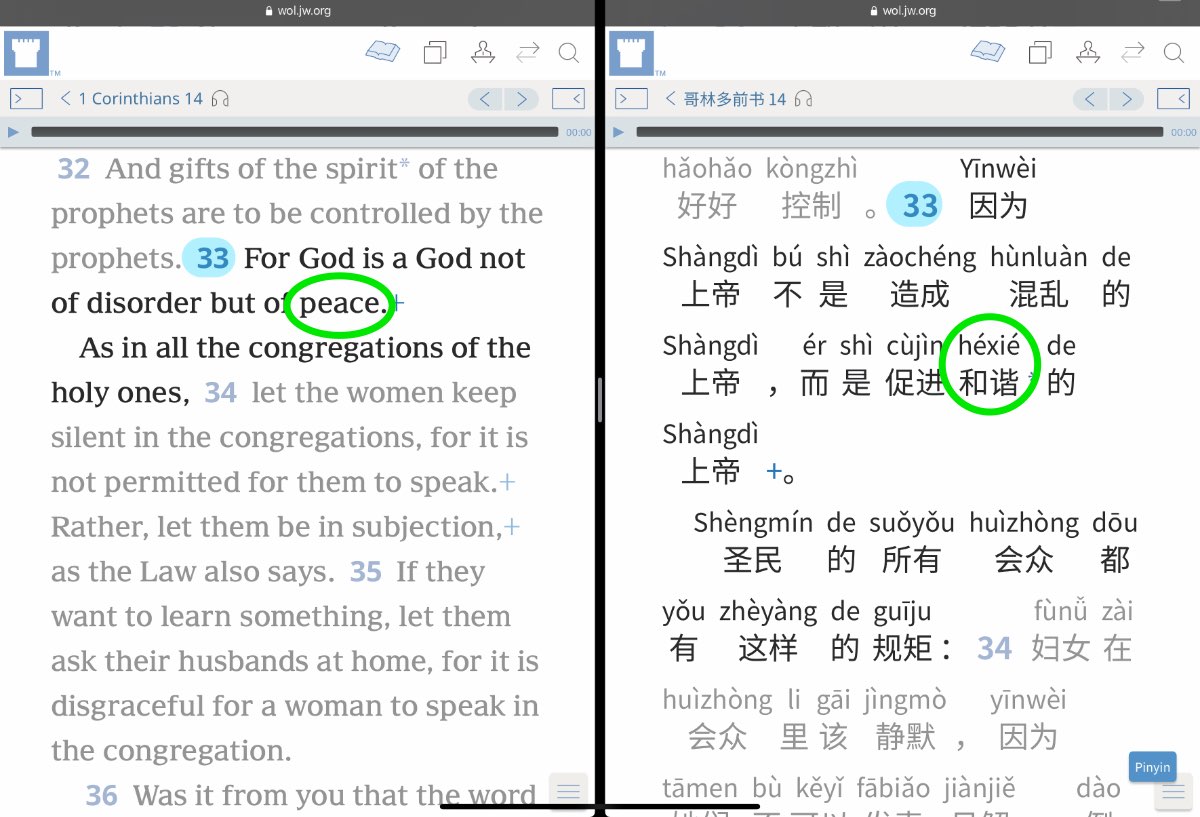
We can see that those who translated the current Mandarin NWT Bible felt that the context of 1 Corinthians 14:33, which discusses who should speak when during meetings for spiritual encouragement, calls for “héxié ({[is] harmonious} 和谐 和諧)” to be used in this verse to translate the Greek word ei·reʹne, since the harmony that “héxié ({[is] harmonious} 和谐 和諧)” refers to contrasts well with the dissonance and disorder that would result if a meeting degenerated into a free-for-all of people speaking whenever and however they pleased.
Categories
Theocratic

héxié

héxié ({[is] harmonious} 和谐 和諧) ← Tap/click to show/hide the “flashcard”

Appendix A2 of the English New World Translation of the Holy Scriptures (Study Edition), entitled “Features of This Revision”, discusses vocabulary changes that have been made in the current revision, words that have been translated differently than before. As noted in various entries in the excellent resource Referenced Theo. Expressions (RTE), Appendix A2 of the current Mandarin version of the New World Translation Bible (nwtsty) correspondingly discusses words that have been translated differently in the current revision of the Mandarin NWT Bible, compared to how they had been translated before.

Since we base what we say in Jehovah’s service on his Word the Bible, the vocabulary used in it—and the way those vocabulary words are translated—should be reflected in how we speak in our ministry, at our meetings, etc. So, it is beneficial for us Mandarin field language-learners to be familiar with the latest thinking from the organization on how Bible terms should be translated into Mandarin.

Peace and Harmony in 1 Corinthians 14:33

Note that the current English version of the New World Translation Bible (Study Edition) uses the word “peace” at 1 Corinthians 14:33, and that the current Mandarin version of the New World Translation Bible (nwtsty) in that verse correspondingly uses this week’s MEotW, “héxié ({[is] harmonious} 和谐 和諧)”:

1 Corinthians 14:33 (WOL English - CHS+Pinyin Comparison)

Why doesn’t the Mandarin translation use good old “píng’ān (píng’·ān {[is] flat, level, even → [[is] peaceful]} · {[is] safe, secure} (nwtsty-CHS Appx. A2 says this term mainly refers to things being smooth and stable, safe and secure, free of danger) 平安)” or “hépíng (peace | {[is] peaceful} (nwtsty-CHS Appx. A2 says this term mainly refers to the absence of war or conflict) 和平)” to translate “peace” in this verse? Appendix A2 of the current Mandarin version of the New World Translation Bible (nwtsty) explains that “píng’ān (píng’·ān {[is] flat, level, even → [[is] peaceful]} · {[is] safe, secure} (nwtsty-CHS Appx. A2 says this term mainly refers to things being smooth and stable, safe and secure, free of danger) 平安)” mainly refers to things being smooth and stable, safe and secure, free of danger, and that “hépíng (peace | {[is] peaceful} (nwtsty-CHS Appx. A2 says this term mainly refers to the absence of war or conflict) 和平)” mainly refers to the absence of war or conflict. These are specific aspects of peace that don’t necessarily apply in every context.

We can see that those who translated the current Mandarin NWT Bible felt that the context of 1 Corinthians 14:33, which discusses who should speak when during meetings for spiritual encouragement, calls for “héxié ({[is] harmonious} 和谐 和諧)” to be used in this verse to translate the Greek word ei·reʹne, since the harmony that “héxié ({[is] harmonious} 和谐 和諧)” refers to contrasts well with the dissonance and disorder that would result if a meeting degenerated into a free-for-all of people speaking whenever and however they pleased.
“Harmony” and “Harmony”

You may recall that a past MEotW pointed out that the current Mandarin NWT Bible sometimes also uses “hémù ({[is] harmonious} 和睦)” in some places to also basically refer to “harmony”. Is there any difference between “hémù ({[is] harmonious} 和睦)” and “héxié ({[is] harmonious} 和谐 和諧)”?

Some comparing of a few different dictionaries seems to show that the main meanings of these words are similar, although there are different shades of meaning in the morphemes used—the “ ({[is] peaceful; harmonious; amicable; friendly; amiable} 睦)” in “hémù ({[is] harmonious} 和睦)” has possible meanings involving being friendly and amicable, whereas the “xié ({[is] harmonious; in accord; | [is] humorous | agree; settle})” in “héxié ({[is] harmonious} 和谐 和諧)” has possible meanings involving being in accord or in agreement.

Categories
Theocratic

hémù

hémù ({[is] harmonious} 和睦) ← Tap/click to show/hide the “flashcard”

Appendix A2 of the English New World Translation of the Holy Scriptures (Study Edition), entitled “Features of This Revision”, discusses vocabulary changes that have been made in the current revision, words that have been translated differently than before. As noted in various entries in the excellent resource Referenced Theo. Expressions (RTE), Appendix A2 of the current Mandarin version of the New World Translation Bible (nwtsty) correspondingly discusses words that have been translated differently in the current revision of the Mandarin NWT Bible, compared to how they had been translated before.

Since we base what we say in Jehovah’s service on his Word the Bible, the vocabulary used in it—and the way those vocabulary words are translated—should be reflected in how we speak in our ministry, at our meetings, etc. So, it is beneficial for us Mandarin field language-learners to be familiar with the latest thinking from the organization on how Bible terms should be translated into Mandarin.

Peace Is Multifaceted

One of the matters that Appendix A2 of the current Mandarin version of the New World Translation Bible (nwtsty) discusses is how several translations sometimes use the terms “píng’ān (píng’·ān {[is] flat, level, even → [[is] peaceful]} · {[is] safe, secure} (nwtsty-CHS Appx. A2 says this term mainly refers to things being smooth and stable, safe and secure, free of danger) 平安)” and “hépíng (peace | {[is] peaceful} (nwtsty-CHS Appx. A2 says this term mainly refers to the absence of war or conflict) 和平)” in ways that don’t really fit the context, considering the relatively narrow meanings of these terms.

A previous MEotW post discussed why “ānníng ({being peaceful}; {being tranquil} 安宁 安寧)” was selected to be used in Galatians 5:22 in the current version of the Mandarin NWT Bible, when the previous major revision used “hépíng (peace | {[is] peaceful} (nwtsty-CHS Appx. A2 says this term mainly refers to the absence of war or conflict) 和平)” there. Now, we will consider a couple of examples of how this week’s MEotW, “hémù ({[is] harmonious} 和睦)”, is used in the current version of the Mandarin NWT Bible.

Peace and Harmony in Romans 3:17

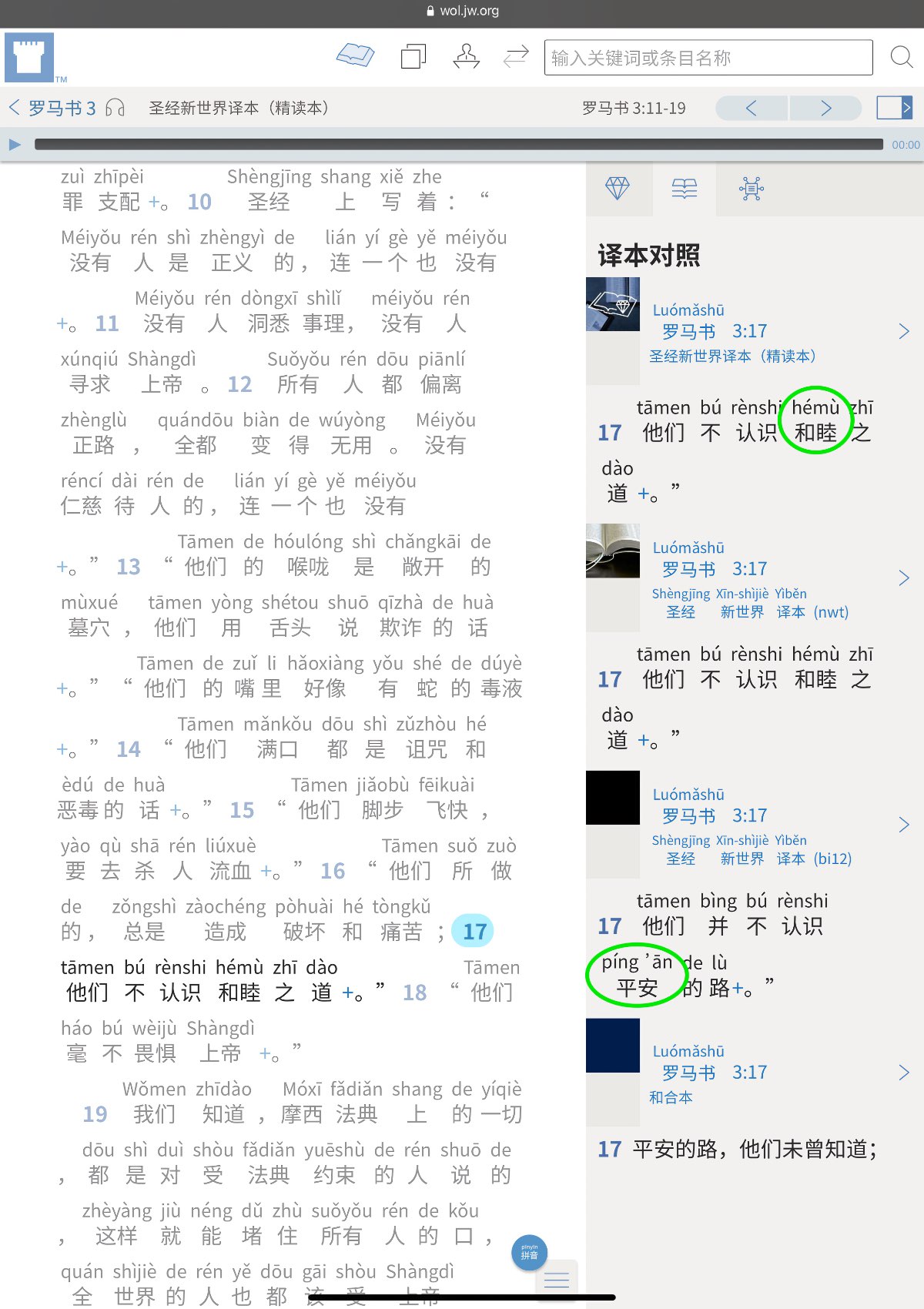
First, note how the Parallel Translations (Yìběn (Yì·běn Translated · {Roots → [Editions]} → [Translations] 译本 譯本) Duìzhào (Duì·zhào {Facing → [Comparing]} · {Illuminating → [Comparing/Contrasting]} → [Comparing/Contrasting] 对照 對照) in Mandarin) feature of the Watchtower ONLINE LIBRARY shows us that in Romans 3:17, the current version of the Mandarin NWT Bible uses “hémù ({[is] harmonious} 和睦)” to replace “píng’ān (píng’·ān {[is] flat, level, even → [[is] peaceful]} · {[is] safe, secure} (nwtsty-CHS Appx. A2 says this term mainly refers to things being smooth and stable, safe and secure, free of danger) 平安)”:

Romans 3:17 (WOL CHS+Pinyin Parallel Translations)

Appendix A2 of the current Mandarin version of the New World Translation Bible (nwtsty) explains that “píng’ān (píng’·ān {[is] flat, level, even → [[is] peaceful]} · {[is] safe, secure} (nwtsty-CHS Appx. A2 says this term mainly refers to things being smooth and stable, safe and secure, free of danger) 平安)” mainly refers to things being smooth and stable, safe and secure, free of danger. In contrast, “hémù ({[is] harmonious} 和睦)” refers more specifically to being harmonious, making for peaceful relations with God and our fellow humans.

Peace and Harmony in Ephesians 2:14

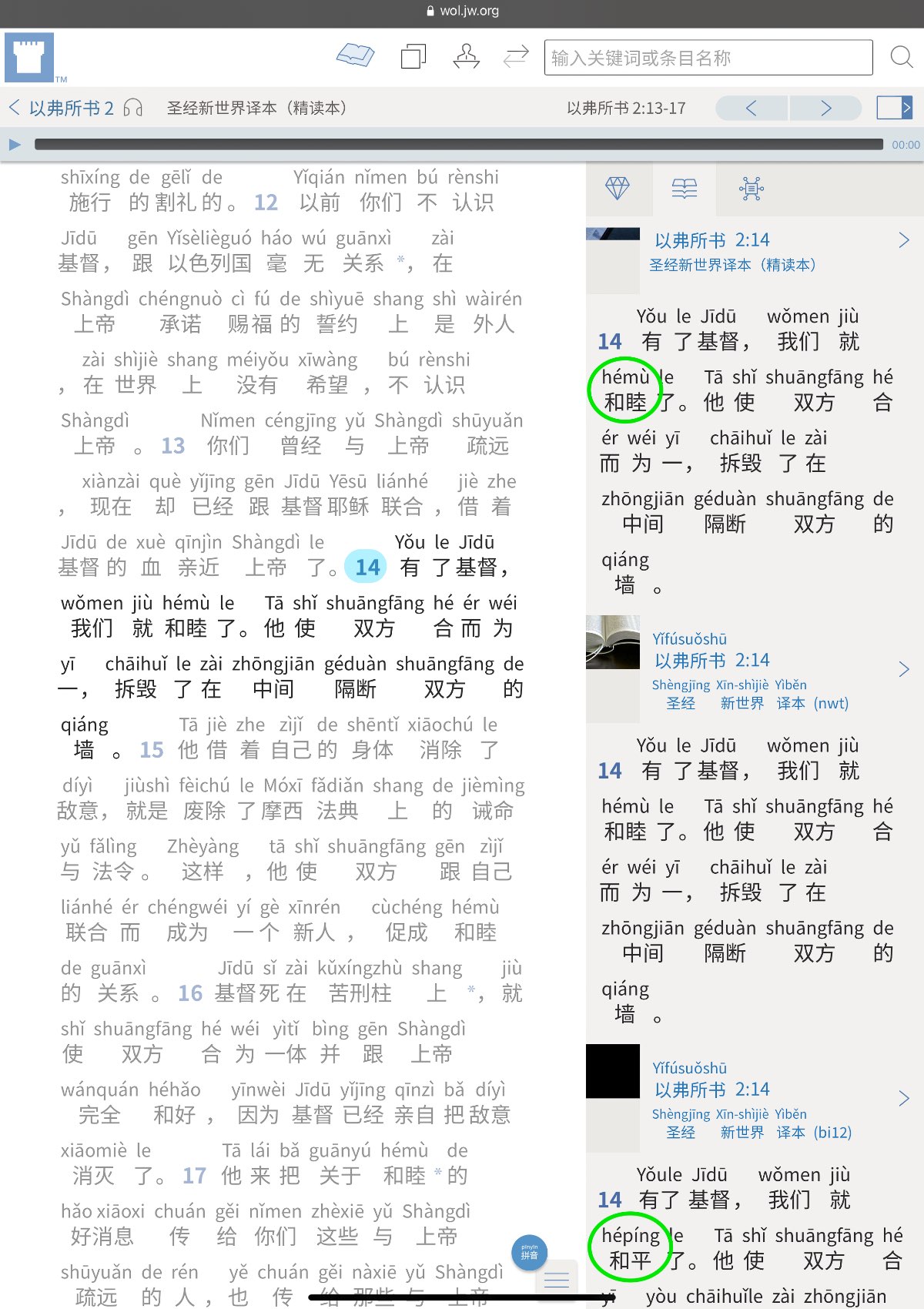
Next, note that in Ephesians 2:14, the current version of the Mandarin NWT Bible uses “hémù ({[is] harmonious} 和睦)” to replace “hépíng (peace | {[is] peaceful} (nwtsty-CHS Appx. A2 says this term mainly refers to the absence of war or conflict) 和平)”:

Ephesians 2:14 (WOL CHS+Pinyin Parallel Translations)

Appendix A2 of the current Mandarin version of the New World Translation Bible (nwtsty) explains that “hépíng (peace | {[is] peaceful} (nwtsty-CHS Appx. A2 says this term mainly refers to the absence of war or conflict) 和平)” mainly refers to the absence of war or conflict. In contrast, “hémù ({[is] harmonious} 和睦)” is used here in a more positive and precise way to refer to the peaceful harmony and unity that the Christ makes possible for “shuāngfāng (shuāng·fāng (the) two · {directions → [parties]} 双方 雙方)”, “the two groups”, Jews and non-Jews.