Categories
Culture Current Events Language Learning Science

bǎilàn

bǎilàn (bǎi·làn {place; arrange → [assume; put on (air of) | exhibit; display]} · {being rotten; decayed; spoiled | worn out; broken; ragged; crappy | mushy} 摆烂 擺爛) ← Tap/click to show/hide the “flashcard”

In 2022, this week’s MEotW, “bǎilàn (bǎi·làn {place; arrange → [assume; put on (air of) | exhibit; display]} · {being rotten; decayed; spoiled | worn out; broken; ragged; crappy | mushy} 摆烂 擺爛)”, gained popularity among some young people in China as an expression that represents their approach to life in view of the difficult, even seemingly hopeless work culture, societal expectations, etc. that they are faced with. “Bǎilàn (Bǎi·làn {place; arrange → [assume; put on (air of) | exhibit; display]} · {being rotten; decayed; spoiled | worn out; broken; ragged; crappy | mushy} 摆烂 擺爛)” represents a progression beyond “tǎngpíng (tǎng·píng lie; recline · {[to be] flat} 躺平)”, a past MEotW—just compare the cats!

Screenshot of some image results from searching for “摆烂” (“bǎilàn”) on Google

Some image results from searching for “摆烂” (bǎilàn (bǎi·làn {place; arrange → [assume; put on (air of) | exhibit; display]} · {being rotten; decayed; spoiled | worn out; broken; ragged; crappy | mushy} 摆烂 擺爛)) on Google

Reports from Around the Internet

Here are some of the many media reports about this expression:

The rise of ‘bai lan’: why China’s frustrated youth are ready to ‘let it rot’ | China | The Guardian

Here are some quotes from the above article:

In recent days, this phrase – and more previously ‘tang ping’ (lying flat, 躺平), which means rejecting gruelling competition for a low desire life – gained popularity as severe competition and high social expectations prompted many young Chinese to give up on hard work.

But bai lan has a more worrying layer in the way it is being used by young people in China: to actively embrace a deteriorating situation, rather than trying to turn it around.

Prof Mary Gallagher, director of the Centre for Chinese Studies at the University of Michigan, says ‘bai lan’ is not necessarily a sentiment unique to China. “It is a bit like the ‘slacker’ generation in America in the 1990s. And like ‘tang ping’ last year, it is also a rejection against the ultra-competitiveness of today’s Chinese society.”

More than 18% of young Chinese people aged between 16 and 24 were jobless in April – the highest since the official record began. “Hard to find a job after graduation this year? Fine, I’ll just bai lan – stay at home and watch TV all day,” wrote one netizen who struggled to find work, despite China’s top leader urged young people to fight for the future.

Language Log » “Let it rot”

For a really deep dive into “bǎilàn (bǎi·làn {place; arrange → [assume; put on (air of) | exhibit; display]} · {being rotten; decayed; spoiled | worn out; broken; ragged; crappy | mushy} 摆烂 擺爛)”, check out this extended video news report from CNA, an English language news network based in Singapore:

“Letting It Rot” in the Mandarin Field?

Perhaps we can apply “bǎilàn (bǎi·làn {place; arrange → [assume; put on (air of) | exhibit; display]} · {being rotten; decayed; spoiled | worn out; broken; ragged; crappy | mushy} 摆烂 擺爛)” to how some may be resigned to being “crappy”, or at best mediocre, at the language-related aspects of being in the Mandarin field.

Some Mandarin field language learners have noticed that after an initial period of progress, they—and perhaps some/many of their fellow workers—may have plateaued, or leveled out in how good they are with the Mandarin language. Instead of moving on to a reasonable level of fluency or mastery, they may have gotten stuck for a long time at a “crappy” or at best mediocre level.

They may be resigned to this situation, or they may even actively embrace it, perhaps reasoning that the Great Wall of Characters is what it is, or that Mandarin just sounds too different from what they’re used to (e.g., with its tones), or that they personally just don’t have the intelligence or the talent to do any better. They may thus quit trying to do any better, or they may even quit the Mandarin field altogether. Such ones have effectively chosen to “bǎilàn (bǎi·làn {arrange → [exhibit]} · {being crappy} 摆烂 擺爛)” with regard to their Mandarin and their service in the Mandarin field.

The Great Wall of China

Can we do better than to bǎilàn (bǎi·làn {arrange → [exhibit]} · {being crappy} 摆烂 擺爛) when faced with the Great Wall of Characters?

Note, though, that changing to focus on first principles of language rather than sticking to played out traditional learning methods can provide fuel and energy for progress beyond being “crappy” or just mediocre at using the Mandarin language in your service to Jehovah God and your Mandarin-speaking neighbours. For example, while traditional Chinese culture dictates that Mandarin learners must focus on learning the extraordinarily and unnecessarily complex Chinese characters, first principles of language–as illuminated by linguistics, the scientific study of language—hold that SPEECH is actually the primary aspect of any human language, not writing, even if that writing is as traditionally and culturally entrenched as Chinese characters are. Indeed, I can personally testify that I have found that changing focus from the traditionally mandated crazy-complex characters to Mandarin SPEECH, with the help of the simple and elegant Pīnyīn (Pīn·yīn {Piecing Together} · Sounds → [Pinyin] 拼音) writing system, is working to help me make noticeable ongoing progress in how much Mandarin I understand, and in how much I speak and sound like a native speaker of Mandarin.

Of course, such progress is personally satisfying, but as Jehovah’s dedicated servants and fellow workers, we should be even more concerned about how Jehovah views our efforts. Here are a couple of scriptures that may help us to understand Jehovah’s view of unnecessarily “crappy” or mediocre ‘sacrifices of praise’ (Hebrews 13:15) that some may offer in the Mandarin field:

6 “‘A son honors a father, and a servant his master. So if I am a father, where is the honor due me? And if I am a master, where is the fear due me?’ Jehovah of armies says to you priests who are despising my name.

“‘But you say: “How have we despised your name?”’

7 “‘By presenting polluted food on my altar.’

“‘And you say: “How have we polluted you?”’

“‘By saying: “The table of Jehovah is something to be despised.” 8 And when you present a blind animal as a sacrifice, you say: “It is nothing bad.” And when you present a lame animal or a sick one: “It is nothing bad.”’”

“Try presenting them, please, to your governor. Will he be pleased with you or receive you with favor?” says Jehovah of armies.

9 “And now, please, appeal to God, that he may show us favor. With such offerings from your own hand, will he receive any of you with favor?” says Jehovah of armies.

Malachi 1:6–9.

15 ‘I know your deeds, that you are neither cold nor hot. I wish you were cold or else hot. 16 So because you are lukewarm and neither hot nor cold, I am going to vomit you out of my mouth. 17 Because you say, “I am rich and have acquired riches and do not need anything at all,” but you do not know that you are miserable and pitiful and poor and blind and naked, 18 I advise you to buy from me gold refined by fire so that you may become rich, and white garments so that you may become dressed and that the shame of your nakedness may not be exposed, and eyesalve to rub in your eyes so that you may see.

Revelation 3:15–18.

We should also remember that moving beyond “crappiness” or mediocrity in our Mandarin can help us to be more able to give spiritual help to the people in the Mandarin field who looking for something beyond the crappiness and mediocrity of this old system of things, something beyond the selfish, materialistic, and ultimately meaningless rat race promoted by Satan’s world. These people need the good news of God’s Kingdom, and they need people like us to share it with them in a language that they will understand and respond to from the heart.—Mark 6:34.

Categories
Culture Language Learning Science Theocratic

yīnyì

yīnyì (yīn·yì sound · translating → [transcribing | transcription] 音译 音譯) ← Tap/click to show/hide the “flashcard”

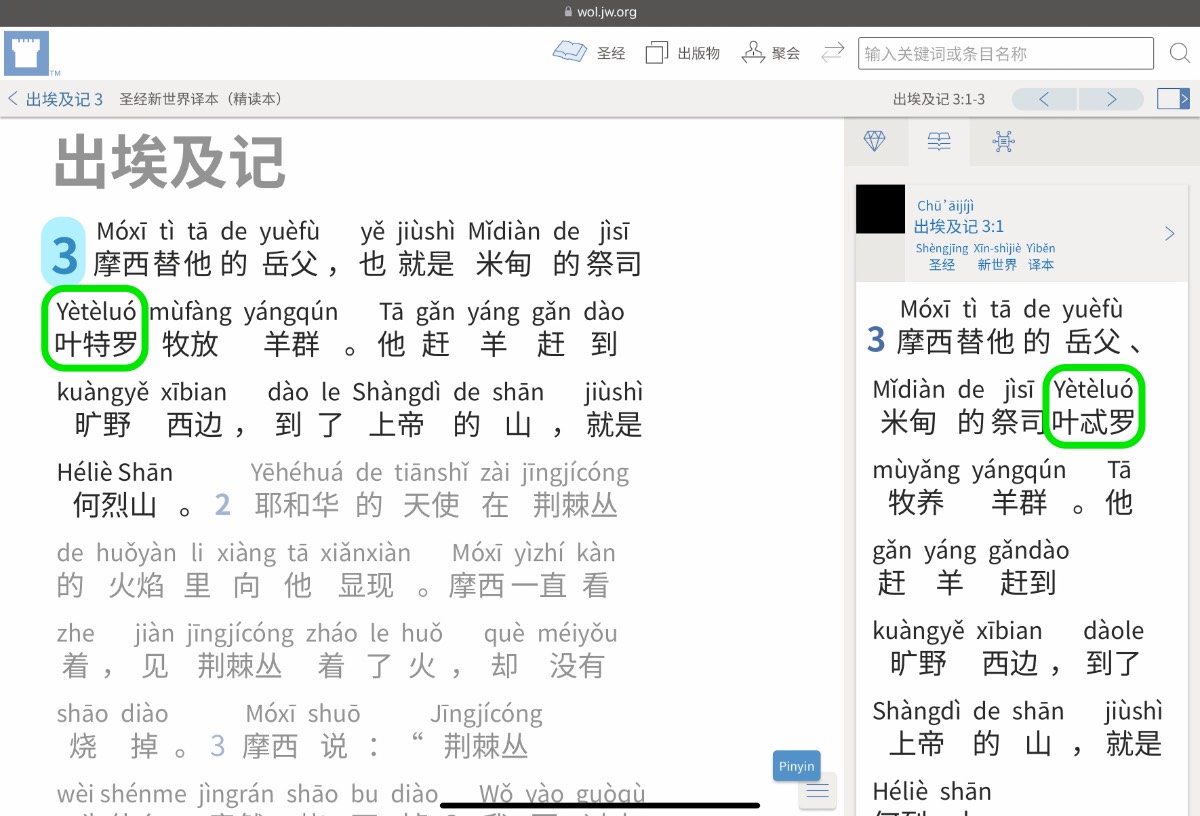
Appendix A2 of the English New World Translation of the Holy Scriptures (Study Edition), entitled “Features of This Revision”, discusses vocabulary changes that have been made in the current revision, words that have been translated differently than before. As noted in various entries in the excellent resource Referenced Theo. Expressions (RTE), Appendix A2 of the current Mandarin version of the New World Translation Bible (nwtsty) correspondingly discusses words that have been translated differently in the current revision of the Mandarin NWT Bible, compared to how they had been translated before.

Since we base what we say in Jehovah’s service on his Word the Bible, the vocabulary used in it—and the way those vocabulary words are translated—should be reflected in how we speak in our ministry, at our meetings, etc. So, it is beneficial for us Mandarin field language learners to be familiar with the latest thinking from the organization on how Bible terms should be translated into Mandarin.

Units of Measurement

Appendix A2 of the current Mandarin version of the New World Translation Bible (nwtsty) points out that in previous editions of the Mandarin New World Translation, basically metric system units of measurement were used, although sometimes units from the original language were used. However, the whole number metric measurements that were considered best to use in the main text generally ended up being inexact conversions from the original measurements. Also, some metric units of measurement are named differently in different places. For example, some places use “ (metre 米)” to mean “metre”, while other places use “gōngchǐ (gōng·chǐ {collective → [metric]} · {Chinese foot (⅓ of a metre)} → [metre] 公尺)”. So, the current version of the Mandarin NWT in most scriptures uses the original language units of measurement through what in Mandarin is called “yīnyì (yīn·yì sound · translating → [transcribing | transcription] 音译 音譯)”, and in footnotes it provides the metric equivalents and perhaps other information.

What does “yīnyì (yīn·yì sound · translating → [transcribing | transcription] 音译 音譯)” involve? Some Chinese-English dictionaries say that this word is used to mean either “transliterate”/“transliteration” or “transcribe”/“transcription”. What’s the difference? Is there a difference?

[Note on terminology:Writing system” and “script” are synonymous, while an “orthography” is a “set of conventions [connected to a writing system/script] for writing a language, including norms of spelling, capitalization, emphasis, hyphenation, punctuation, and word breaks”.]

Transliteration?

The Wikipedia page on transliteration provides the following summaries to help define transliteration:

Transliteration is a type of conversion of a text from one script to another that involves swapping letters (thus trans- + liter-) in predictable ways

Transliteration is not primarily concerned with representing the sounds of the original but rather with representing the characters, ideally accurately and unambiguously.

Systematic transliteration is a mapping from one system of writing into another, typically grapheme to grapheme [e.g., letter to letter]. Most transliteration systems are one-to-one, so a reader who knows the system can reconstruct the original spelling.

Echoing the above quote, the academic paper “Two Steps Toward Digraphia in China” (Sino-Platonic Paper Number 134), by Xieyan Hincha, provides this rigorous definition of transliteration:

By transliteration is meant the letter-by-letter conversion of a text written in an alphabet into another alphabetical script, if necessary using diacritical marks, in such a way that the text can be correctly converted back into the original text by means of a transliteration table.

Transcription?

Now, compare the above to summaries provided by the Wikipedia page on transcription that help to define transcription:

Transcription in the linguistic sense is the systematic representation of spoken language in written form.

There are two main types of linguistic transcription. Phonetic transcription focuses on phonetic and phonological properties of spoken language. Systems for phonetic transcription thus furnish rules for mapping individual sounds or phones to written symbols. Systems for orthographic transcription, by contrast, consist of rules for mapping spoken words onto written forms as prescribed by the orthography of a given language. Phonetic transcription operates with specially defined character sets, usually the International Phonetic Alphabet. [emphasis added]

The above-mentioned academic paper “Two Steps Toward Digraphia in China” also provides a rigorous definition for transcription, which seems to specifically refer to phonetic transcription, as referred to in the Wikipedia quote above:

It is time to ask what exactly is a transcription system. It is a graphic system whose elements unambiguously represent the sounds of a spoken language. The transcription can be narrow or broad: in both cases one graphic symbol represents in principle precisely one single sound.

“There is Too Much…Let Me Sum Up”


To sum up, basically transliteration refers to mapping from one writing system to another writing system, while transcription refers to mapping from a language’s sounds to a graphic system like the IPA (phonetic transcription), or to a writing system with an orthography (orthographic transcription).

Thus, I would say that it’s not really appropriate to use “yīnyì (yīn·yì sound · translating → [transcribing | transcription] 音译 音譯)”—which literally means “sound translating”—to mean “transliterate” or “transliteration”. From the literal meanings of its morphemes, “yīnyì (yīn·yì sound · translating → [transcribing | transcription] 音译 音譯)” is a much better fit for meaning “transcribe” or “transcription”, which refer to mapping the sounds of a language to a graphic system or a writing system.

Going back to Appendix A2 of the current Mandarin version of the NWT Bible, when it says that this version in most scriptures yīnyì (yīn·yì sound · translates → [transcribes] 音译 音譯) (transcribes) the original language’s units of measurement, that means that it uses Chinese characters/Pīnyīn (Pīn·yīn {Piecing Together} · Sounds → [Pinyin] 拼音) to represent (as well as they can) how these units of measurement sounded in the original language. For example, the original language unit of measurement translated into English as “seah measure” is translated into Mandarin as “xìyà ({seah (measure)} 细亚 細亞)”.—2 Kings 7:1 (English/Mandarin).

Transliteration, Transcription, and Pīnyīn (Pīn·yīn {Piecing Together} · Sounds → [Pinyin] 拼音)

Besides offering definitions of transliteration and transcription, the academic paper “Two Steps Toward Digraphia in China” mentioned above also discusses whether these terms apply to Pīnyīn (Pīn·yīn {Piecing Together} · Sounds → [Pinyin] 拼音). Here are a couple of quotes:

In the case of Chinese characters, ISO has established that a transliteration between Chinese characters and Pīnyīn (Pīn·yīn {Piecing Together} · Sounds → [Pinyin] 拼音) is impossible: the supposedly more than 40,000 (“ideo-phonographic”) characters cannot be represented by the 26 letters of the Latin alphabet. There is no doubt about that. This clearly shows that Hànyǔ (Hàn·yǔ {Han (Chinese)} · Language → [(Modern Standard) Mandarin] 汉语 漢語) Pīnyīn (Pīn·yīn {Piecing Together} · Sounds → [Pinyin] 拼音) Fāng’àn (Fāng’·àn {Direction → [Method]} · {Long, Narrow Table or Desk → [Plan]} 方案) is not a transliteration system, because it does not fulfill all the criteria of a transliteration system.

If Hànyǔ (Hàn·yǔ {Han (Chinese)} · Language → [(Modern Standard) Mandarin] 汉语 漢語) Pīnyīn (Pīn·yīn {Piecing Together} · Sounds → [Pinyin] 拼音) Fāng’àn (Fāng’·àn {Direction → [Method]} · {Long, Narrow Table or Desk → [Plan]} 方案) were a transcription system, this table would contain three state-prescribed violations of the transcription principle, namely: y+i, y+in, and y+ing. In all three of these cases, two letters represent one sound. The same is true when writing y+u and w+u. This rule does not concern phonetic transcription; rather, it is an orthographic rule: in these cases <y> and <w> are artificial and arbitrary initial symbols. But phonetically these are not consonants. Consequently, in this respect Hànyǔ (Hàn·yǔ {Han (Chinese)} · Language → [(Modern Standard) Mandarin] 汉语 漢語) Pīnyīn (Pīn·yīn {Piecing Together} · Sounds → [Pinyin] 拼音) Fāng’àn (Fāng’·àn {Direction → [Method]} · {Long, Narrow Table or Desk → [Plan]} 方案) is not a transcription system.

The above quote explains that Pīnyīn (Pīn·yīn {Piecing Together} · Sounds → [Pinyin] 拼音) does not qualify as a phonetic transcription system. However, it shows that Pīnyīn (Pīn·yīn {Piecing Together} · Sounds → [Pinyin] 拼音) has orthographic rules connected to it, meaning it could be used for orthographic transcription…

No, Could It Be?

So, this academic paper concludes that Pīnyīn (Pīn·yīn {Piecing Together} · Sounds → [Pinyin] 拼音) is not a system for transliterating Chinese characters, nor is it a system for phonetically transcribing Mandarin speech. What is it, then? The paper comes to this conclusion:

As is well known, the Chinese leadership refuses to recognize Hànyǔ (Hàn·yǔ {Han (Chinese)} · Language → [(Modern Standard) Mandarin] 汉语 漢語) Pīnyīn (Pīn·yīn {Piecing Together} · Sounds → [Pinyin] 拼音) as a script and to permit digraphia [the state of having two standard scripts, Chinese characters and Pīnyīn (Pīn·yīn {Piecing Together} · Sounds → [Pinyin] 拼音)]. But scientific facts demonstrate that Hànyǔ (Hàn·yǔ {Han (Chinese)} · Language → [(Modern Standard) Mandarin] 汉语 漢語) Pīnyīn (Pīn·yīn {Piecing Together} · Sounds → [Pinyin] 拼音) Fāng’àn (Fāng’·àn {Direction → [Method]} · {Long, Narrow Table or Desk → [Plan]} 方案), including its orthography, is a writing system for Chinese. [emphasis added]

Categories
Language Learning Science

Jīdū

Jīdū (Christ 基督) ← Tap/click to show/hide the “flashcard”

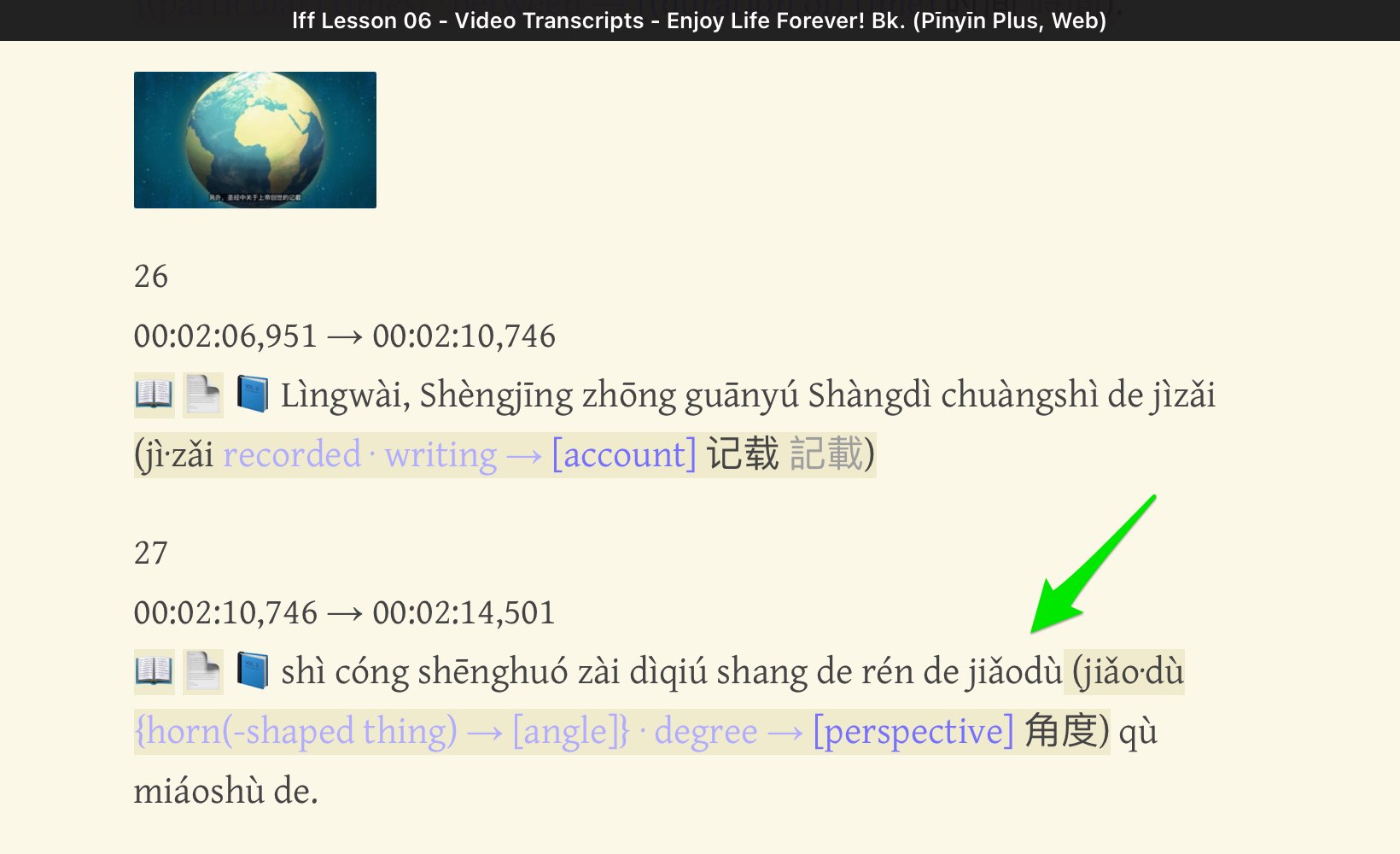
Earlier Pīnyīn (Pīn·yīn {Piecing Together} · Sounds → [Pinyin] 拼音) Plus material rendered the English meaning of “Jīdū (Christ 基督)” as “Foundation · {Directing (Person)} → [Christ]”, on the supposition that the meanings of the Mandarin syllables used in “Jīdū (Christ 基督)” may have mattered in their selection for inclusion in “Jīdū (Christ 基督)”. (In contrast, “Yēsū (Jesus 耶稣 耶穌)” (Jesus) is a name, not a title like “Jīdū (Christ 基督)” is, so, like the Mandarin syllables used in other Mandarin names of Bible personages, the Mandarin syllables for “Yēsū (Jesus 耶稣 耶穌)” were obviously also chosen mainly for their sounds, with only secondary consideration given to their meanings.) Unfortunately, while it seems to make some sense, it turns out that this earlier rendering of the English meaning of “Jīdū (Christ 基督)” was a case of Trying Too Hard 😜. (Oh, well, as I once heard a cable guy say as he was preparing to make a new cable, “too much is better than not enough”.)

Now, when one looks up “Jīdū (Christ 基督)” in the Pīnyīn (Pīn·yīn {Piecing Together} · Sounds → [Pinyin] 拼音) Plus Expressions resource, one will see a note about why the English meaning of “Jīdū (Christ 基督)” is now simply rendered as “Christ”:

(This is a transcription of “Christ”, so the syllables were chosen mainly for their sound, not their meaning. For more info, see this Language Log post by Victor Mair.)

Who Is Victor Mair and What Did He Say About This?

Victor H. Mair, who has been mentioned several times in this blog, is an American sinologist and a University of Pennsylvania Professor of East Asian Languages and Civilizations. He also inspired and helped to edit the highly regarded ABC Chinese-English Dictionary. So, we can be pretty sure he knows what he’s talking about when it comes to Mandarin words. (In fact, for what it’s worth, after my several years of researching the Mandarin language, I have come to consider him the most trustworthy living scholarly authority on the Chinese languages.)

Concerning the etymology of “Jīdū (Christ 基督)”, Prof. Mair said the following in the above-mentioned Language Log blog post:

Jīdū 基督 is a short form of Jīlìsīdū 基利斯督, which is a transcription of “Christ”, from Ancient Greek Χριστός (Khristós).

So, I revised the English meaning in the Pīnyīn (Pīn·yīn {Piecing Together} · Sounds → [Pinyin] 拼音) Plus Expressions resource entry for “Jīdū (Christ 基督)”, added the note quoted above, and am gradually revising occurrences of “Jīdū (Christ 基督)” in existing Pīnyīn (Pīn·yīn {Piecing Together} · Sounds → [Pinyin] 拼音) Plus material as time allows. Of course, going forward, new Pīnyīn (Pīn·yīn {Piecing Together} · Sounds → [Pinyin] 拼音) Plus material that includes the expression “Jīdū (Christ 基督)” will simply use “Christ” as its English meaning.

A Reminder That Speech Is Primary

This situation with “Jīdū (Christ 基督)”, in which the deciding factor in how the word is formed is how it sounds, reminds us that regardless of the Chinese cultural obsession with characters and the meanings represented by their intricate visual designs, the basic scientific principle about human languages holds true, that the primary aspect of human languages is actually speech, which represents meanings with sounds. Writing, even writing as revered as Chinese characters are with all their visual embellishments, is at best secondary.