Categories
Current Events

Dé’ěrtǎ

Dé’ěrtǎ+ (Delta 德尔塔 德爾塔) ← Tap/click to show/hide the “flashcard”

[Note: Tap/click on a Pīnyīn (Pīn·yīn {Piecing Together} · Sounds → [Pinyin] 拼音) expression to reveal its “flashcard”, tap/click on a “flashcard” or its Pīnyīn (Pīn·yīn {Piecing Together} · Sounds → [Pinyin] 拼音) expression to hide the “flashcard”.]

As of this writing, deep in the year 2021, the subject of the COVID-19 pandemic has been, to say the least, on people’s minds now for a while. So, it would be good to be able to refer to things related to it in Mandarin when speaking to people in the Mandarin field, or when speaking to our brothers and sisters in the truth.

electron microscope image of SARS-CoV-2—also known as 2019-nCoV, the virus that causes COVID-19

An electron microscope image of SARS-CoV-2—also known as 2019-nCoV, the virus that causes COVID-19
Creative Commons Attribution License logo NIAID

This week’s MEotW, “Dé’ěrtǎ (Delta 德尔塔 德爾塔)”, is one of the more “Mandariny” ways to say “Delta”—as in the Delta variant of the virus that causes COVID-19—in Mandarin.

There are, however, other ways to say “Delta” in Mandarin, e.g.:

  • Děi’ěrtǎ (Delta 得尔塔 得爾塔)
  • sānjiǎo+ (sān·jiǎo three · {horns → [corners]} → [triangle; delta] 三角) [xíng (form; shape 形)]”
  • sānjiǎo (sān·jiǎo three · {horns → [corners]} → [triangle (of)] 三角) zhōu+ ({river islets/islands} → [(river) delta] 洲)
  • sānjiǎo (sān·jiǎo three · {horns → [corners]} → [triangle; delta] 三角) + (wing 翼)

To get an idea of how commonly used these expressions are compared to each other, consider the numbers of Google search results involving these expressions, together with “biànzhǒng+ (biàn·zhǒng changed · kind; type; variety → [mutation; variant; variety] 变种 變種)” (a past MEotW) and “biànyì zhū+ ((biàn·yì changed · {to be different} 变异 變異) (zhū {trunk of a tree → [strain]} 株) [(virus) strain/variant])”, two common ways to say “variant”:

Dé’ěrtǎ+ (Delta 德尔塔 德爾塔)
Search Terms Google Results Approx. No.
"德尔塔变种"
(Dé’ěrtǎ (Delta 德尔塔 德爾塔) biànzhǒng (biàn·zhǒng changed · kind; type; variety → [mutation; variant; variety] 变种 變種))
619,000
"德尔塔变异株"
(Dé’ěrtǎ (Delta 德尔塔 德爾塔) biànyì zhū ((biàn·yì changed · {to be different} 变异 變異) (zhū {trunk of a tree → [strain]} 株) [(virus) strain/variant]))
1,980,000
Děi’ěrtǎ+ (Delta 得尔塔 得爾塔)
Search Terms Google Results Approx. No.
"得尔塔变种"
(Děi’ěrtǎ (Delta 得尔塔 得爾塔) biànzhǒng (biàn·zhǒng changed · kind; type; variety → [mutation; variant; variety] 变种 變種))
824
"得尔塔变异株"
(Děi’ěrtǎ (Delta 得尔塔 得爾塔) biànyì zhū ((biàn·yì changed · {to be different} 变异 變異) (zhū {trunk of a tree → [strain]} 株) [(virus) strain/variant]))
13,300
sānjiǎo+ (sān·jiǎo three · {horns → [corners]} → [triangle; delta] 三角) [xíng+ (form; shape 形)]
Search Terms Google Results Approx. No.
"三角变种"
(sānjiǎo (sān·jiǎo three · {horns → [corners]} → [triangle; delta] 三角) biànzhǒng (biàn·zhǒng changed · kind; type; variety → [mutation; variant; variety] 变种 變種))
354
"三角变异株"
(sānjiǎo (sān·jiǎo three · {horns → [corners]} → [triangle; delta] 三角) biànyì zhū ((biàn·yì changed · {to be different} 变异 變異) (zhū {trunk of a tree → [strain]} 株) [(virus) strain/variant]))
4
"三角形变种"
(sānjiǎo (sān·jiǎo three · {horns → [corners]} → [triangle; delta] 三角) xíng (form; shape 形) biànzhǒng (biàn·zhǒng changed · kind; type; variety → [mutation; variant; variety] 变种 變種))
127
"三角形变异株"
(sānjiǎo (sān·jiǎo three · {horns → [corners]} → [triangle; delta] 三角) xíng (form; shape 形) biànyì zhū ((biàn·yì changed · {to be different} 变异 變異) (zhū {trunk of a tree → [strain]} 株) [(virus) strain/variant]))
0
sānjiǎo+ (sān·jiǎo three · {horns → [corners]} → [triangle (of)] 三角) zhōu+ ({river islets/islands} → [(river) delta] 洲)
Search Terms Google Results Approx. No.
"三角洲变种"
(sānjiǎo (sān·jiǎo three · {horns → [corners]} → [triangle (of)] 三角) zhōu ({river islets/islands} → [(river) delta] 洲) biànzhǒng (biàn·zhǒng changed · kind; type; variety → [mutation; variant; variety] 变种 變種))
20,800
"三角洲变异株"
(sānjiǎo (sān·jiǎo three · {horns → [corners]} → [triangle (of)] 三角) zhōu ({river islets/islands} → [(river) delta] 洲) biànyì zhū ((biàn·yì changed · {to be different} 变异 變異) (zhū {trunk of a tree → [strain]} 株) [(virus) strain/variant]))
982
sānjiǎo+ (sān·jiǎo three · {horns → [corners]} → [triangle; delta] 三角) + (wing 翼)
Search Terms Google Results Approx. No.
"三角翼变种"
(sānjiǎo (sān·jiǎo three · {horns → [corners]} → [triangle; delta] 三角) (wing 翼) biànzhǒng (biàn·zhǒng changed · kind; type; variety → [mutation; variant; variety] 变种 變種))
146
"三角翼变异株"
(sānjiǎo (sān·jiǎo three · {horns → [corners]} → [triangle; delta] 三角) (wing 翼) biànyì zhū ((biàn·yì changed · {to be different} 变异 變異) (zhū {trunk of a tree → [strain]} 株) [(virus) strain/variant]))
0

(Note that the quotation marks in the search terms tell Google to look for the exact sequences of characters that are inside the quotation marks—the results of searching without the quotation marks can be very different.)

Sounds Like…

You may notice that the ways to say “Delta” in Mandarin can be divided into

  • those that are derived from the meaning of “Delta” (the uppercase Greek letter delta (Δ), or something that looks like a triangle like it does), and
  • those that are derived from the sound of the English word “Delta”.

It is evident from the above Google search results that overall, saying “Delta” in Mandarin using expressions that sound like the English word “Delta” is much more common than doing so using expressions that mean what “Delta” means, or that mean something that looks like what a “Delta” looks like.

In fact, as was shown in the MEotW post about “biànzhǒng (biàn·zhǒng changed · kind; type; variety → [mutation; variant; variety] 变种 變種)”, when talking or writing in Mandarin about the Delta variant, it is very common for people to just use the actual English word “Delta”, which sounds more like the English word “Delta” than anything else, and is not a Mandarin word written using the supposedly ideographic (representing meaning through visible symbols) Chinese characters.

Delta
Search Terms Google Results Approx. No.
"delta变种"
(Delta biànzhǒng (biàn·zhǒng changed · kind; type; variety → [mutation; variant; variety] 变种 變種))
2,230,000
"delta变异株"
(Delta biànyì zhū ((biàn·yì changed · {to be different} 变异 變異) (zhū {trunk of a tree → [strain]} 株) [(virus) strain/variant]))
1,750,000

It is no surprise to linguists (language scientists/scholars) that people naturally focus on what words sound like when spoken, because, while of course meaning is what, well, gives life meaning, one of the basic principles of modern linguistics (the scientific study of language) is that speech is primary, and writing is secondary. That means that God designed us humans to express meaning via language primarily using speech that is heard, not writing that is seen, no matter how much lovers of Chinese characters traditionally focus on that visually intricate writing system above all else.—1 Corinthians 14:8–11.

Categories
Culture Theocratic

xìnxīn

xìnxīn+ (xìn·xīn believing · heart → [faith; confidence] 信心) ← Tap/click to show/hide the “flashcard”

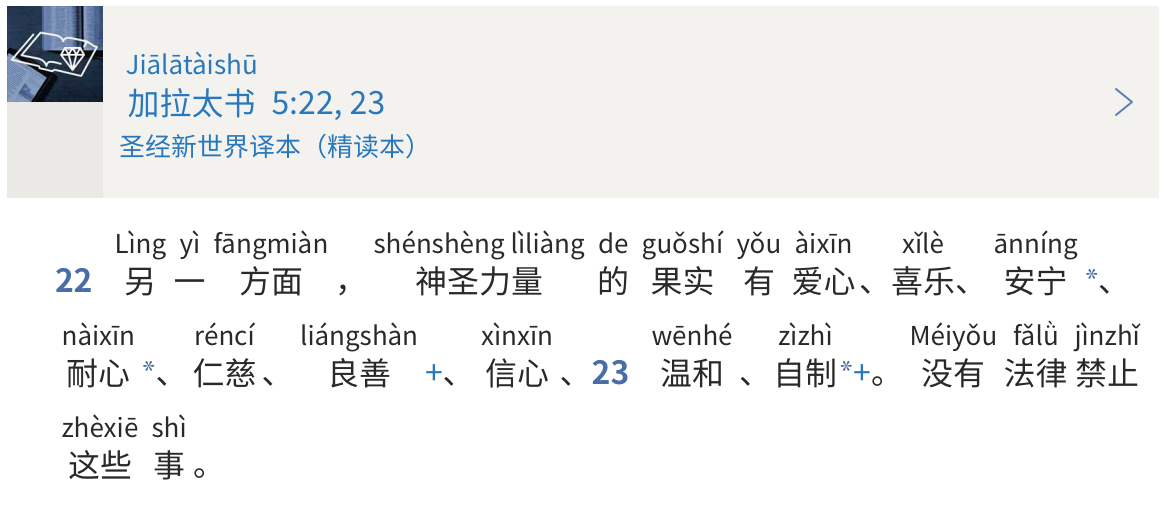
The seventh part of the fruitage of the spirit listed is faith.— Jiālātàishū (Jiālātài·shū Galatia · Book → [Galatians] 加拉太书 加拉太書) 5:22, 23.

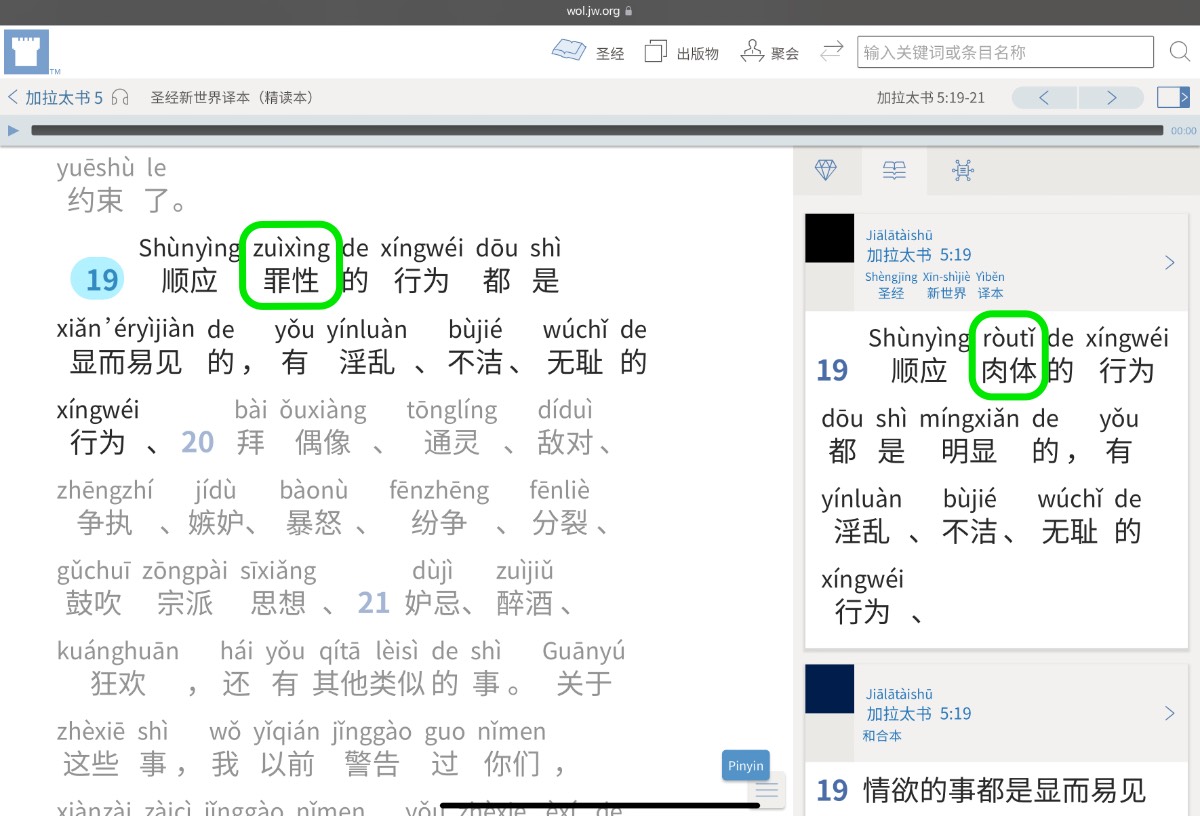
Galatians 5:22, 23 (WOL nwtsty-CHS+Pīnyīn)

As shown above, the current Mandarin version of the New World Translation Bible (nwtsty) translates the English word “faith” using this week’s MEotW, “xìnxīn (xìn·xīn believing · heart → [faith; confidence] 信心)”.

As with “àixīn (ài·xīn loving · heart → [love] 爱心 愛心)”, a past MEotW, “xìnxīn (xìn·xīn believing · heart → [faith; confidence] 信心)” includes “xīn+ (heart 心)”, meaning “heart”, as one of its morphemes. Why is this especially fitting when discussing the fruitage of the spirit?

The Mandarin culture and language correctly recognize that the heart is deeply involved in spirituality. In fact, as mentioned in Appendix A2 of the current Mandarin version of the New World Translation Bible (nwtsty), one of the expressions that the current version of the Mandarin NWT Bible uses to translate the English word “spiritual” is “xīnlíng+ (xīn·líng heart · spirit [→ [spiritual]] 心灵 心靈)”, which is a past MEotW. This expression literally means “heart spirit”.

So, it is especially fitting that the Mandarin expression chosen to translate the English word “faith” in reference to the fruitage of the spirit connects both to faith and to the heart.

Categories
Theocratic

zīyǎng

zīyǎng+ (zī·yǎng grow · support → [nourish] 滋养 滋養) ← Tap/click to show/hide the “flashcard”

With last week’s MEotW being “xīnlíng+ (xīn·líng heart · spirit [→ [spiritual]] 心灵 心靈)”, which the organization is now using as a more understandable translation for “spiritual” compared to “shǔlíng (shǔ·líng {(in the) category (of)} · spirit → [spiritual (nwtsty-CHS Appx. A2 notes change from “shǔlíng” to “xīnlíng”, etc.)] 属灵 屬靈)”, one may wonder how the organization now chooses to translate “spiritual food”, which before was translated as “shǔlíng (shǔ·líng {(in the) category (of)} · spirit → [spiritual (nwtsty-CHS Appx. A2 notes change from “shǔlíng” to “xīnlíng”, etc.)] 属灵 屬靈) shíwù (shí·wù eating · matter → [food] 食物)” or “língliáng (líng·liáng spirit · {grain → [food]} → [spiritual food (old translation, no longer used in nwt-CHS)] 灵粮 靈糧)”.

A bit of digging reveals that the organization now seems to mainly translate “spiritual food” as “zīyǎng+ (zī·yǎng grows · supports → [nourishes] 滋养 滋養) xìnxīn (xìn·xīn believing · heart → [faith] 信心) de (’s 的) shíwù (shí·wù eating · matter → [food] 食物)”.

For example, that is how “spiritual food” is translated in Lesson 54 of the Enjoy Life Forever! book, which is now the main publication officially recommended for use on Bible studies. We can see this when we compare the English and the Mandarin versions of this Lesson:

“spiritual food” in _Enjoy Life Forever!_ bk. Lesson 54 (WOL Eng and CHS+Pinyin)

[Update, 2026-07-25: Pīnyīn (Pīn·yīn {Piecing Together of} · Sounds → [Pinyin] 拼音)+ material for Lesson 54 of the Enjoy Life Forever! book is now available as well.]

The translation “zīyǎng+ (zī·yǎng grows · supports → [nourishes] 滋养 滋養) xìnxīn (xìn·xīn believing · heart → [faith] 信心) de (’s 的) shíwù (shí·wù eating · matter → [food] 食物)” is also used in these recent issues of The Watchtower:

(The Watchtower ONLINE LIBRARY’s Synchronization feature can be used to quickly change the language of the currently loaded material, or you may want to open two separate browser windows to see the same material in two different languages side by side.)

Alternately…

Interestingly, “spiritual food” is sometimes now translated in other ways as well. For example, “mǎnzú (mǎn·zú fills · {to be sufficient} → [satisfies] 满足 滿足) xīnlíng (xīn·líng heart · spirit → [spiritual] 心灵 心靈) xūyào ({(things) needed} 需要) de (’s 的)shíwù (shí·wù eating · matter → [food] 食物)’ ” is used in the following issue of The Watchtower:

Also, the current version of the Mandarin New World Translation Bible (nwtsty) uses the expression “Shàngdì (Shàng·dì Above’s · God → [God] 上帝) cìxia (cì·xia gives · down 赐下 賜下) de (’s 的) shíwù (shí·wù eating · matter → [food] 食物)” to translate “spiritual food” at 1 Corinthians 10:3.