Categories
Culture Current Events Language Learning Theocratic

húzi

húzi (hú·zi beard; moustache; whiskers · [suf for nouns] [beard; moustache; whiskers] 胡子 鬍子) ← Tap/click to show/hide the “flashcard”

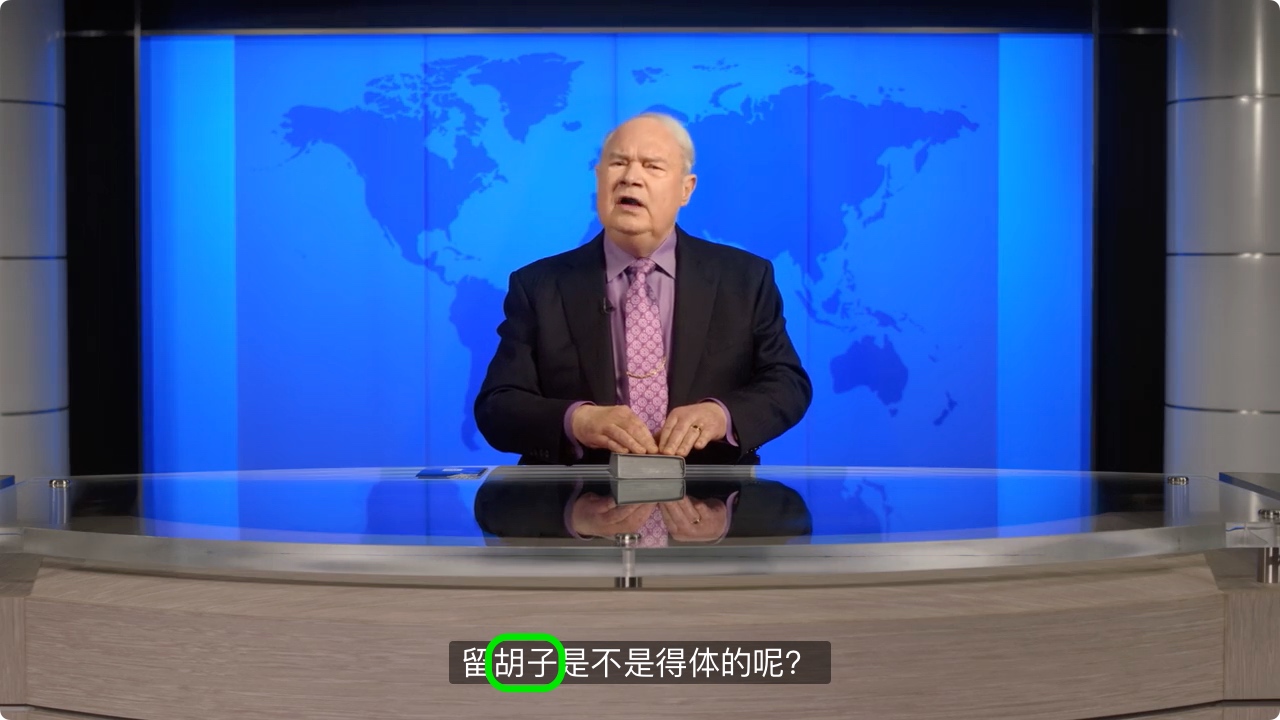
This week’s MEotW, “húzi (hú·zi beard; moustache; whiskers · [suf for nouns] [beard; moustache; whiskers] 胡子 鬍子)”, is used, along with the expression “húxū (hú·xū beard; moustache; whiskers · beard; moustache 胡须 鬍鬚)”, to translate “beard” in the Mandarin version of the 2023 Governing Body Update #8 video.

“_Húzi_” used in the Mandarin version of the 2023 Governing Body Update #8 video

Morphemic Breakdown

In “húzi (hú·zi beard; moustache; whiskers · [suf for nouns] [beard; moustache; whiskers] 胡子 鬍子)”, “hú (beard; moustache; whiskers) means “beard; moustache; whiskers”. (Note that this is the meaning of the Simplified Chinese character “胡” when it corresponds to the Traditional Chinese character “鬍”. This Simplified character can also correspond to the Traditional characters “胡” and “衚”, which have different meanings.)

As for “zi ([suf for nouns] 子)”, it is used in “húzi (hú·zi beard; moustache; whiskers · [suf for nouns] [beard; moustache; whiskers] 胡子 鬍子) as a suffix that is attached to nouns. Other examples of this in use are:

  • cèzi (cè·zi brochure; booklet · [suf for nouns] 册子 冊子)
  • dùzi (dù·zi belly; abdomen; stomach; bowels · [suf for nouns] 肚子)
  • rìzi (rì·zi {sun → [day]} · [suf for nouns] 日子)
  • shīzi (shī·zi lion · [suf for nouns] 狮子 獅子)
  • qīzi (qī·zi wife · [suf for nouns] 妻子)
  • érzi (ér·zi son · [suf for nouns] 儿子 兒子)
  • háizi (hái·zi child · [suf for nouns] [→ [son; daughter]] 孩子)
  • sūnzi (sūn·zi grandson · [suf for nouns] [→ [son’s son]] 孙子 孫子)

In specific cases, like in “nánzǐ (nán·zǐ male · person [→ [man]] 男子) and in “nǚzǐ (nǚ·zǐ female · person [→ [woman]] 女子)”, “子” is written in Pīnyīn (Pīn·yīn {Piecing Together of} · Sounds → [Pinyin] 拼音) with a third tone, and is used to mean “person”.

Avoiding Unnecessary Divisions

One of the things that the above-mentioned video touches on is that we should not let the matter of beards become a cause for division among God’s people. In the Mandarin field, it may be that some hesitate to use or speak of Pīnyīn (Pīn·yīn {Piecing Together of} · Sounds → [Pinyin] 拼音), out of concern about causing real or perceived division, since many Mandarin field publishers are still accustomed to the traditional primacy of Chinese characters in worldly Chinese culture. Of course, we should avoid using or speaking about Pīnyīn (Pīn·yīn {Piecing Together of} · Sounds → [Pinyin] 拼音) in situations and ways that would truly lead to unnecessary division among Jehovah’s people—every situation is different, and we must try our best to be motivated by Christian love and to use discernment and sound judgment in every situation.

Also, let me emphasize that I, on this blog or anywhere else, do not presume to be giving authoritative spiritual direction to any of God’s people—that is the privilege and responsibility of the slave class. (Matthew 24:45–47) Rather, like any publisher who gives talks, gives comments, or just discusses various subjects both technical and spiritual with fellow believers, I seek to share what I have learned from my studies and my experience, that hopefully can be helpful to fellow workers in Jehovah’s service.

Beards vs. Writing Systems

One thing I notice is that while the Bible and the organization have specifically commented on and provided direction for God’s people living in different time periods concerning beards, it seems that neither the Bible nor the organization has specifically commented on or provided direction about any particular writing system like Chinese characters or Pīnyīn (Pīn·yīn {Piecing Together of} · Sounds → [Pinyin] 拼音). (Note, though, that the organization’s actions may have done some speaking of their own—over time, overall, the organization has gradually been making available more and more official material that contains Pīnyīn (Pīn·yīn {Piecing Together of} · Sounds → [Pinyin] 拼音).)

As far as I know and can recall, one of the only scriptures in the Bible from which we can gain some insight about writing systems is 1 Corinthians 14:8–11:

8 For if the trumpet sounds an indistinct call, who will get ready for battle? 9 In the same way, unless you with the tongue use speech that is easily understood, how will anyone know what is being said? You will, in fact, be speaking into the air. 10 It may be that there are many kinds of speech in the world, and yet no kind is without meaning. 11 For if I do not understand the sense of the speech, I will be a foreigner to the one speaking, and the one speaking will be a foreigner to me.

This scripture speaks about the primary importance of understandable speech when it comes to how Christian ministers should use language, while not bothering to even mention writing systems. This reflects well the reality that linguists are familiar with, that because of the way that Jehovah created us humans to use language, speech is primary, and writing is secondary, if anything. Indeed, many, many languages don’t even have a writing system! And yet, as Revelation 14:6 shows us, this does not stop the preaching of the good news in any of these tongues, that is, spoken languages:

And I saw another angel flying in midheaven, and he had everlasting good news to declare to those who dwell on the earth, to every nation and tribe and tongue and people.

(Interestingly, while it mentions “every…tongue”, or spoken language, this scripture doesn’t bother to mention writing systems either.)

So, while the prevailing worldly Chinese culture may tell us that Chinese characters are awesome and that we should all primarily focus on learning them, the Bible and the organization consider beards more worthy of mention than writing systems like Chinese characters. One thing that the above-mentioned video points out as something to avoid is “contradicting the guidance from the organization”, and it’s not difficult to avoid this with regard to, say, Chinese writing systems when there is no guidance from the organization about this subject (unless one has a tendency to, say, carry on as if there has been guidance from the organization to focus on Chinese characters when, actually, as far as I am aware, there has not been any such guidance, and what writing system to use remains a personal decision).

At the same time, though, if we focus on the inhumanly and unnecessarily numerous and complex Chinese characters so much that our abilities to understand spoken Mandarin and to speak Mandarin understandably remain seriously underdeveloped, then we would obviously not be following the counsel at 1 Corinthians 14:8–11 about the need to prioritize and use understandable speech in our ministry.

Traditions and Divisions

It is evident, then, that if any publisher were to make a fuss in support of the Chinese characters writing system or opposing or ridiculing the Pīnyīn (Pīn·yīn {Piecing Together of} · Sounds → [Pinyin] 拼音) writing system, that publisher would be doing so because of some mixture of personal opinion/ignorance, human tradition, and cultural pride, not because of any scriptural basis or direction from the organization. And, as we should know, the Bible and the organization DO have a lot to say about the importance of NOT doing things because of things like personal opinion/ignorance, human tradition, and cultural pride. Such things can certainly cause unnecessary division among God’s people, since our unity as God’s people comes, not from together following human traditions and ways of doing things, but from together following direction from the Bible and from God’s organization. Let us, then, follow the actual direction from the Bible and from God’s organization so that we can build each other up spiritually, and so that we can really do the best we can to help praise and glorify Jehovah—not any human culture—and accomplish well the great work that he has given us to do in these last days.

Categories
Culture Current Events History

kǒngbù huódòng

kǒngbù huódòng ((kǒng·bù fearing · terror → [terrorist] 恐怖) (huó·dòng living · moving → [activities] 活动 活動) [terrorism; terrorist activities]) ← Tap/click to show/hide the “flashcard”

[Notes: Tap/click on a Pīnyīn (Pīn·yīn {Piecing Together of} · Sounds → [Pinyin] 拼音) expression to reveal its “flashcard”; tap/click on a “flashcard” or its Pīnyīn (Pīn·yīn {Piecing Together of} · Sounds → [Pinyin] 拼音) expression to hide the “flashcard”. 📖 📄 📘 icons mean 📖 Reveal All, 📄 Reveal Advanced, and 📘 Reveal None re all the “flashcards” in the heading, paragraph, etc. that they are placed at the beginning of.]

With what’s currently going on in the world, at the time of this writing, jw.org was featuring the article “Will Terrorism Ever End?”. Where the English version of this article uses the word “terrorism”, the Mandarin version uses this week’s MEotW, “kǒngbù huódòng ((kǒng·bù fearing · terror → [terrorist] 恐怖) (huó·dòng living · moving → [activities] 活动 活動) [terrorism; terrorist activities])”. For example, the titles of the English and Mandarin versions of the article are rendered as follows:

English:

Will Terrorism Ever End?

Mandarin:

📖 📄 📘 Kǒngbù Huódòng ((Kǒng·bù Fearing · Terror → [Terrorist] 恐怖) (Huó·dòng Living · Moving → [Activities] 活动 活動) [Terrorism]) Huì (Will) Yǒu (Have 有) Zhōngzhǐ (Zhōng·zhǐ Ending · Stopping 终止 終止) de (’s 的) (One 一) Tiān (Sky → [Day] 天) Ma ([? ptcl for “yes/no” questions])?

Morphemic Breakdown

In “kǒngbù huódòng ((kǒng·bù fearing · terror → [terrorist] 恐怖) (huó·dòng living · moving → [activities] 活动 活動) [terrorism; terrorist activities])”, “kǒngbù (kǒng·bù fearing · terror | terrifying · frightening [→ [terror; horror | horrible | terrorist (adj)]] 恐怖) is made up of morphemes that literally mean “fearing” and “terror”, and that together effectively mean “terrorist” (used as an adjective) in this context. Another expression in which “kǒngbù (kǒng·bù fearing · terror | terrifying · frightening [→ [terror; horror | horrible | terrorist (adj)]] 恐怖) is used this way is “kǒngbù fènzǐ ((kǒng·bù fearing · terror → [terrorist] 恐怖) (fèn·zǐ {component; part; portion (of a whole)} · person → [member (of a class or group)] 分子) [terrorist (person)])”, which means “terrorist”, that is, a person who is a terrorist.

As for “huódòng (huó·dòng living · moving → [activities] | {to be living → [to be moving]} · {to move} 活动 活動)”, its morphemes literally mean “living” and “moving”, and, in the context of “kǒngbù huódòng ((kǒng·bù fearing · terror → [terrorist] 恐怖) (huó·dòng living · moving → [activities] 活动 活動) [terrorism; terrorist activities])”, together they effectively mean “activities”. On one level of literalness, then, “kǒngbù huódòng ((kǒng·bù fearing · terror → [terrorist] 恐怖) (huó·dòng living · moving → [activities] 活动 活動) [terrorism; terrorist activities]) means “terrorist activities”. From there, it’s easy to see how it came to correspond with “terrorism”.

Mandarin -isms

“Terrorism” is but one of the world’s many -isms. Below are some other Mandarin expressions, besides “huódòng (huó·dòng living · moving → [activities] | {to be living → [to be moving]} · {to move} 活动 活動)”, used to construct the Mandarin equivalents of various English -isms, along with examples of them in use:

  • zhǔyì (zhǔ·yì master · meaning → [doctrine; ideology; -ism] 主义 主義)

    • guójiā zhǔyì ((guó·jiā nation · family → [nation] 国家 國家) (zhǔ·yì master · meaning → [-ism] 主义 主義) [nationalism])
    • zhǒngzú zhǔyì ((zhǒng·zú kind · race → [race] 种族 種族) (zhǔ·yì master · meaning → [-ism] 主义 主義) [racism; ethnocentrism])
    • chuántǒng zhǔyì ((chuán·tǒng {passed on} · {gathered together (things) → [interconnected system]} → [tradition] 传统 傳統) (zhǔ·yì master · meaning → [-ism] 主义 主義) [traditionalism])
  • lùn (discussing → [theory; doctrine; -ism | view; opinion])

    • wúshén lùn ((wú·shén no · God 无神 無神) (lùn discussing → [-ism]) [atheism])
    • bùkězhī lùn ((bù·kě·zhī not · can · {be known} → [[is] unknowable] 不可知) (lùn discussing → [-ism]) [agnosticism])
  • jīngshén (spirit [→ [mind; mental state; psycho-; -ism]] 精神)

    • Ā Q jīngshén ((Ā [pref indicating familiarity] 阿) (Q) (jīngshén spirit → [-ism] 精神) [Ah Q-ism; self-deception and rationalization as a coping mechanism, involving viewing personal and societal failures as “spiritual/moral victories” (Ā Q is the protagonist of Ā Q Zhèngzhuàn (The True Story of Ah Q), by Lǔ Xùn)])

Ah Q

To provide some background for “Ā Q jīngshén ((Ā [pref indicating familiarity] 阿) (Q) (jīngshén spirit → [-ism] 精神) [Ah Q-ism; self-deception and rationalization as a coping mechanism, involving viewing personal and societal failures as “spiritual/moral victories” (Ā Q is the protagonist of Ā Q Zhèngzhuàn (The True Story of Ah Q), by Lǔ Xùn)])”, Ā Q ((Ā [pref indicating familiarity] 阿) (Q) [protagonist of Ā Q Zhèngzhuàn (The True Story of Ah Q), by Lǔ Xùn]) is the protagonist of Ā Q Zhèngzhuàn ((Ā [pref indicating familiarity] 阿) (Q Q’s) (Zhèng·zhuàn Correct · Story → [True Story] 正传 正傳) [The True Story of Ah Q (novella by Lǔ Xùn; considered the first work written in Vernacular Chinese)]) (The True Story of Ah Q), a novella by Lǔ Xùn ((Lǔ Stupid; Rash (surname)) (Xùn Fast; Quick; Swift 迅) (pen name of Zhōu Shùrén, the greatest Chinese writer of the 20th cent. and a strong advocate of alphabetic writing)), who is considered the greatest Chinese writer of the 20th century, and who was a strong advocate of alphabetic writing for China. Regarding Ā Q Zhèngzhuàn ((Ā [pref indicating familiarity] 阿) (Q Q’s) (Zhèng·zhuàn Correct · Story → [True Story] 正传 正傳) [The True Story of Ah Q (novella by Lǔ Xùn; considered the first work written in Vernacular Chinese)]), Wikipedia provides this summary of how this literary work is viewed:

The piece is generally held to be a masterpiece of modern Chinese literature, since it is considered the first piece of work to fully utilize Vernacular Chinese after the 1919 May 4th Movement in China.[source]

Categories
Culture Current Events History Names

bǎixìng

bǎixìng (bǎi·xìng {hundred → [all]} · surnames → [common people | all existing surnames] 百姓) ← Tap/click to show/hide the “flashcard”

[Notes: Tap/click on a Pīnyīn (Pīn·yīn {Piecing Together of} · Sounds → [Pinyin] 拼音) expression to reveal its “flashcard”; tap/click on a “flashcard” or its Pīnyīn (Pīn·yīn {Piecing Together of} · Sounds → [Pinyin] 拼音) expression to hide the “flashcard”. 📖 📄 📘 icons mean 📖 Reveal All, 📄 Reveal Advanced, and 📘 Reveal None re all the “flashcards” in the heading, paragraph, etc. that they are placed at the beginning of.]

With the deadly shooting wars now being fought in places like Israel and Ukraine, jw.org recently featured an article with the following title:

English:

Who Will Save the Civilians?—What Does the Bible Say?

Mandarin:

📖 📄 📘 Zhànhuǒ (Zhàn·huǒ War · Fire → [Flames of War] 战火 戰火) Wúqíng (Wú·qíng {Not Having} · Feeling → [Being Heartless] 无情 無情), Shéi (Who) Lái ({Will Come}) Zhěngjiù ({to Save} 拯救) Wúgū (Wú·gū Without · Guilt → [Innocent] 无辜 無辜) de (’s 的) Bǎixìng (Bǎi·xìng {Hundred → [All]} · Surnames → [Common People] 百姓)?

This week’s MEotW is the last word in the above Mandarin title, “bǎixìng (bǎi·xìng {hundred → [all]} · surnames → [common people | all existing surnames] 百姓)”, which corresponds to “civilians”, or “common people”. And, as the Wikipedia page for this expression says:

The word “lao” (Chinese: 老; lit. ‘old’) is often added as a prefix before “baixing”.[source]

Origins?

“Bǎixìng (Bǎi·xìng {hundred → [all]} · surnames → [common people | all existing surnames] 百姓) literally means “hundred surnames”. Regarding how a hundred surnames came to represent the people of China, the above-mentioned Wikipedia article claims:

A confederation of tribes living along the Yellow River were the ancestors of what later became the Han ethnic group in China.[source][source] Several large tribes, including the Huangdi tribes (Chinese: 黄帝族), Yandi tribes (Chinese: 炎帝族), and the Yi tribes, formed an alliance that consisted of roughly 100 tribes. This alliance is the origin of the baixing () or the “hundred surnames.”

Around 2,000 Han Chinese surnames are currently in use, but 19 of these surnames are used by about half of the Han Chinese people. About 87% of the population shares 100 surnames.[source][source]

Logically, as the population of the grouping of tribes that eventually became China grew, for a time there were fewer than one hundred surnames, for a relatively brief time there were exactly one hundred surnames, and then there were over a hundred surnames. Whether the particular claim above about there having been about a hundred early tribes is accurate, somewhere along the line, the idea may have taken root that one hundred surnames were generally representative of the people of China, especially if it’s true, as claimed above, that a hundred surnames covers about 87% of China’s population.

Another possibility is that the “bǎi (hundred [→ [numerous; all [kinds of]]] 百) in “bǎixìng (bǎi·xìng {hundred → [all]} · surnames → [common people | all existing surnames] 百姓) is used to effectively mean “all”, like it does in “bǎiwù (bǎi·wù {hundred → [all]} · things 百物). A similar expression is “wànwù (wàn·wù {ten thousand → [all]} · things 万物 萬物)”, in which “wàn ({ten thousand} [→ [all; a very great number of]]萬/万), which literally means “ten thousand”, is used to mean “all”, or “a very great number of”.

Either way, as we can see from the above Mandarin jw.org article title, besides being used to refer to the common people of China, “bǎixìng (bǎi·xìng {hundred → [all]} · surnames → [common people | all existing surnames] 百姓) is now also used to refer to the common people of other nations as well.

The Book of Family Surnames

The expression “bǎixìng (bǎi·xìng {hundred → [all]} · surnames → [common people | all existing surnames] 百姓) is apparently referenced in the title of the classic Chinese text Bǎijiā Xìng ((Bǎi·jiā {Hundred → [Many; Various; All]} · Families’ 百家) (Xìng Surnames 姓) [Hundred Family Surnnames/The Book of Family Names (classic Chinese text listing common Chinese surnames)]), which is the subject of the following summary from Wikipedia:

The Hundred Family Surnames (Chinese: 百家姓), commonly known as Bai Jia Xing,[source] also translated as Hundreds of Chinese Surnames,[source] is a classic Chinese text composed of common Chinese surnames. An unknown author compiled the book during the Song dynasty (960–1279).[source] The book lists 507 surnames.[source] Of these, 441 are single-character surnames and 66 are double-character surnames.[source] About 800 names have been derived from the original ones.[source]

In the dynasties following the Song, the 13th-century Three Character Classic, the Hundred Family Surnames, and the 6th-century Thousand Character Classic came to be known as San Bai Qian (Three, Hundred, Thousand), from the first character in their titles. They served as instructional books for children,[source] becoming the almost universal introductory literary texts for students (almost exclusively boys) from elite backgrounds and even for a number of ordinary villagers.

An example of the Chinese poem “Hundred Family Surnames” written in Chinese characters and in ʼPhags-pa script
Creative Commons Public Domain logo
An example of the Chinese poem “Hundred Family Surnames” written in Chinese characters and in ʼPhags-pa script (For more information on the ʼPhags-pa script, see the MEotW post on “cuò ({[is] alternating; staggered} [→ [[is] wrong; mistaken; incorrect; erroneous | missed | grinding; rubbing | moving to the side | mistake; error; blunder [→ [fault]]]] | {[is] interlocked and jagged} [→ [intricate]])”.)

Help for Dealing With the Easily-Offended?

Years ago, in the door-to-door work, I called on a Chinese man who had a double-character surname. Being a Chinese person who had grown up in Canada and who had not even heard of Qín Shǐhuáng ((Qín {Qin (dynasty)} 秦) (Shǐ·huáng Beginning · Emperor 始皇) (the founder of the Qín dynasty and the first emperor of China)) until I saw a movie about this remarkable historical figure when I was an adult, I was not familiar with the background of the relatively rare double-character surnames, so I innocently asked him about it. However, rather than being flattered by the interest and politely enlightening me, he chose to be offended that I didn’t know something about his background and culture that he had known since his childhood and just—unhelpfully—said something like, ‘Don’t you know about the history of China?’

Well, dear reader, after learning of Bǎijiā Xìng ((Bǎi·jiā {Hundred → [Many; Various; All]} · Families’ 百家) (Xìng Surnames 姓) [Hundred Family Surnnames/The Book of Family Names (classic Chinese text listing common Chinese surnames)]) and the double-character surnames in it, perhaps you may be spared a similarly dreary experience in the ministry. (Since we seek to reach everyone in our territories, we can end up meeting all kinds of people, like Jesus did. Some of them may be proud, petty, and unpleasant, but then again, some of them may be sheeplike, hungry for the truth, and appreciative of our imperfect efforts.)