Categories
Culture History

báihuà

báihuà (bái·huà {white → [colloquial; vernacular]} · speech [→ [writing based on vernacular speech]] 白话 白話) ← Tap/click to show/hide the “flashcard”

As mentioned in last week’s MEotW on “chéngyǔ (chéng·yǔ {(sth. that) has become} · saying → [set phrase (typically of 4 characters); idiom] 成语 成語)”, Literary Chinese was the standard style of writing in China for a long, long time. Since language naturally changes as time goes by, though, the way people actually talked became more and more different from Literary Chinese.

Eventually, starting about a century ago, in the early 1920s, written vernacular Chinese, or báihuà (bái·huà {white → [colloquial; vernacular]} · speech [→ [writing based on vernacular speech]] 白话 白話)—this week’s MEotW—began replacing Literary Chinese in literary works, and it eventually became the standard style of writing for Modern Standard Mandarin.

A Literary Turning Point

The Wikipedia article on written vernacular Chinese provides this summary regarding this literary turning point:

Jin Shengtan, who edited several novels in vernacular Chinese in the 17th century, is widely regarded as the pioneer of literature in the vernacular style. However, it was not until after the May Fourth Movement in 1919 and the promotion by scholars and intellectuals such as pragmatist reformer Hu Shih, pioneering writer Chen Hengzhe, leftist Lu Xun, Chen Duxiu, and leftist Qian Xuantong that vernacular Chinese, or Bai hua, gained widespread importance. In particular, The True Story of Ah Q by Lu Xun is generally accepted as the first modern work to fully utilize the vernacular language.[source]

The Wikipedia article on the May Fourth Movement adds the following:

In Chinese literature, the May Fourth Movement is regarded as the watershed after which the use of the vernacular language (baihua) gained currency over and eventually replaced the use of Literary Chinese in literary works. Intellectuals were driven toward expressing themselves using the spoken tongue under the slogan 我手写我口 [ (my 我) shǒu (hand 手) xiě (writes) (my 我) kǒu ({mouth(’s utterances)} 口)] (‘my hand writes [what] my mouth [speaks]’), although the change was actually gradual: Hu Shih had already argued for the use of the modern vernacular language in literature in his 1917 essay “Preliminary discussion on literary reform” (文学改良刍议), while the first short story written exclusively in the vernacular language, The True Story of Ah Q by Lu Xun, was not published until 1921.

Punctuation! Arabic Numerals!

Interestingly, the Wikipedia article on written vernacular Chinese, quoted above, goes on to make the following claim about what came along with this change to the vernacular style:

Along with the growing popularity of vernacular writing in books in this period was the acceptance of punctuation, modeled after that used in Western languages (traditional Chinese literature was almost entirely unpunctuated), and the use of Arabic numerals.

The above claim about how it came to be that we now benefit from punctuation in modern Chinese writings is repeated in the separate Wikipedia article on Chinese punctuation:

Although there was a long native tradition of textual annotation to indicate the boundaries of sentences and clauses, the concept of punctuation marks being a mandatory and integral part of the text was only adapted in the written language during the 20th century due to Western influence.

A quick web search also turned up this post on the Chinese Language Stack Exchange website, part of which says:

I have seen some old Chinese books. The words flowed from top to bottom on the page and there was no punctuation.

We can be thankful that báihuà (bái·huà {white → [colloquial; vernacular]} · speech [→ [writing based on vernacular speech]] 白话 白話) (along with, apparently, punctuation and Arabic numerals) replaced Literary Chinese as the standard style of writing for Mandarin, just as I’m sure that the English-speakers among us are thankful that the standard written English of today is no longer the written English of Shakespeare or that of the King James Version of the Bible.

How About Cantonese, Shanghainese, Etc.?

Báihuà (Bái·huà {white → [colloquial; vernacular]} · speech [→ [writing based on vernacular speech]] 白话 白話) not only became the standard style of writing for Modern Standard Mandarin, but due to China’s particular language and political situation, it also became the standard style of writing for speakers of Cantonese and of other Chinese languages, as Wikipedia points out:

Since the early 1920s, this modern vernacular form has been the standard style of writing for speakers of all varieties of Chinese throughout mainland China, Taiwan, Malaysia and Singapore

As someone who was in the Cantonese field for a long time before joining the Mandarin field, I can attest to the fact that years ago in the Cantonese field, we would use official publications that were actually in written Mandarin, with its different vocabulary, etc., because báihuà (bái·huà {white → [colloquial; vernacular]} · speech [→ [writing based on vernacular speech]] 白话 白話), the standard writing style in the Chinese world, is based on Mandarin.

Recently, though, Jehovah’s organization has carried on in the direction gone in by báihuà (bái·huà {white → [colloquial; vernacular]} · speech [→ [writing based on vernacular speech]] 白话 白話), of having writing reflect how people actually talk, by making available publications in which the writing is based on spoken Cantonese, in addition to the existing publications using written Mandarin. (Publications in which the writing is based on other spoken Chinese languages are also available.) This is in harmony with a basic principle regarding how God designed and created humans to use language, which, as linguists have figured out, is that speech is primary and writing is secondary.
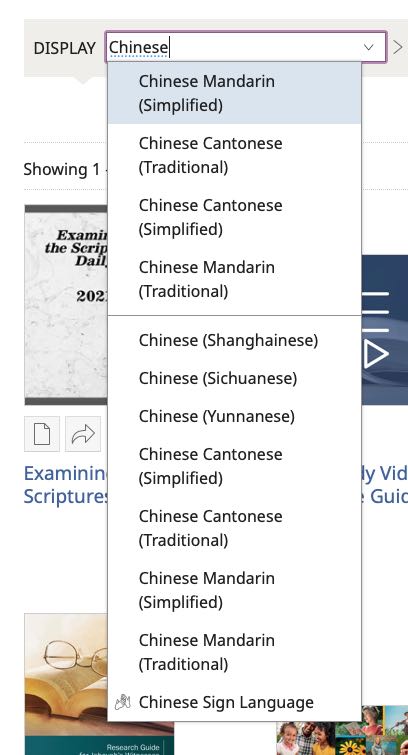
Different kinds of written Chinese on jw.org

Publications are available on jw.org in writing based on different Chinese languages, to better match how people actually talk in those languages.
Categories
Culture History Language Learning

Zhùyīn

Zhùyīn (Zhù·yīn {Annotating of} · Sounds → [Zhuyin] 注音 註/注音) 👈🏼 Tap/click to show/hide the “flashcard”

The last imperial dynasty of China was the Qing dynasty. We call it the last dynasty, though, because it ended, and it was not followed by another dynasty. Towards the end of the Qing dynasty’s rule, China was in a bad way. Wikipedia provides this summary of the situation:

The dynasty reached its high point in the late 18th century, then gradually declined in the face of challenges from abroad, internal revolts, population growth, disruption of the economy, corruption, and the reluctance of ruling elites to change their mindsets.

One of the ways in which some sought to help with the deteriorating situation in China is described by American linguist, sinologist, author of Chinese language textbooks, lexicographer of Chinese dictionaries, and Professor Emeritus of Chinese Studies at the University of Hawaiʻi at Mānoa John DeFrancis, in his book The Chinese Language: Fact and Fantasy:

…toward the end of the nineteenth century…The obvious disintegration of Chinese society and the inability to cope with foreign aggressors led some reformers in contact with missionaries to conceive of carrying out a reform of the writing as part of a general educational reform that would help revitalize the country and save it from extinction.1

Professor DeFrancis goes on the describe the development and naming of an early result of the efforts of these reformers:

Official resolution of these issues was effected by the decisions reached by the Conference on Unification of Pronunciation that was held under government auspices in 1913. …The majority members of the conference reached the decision to adopt a set of thirty-nine phonetic symbols derived from Chinese characters, to use them as an adjunct to the characters, and to confine their scope to representing the Mandarin pronunciation as the national standard. The symbols were initially called Zhùyīn Zìmǔ (“Phonetic Alphabet”); later they were also called Guóyīn Zìmǔ (“National Phonetic Alphabet”). The fear that they might be considered an alphabetic system of writing independent of characters led in 1930 to their being renamed Zhùyīn Fúhào (“Phonetic Symbols”).2

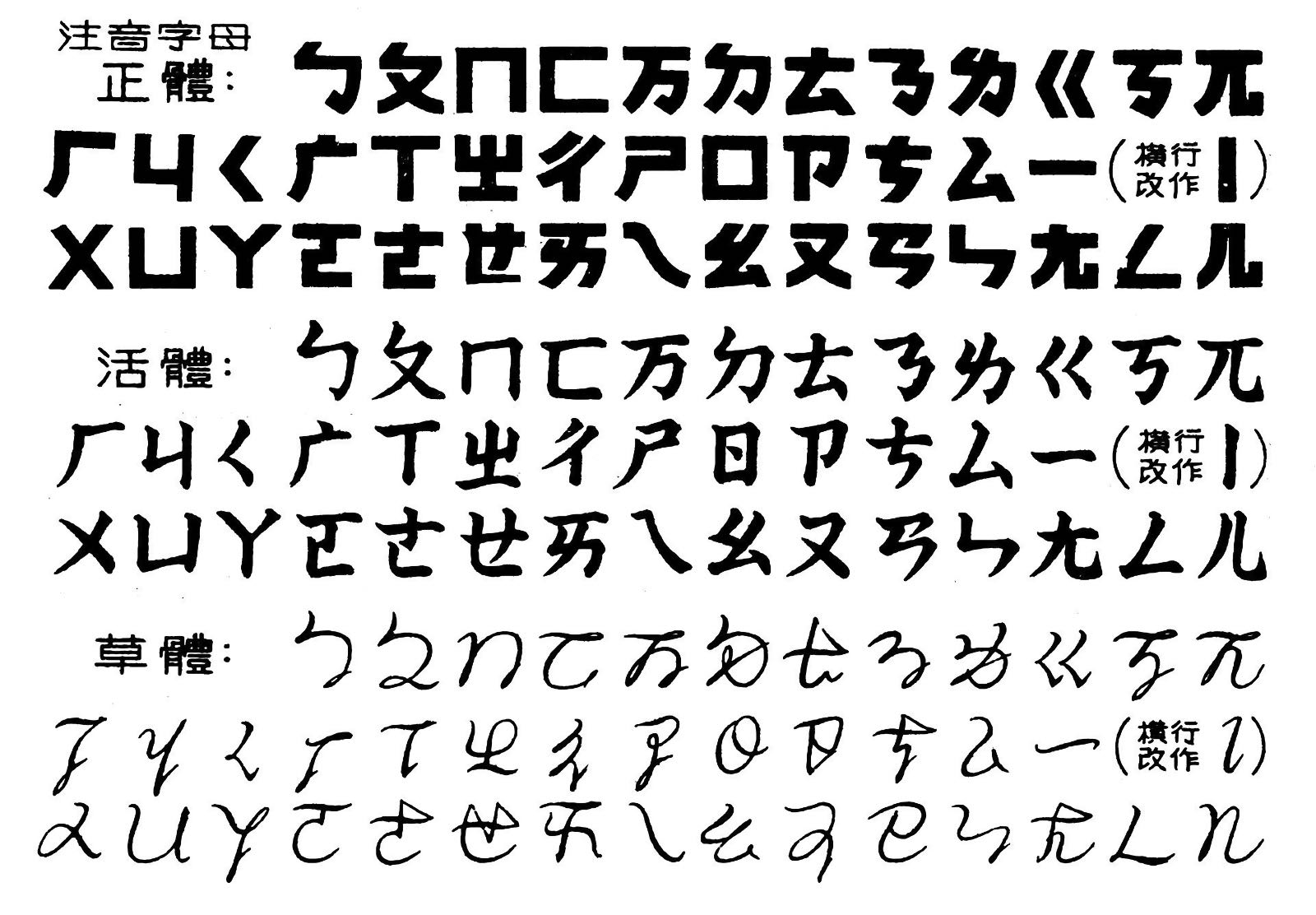
Bopomofo in Regular, Handwritten Regular, & Cursive formats

Zhùyīn (Zhù·yīn {Annotating of} · Sounds → [Zhuyin] 注音 註/注音), or Bopomofo, in regular, handwritten regular, and cursive formats

This week’s MEotW, “Zhùyīn (Zhù·yīn {Annotating of} · Sounds → [Zhuyin] 注音 註/注音)”, is a commonly used name for this system. It’s also commonly called “Bopomofo (ㄅㄆㄇㄈ)”, after the first four symbols of the system. This is similar to how in English we use “ABCs” to refer to the alphabet, and to how the word “alphabet” itself comes from alpha and bēta, the first two letters of the Greek alphabet.

The Zhùyīn (Zhù·yīn {Annotating of} · Sounds → [Zhuyin] 注音 註/注音) system continues to be used in elementary schools in Taiwan for teaching reading and writing, with the system’s symbols often appearing as ruby characters over Chinese characters in textbooks.

Zhùyīn (Zhù·yīn {Annotating of} · Sounds → [Zhuyin] 注音 註/注音) / Pīnyīn (Pīn·yīn {Piecing Together of} · Sounds → [Pinyin] 拼音)

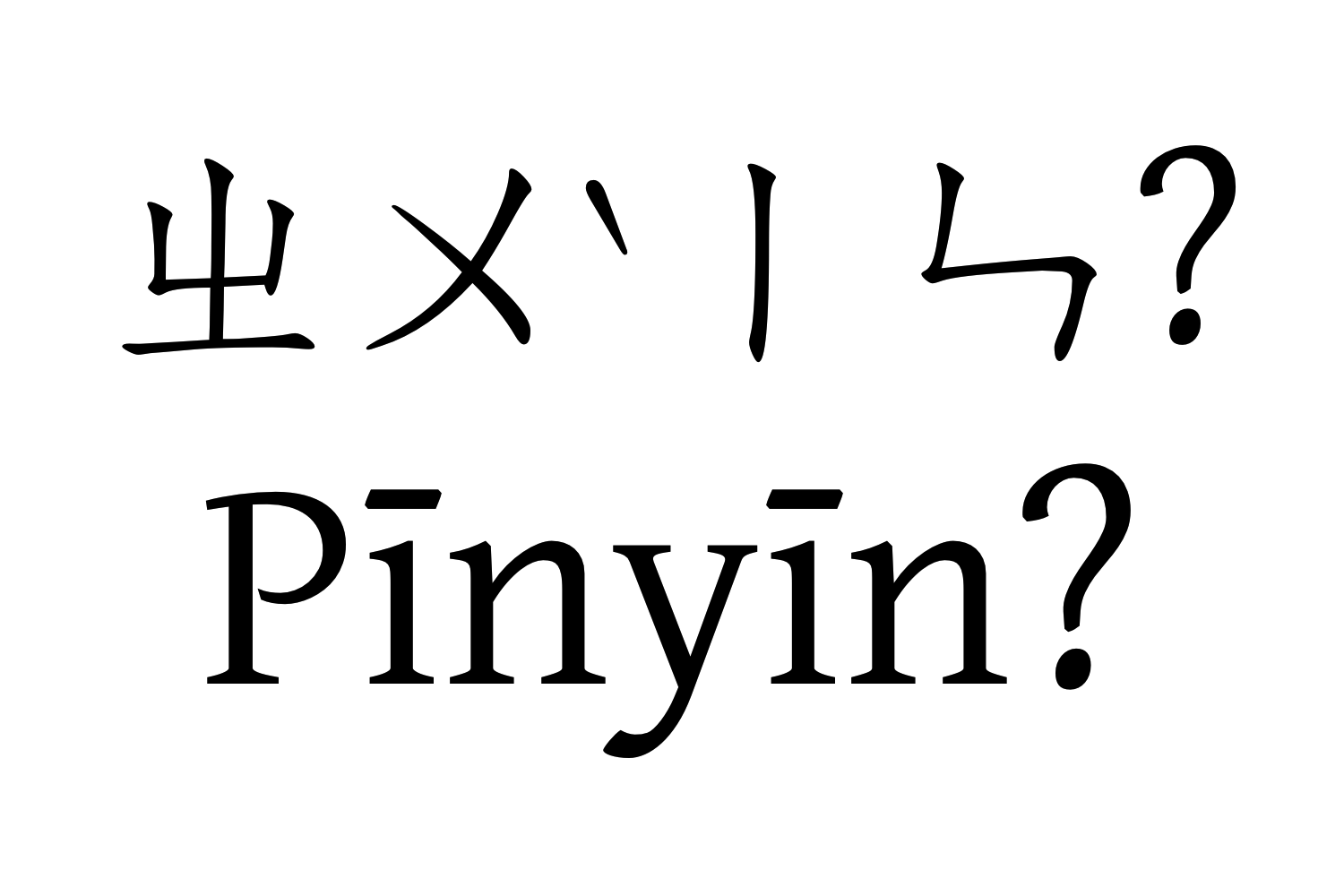
ㄓㄨ`ㄧㄣ? Pīnyīn?

In mainland China, Zhùyīn (Zhù·yīn {Annotating of} · Sounds → [Zhuyin] 注音 註/注音) has largely been replaced by Pīnyīn (Pīn·yīn {Piecing Together of} · Sounds → [Pinyin] 拼音), which was adopted by the mainland Chinese government in 1958. This was possible because Zhùyīn (Zhù·yīn {Annotating of} · Sounds → [Zhuyin] 注音 註/注音) and Pīnyīn (Pīn·yīn {Piecing Together of} · Sounds → [Pinyin] 拼音) both do the same job of representing in alphabetic writing the sounds of Mandarin speech—they just use different symbols.

Around the time that Pīnyīn (Pīn·yīn {Piecing Together of} · Sounds → [Pinyin] 拼音) was introduced, Premier of the People’s Republic of China Zhōu Ēnlái ((Zhōu {Circumference (surname)}周/週) (Ēn·lái Kindness · Comes 恩来 恩來) (the first Premier of the People’s Republic of China)) wrote the following comparing the different practical effects of using these different sets of symbols:

Although [Zhùyīn (Zhù·yīn {Annotating of} · Sounds → [Zhuyin] 注音 註/注音)] has been in existence for forty years and was popularized in primary schools by governments in the past, it has been forgotten by most of its students. Now only a few people know the phonetic transcript. In future, we shall adopt the Latin alphabet for the Chinese phonetic alphabet. Being in wide use in scientific and technological fields and in constant day-to-day usage, it will be easily remembered.

Some Mandarin field language learners prefer not to use the Latin alphabet-based Pīnyīn (Pīn·yīn {Piecing Together of} · Sounds → [Pinyin] 拼音) system, claiming that it makes them think of English sounds rather than Mandarin sounds. Perhaps those who feel this way could instead get the benefits of a phonetic alphabet by using Zhùyīn (Zhù·yīn {Annotating of} · Sounds → [Zhuyin] 注音 註/注音). However, they would first have to learn and remember the rarely-used symbols of Zhùyīn (Zhù·yīn {Annotating of} · Sounds → [Zhuyin] 注音 註/注音), which for almost everyone these days is going to be significantly harder than remembering the familiar Latin alphabet letters of Pīnyīn (Pīn·yīn {Piecing Together of} · Sounds → [Pinyin] 拼音).

Regarding associating language sounds with a writing system (which both Zhùyīn (Zhù·yīn {Annotating of} · Sounds → [Zhuyin] 注音 註/注音) and Pīnyīn (Pīn·yīn {Piecing Together of} · Sounds → [Pinyin] 拼音) qualify as), once a Mandarin learner passes the very beginning stage and gets familiar with Mandarin sounds and gets used to the Pīnyīn (Pīn·yīn {Piecing Together of} · Sounds → [Pinyin] 拼音) system, he or she will actually have no more problem associating Pīnyīn (Pīn·yīn {Piecing Together of} · Sounds → [Pinyin] 拼音) with Mandarin sounds than an English-speaking non-beginner student of French has associating French words with French sounds.

For more information on how Zhùyīn (Zhù·yīn {Annotating of} · Sounds → [Zhuyin] 注音 註/注音) compares to Pīnyīn (Pīn·yīn {Piecing Together of} · Sounds → [Pinyin] 拼音) for Mandarin field language learners, please see the tiandi.info post “Pinyin and Zhuyin”. (If you need login information for the parts of tiandi.info that require it, request it by email, and include information on who referred you and/or what group/cong. you are in.)

1. John DeFrancis, The Chinese Language: Fact and Fantasy (Honolulu: University of Hawaii Press, 1984), p. 241. ^

2. Ibid., p. 242. ^

Categories
Culture History Language Learning Names Technology

fántǐ‐zì

fántǐ (fán·tǐ complicated; complex; difficult · {body → [style] → [typeface; font]} → [traditional Chinese] 繁体 繁體) (characters 字) 👈🏼 Tap/click to show/hide the “flashcard”

For a long, long, long time, Chinese characters were just Chinese characters. Then, in 1956, the Communist government of mainland China issued what came to be known as the First Chinese Character Simplification Scheme (a second round of Chinese character simplification was later attempted and ultimately rescinded), and official simplified Chinese characters came into the world. (Some characters had been unofficially simplified and used for various purposes, both everyday and artistic, before that.)

Name?

To distinguish these newfangled official simplified Chinese characters from the Chinese characters that had existed before, and that continue to be used by many people in many parts of the world, retronyms were coined to refer to these pre-existing Chinese characters, just as the term “acoustic guitar” was coined to refer to a regular non-electric guitar after electric guitars came along.

In the English-speaking world, the pre-official simplification characters have come to be called “traditional Chinese characters”, as opposed to the “simplified Chinese characters”. In the Chinese-speaking world, as is true of many things regarding Chinese characters, the situation is…complicated. Wikipedia summarizes the situation thusly:

Traditional Chinese characters (the standard characters) are called several different names within the Chinese-speaking world. The government of Taiwan officially calls traditional Chinese characters standard characters or orthodox characters (traditional Chinese: 正體字; simplified Chinese: 正体字; pinyin: zhèngtǐzì; Zhuyin Fuhao: ㄓㄥˋ ㄊㄧˇ ㄗˋ).[source] However, the same term is used outside Taiwan to distinguish standard, simplified and traditional characters from variant and idiomatic characters.[source]

In contrast, users of traditional characters outside Taiwan, such as those in Hong Kong, Macau and overseas Chinese communities, and also users of simplified Chinese characters, call them complex characters (traditional Chinese: 繁體字; simplified Chinese: 繁体字; pinyin: fántǐzì; Zhuyin Fuhao: ㄈㄢˊ ㄊㄧˇ ㄗˋ). Users of simplified characters sometimes informally refer to them as “old characters” (Chinese: 老字; pinyin: lǎozì; Zhuyin Fuhao: ㄌㄠˇ ㄗˋ).

Users of traditional characters also sometimes call them “full Chinese characters” (traditional Chinese: 全體字; simplified Chinese: 全体字; pinyin: quántǐ zì; Zhuyin Fuhao: ㄑㄩㄢˊ ㄊㄧˇ ㄗˋ) to distinguish them from simplified Chinese characters.

In my experience in the Chinese fields in Canada, I have always heard traditional Chinese characters referred to using this week’s MEotW, “fántǐ (fán·tǐ complicated; complex; difficult · {body → [style] → [typeface; font]} → [traditional Chinese] 繁体 繁體) (characters 字)”. For reference, this is also the term used on jw.org when referring to Mandarin written using traditional Chinese characters:

jw.org referring to Mandarin written using traditional Chinese characters

jw.org refers to traditional Chinese characters as “fántǐ (fán·tǐ complicated; complex; difficult · {body → [style] → [typeface; font]} → [traditional Chinese] 繁体 繁體)” characters.

Beloved by Traditionalists and Purists, But Complicated

Many feel that traditional characters are the best characters of all, since, in their estimation, the official simplified characters have lost some of the heart and soul of characters. As a symbolic example, some point to how the simplified character for “love”, “爱”, omits the “heart” radical (“心”), which is appropriately in the traditional character for “love”, “愛”.

Yes, as the above post mentions, the obvious, glaring issue with traditional characters is—aggravated by the fact that there are tens of thousands of them—their extreme, extraordinary complexity, the result of their problematically complex basic nature, along with thousands of years of accumulated occasionally arbitrary design decisions and developmental cruft. For example, note the below excerpt from p. 82 of the book The Chinese Language: Fact and Fantasy, by John DeFrancis:

In the case of the rendition for the huáng meaning “sturgeon” we have two variants, one written with the “yellow” phonetic and the other with the “emperor” phonetic, both combined with the semantic element for “fish”:

魚 “fish”
鱑 “fish” + huáng “yellow” = huáng “sturgeon”
鰉 “fish” + huáng “emperor” = huáng “sturgeon”

While etymological research might succeed in clarifying the basis for some of the variation, in many cases, as one specialist in Chinese paleography concludes, “it is simply a matter of the whim of the writer” (Barnard 1978:203).

Scribal whim goes far to explain a diversity bordering on chaos in the forms of the Chinese characters as they evolved in the Shang dynasty and during the long years of political and administrative disunity in the Zhou dynasty (ca. 1028–221 B.C.). The situation was aggravated by the fact that characters were created by writers living in different historical periods, which inevitably meant changes in sounds over the years, and speaking different dialects, which inevitably affected their choice of phonetic elements in the creation of new characters.

Their inherent extraordinary complexity, exacerbated by an accumulated millennia-long history of design decisions made on a whim, out-of-date phonetic elements, etc., causes especially the traditional characters, and even the (moderately) simplified characters, to be extremely difficult for us imperfect humans to learn and to remember. This has lead to character amnesia and the Great Wall of unfamiliar characters being real things, even among those who have been studying characters for decades. How complex can traditional characters get? Theoretically, there is no upper limit!

The extreme, extraordinary complexity of traditional characters undoubtedly contributed greatly to illiteracy having been widespread in China for much of its history. Even for those who are privileged to be able to devote the extraordinary amount of time and effort needed to learn traditional characters, it’s a long, hard slog, compared to learning a comparatively simple and compact alphabetical writing system. It’s little wonder, then, that there have been serious, concerted efforts to simplify and even replace traditional Chinese characters.