Categories
Culture Theocratic

liánmǐn

liánmǐn ({sympathizing with}; pitying [→ [having compassion; mercy]] 怜悯/闵/愍 憐憫/閔/愍) ← Tap/click to show/hide the “flashcard”

Appendix A2 of the English New World Translation of the Holy Scriptures (Study Edition), entitled “Features of This Revision”, discusses vocabulary changes that have been made in the current revision, words that have been translated differently than before. As noted in various entries in the excellent resource Referenced Theo. Expressions (RTE), Appendix A2 of the current Mandarin version of the New World Translation Bible (nwtsty) correspondingly discusses words that have been translated differently in the current revision of the Mandarin NWT Bible, compared to how they had been translated before.

Since we base what we say in Jehovah’s service on his Word the Bible, the vocabulary used in it—and the way those vocabulary words are translated—should be reflected in how we speak in our ministry, at our meetings, etc. So, it is beneficial for us Mandarin field language learners to be familiar with the latest thinking from the organization on how Bible terms should be translated into Mandarin.

A Different Mandarin “Merciful”

As Appendix A2 of the current Mandarin version of the New World Translation Bible (nwtsty) points out, this current version builds on the previous version’s efforts to avoid expressions that could easily be associated with false religious concepts.

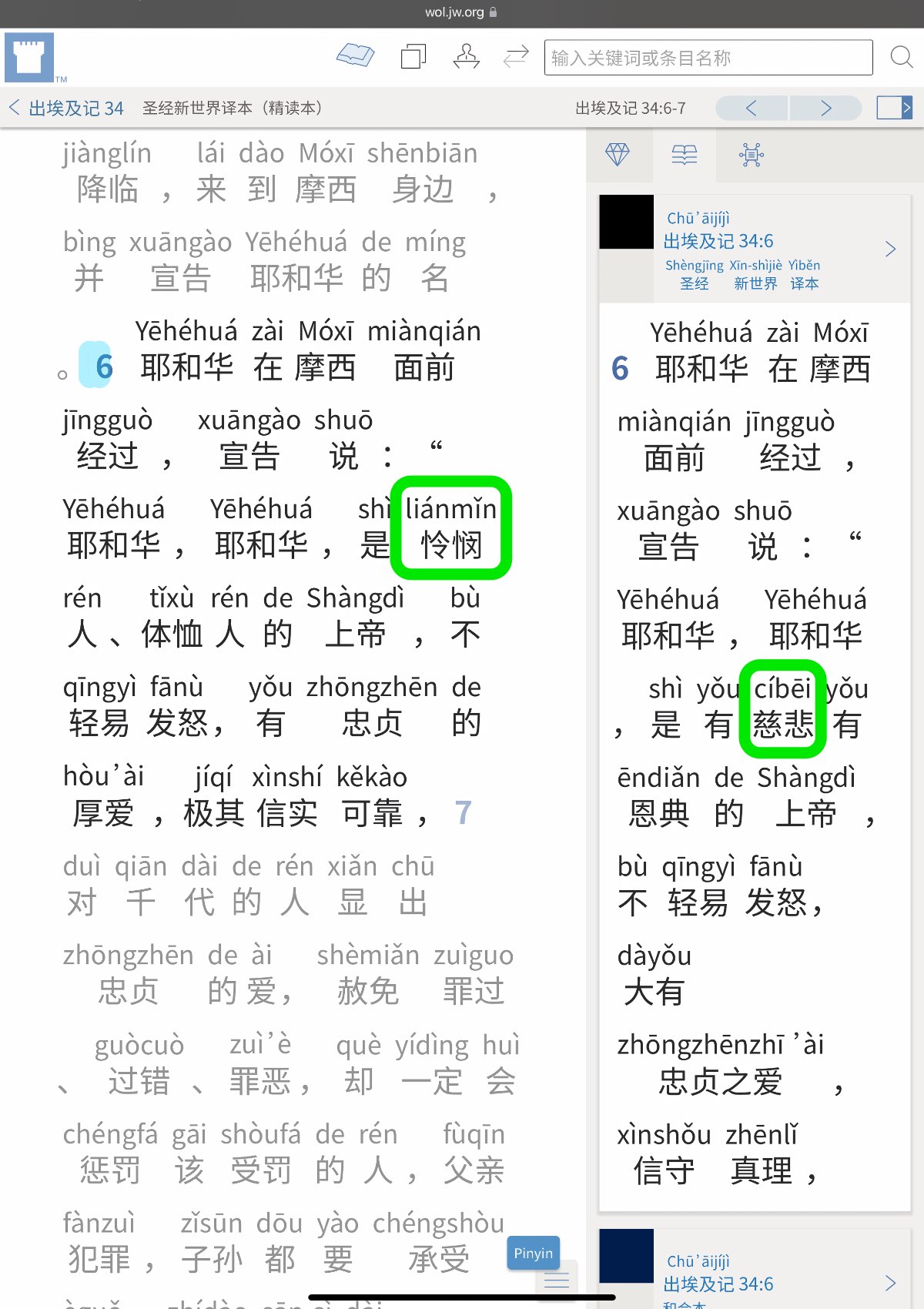
The first example that it points to is that in scriptures such as Exodus 34:6 (English, Mandarin), “cíbēi (cí·bēi {[is] kind} · {[is] compassionate} → [[is] merciful | mercy; benevolence; pity] 慈悲)” has been changed to “liánmǐn ({sympathizing with}; pitying [→ [having compassion; mercy]] 怜悯/闵/愍 憐憫/閔/愍)”:

Exodus 34:6 (WOL CHS+Pinyin Parallel Translations)

Not What We Mean

So, what’s the deal with “cíbēi (cí·bēi {[is] kind} · {[is] compassionate} → [[is] merciful | mercy; benevolence; pity] 慈悲)”? The entries for “cíbēi (cí·bēi {[is] kind} · {[is] compassionate} → [[is] merciful | mercy; benevolence; pity] 慈悲)” in a couple of the dictionaries that are available to be installed in the Pleco app give us some clues. First, consider the entry for this expression in the Referenced Theo. Expressions (RTE) Chinese-English dictionary:

mercy (old translation); Insight article heading in Watchtower Library 2011 CHS. NWT-2019’s Appendix A2 notes 慈悲 changed to 怜悯 to avoid conveying false-religious concepts (in this case perhaps the Buddhist/Jain concept of “karuna” which can be written 慈悲, although that is not stated)

In partial confirmation, Pleco’s own CC-Canto dictionary says this about “cíbēi (cí·bēi {[is] kind} · {[is] compassionate} → [[is] merciful | mercy; benevolence; pity] 慈悲)”:

(noun) (of Buddhism) Karuṇā

For reference, Wikipedia provides these summaries regarding Karuṇā:

Karuṇā (Sanskrit: करुणा) is generally translated as compassion or mercy and sometimes as self-compassion or spiritual longing. It is a significant spiritual concept in the Indic religions of Hinduism, Buddhism, Sikhism, and Jainism.

Karuṇā is important in all schools of Buddhism. For Theravada Buddhists, dwelling in karuṇā is a means for attaining a happy present life and heavenly rebirth. For Mahāyāna Buddhists, karuṇā is a co-requisite for becoming a Bodhisattva.

Karuṇā is associated with the Jain practice of compassion.

Indeed, we definitely would not want people to think we mean any of the above when we talk about the mercifulness of the true God Jehovah!

Categories
Culture History Theocratic

xīshēng

xīshēng (xī·shēng {sacrifice (n or v) | sacrificial} · {[(as with a)] domestic animal} → [sacrifice] 牺牲 犧牲) ← Tap/click to show/hide the “flashcard”

As the war Ukraine rages on, time marches on, and this year’s Memorial season is now upon us. As of this writing, the home page of jw.org now features a page inviting people to this year’s Memorial. Appearing in the title of the Mandarin version of that page is this week’s MEotW, “xīshēng (xī·shēng {sacrifice (n or v) | sacrificial} · {[(as with a)] domestic animal} → [sacrifice] 牺牲 犧牲)”, which effectively means “sacrifice”.

Note that while the “shēng ({domestic animal}; {sacrificial animal}; livestock 牲)” part of “xīshēng (xī·shēng {sacrifice (n or v) | sacrificial} · {[(as with a)] domestic animal} → [sacrifice] 牺牲 犧牲)” sounds like the word for “life”, and while Jesus did indeed give his life for us, in this case the “shēng ({domestic animal}; {sacrificial animal}; livestock 牲)” used literally means “domestic animal”. When applied to Jesus’ sacrifice, we can take the “shēng ({domestic animal}; {sacrificial animal}; livestock 牲)” part of “xīshēng (xī·shēng {sacrifice (n or v) | sacrificial} · {[(as with a)] domestic animal} → [sacrifice] 牺牲 犧牲)” to effectively mean “(as with a) domestic animal”. It’s understandable that this particular morpheme is used in “xīshēng (xī·shēng {sacrifice (n or v) | sacrificial} · {[(as with a)] domestic animal} → [sacrifice] 牺牲 犧牲)”, since domestic animals were commonly used in sacrifices in ancient China, as they were in ancient Israel.

(It’s interesting to note, though, that an Internet search for “ancient China sacrifices” will turn up many references to human sacrifices in ancient China, as there were in ancient Canaan—let us be careful not to think more highly of worldly Chinese history and culture than they actually deserve!)

Referring to the Memorial in Mandarin

By comparing the English and Mandarin versions of the page on jw.org as of this writing inviting people to the Memorial, we can see that the organization is now translating “Memorial of Jesus’ Death” into Mandarin as “Yēsū (Jesus’ 耶稣 耶穌) Xīshēng (Xī·shēng {Sacrifice (n)} · {(as with a) Domestic Animal} → [Sacrifice] 牺牲 犧牲) Jìniàn Jùhuì ((Jì·niàn Remembering · {Thinking Of} → [Commemorating] 记/纪念 記/紀念) (Jùhuì Meeting 聚会 聚會) [Memorial])”. This is in contrast to the past rendering “Yēsū (Jesus’ 耶稣 耶穌) Shòunàn (Shòu·nàn {Being Subjected to → [Suffering of]} · Calamity 受难 受難)Jìniàn (Jì·niàn Remembering · {Thinking of} → [Commemorating] 记/纪念 記/紀念) Jùhuì (Meeting 聚会 聚會)” (km 2/2011) that the excellent resource Referenced Theo. Expressions (RTE) tells us about. (It also tells us about the current rendering, memtioned above.) For the Memorial, it does seem more relevant to emphasize Jesus’ sacrifice (“xīshēng (xī·shēng sacrifice (n)} · {(as with a) domestic animal} → [sacrifice] 牺牲 犧牲)”) itself, as opposed to the suffering (“shòunàn (shòu·nàn {being subjected to → [suffering of]} · calamity 受难 受難)”) that he had to endure in the process of offering it.

Categories
Theocratic

yùyán

yùyán (yù·yán {in advance} · say[ing] → [prophecy | prophesy] 预言 預言) ← Tap/click to show/hide the “flashcard”

Appendix A2 of the English New World Translation of the Holy Scriptures (Study Edition), entitled “Features of This Revision”, discusses vocabulary changes that have been made in the current revision, words that have been translated differently than before. As noted in various entries in the excellent resource Referenced Theo. Expressions (RTE), Appendix A2 of the current Mandarin version of the New World Translation Bible (nwtsty) correspondingly discusses words that have been translated differently in the current revision of the Mandarin NWT Bible, compared to how they had been translated before.

Since we base what we say in Jehovah’s service on his Word the Bible, the vocabulary used in it—and the way those vocabulary words are translated—should be reflected in how we speak in our ministry, at our meetings, etc. So, it is beneficial for us Mandarin field language learners to be familiar with the latest thinking from the organization on how Bible terms should be translated into Mandarin.

The Many Meanings of “Prophecy”

When we hear the word “prophecy”, we probably generally think of foretelling of the future. Indeed, in the past, we in the Mandarin field generally used this week’s MEotW, “yùyán (yù·yán {in advance} · say[ing] → [prophecy | prophesy] 预言 預言)”, which literally means “in advance saying”, to translate “prophecy”. However, foretelling of the future is actually only one of several meanings that the English word “prophecy” is used to represent, as explained in the Insight book entry on “Prophecy”:

PROPHECY

An inspired message; a revelation of divine will and purpose or the proclamation thereof. Prophecy may be an inspired moral teaching, an expression of a divine command or judgment, or a declaration of something to come. Prediction, or foretelling, is not the basic thought conveyed by the root verbs in the original languages (Heb., na·vaʼʹ; Gr., pro·phe·teuʹo); yet it forms an outstanding feature of Bible prophecy.

Since there is such a mismatch between “yùyán (yù·yán {in advance} · say[ing] → [prophecy | prophesy] 预言 預言)” and the possible meanings of “prophecy” that do not involve the future, “yùyán (yù·yán {in advance} · say[ing] → [prophecy | prophesy] 预言 預言)” has often been the cause of misunderstandings. So, depending on the context, the current Mandarin version of the New World Translation Bible (nwtsty) will sometimes use other expressions where previous versions used “yùyán (yù·yán {in advance} · say[ing] → [prophecy | prophesy] 预言 預言)”.

Mandarin “Prophecy” Now and Then

For example, in Romans 12:6, where previously the Mandarin NWT Bible used “yùyán (yù·yán {in advance} · sayings → [prophecies] 预言 預言)”, the current version uses “Shàngdì (Shàng·dì Above’s · {Emperor → [God]} → [God] 上帝) de (’s 的) xìnxī (xìn·xī {letters → [messages]} · news → [messages] 信息)”:

Romans 12:6 (WOL CHS+Pinyin Parallel Translations)

Another example can be found at 1 Corinthians 12:10, which now uses “shòu (receiving 受) Shàngdì (Shàng·dì Above’s · {Emperor → [God]} → [God] 上帝) qǐshì (qǐ·shì {opening → [enlightening]} · showing → [revealing] 启示 啟示) fāyán (fā·yán {issuing forth} · speech → [speaking] 发言 發言)” instead of “shuō ({to speak}說/説) yùyán (yù·yán {in advance} · sayings → [prophecies] 预言 預言)”:

1 Corinthians 12:10 (WOL CHS+Pinyin Parallel Translations)

(And yes, that is indeed the “qǐshì (qǐ·shì {opening → [enlightening]} · showing → [revealing] 启示 啟示)” that’s in “Qǐshìlù (Qǐ·shì·lù {Opening → [Enlightening]} · Showing · Record → [Revelation] 启示录 啟示錄)”.)

Of course, the Bible does indeed often speak of foretelling of the future, so in scriptures like Ezekiel 38:14, the current Mandarin NWT Bible continues to use “yùyán (yù·yán {in advance} · say[ing] → [prophecy | prophesy] 预言 預言)”.