Categories
Culture Current Events History

zhōunián

zhōunián (zhōu·nián {circle → [whole; cycle] of} · year → [anniversary] 周年 周/週年) ← Tap/click to show/hide the “flashcard”

[Notes: Tap/click on a Pīnyīn (Pīn·yīn {Piecing Together} · Sounds → [Pinyin] 拼音) expression to reveal its “flashcard”; tap/click on a “flashcard” or its Pīnyīn (Pīn·yīn {Piecing Together} · Sounds → [Pinyin] 拼音) expression to hide the “flashcard”. 📖 📄 📘 icons mean 📖 Reveal All, 📄 Reveal Advanced, and 📘 Reveal None re all the “flashcards” in the heading, paragraph, etc. that they are placed at the beginning of.]

February 24, 2023, a few days before the date of this post, was the one year anniversary of Russia’s sending of significant military forces into Ukraine, resulting in the largest scale open warfare in Europe since World War II. So, as of this writing jw.org is featuring the article “Ukraine War Enters Second Year—What Hope Does the Bible Offer?”, and this week’s MEotW is “zhōunián (zhōu·nián {circle → [whole; cycle] of} · year → [anniversary] 周年 周/週年)”, the Mandarin word used in the Mandarin version of that article to translate the sense of “anniversary”.

Circles

Zhōunián (Zhōu·nián {circle → [whole; cycle] of} · year → [anniversary] 周年 周/週年)” literally means “circle (or whole; cycle) of a year”, and can be thought of as a year having gone full circle. Another use of the “zhōu (circumference; circle; ring; periphery [→ [whole; cycle] [→ [week]]] | {to circle; to make a circuit}周/週)” in “zhōunián (zhōu·nián {circle → [whole; cycle] of} · year → [anniversary] 周年 周/週年)”, that also involves circles/cycles and time, is to mean “week”. Extending from that, “Zhōu’èr (Zhōu’·èr {Circle → [Cycle] → [Week(day)]} · Two → [Tuesday] 周二 周/週二)” means “Week(day) Two”, or “Tuesday”.

Note, though, that in this pattern, “Sunday” is notZhōuqī (Zhōu·qī {Circle → [Week(day)]} · Seven → [not used to mean “Sunday”] 周七 周/週七)”, but rather, “Zhōurì (Zhōu·rì {Circle → [Cycle] → [Week]} · {Sun → [Day]} → [Sunday] 周日 周/週日)”. Note also that regarding “Zhōurì (Zhōu·rì {Circle → [Cycle] → [Week]} · {Sun → [Day]} → [Sunday | weekday] 周日 周/週日)”, the excellent resource Referenced Theo. Expressions (RTE) says:

weekday; Sunday; Apparently 周日 can mean either “weekday” or “Sunday”; it was used in w07 7/1 p.17 to mean “Sunday” (周六和周日 “Saturday and Sunday”; the Traditional version of wtl07 uses the variant 週 for 周) but in w95 7/15 p.29 and w93 11/1 p.31 it was used to translate “weekday” (i.e. non-Sabbath day in Israel), and g02 4/8 p.7 (5/8 in zh) uses 在周日 to translate “during the workweek”.

In addition to “Zhōurì (Zhōu·rì {Circle → [Cycle] → [Week]} · {Sun → [Day]} → [Sunday] 周日 周/週日)”, Mandarin dictionaries also list several other ways to say “Sunday”, some of which originated from Catholicism.

Not Regular Joes

The “zhōu (circumference; circle; ring; periphery [→ [whole; cycle] [→ [week]]] | {to circle; to make a circuit}周/週)” in “zhōunián (zhōu·nián {circle → [whole; cycle] of} · year → [anniversary] 周年 周/週年)” is also used as a surname. For example, for hundreds of years, China was ruled by the Zhōu ({Circumference; Circle (surname)}周/週) dynasty.

A famous Zhōu ({Circumference; Circle (surname)}周/週) of more recent times was Zhōu Ēnlái ((Zhōu {Circumference; Circle (surname)}周/週) (Ēn·lái Kindness · Comes 恩来 恩來) (the first Premier of the People’s Republic of China)) (Wikipedia article), the first Premier of the People’s Republic of China, who served from October 1, 1949 until his death on January 8, 1976. An English translation of an interesting speech he gave in 1958 regarding some of the tasks that the PRC government faced relating to reforming the written language—such as simplification of the characters, popularization of pǔtōnghuà (pǔ·tōng·huà common; universal · {through(out) → [common]} · speech → [(Modern Standard) Mandarin (term commonly used in China)] 普通话 普通話), and the creation and implementation of Pīnyīn (Pīn·yīn {Piecing Together} · Sounds → [Pinyin] 拼音)—can be found here, on the Pīnyīn.info website.

Usage Examples

In the above-mentioned jw.org Mandarin article, “zhōunián (zhōu·nián {circle → [whole; cycle] of} · year → [anniversary] 周年 周/週年)” is used as follows:

📖 📄 📘 2023 Nián (Year年/秊) 2 Yuè (Moon → [Month] 月) 24 (Sun → [Day] 日) Xīngqīwǔ (Xīng·qī·wǔ {Star · {Period of Time} → [Week (Day)]} · Five → [Friday] 星期五) shì (is 是) (one 一) ge ([mw]個/个) cǎndàn (cǎn·dàn tragic · tasteless → [dismal] 惨淡 慘淡/澹) de (’s 的) rìzi (rì·zi {sun → [day]} · [suf for nouns] 日子), biāozhìzhe (biāo·zhì·zhe {marking (with)} · mark (that) · being → [marking that] 标志着 標志/誌/識着/著) Wūkèlán (Ukraine 乌克兰 烏克蘭) zhànzhēng (zhàn·zhēng war · contending → [war] 战争 戰爭) mǎn ({had filled}滿) (one 一) zhōunián (zhōu·nián {circle → [cycle] of} · year → [anniversary] 周年 周/週年).

The Pleco app’s built-in dictionary provides these usage examples:

wǔshí zhōunián jìniàn ((wǔ·shí five · tens → [fifty] 五十) (zhōu·nián {circle → [cycle] of} · year → [anniversary] 周年 周/週年) (jì·niàn remembering · {thinking of} → [commemoration] 记/纪念 記/紀念) [golden jubilee])

yìbǎi zhōunián ((yì·bǎi one · hundred 一百) (zhōu·nián {circle → [cycle] of} · year → [anniversary] 周年 周/週年) [centenary])

Will There Be Another Anniversary?

For now, it seems uncertain how much longer Russia and Ukraine will continue to battle for. While many experts, including some Western experts, initially expected Russia might succeed in its initial plan to topple the Ukraine government in a few days, Ukraine has succeeded in holding out, and, with much Western support, has even conducted some successful counteroffensives in the last year. Russia continues to have significant combat power, however, and seems intent on continuing to pursue its goals in this war. Recently, the director of the CIA said the USA believes that China is considering providing lethal aid to Russia, perhaps in the forms of drones and ammunition. Meanwhile, Ukraine remains intent on completely driving out the Russian invaders, and many nations, including many Western nations, continue to provide it with ever more significant military support, now including advanced Western main battle tanks.

Regardless of how long this war may drag on, may we keep our brothers and sisters in the affected areas in our prayers to Jehovah, the only true God and the “God of all comfort”—John 17:3, 2 Corinthians 1:3.

Categories
Culture Theocratic

zuì’è

zuì’è (zuì’·è {crime | sin} · evil 罪恶 罪惡) ← Tap/click to show/hide the “flashcard”

Appendix A2 of the English New World Translation of the Holy Scriptures (Study Edition), entitled “Features of This Revision”, discusses vocabulary changes that have been made in the current revision, words that have been translated differently than before. As noted in various entries in the excellent resource Referenced Theo. Expressions (RTE), Appendix A2 of the current Mandarin version of the New World Translation Bible (nwtsty) correspondingly discusses words that have been translated differently in the current revision of the Mandarin NWT Bible, compared to how they had been translated before.

Since we base what we say in Jehovah’s service on his Word the Bible, the vocabulary used in it—and the way those vocabulary words are translated—should be reflected in how we speak in our ministry, at our meetings, etc. So, it is beneficial for us Mandarin field language learners to be familiar with the latest thinking from the organization on how Bible terms should be translated into Mandarin.

Different “Sins” in Mandarin

As Appendix A2 of the current Mandarin version of the New World Translation Bible (nwtsty) points out, this current version builds on the previous version’s efforts to avoid expressions that could easily be associated with false religious concepts.

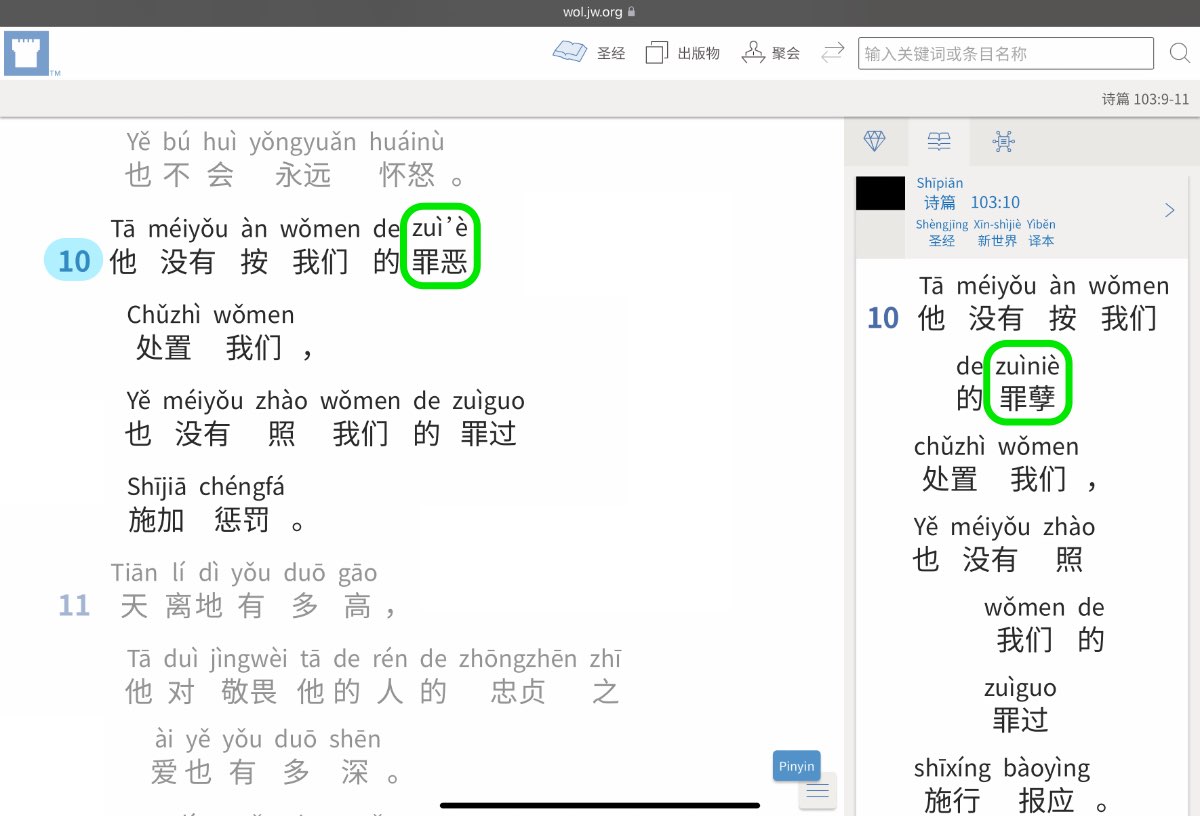
One example that it points to is that in scriptures such as Psalm 103:10 (English, Mandarin), “zuì’è (zuì’·è {crime | sin} · evil 罪恶 罪惡)” is now used instead of “zuìniè (zuì·niè {sin | crime} · evil [→ [wrongdoing that brings retribution]] 罪孽)” to correspond with the word “sins” that is used in the English version:

Psalm 103:10 (WOL CHS+Pinyin Parallel Translations)

A Buddhist Concept?

So, what’s the deal with “zuìniè (zuì·niè {sin | crime} · evil [→ [wrongdoing that brings retribution]] 罪孽)”? A dictionary of Chinese Buddhist terms that is available to be installed in the Pleco app contains an entry for “zuìniè (zuì·niè {sin | crime} · evil [→ [wrongdoing that brings retribution]] 罪孽)”, with the following sparse definition:

Sins, crimes.

Pleco’s own built-in dictionary lists “wrongdoing that brings retribution” as one of the definitions of “zuìniè (zuì·niè {sin | crime} · evil [→ [wrongdoing that brings retribution]] 罪孽)”. If that definition is connected to the Buddhist concept of “zuìniè (zuì·niè {sin | crime} · evil [→ [wrongdoing that brings retribution]] 罪孽)”, then presumably the retribution that “zuìniè (zuì·niè {sin | crime} · evil [→ [wrongdoing that brings retribution]] 罪孽)” supposedly brings is supposedly brought about by humans, or by some abstract force of justice, since Buddhists do not believe in a God who is a Person.

Anyway, if the expression “zuìniè (zuì·niè {sin | crime} · evil [→ [wrongdoing that brings retribution]] 罪孽)” makes some people think of some Buddhist concept, instead of, for example, the sins referred to in Psalm 103:10 that Jehovah God—not some abstract, impersonal force—would be justified to deal out punishment for, then that seems like a good reason not to continue to use that particular expression in the Mandarin version of the NWT Bible.

Categories
Culture Theocratic

chéngfá

chéngfá (punishing; penalizing 惩罚 懲罰) ← Tap/click to show/hide the “flashcard”

Appendix A2 of the English New World Translation of the Holy Scriptures (Study Edition), entitled “Features of This Revision”, discusses vocabulary changes that have been made in the current revision, words that have been translated differently than before. As noted in various entries in the excellent resource Referenced Theo. Expressions (RTE), Appendix A2 of the current Mandarin version of the New World Translation Bible (nwtsty) correspondingly discusses words that have been translated differently in the current revision of the Mandarin NWT Bible, compared to how they had been translated before.

Since we base what we say in Jehovah’s service on his Word the Bible, the vocabulary used in it—and the way those vocabulary words are translated—should be reflected in how we speak in our ministry, at our meetings, etc. So, it is beneficial for us Mandarin field language learners to be familiar with the latest thinking from the organization on how Bible terms should be translated into Mandarin.

‘Punishing’ Differently in Mandarin

As Appendix A2 of the current Mandarin version of the New World Translation Bible (nwtsty) points out, this current version builds on the previous version’s efforts to avoid expressions that could easily be associated with false religious concepts.

One example that it points to is that in scriptures such as Psalm 103:10 (English, Mandarin), “bàoyìng (bào·yìng retribution · responding 报应 報應)” has been changed to “chéngfá (punishing; penalizing 惩罚 懲罰)”:

Psalm 103:10 (WOL CHS+Pinyin Parallel Translations)

Is It Karma?

So, what’s the deal with “bàoyìng (bào·yìng retribution · responding 报应 報應)”? The entries for “bàoyìng (bào·yìng retribution · responding 报应 報應)” in a couple of the dictionaries that are available to be installed in the Pleco app give us some clues. First, consider the entry for this expression in the Referenced Theo. Expressions (RTE) Chinese-English dictionary:

retribution (old translation); Insight article heading in Watchtower Library 2011 CHS. NWT-2019’s Appendix A2 notes 报应 changed to 应得的惩罚 or similar, to avoid conveying false-religious concepts (in this case perhaps the Buddhist concept of karma, see 因果报应, although that is not stated).

In partial confirmation, the CC-CEDICT dictionary contains these definitions for “bàoyìng (bào·yìng retribution · responding 报应 報應)”:

1 (Buddhism) divine retribution
2 karma

For reference, Wikipedia provides this summary regarding karma:

Karma…in Sanskrit means an action, work, or deed, and its effect or consequences.[source] In Indian religions, the term more specifically refers to a principle of cause and effect, often descriptively called the principle of karma, wherein intent and actions of an individual (cause) influence the future of that individual (effect):[source] Good intent and good deeds contribute to good karma and happier rebirths, while bad intent and bad deeds contribute to bad karma and bad rebirths.[source][source]

The concept of karma is closely associated with the idea of rebirth in many schools of Indian religions (particularly Hinduism, Buddhism, Jainism and Sikhism),[source] as well as Taoism.[source] In these schools, karma in the present affects one’s future in the current life, as well as the nature and quality of future lives—one’s saṃsāra.[source][source] This concept has also been adopted in Western popular culture, in which the events which happen after a person’s actions may be considered natural consequences.

Indeed, we definitely would not want people to think that any part of God’s Word the Bible is referring to the false religious concept of karma!