zhēngyì+ (zhēng·yì contending · discussing [→ [dispute; controversy]] 争议 爭議) ← Tap/click to show/hide the “flashcard”
[Notes: Tap/click on a Pīnyīn (Pīn·yīn {Piecing Together of} · Sounds → [Pinyin] 拼音) expression to reveal its “flashcard”; tap/click on a “flashcard” or its Pīnyīn (Pīn·yīn {Piecing Together of} · Sounds → [Pinyin] 拼音) expression to hide the “flashcard”. 📖 📄 ➕ icons mean 📖 Reveal All, 📄 Reveal Advanced, and ➕ Reveal + Symbols re all the “flashcards” in the heading, paragraph, etc. that they are placed at the beginning of.]
The Shēngmìng Láizì Chuàngzào Ma? ((Shēngmìng Life 生命) (Lái·zì Came · From 来自 來自) (Chuàng·zào Initiating · {Making, Creating} → [Creating] 创造 創造) (Ma [? ptcl for “yes/no” questions] 吗 嗎)? → [Was Life Created? (lc)]) (Was Life Created? (lc)) brochure and the Shēngmìng de Qǐyuán—Zhíde Sīkǎo de Wǔ Ge Wèntí ((Shēngmìng Life 生命) (de ’s 的) (Qǐ·yuán {Rising → [Starting]} · Source → [Origin] 起源/原)—(Zhí·de Worth · Getting → [Worth] 值得) (Sī·kǎo {Thinking About} · Examining 思考) (de ’s 的) (Wǔ Five 五) (Ge [mw] 个 個/个) (Wèn·tí Asking · Subjects → [Questions] 问题 問題) → [The Origin of Life—Five Questions Worth Asking (lf)]) (The Origin of Life—Five Questions Worth Asking (lf)) brochure were originally published back in 2010, but recently, the English version of the Was Life Created? brochure was updated to the December 2022 Printing, and the Mandarin version of it was updated to the February 2023 Printing. Also, the Was Life Created? brochure and the Origin of Life brochure are now in the Teaching Toolbox section in the JW Library app. So, it would be good to consider some of the expressions used in the Mandarin versions of these publications that can be so helpful when discussing whether life was created.
Controversy!
This week’s MEotW, which appears in the section of the Mandarin Was Life Created? brochure entitled “Jiǎnjiè+ (Jiǎn·jiè {Simple → [Brief]} · {Being Situated Between → [Introduction]} 简介 簡介)” (“Introduction”), is “zhēngyì (zhēng·yì contending · discussing [→ [dispute; controversy]] 争议 爭議)”:
Was life created, or are you purely the product of random, undirected events? Few questions create more controversy.
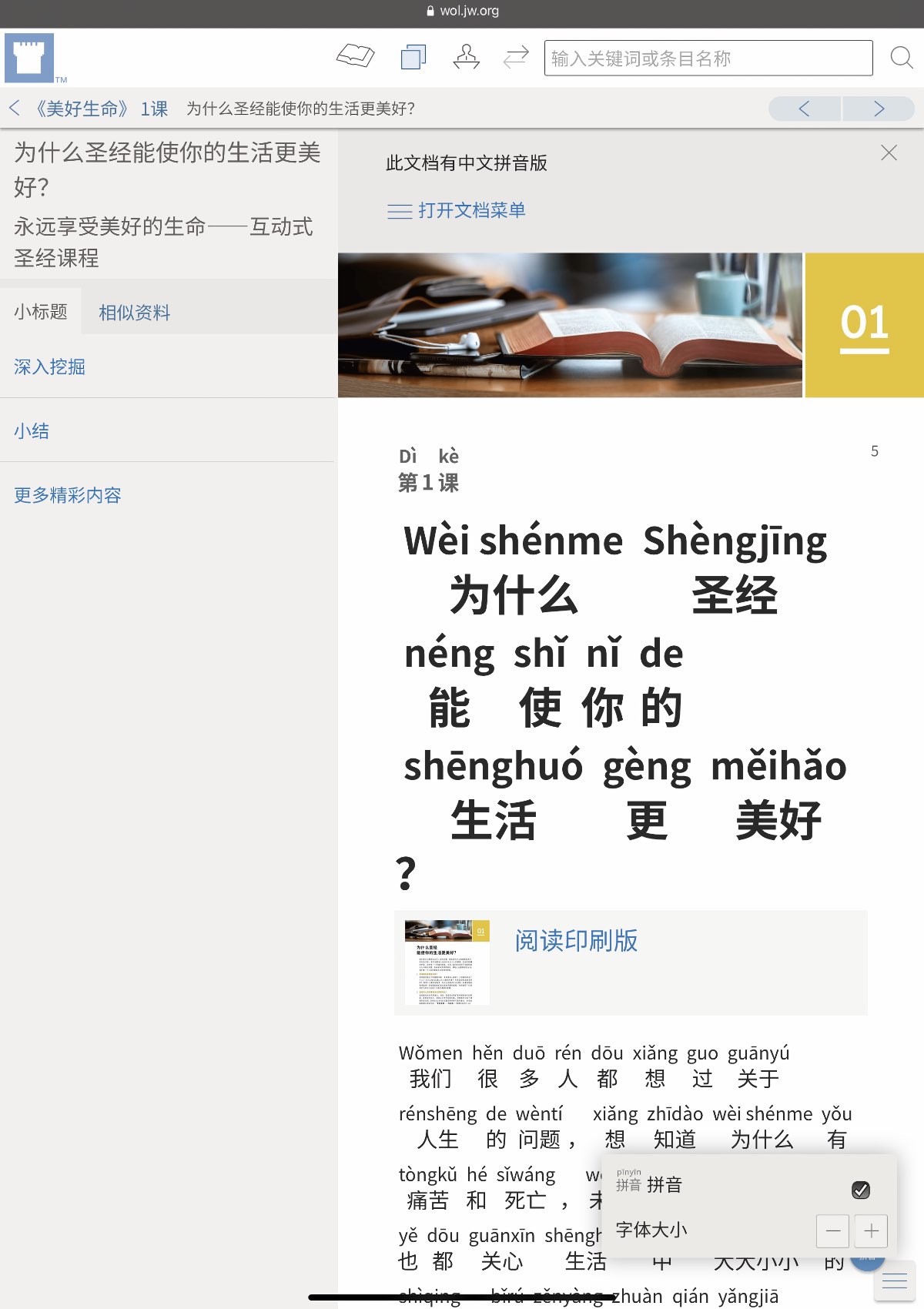
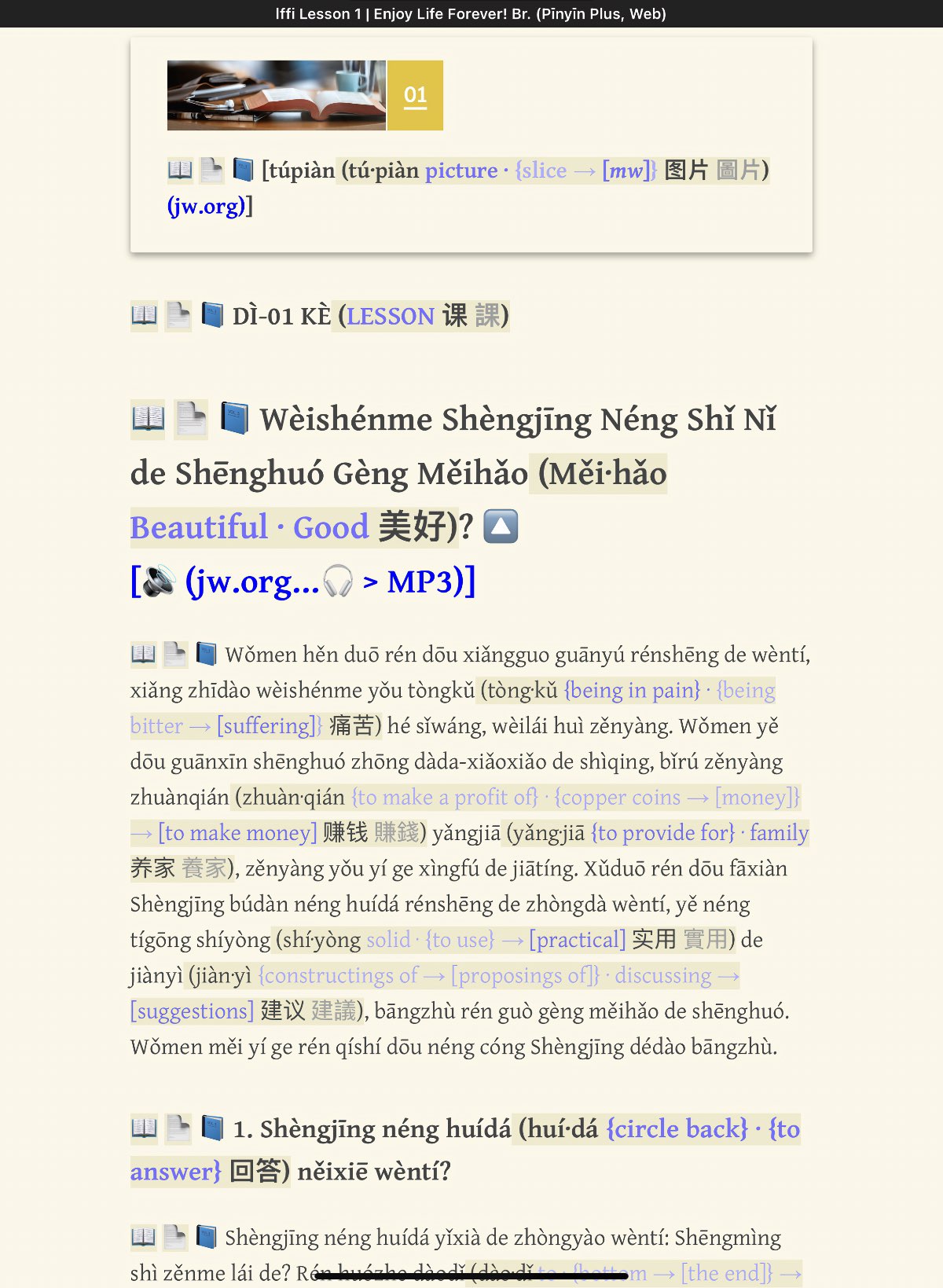
Mandarin (WOL; Pīnyīn (Pīn·yīn {Piecing Together of} · Sounds → [Pinyin] 拼音) Plus)
📖 📄 ➕ Shēngmìng (life 生命) láizì (lái·zì came · from 来自 來自) chuàngzào (chuàng·zào initiating · {making, creating} → [creating] 创造 創造) ma ([? ptcl for “yes/no” questions] 吗 嗎)? Háishi (Hái·shi {still more → [or]} · {is (it a)} 还是 還是) chúncuì+ ({being pure} → [purely] 纯粹 純粹) yóu ({due to} 由/繇) yìxiē (yì·xiē one · {indefinite number of} → [some] 一些) suíjī+ (suí·jī {coming along with} · chance → [random] 随机 隨機), bú (not 不) shòu ({having received} 受) zhǐhuī (zhǐ·huī {(pointing with) finger → [pointing]} · {spraying → [directing]} → [directing] 指挥 指揮) de (’s 的) shìjiàn (shì·jiàn events · [mw] 事件) yǎnshēng+ (yǎn·shēng {having been spilled over} · {having been given birth to} → [having been produced] 衍生) chulai (chu·lai out · {to come} 出来 出來) de ({’s (thing)} 的) ne ([? ptcl] 呢)? Zhèixiē (Zhèi·xiē this · {indefinite number of} → [these] 这些 這些) wèntí (wèn·tí asking · subjects → [questions] 问题 問題) bèishòu (bèi·shòu fully · receive 备受 備受) zhēngyì+ (zhēng·yì contending · discussing → [controversy] 争议 爭議),
As can be seen from the above quotes, the Mandarin Was Life Created? brochure uses “zhēngyì (zhēng·yì contending · discussing [→ [dispute; controversy]] 争议 爭議)” to translate the English word “controversy”.
War!
In “zhēngyì (zhēng·yì contending · discussing [→ [dispute; controversy]] 争议 爭議)”, “zhēng (contend; fight; vie; strive; dispute [→ [argue; debate; ]] 争 爭)” means “contend”, and “yì (discussing; conferring; {exchanging views}; {talking over} [→ [(exchanged) opinion; view]] 议 議)” means “discuss”. Together, they can be understood to mean something like “contentious discussion”, which leads us to the meaning of “controversy” in cases such as its use in the Was Life Created? brochure that is mentioned above.
Interestingly, the “zhēng (contend; fight; vie; strive; dispute [→ [argue; debate; ]] 争 爭)” that’s in “zhēngyì (zhēng·yì contending · discussing [→ [dispute; controversy]] 争议 爭議)” also appears in “zhànzhēng (zhàn·zhēng war · contending → [war; warfare] 战争 戰爭)”, which means “war”. Is it going too far to associate creation vs. evolution discussions with war? Well, for what it’s worth, consider that “Creation–evolution controversy” is listed as a related link on the Wikipedia page for “culture war”.
Culture Wars and Spiritual Warfare
While the expression “culture war” does not seem to appear in the publications of Jehovah’s organization, searching the Watchtower ONLINE LIBRARY (WOL) for “spiritual & (war | warfare)” (not including the quotation marks) returns lots of results. This blog also has a “Spiritual War” tag for posts that touch on this subject. And of course, in 2 Corinthians 10:3–5, the Bible itself explains to us that God’s true worshippers must fight a spiritual war:
For though we walk in the flesh, we do not wage warfare according to what we are in the flesh. For the weapons of our warfare are not fleshly, but powerful by God for overturning strongly entrenched things. For we are overturning reasonings and every lofty thing raised up against the knowledge of God, and we are bringing every thought into captivity to make it obedient to the Christ;
Also, as Jehovah’s Witnesses and Jesus’ true followers, we seek to follow Jesus’ example, as described by Jesus himself at John 18:37:
…For this I have been born, and for this I have come into the world, that I should bear witness to the truth.…
One way we can distinguish between the culture wars of this world and the spiritual warfare that true Christians engage in is that the world’s culture wars involve contentions over human ideas embodied in this world’s human cultures, while true Christian spiritual warfare involves bearing witness to and fighting for God’s truth, “the knowledge of God”. Also, the world’s culture wars often spill over into the political arena, whereas like Christ himself, true Christian spiritual warriors stay out of politics.—John 18:36.
Principled Spiritual Warfare
Since the theory of evolution obviously qualifies as a “lofty thing raised up against the knowledge of God”, it can rightly be said that witnessing to Mandarin-speaking people—many of whom were taught to be atheists—about creation and evolution is an important part of fighting on the Mandarin front of the spiritual war that true Christians are involved in. Of course, though, it’s not true that “all’s fair in love and war”. Even the world has its law of war, and as true Christians, we fight our spiritual war in harmony with the counsel and principles in God’s Word the Bible, such as this counsel in 1 Peter 3:15:
But sanctify the Christ as Lord in your hearts, always ready to make a defense before everyone who demands of you a reason for the hope you have, but doing so with a mild temper and deep respect.
How can we be effective spiritual warriors, and also be “doing so with a mild temper and deep respect”? Regarding this possible conundrum, I am reminded of a well-meaning circuit overseer I remember who, while saying that although God’s Word is the sword of the spirit, we should use it kindly, was making stabbing motions with his arm. 🤭
Seriously, though, when it comes to discussing creation and evolution with people, we can learn much by noting the example set by Jehovah’s organization re tone, wording, etc. in the Was Life Created? and Origin of Life brochures, in the “Science and the Bible” articles on jw.org, etc. For us Mandarin field language learners, resources like the Pīnyīn (Pīn·yīn {Piecing Together of} · Sounds → [Pinyin] 拼音) WOL and the Pīnyīn (Pīn·yīn {Piecing Together of} · Sounds → [Pinyin] 拼音) Plus resources can help us to follow the organization’s example re tone, wording, etc. in Mandarin.
Mandarin Writing System Controversy?
To many, the idea that Pīnyīn (Pīn·yīn {Piecing Together of} · Sounds → [Pinyin] 拼音) is a full writing system for Mandarin and thus can and should be advantageously used as a full writing system (and not just as a pronunciation aid) in the Mandarin field may still seem controversial. However, the evidence for this idea is quite solid from a linguistics (language science) point of view. It’s only when looked at from a nostalgic, traditionalist point of view that it may seem controversial, even outrageous—Chinese characters have been the traditionally accepted writing system for the Chinese languages for thousands of years, and teachers continue to teach their students accordingly. Indeed, Chinese characters may literally represent the most deeply and widely embedded cultural tradition still in existence.
Even so, ultimately, tradition is now the only reason for using characters, because technically, objectively, characters are not necessary for writing any language (e.g., alternatives like Pīnyīn (Pīn·yīn {Piecing Together of} · Sounds → [Pinyin] 拼音), Hangul, and the Vietnamese alphabet already exist), nor, with their extraordinary complexity, inconsistent design, and inhuman numerousness, are they advantageous, except for fitting in with prevailing tradition.
However, as true Christians, should we be bound by such tradition, deeply embedded as it is? In Jesus’ time, there were also many deeply embedded traditions that teachers promoted and people followed, but which made worshipping God unnecessarily difficult and burdensome. Do you remember how Jesus felt about that?
Mark 7:13 records Jesus saying this to the Pharisees and scribes:
Thus you make the word of God invalid by your tradition that you have handed down. And you do many things like this.”
According to Wordnik, “invalid” could mean “deficient in health; infirm; weak; sick”, or “of no force, weight, or cogency; weak”. The experiences of many in the Mandarin field have shown that giving priority to Chinese characters can indeed lead to Mandarin language skills that are weak and sickly, such that many Mandarin field language learners ended up unable to speak the word of God in Mandarin with cogency, that is, “power of proving or of producing belief; the quality of being highly probable or convincing; force; credibility”.
Regardless of deeply embedded human tradition, do we dedicated servants of Jehovah God not owe it to him to do better than that, if we can?—Malachi 1:6–8.
On a more positive note, I can testify that my own Mandarin improved noticeably after I switched to using Pīnyīn (Pīn·yīn {Piecing Together of} · Sounds → [Pinyin] 拼音) as much as possible, and only using characters when absolutely necessary. One indication of the degree of this improvement is that after I made that switch, native Mandarin-speakers started telling me that I sound like a native Mandarin-speaker, something no one ever said to me in all the many years that I spent focusing on characters.
How Will We Personally Deal with Controversy?
When faced with controversy, many just “go along to get along” (“conform to general expectations so as not to disrupt or endanger one’s sense of security or belonging”). As Jesus said, many just follow the crowd and take the broad road. (Matthew 7:13) However, Jesus did not do that when faced with burdensome, deeply embedded traditions in his day, we Jehovah’s Witnesses do not do that when it comes to widely accepted ideas about evolution, and we do not have to do that when it comes to how we view and use Chinese characters and Pīnyīn (Pīn·yīn {Piecing Together of} · Sounds → [Pinyin] 拼音). As the MEotW post on “Yànwén+ (Yàn·wén {Proverb (Korean: Vernacular)} · Writing → [Hangul/Hankul (modern Korean writing system)] 谚文 諺文)” pointed out:
Your Own Personal Hangul for Mandarin?
However, while that may be the situation with the proud worldly nation of China, what about each of us Mandarn field language learners, as individuals who are dedicated to Jehovah God and not to any worldly human culture? …we are free to choose for ourselves to use Pīnyīn (Pīn·yīn {Piecing Together of} · Sounds → [Pinyin] 拼音) as a full writing system for Mandarin and thus be fully empowered by its simplicity and elegance to serve Jehovah better, as long as we don’t allow ourselves to be shackled by mere human tradition, or by peer pressure.
For convenience:
The direct link for the current generation Pīnyīn (Pīn·yīn {Piecing Together of} · Sounds → [Pinyin] 拼音) Plus resource for the Was Life Created? brochure is:
The short link for Chinese field language-learning links for the Was Life Created? brochure is:
More Pīnyīn (Pīn·yīn {Piecing Together of} · Sounds → [Pinyin] 拼音) and Pīnyīn (Pīn·yīn {Piecing Together of} · Sounds → [Pinyin] 拼音) Plus web material based on the Mandarin Was Life Created? brochure will be made available in the Pīnyīn (Pīn·yīn {Piecing Together of} · Sounds → [Pinyin] 拼音) Plus web resource as time allows.