Hāmǐjíduōdùn+
(Armageddon
哈米吉多顿
哈米吉多頓)
← Tap/click to show/hide the “flashcard”
[Notes: Tap/click on a Pīnyīn
(Pīn·yīn
{Piecing Together of} · Sounds → [Pinyin]
拼音) expression to reveal its “flashcard”; tap/click on a “flashcard” or its Pīnyīn
(Pīn·yīn
{Piecing Together of} · Sounds → [Pinyin]
拼音) expression to hide the “flashcard”. 📖 📄 ➕ icons mean 📖 Reveal All, 📄 Reveal Advanced, and ➕ Reveal + Symbols re all the “flashcards” in the heading, paragraph, etc. that they are placed at the beginning of.]
At the time of this writing, jw.org was featuring an article with the following title:
English:
Will Armageddon Begin in Israel?—What Does the Bible Say?
Mandarin:
📖 📄 ➕
Hāmǐjíduōdùn
(Armageddon
哈米吉多顿
哈米吉多頓)
Dàzhàn
(Dà·zhàn
{Big → [Great]} · War
大战
大戰)
Huì
(Will
会
會)
zài
(in
在)
Yǐsèliè
(Israel
以色列)
Bàofā+
(Bào·fā
Explode · {Issue Forth} → [Erupt]
爆发
爆發)
ma
([? ptcl for “yes/no” questions]
吗
嗎)?
Shèngjīng
(Shèng·jīng
(the) Holy · Scriptures → [the Bible]
圣经
聖經)
de
(’s
的)
Guāndiǎn
(Guān·diǎn
{Looking At → [View]} · Point → [Viewpoint]
观点
觀點)
Shì
(Is
是)
Shénme
(Shén·me
What · [suf]
什么
什/甚麼)?
This week’s MEotW is “Hāmǐjíduōdùn
(Armageddon
哈米吉多顿
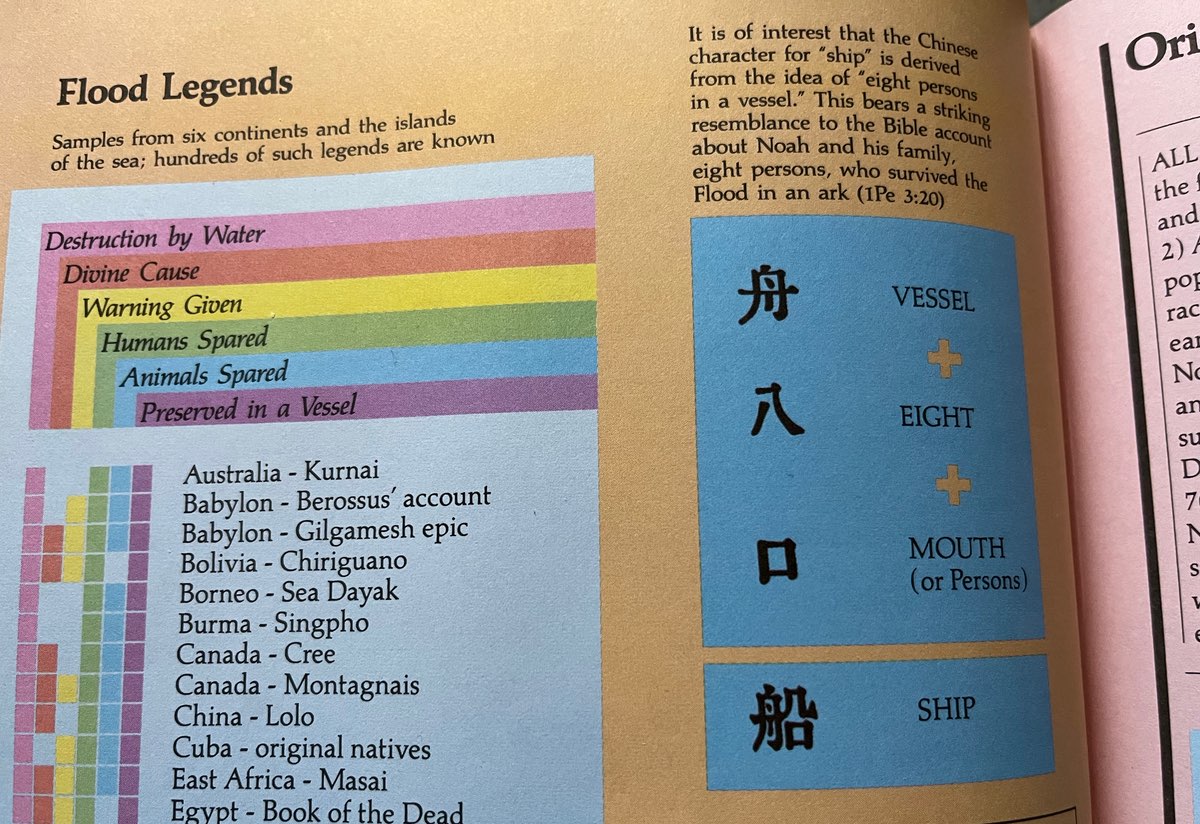
哈米吉多頓)”, the Mandarin syllables of which were obviously chosen first because of how much they sound like the English word “Armageddon” (and perhaps the original Hebrew word from which that came), not because of the meanings of the supposedly ideographic Chinese characters used to write them out (“Exhale Rice Lucky Much Pausing”??? 🤷🏻).
This emphasizes to us that when it comes to human language, SPEECH is primary—SOUNDS are the primary medium for transmitting meaning, and a writing system that transmits meaning purely with its visual symbols, without any dependency on speech sounds, is not a thing. However, this erroneous concept is so prevalent that there’s a name for it: The Ideographic Myth.
Several past MEotW posts have mentioned in passing the Ideographic Myth concerning Chinese characters, so it’s about time this blog took a deeper dive into this subject. Below are some selected excerpts from the chapter “The Ideographic Myth”, of the book The Chinese Language: Fact and Fantasy, by John DeFrancis, along with some commentary.
the concept of written symbols conveying their message directly to our minds, thus bypassing the restrictive intermediary of speech
This is a definition of the concept of “ideographic” writing.
Aren’t Chinese characters a sophisticated system of symbols that similarly convey meaning without regard to sound? Aren’t they an ideographic system of writing?
The answer to these questions is no. Chinese characters are a phonetic, not an ideographic, system of writing…There never has been, and never can be, such a thing as an ideographic system of writing.
Indeed, Chinese characters are always used to represent some language’s speech, are they not? They can be used to represent the speech of multiple languages, but they are not used in any way in which they do not represent the speech of any language, are they? There are no Chinese characters that have no spoken pronunciation in any language, are there? So, while some may find the idea of Chinese characters being an ideographic writing system fascinating, in real-life, actual use, Chinese characters are a phonetic writing system representing a language’s speech sounds (which do the actual representing of meanings)—Chinese characters are not an ideographic writing system directly representing meanings.
Origin of the Myth
The concept of Chinese writings as a means of conveying ideas without regard to speech took hold as part of the chinoiserie fad among Western intellectuals that was stimulated by the generally highly laudatory writings of Catholic missionaries from the sixteenth to the eighteenth centuries.
…
It was not acquaintance with Chinese but decipherment of Egyptian hieroglyphic writing following Napoleon’s conquests in North Africa that led to the coining of several expressions related to the ideographic idea.
…
Decipherment of this script had long been impeded by the notion that it was symbolic of ideas, particularly mystical or spiritual ones. It was not just the discovery of the famous Rosetta Stone, with its bilingual text in three scripts (Hieroglyphic Egyptian, Demotic Egyptian, and Greek) that made this possible. As Gordon (1968:24) stresses: “The decipherment of Hieroglyphic Egyptian required the replacement of the deep-seated notion of symbolism by the correct view that the main (though not the only) feature of the script is phonetic.”
Champollion’s success in deciphering the Egyptian script was due to his recognition of its phonetic aspect.
…
The rebus idea seems obvious to us since we use it in children’s games, but it actually constitutes a stupendous invention, an act of intellectual creation of the highest order—a quantum leap forward beyond the stage of vague and imprecise pictures to a higher stage that leads into the ability to represent all the subtleties and precision expressible in spoken language. Writing is now directly, clearly, firmly related to language: to speech. If there was ever any question whether a symbol had a sound attached to it, this now receives a positive answer. In the earliest form known to us, the character for “wheat” was borrowed to represent the word “come” precisely because both were pronounced in the same way.
…
What is crucial is to recognize that the diverse forms perform the same function in representing sound. To see that writing has the form of pictures and to conclude that it is pictographic is correct in only one sense—that of the form, but not the function, of the symbols. We can put it this way:
QUESTION: When is a pictograph not a pictograph?
ANSWER: When it represents a sound.
The use of the pictograph for “wheat” to represent the homophonous word ləg (“come”) transformed the function of the symbol from pictographic depiction of an object to syllabic representation of a sound. This change in function has been the essential development marking the emergence of all true systems of writing, including Chinese.
Sinological Contribution to the Myth
The fact that some Chinese pictographs have not undergone a change in form parallel to the change in function has tended to obscure the significance of the change that did take place. As a result, the phonetic aspect of Chinese writing is minimized by many people, even specialists in the field.
…
The error of exaggerating the pictographic and hence semantic aspect of Chinese characters and minimizing if not totally neglecting the phonetic aspect tends to fix itself very early in the minds of many people, both students of Chinese and the public at large, because their first impression of the characters is likely to be gained by being introduced to the Chinese writing system via some of the simplest and most interesting pictographs…. Unless a determined effort is made to correct this initial impression, it is likely to remain as an article of faith not easily shaken by subsequent exposure to different kinds of graphs.
…
Myth vs. Reality
A limited number of pictographic or semantic characters…cannot be considered indicative of full systems of nonphonetic writing that can function like ordinary orthographies to express nearly everything we can express in spoken language. The fact is that such a full system of nonphonetic writing has never existed. The system of Chinese characters, the Sumerian, Accadian, and Hittite cuneiform systems, and the Egyptian hieroglyphic system were none of them complete systems of semantic writing.
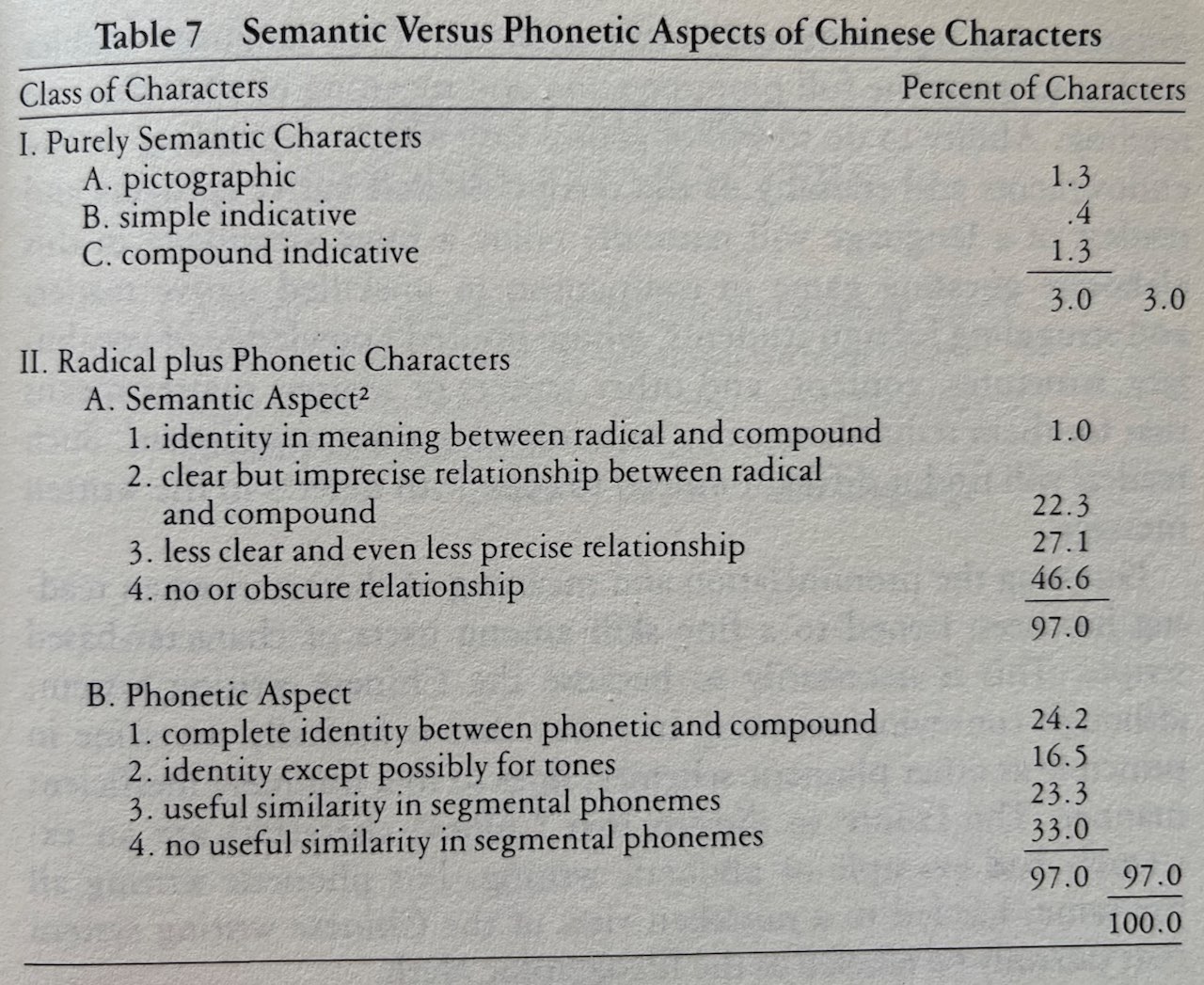
How limited is the number of pictographic or semantic characters, like “人”, “口”, “山”, etc., as opposed to the number of characters with some phonetic component related to pronunciation? This table from p. 129 of the book The Chinese Language: Fact and Fantasy says that only about 3% of all Chinese characters are purely pictographic or semantic:

This myth, it is apparent, exists in two aspects. Both must be rejected. The first is that the Chinese characters constitute an existing system of ideographic writing. This has been shown to be factually untrue. The second aspect is the validity of the ideographic concept itself. I believe it to be completely untenable because there is no evidence that people have the capacity to master the enormous number of symbols that would be needed in a written system that attempts to convey thought without regard to sound, which means divorced from spoken language. …But while it is possible for a writing system to have many individual “ideographs” or “ideograms”, it is not possible to have a whole writing system based on the ideographic principle. Alphabetic writing requires mastery of several dozen symbols that are needed for phonemic representation. Syllabic writing requires mastery of what may be several hundred or several thousand symbols that are needed for syllabic representation. Ideographic writing, however, requires mastery of the tens of thousands or hundreds of thousands of symbols that would be needed for ideographic representation of words or concepts without regard to sound. A bit of common sense should suggest that unless we supplement our brains with computer implants, ordinary mortals are incapable of such memory feats.
Indeed, how many concepts or ideas exist, or could potentially come into existence as they get invented? That’s how many symbols an actual ideographic writing system would need to have. Obviously, even if such a system could be made to exist, it would be unusable by actual imperfect humans. Even Chinese characters, which “only” number somewhere over 100,000, are not numerous enough to be an actual ideographic writing system, and Chinese characters are already inhumanly complex and numerous.
Objections to the Term “Ideographic”
We need to go further and throw out the term itself.
…
Chinese characters represent words (or better, morphemes), not ideas, and they represent them phonetically, for the most part, as do all real writing systems despite their diverse techniques and differing effectiveness in accomplishing the task.
…
Both terms [“logographic” and “ideographic”] are inadequate and misleading because they fail to indicate that the process of getting from graph to word/morpheme involves the phonetic aspect of the latter and because this failure leaves the way open to the idea that we get from graph to word/morpheme by means of some nonphonetic, in a word, “ideographic”, approach. Only the adoption of some such term as “morphosyllabic”, which calls attention to the phonetic aspect, can contribute to dispelling the widespread misunderstanding of the nature of Chinese writing.
Chinese characters being a “morphosyllabic” writing system means that “each character is pronounced as a single syllable and represents a single morpheme”* (smallest unit of language SOUND with meaning)—a Chinese character does NOT bypass language sounds to directly represent an idea.
So, every time you hear in Mandarin a name like “Hāmǐjíduōdùn
(Armageddon
哈米吉多顿
哈米吉多頓)” that came from another language, and is made up in Mandarin of syllables that make no sense except that they sound like the name in the original language, remember that the Ideographic Myth is just that—a myth!
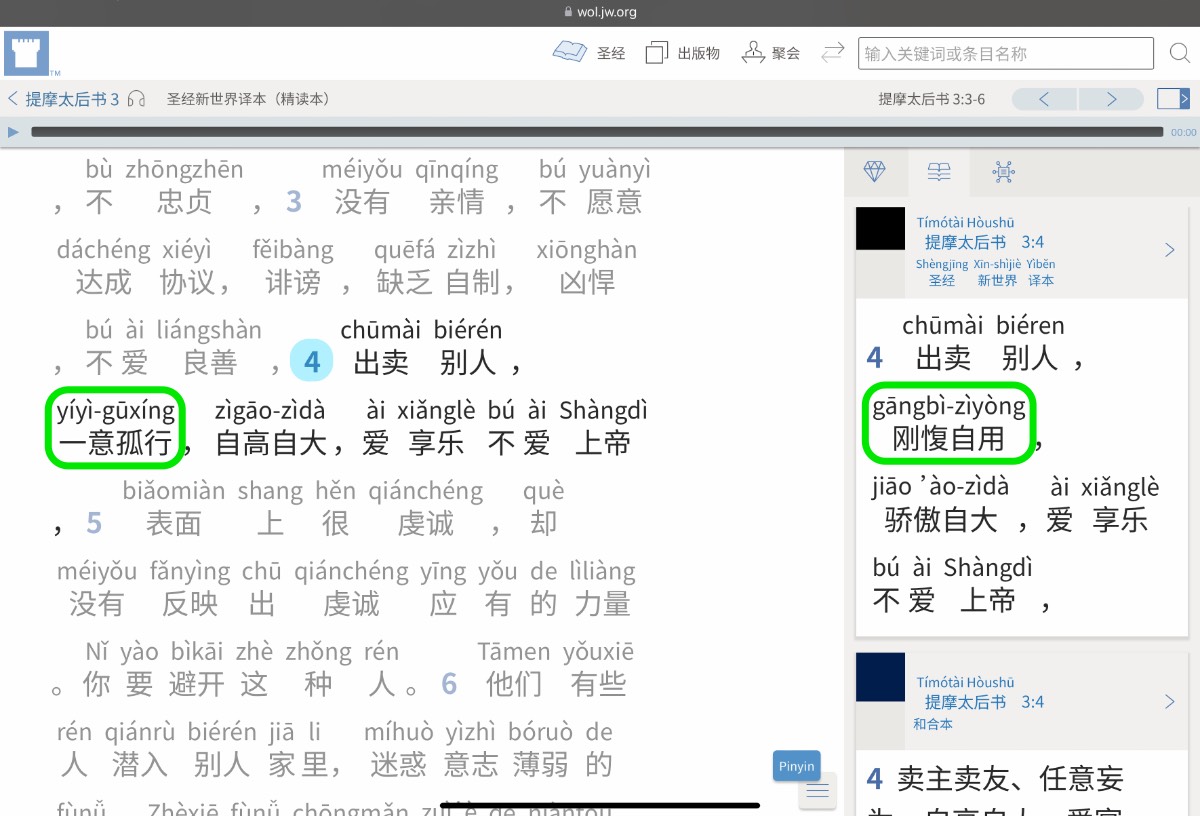
As worshippers of the one true God Jehovah, we carefully avoid spiritual idolatry, realizing that no visible idol or image can be allowed to replace the invisible, almighty Spirit Jehovah as the object of our worship. Similarly, us Chinese field language learners must also carefully avoid the linguistic idolatry of considering visible Chinese characters to be direct representations of meaning in Chinese languages, when the truth is that in human languages, including Chinese languages, meaning is primarily transmitted via invisible speech.
* John DeFrancis, The Chinese Language: Fact and Fantasy (Honolulu: University of Hawaii Press, 1984), p. 125. ^