Categories
Culture Language Learning

fēicháng

fēicháng (fēi·cháng un·usual/common/ordinary | un·usually/commonly [→ [very [much]; extremely; highly]] 非常) ← Tap/click to show/hide the “flashcard”

Fēicháng (Fēi·cháng un·usual/common/ordinary | un·usually/commonly [→ [very [much]; extremely; highly]] 非常)” was probably one of the first words you learned as a Mandarin field language learner. In fact, one of the first things your Mandarin instructor may have said to you in Mandarin may have been “fēicháng (fēi·cháng un·usually → [very] 非常) hǎo (good 好)!”, if you had just said something well in Mandarin. So, having learned that “fēicháng (fēi·cháng un·usual/common/ordinary | un·usually/commonly [→ [very [much]; extremely; highly]] 非常)” means “very”, you may have been confused when seeing how “fēicháng (fēi·cháng un·usual/common/ordinary | un·usually/commonly [→ [very [much]; extremely; highly]] 非常)” is used in the Mandarin New World Translation Bible at 2 Timothy 3:1:
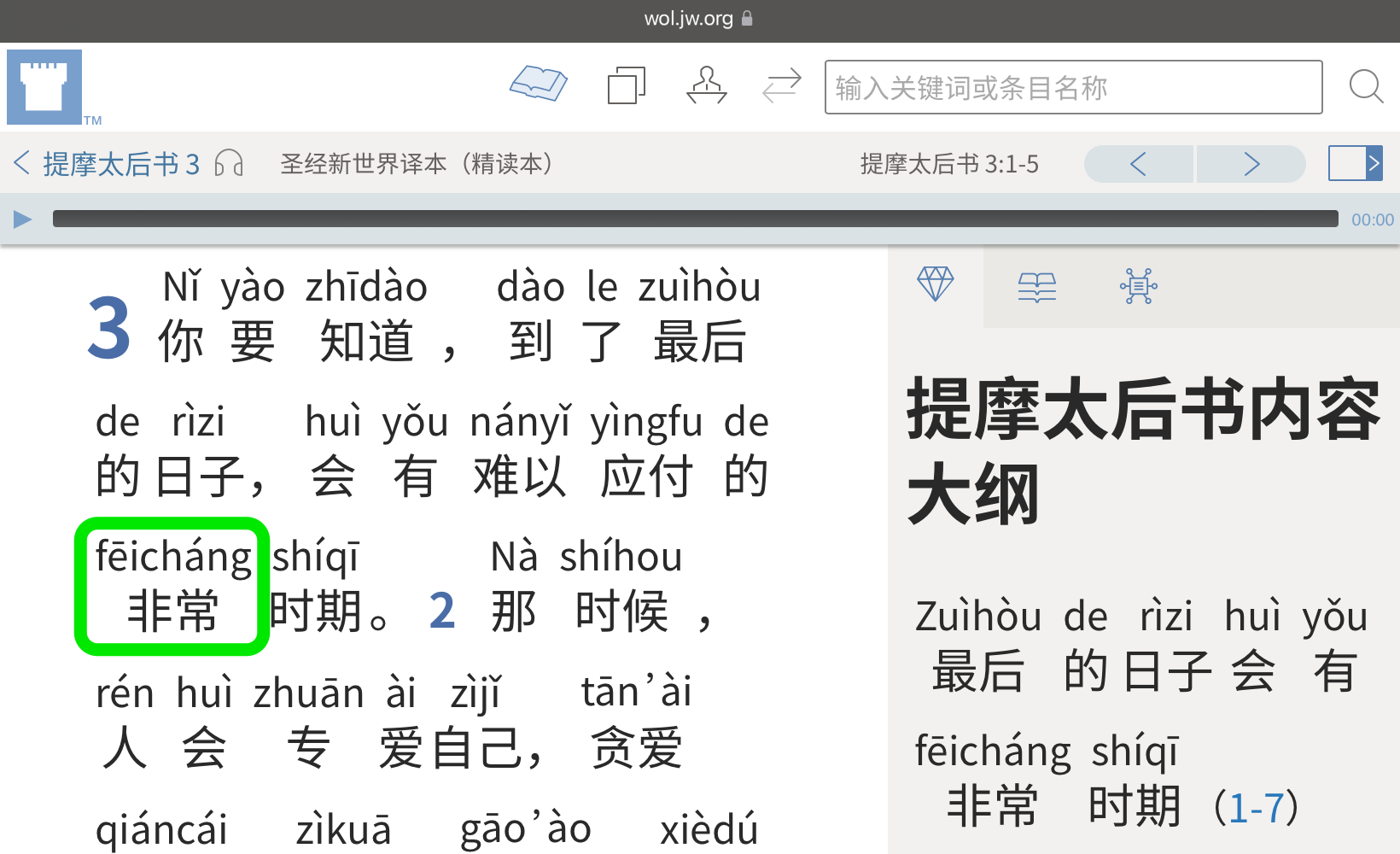
2 Timothy 3:1 (WOL CHS+Pinyin)

Fēicháng shíqī ((Fēi·cháng un·ordinary 非常) (shí·qī {(particular) times} · periods 时期 時期) [times of emergency])”? The corresponding term that the English NWT Bible uses in this scripture is “critical times”, but this Mandarin translation seems to mean “very times”, which doesn’t make sense. What’s going on here?

Breaking It Down

While especially as our Mandarin learning journeys begin we may want to keep things simple and mentally just have the view that this Mandarin word means that English word, eventually we encounter the more complex reality that Mandarin and English are two very different languages that come from different cultures, and that have different techniques and histories relating to how speech sounds are put together to convey meanings.

To help us get a grip on this sometimes messy reality, let us remember that while phrases and sentences can be broken down into words, words can in turn be broken down into morphemes. This excerpt from the introduction of a Pīnyīn (Pīn·yīn {Piecing Together} · Sounds → [Pinyin] 拼音) Plus resource briefly discusses Mandarin morphemes and how they are handled in Pīnyīn (Pīn·yīn {Piecing Together} · Sounds → [Pinyin] 拼音) Plus material:

As far as is practical, the meaning of each individual Mandarin morpheme (smallest unit of language sound with meaning) is translated literally according to how it is used in the context in which it appears. (In Mandarin, morphemes usually correspond with syllables, but some syllables are sound-only (without meaning) and thus not morphemes, and some morphemes have more than one syllable.)

The morphemes in “fēicháng (fēi·cháng un·usual/common/ordinary | un·usually/commonly [→ [very [much]; extremely; highly]] 非常) ” are:

  • fēi (not; no; non[-]; un[-]; in[-] 非)
  • cháng (ordinary; common; normal | constant; invariable | often; usually; frequently 常)

Putting It Together

So, while “fēicháng (fēi·cháng un·usual/common/ordinary | un·usually/commonly [→ [very [much]; extremely; highly]] 非常)” as a whole word is often used to effectively mean “very”, a look at the literal meanings of the morphemes that make it up helps us to understand that it actually literally means “unusually” or “uncommonly” when it is used to effectively mean “very”. In the context of 1 Timothy 3:1, “fēicháng (fēi·cháng un·ordinary 非常)” is used as an adjective meaning “unordinary” or “uncommon”, and it is put together with “shíqī (shí·qī {(particular) times} · periods 时期 時期)” to make up “fēicháng shíqī ((fēi·cháng un·ordinary 非常) (shí·qī {(particular) times} · periods 时期 時期) [times of emergency])”, an expression that is used to effectively mean “times of emergency”.

Plus

The curious case of “fēicháng (fēi·cháng un·usual/common/ordinary | un·usually/commonly [→ [very [much]; extremely; highly]] 非常)” in 1 Timothy 3:1 illustrates some of the advantages of Pīnyīn (Pīn·yīn {Piecing Together} · Sounds → [Pinyin] 拼音) Plus material (which you may have noticed is used in this blog) compared to older generations of Mandarin language-learning material, such as 3-line material.

In 3-line material, which was originally designed for paper printouts, all the English information was always visible, and it had to be practical to print out and use on paper. So, there was no room to show luxuriously long amounts of information like literal meanings in addition to effective meanings. In contrast, Pīnyīn (Pīn·yīn {Piecing Together} · Sounds → [Pinyin] 拼音) Plus material takes advantage of the dynamic displays of modern smartphones, tablets, etc. to put the English information (and other information too) in “flashcards” that can be hidden from view when they’re not needed. (Tap/click on a Pīnyīn (Pīn·yīn {Piecing Together} · Sounds → [Pinyin] 拼音) word/expression to reveal its “flashcard”, tap/click on a “flashcard” to hide it.) Thus, there is room for more and richer information—as Doctor Who fans would say, I thought it’d be cleaner it’s bigger on the inside/smaller on the outside”!

The “dimensional transcendentalness” and flexibility of Pīnyīn (Pīn·yīn {Piecing Together} · Sounds → [Pinyin] 拼音) Plus material also make it possible for it to render compound expressions such as “fēicháng shíqī ((fēi·cháng un·ordinary 非常) (shí·qī {(particular) time} · period 时期 時期) [time of emergency])”, which I believe no one was crazy enough to even attempt with 3-line material.

A list of the currently available Pīnyīn (Pīn·yīn {Piecing Together} · Sounds → [Pinyin] 拼音) Plus resources can be found at tiandi.info/pyp.

Categories
Theocratic

zuìxìng

zuìxìng (zuì·xìng sinful · nature 罪性) ← Tap/click to show/hide the “flashcard”

Appendix A2 of the English New World Translation of the Holy Scriptures (Study Edition), entitled “Features of This Revision”, discusses vocabulary changes that have been made in the current revision, words that have been translated differently than before. As noted in various entries in the excellent resource Referenced Theo. Expressions (RTE), Appendix A2 of the current Mandarin version of the New World Translation Bible (nwtsty) correspondingly discusses words that have been translated differently in the current revision of the Mandarin NWT Bible, compared to how they had been translated before.

Since we base what we say in Jehovah’s service on his Word the Bible, the vocabulary used in it—and the way those vocabulary words are translated—should be reflected in how we speak in our ministry, at our meetings, etc. So, it is beneficial for us Mandarin field language learners to be familiar with the latest thinking from the organization on how Bible terms should be translated into Mandarin.

Referring to “Flesh” in Mandarin

For a long time, we in the Mandarin field had been using the Mandarin word “ròutǐ (ròu·tǐ {(of) flesh} · body (nwtsty-CHS Appx. A2 notes change from “ròutǐ” to “shìsú”, “zuìxìng”, etc.) 肉体 肉體)” to correspond with the English word “flesh”. However, Appendix A2 of the current Mandarin version of the New World Translation Bible (nwtsty) points out that not only can the word “ròutǐ (ròu·tǐ {(of) flesh} · body (nwtsty-CHS Appx. A2 notes change from “ròutǐ” to “shìsú”, “zuìxìng”, etc.) 肉体 肉體)” be hard to understand, it can also make people think a scripture is exclusively referring to things related to sexual desires. So, the current revision of the Mandarin NWT Bible (nwtsty) instead uses expressions with clearer meanings, with the context determining which expression is used.

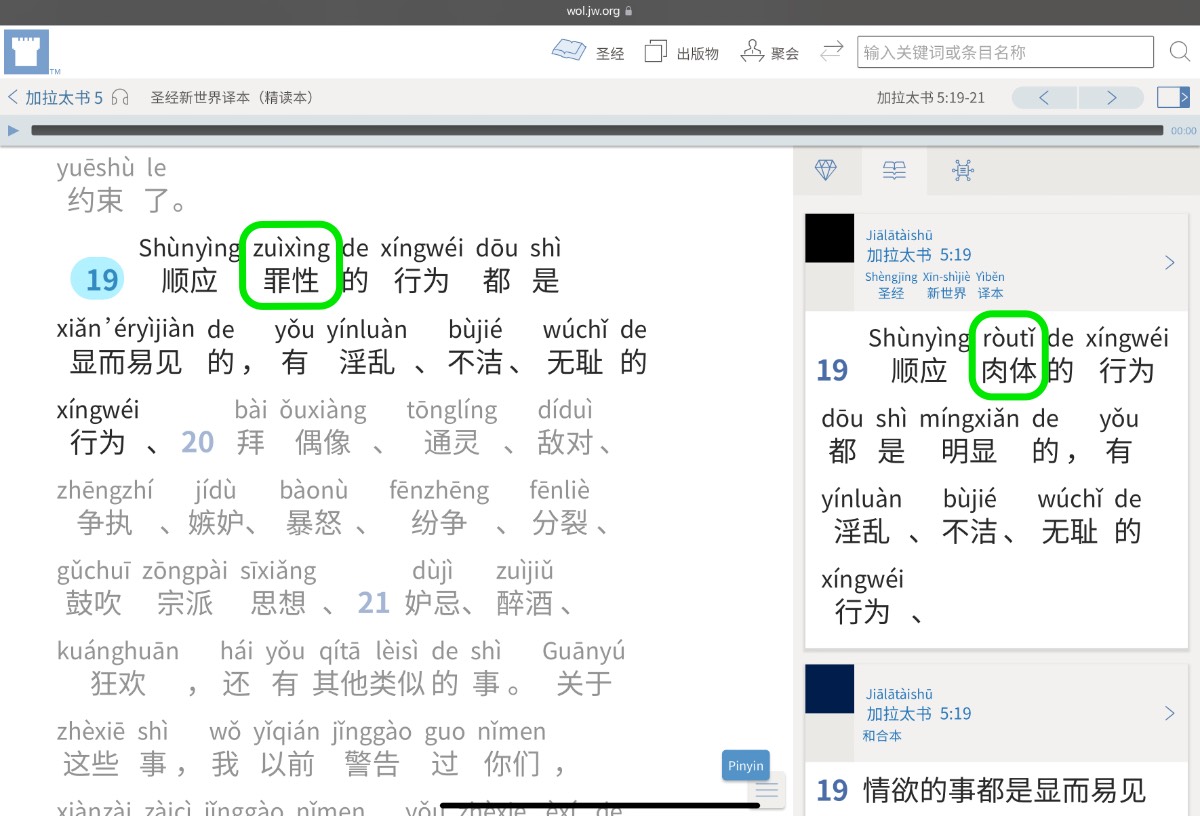
One example that the appendix provides is that Galatians 5:19 (Mandarin NWT (nwtsty)) now uses “zuìxìng (zuì·xìng sinful · nature 罪性)”, this week’s MEotW, instead of “ròutǐ (ròu·tǐ {(of) flesh} · body (nwtsty-CHS Appx. A2 notes change from “ròutǐ” to “shìsú”, “zuìxìng”, etc.) 肉体 肉體)”:

Galatians 5:19 (WOL CHS+Pinyin Parallel Translations)

Appendix A2 of the current Mandarin version of the New World Translation Bible (nwtsty) explains that the new translation uses “zuìxìng (zuì·xìng sinful · nature 罪性)” instead of “ròutǐ (ròu·tǐ {(of) flesh} · body (nwtsty-CHS Appx. A2 notes change from “ròutǐ” to “shìsú”, “zuìxìng”, etc.) 肉体 肉體)” here because the “works” that are listed afterwards are not only sins involving sex. Rather, other kinds of bad conduct are also listed, which come from the imperfect tendencies of humans, sinful human nature.—Galatians 5:19 (English NWT (nwtsty)).

Categories
Current Events

Àomìkèróng

Àomìkèróng (Omicron 奥密克戎 奧密克戎) ← Tap/click to show/hide the “flashcard”

[Note: Tap/click on a Pīnyīn (Pīn·yīn {Piecing Together} · Sounds → [Pinyin] 拼音) expression to reveal its “flashcard”, tap/click on a “flashcard” or its Pīnyīn (Pīn·yīn {Piecing Together} · Sounds → [Pinyin] 拼音) expression to hide the “flashcard”.]

As of this writing, near the end of 2021, the subject of the COVID-19 pandemic has been, to say the least, on people’s minds now for a while. So, it would be good to be able to refer to things related to it in Mandarin when speaking to people in the Mandarin field, or when speaking to our brothers and sisters in the truth.

electron microscope image of SARS-CoV-2—also known as 2019-nCoV, the virus that causes COVID-19

An electron microscope image of SARS-CoV-2—also known as 2019-nCoV, the virus that causes COVID-19
Creative Commons Attribution License logo NIAID

This week’s MEotW, “Àomìkèróng (Omicron 奥密克戎 奧密克戎)”, is one way to say “Omicron”—as in the Omicron variant of the virus that causes COVID-19—in Mandarin.

Another way to say “Omicron” in Mandarin is “Àomǐkěróng (Omicron 奥米可戎 奧米可戎)”.

To get an idea of how commonly used these expressions are compared to each other, consider the numbers of Google search results involving these expressions, together with “biànzhǒng (biàn·zhǒng changed · kind; type; variety → [mutation; variant; variety] 变种 變種)” (a past MEotW) and “biànyì zhū ((biàn·yì changed · {to be different} 变异 變異) (zhū {trunk of a tree → [strain]} 株) [(virus) strain/variant])”, two common ways to say “variant”:

Àomìkèróng (Omicron 奥密克戎 奧密克戎)
Search Terms Google Results Approx. No.
"奥密克戎变种"
(Àomìkèróng (Omicron 奥密克戎 奧密克戎) biànzhǒng (biàn·zhǒng changed · kind; type; variety → [mutation; variant; variety] 变种 變種))
696,000
"奥密克戎变异株"
(Àomìkèróng (Omicron 奥密克戎 奧密克戎) biànyì zhū ((biàn·yì changed · {to be different} 变异 變異) (zhū {trunk of a tree → [strain]} 株) [(virus) strain/variant]))
4,220,000
Àomǐkěróng (Omicron 奥米可戎 奧米可戎)
Search Terms Google Results Approx. No.
"奥米可戎变种"
(Àomǐkěróng (Omicron 奥米可戎 奧米可戎) biànzhǒng (biàn·zhǒng changed · kind; type; variety → [mutation; variant; variety] 变种 變種))
4
"奥米可戎变异株"
(Àomǐkěróng (Omicron 奥米可戎 奧米可戎) biànyì zhū ((biàn·yì changed · {to be different} 变异 變異) (zhū {trunk of a tree → [strain]} 株) [(virus) strain/variant]))
0

(Note that the quotation marks in the search terms tell Google to look for the exact sequences of characters that are inside the quotation marks—the results of searching without the quotation marks can be very different.)

Sounds Like…

Note that both “Àomìkèróng (Omicron 奥密克戎 奧密克戎)” and “Àomǐkěróng (Omicron 奥米可戎 奧米可戎)” are Mandarin expressions that were constructed, not because of the meanings represented by the Chinese characters used to write them, but because the Mandarin syllables used to say them sound like the English word “Omicron”.

In fact, when talking or writing in Mandarin about the Omicron variant, it is very common for people to just use the actual English word “Omicron”, which sounds more like the English word “Omicron” than anything else, and is not a Mandarin word written using the supposedly ideographic (representing meaning through visible symbols) Chinese characters.

Omicron
Search Terms Google Results Approx. No.
"omicron变种"
(Omicron biànzhǒng (biàn·zhǒng changed · kind; type; variety → [mutation; variant; variety] 变种 變種))
3,880,000
"omicron变异株"
(Omicron biànyì zhū ((biàn·yì changed · {to be different} 变异 變異) (zhū {trunk of a tree → [strain]} 株) [(virus) strain/variant]))
2,850,000

It is no surprise to linguists (language scientists/scholars) that people naturally focus on what words sound like when spoken, because, while of course meaning is what, well, gives life meaning, one of the basic principles of modern linguistics (the scientific study of language) is that speech is primary, and writing is secondary. That means that God designed us humans to express meaning via language primarily using speech that is heard, not writing that is seen, no matter how much lovers of Chinese characters traditionally focus on that visually intricate writing system above all else.—1 Corinthians 14:8–11.