fāngyán+
(fāng·yán
{direction → [place]} · speech → [topolect; dialect (common but misleading translation)]
方言) ← Tap/click to show/hide the “flashcard”
The term “fāngyán
(fāng·yán
{direction → [place]} · speech → [topolect; dialect (common but misleading translation)]
方言)” has been used in the Chinese-speaking world in various ways, but the literal meanings of the words that make it up indicate that it refers to the speech pattern of a place, even a place as small as a village. For reference, the “fāng+
(direction [→ [side; party | place; region | method; way [→ [prescription; recipe]] | power (math.)]] | {[is] square} [→ [[is] upright; honest]] | [mw for square things]
方)” in “fāngyán
(fāng·yán
{direction → [place]} · speech → [topolect; dialect (common but misleading translation)]
方言)” is the “fāng
(direction [→ [side; party | place; region | method; way [→ [prescription; recipe]] | power (math.)]] | {[is] square} [→ [[is] upright; honest]] | [mw for square things]
方)” in “dìfang
(dì·fang
{(section of) earth → [place]} · {direction → [place]} → [place]
地方)”, and the “yán+
(speech; word; talk; language | say; talk; speak | character; syllable; word
言)” in “fāngyán
(fāng·yán
{direction → [place]} · speech → [topolect; dialect (common but misleading translation)]
方言)” is the “yán
(speech; word; talk; language | say; talk; speak | character; syllable; word
言)” in “yǔyán
(yǔ·yán
language · {(type of) speech}
语言
語言)”.
“Fāngyán
(Fāng·yán
{direction → [place]} · speech → [topolect; dialect (common but misleading translation)]
方言)” has customarily been translated into English as “dialect”, but this practice can be misleading and confusing, because while “fāngyán
(fāng·yán
{direction → [place]} · speech → [topolect; dialect (common but misleading translation)]
方言)” and “dialect” can sometimes both be applied to a particular speech pattern, the two terms don’t mean exactly the same thing.
What is a Chinese “Dialect”?
American sinologist and University of Pennsylvania Professor of East Asian Languages and Civilizations Victor H. Mair wrote an extensive article on this subject, “What Is a Chinese ‘Dialect/Topolect’? Reflections on Some Key Sino-English Linguistic Terms”, which can be found here (PDF) and here (web page) on his website Sino-Platonic Papers.
It has been said that “a language is a dialect with an army and navy”, but in his article Professor Mair gives us a more linguistically correct and useful way to distinguish between a language and a dialect:
Regardless of the imprecision of lay usage, we should strive for a consistent means of distinguishing between language and dialect. Otherwise we might as well use the two terms interchangeably. That way lies chaos and the collapse of rational discourse. Mutual intelligibility [emphasis added] is normally accepted by most linguists as the only plausible criterion for making the distinction between language and dialect in the vast majority of cases. Put differently, no more suitable, workable device for distinguishing these two levels of speech has yet been proposed. If there are to be exceptions to the useful principle of mutual intelligibility, there should be compelling reasons for them. Above all, exceptions should not be made the rule.
What is mutual intelligibility? Simply put, in linguistics, two or more speech varieties are said to be mutually intelligible if they are “able to be understood by one another’s speakers”. For example, if one person only knows English, and another person only knows Spanish, they can’t really understand each other if they try to talk to each other—English and Spanish are not mutually intelligible, and are suitably recognized as being different languages, not just different dialects of “European”.
Similarly, if one person only knows Mandarin, and another person only knows Cantonese, they can’t really understand each other if they try to talk to each other—Mandarin and Cantonese are not mutually intelligible. So, while they may be “fāngyán+
(fāng·yán
{direction → [place]} · {(patterns of) speech}
方言)”, linguistically, Mandarin and Cantonese should really be considered to be different languages, not just different dialects of “Chinese”.
If many of the varieties of speech in China are really different languages, as linguists would refer to them, why have so many people come to think that they are just dialects of a single Chinese language? China’s central government is highly motivated to convince people that China is one unified political and cultural entity which should thus be governed by one central government—them—so they have promoted this idea. In other words, it’s basically political propaganda!
Being Clear on What’s What
Why is it especially important for language-learners in a language field like the Mandarin field to recognize, in spite of the commonly accepted political propaganda, that Chinese varieties of speech like Mandarin and Cantonese really function like different languages, and not different dialects of the same language? Well, as someone who along with many others has come to the Mandarin field from the Cantonese field, I have had the dubious pleasure of observing how some have tried to speak Mandarin by just taking the Cantonese they knew and twisting it a little, since they were relying on the conventional wisdom that Mandarin and Cantonese are just different dialects of the same language. As well-meaning as they may have been, the results were often just as bad as when someone sings badly off-key, or as Star Trek fans may say, they often sounded like the language equivalent of a transporter accident 🙀. Even after decades in the Mandarin field, some publishers who had come over from the Cantonese field still say some Mandarin words with Cantonese-y pronunciations.
In contrast, when one recognizes, for example, that Cantonese is Cantonese and Mandarin is Mandarin, and that neither one is just a slightly mutated version of the other, then that paves the way for language-learning progress that is free of being distorted by untruthful and misleading beliefs. Yes, by recognizing and accepting a variety of speech for what it really is, we can go on to freely learn to speak it well and properly, so that we can be as effective as possible at helping people whose mother tongue is that variety of speech.
As with everything else in life, in language-learning too, the truth matters. As Jehovah’s people, we especially want to “worship the Father with spirit and truth”, and when we seek to do so as we learn a language to use it in Jehovah’s service, we will find that ‘the truth will set us free’ from the distortions and burdens of untruthful and misleading beliefs.—John 4:23; 8:32.
Some Official Recognition
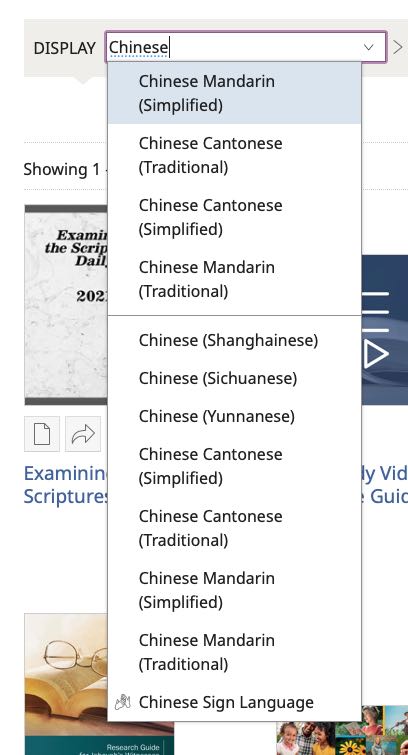
The organization has recently demonstrated that it recognizes the truth about how different many of the Chinese varieties of speech are from one another. For example, whereas before there was one Chinese edition of each publication (using Mandarin wording), now, some publications are available in different Chinese editions for different Chinese languages (including Cantonese), each with different wording.

jw.org now has publications in different Chinese languages.
To help reduce the confusion around the inappropriate use of the English word “dialect” to translate “fāngyán
(fāng·yán
{direction → [place]} · speech → [topolect; dialect (common but misleading translation)]
方言)”, Professor Mair proposed that the word “topolect” (topo- (“place”) + -lect (“[language] variety”)) be used instead as an exact, neutral English translation of “fāngyán
(fāng·yán
{direction → [place]} · speech → [topolect; dialect (common but misleading translation)]
方言)”. While not as well-known as “dialect”, the word “topolect” has gained a certain amount of recognition, and it can now be found in several dictionaries, e.g., The American Heritage Dictionary of the English Language, Wordnik, and Wiktionary.