Categories
Culture Experiences History Language Learning Names

Shànghǎi


Shànghǎi+ (Shàng·hǎi Upon · {the Sea} → [Shanghai] 上海) 👈🏼 Tap/click to show/hide the “flashcard”

Shanghai is well-known as an exceptionally populous and prosperous city in China. Of at least some interest to Mandarin field language learners, Wikipedia reports that Shanghainese is the prestige variety or prestige dialect of the Wu Chinese language branch, and that there are estimated to be about 16 million speakers of Shanghainese, out of the approximately 83 million speakers of some variety of Wu Chinese.

This reminds me that one of the things I realized soon after I went from the Cantonese field to the Mandarin field is that there are actually many different peoples in the world who are called “Chinese”, peoples who have different cultures and who speak different languages, including Shanghainese. Indeed, as the MEotW post on “Yuèyǔ (Yuè·yǔ Yue · Language [→ [Cantonese]] 粤语 粵語)” says:

While the central government of China wants everyone to just think of China as one monolithic political entity that should be governed by them, the central government, modern China actually is made up of many different parts. If it wasn’t for Qín Shǐhuáng ((Qín {Qin (dynasty)} 秦) (Shǐ·huáng Beginning · Emperor 始皇) (the founder of the Qín dynasty and the first emperor of China)) (Wikipedia article), who (rather forcefully) united several warring states and became the first emperor of China, China could have ended up like modern Europe, with its several independent nations.

These different parts of modern China, that in an alternate timeline could have become independent nations, each have their own history, including their own linguistic history—just like modern France, Spain, Germany, etc. have historically had their own mutually unintelligible languages, modern Guǎngdōng (Guǎng·dōng Wide · East → [Guangdong (Canton) Province] 广东 廣東), Shànghǎi (Shàng·hǎi Upon · {the Sea} → [Shanghai] 上海), Fújiàn (Fú·jiàn {Blessing (abbr. for the city name Fúzhōu)} · {Established (abbr. for the city name Jiànzhōu)} → [Fujian (Province)] 福建), etc. also have historically had their own mutually unintelligible languages, even if China’s central government would like everyone to just (erroneously) call them dialects of “Chinese”.

A Gold Rush Leads to Shanghaiing

Not as well known as Shanghai’s current prosperous and respected status is why “shanghai” is used in English to mean “to kidnap (a man) for compulsory service aboard a ship, especially after drugging him”, or “to induce or compel (someone) to do something, especially by fraud or force.” Recently, I came across an article on the website The World of Chinese entitled “ ‘Shanghai’ Beyond the Map: The Story of an English Verb”, which provides some background on this:

But the answer to how “shanghai” became an action rather than merely a destination lies in the American West during the turbulent mid-19th century.

The California Gold Rush transformed sleepy Pacific ports like San Francisco into booming maritime hubs virtually overnight. More than a thousand merchant vessels sailed into San Francisco Bay, many of them promptly abandoned by their crews, who jumped ship to seek fortunes in the Sierra Nevada foothills. Ship captains found themselves stranded with hulls full of cargo and few hands to man the sails.

Because long-distance voyages in the 19th century were extremely hazardous and physically punishing, few ordinary men were willing to volunteer for the sea. Compounding the situation was strict federal legislation dating back to 1790, which made it a punishable crime for a sailor to leave a ship before the end of his contracted voyage. Although originally intended to maintain order in the merchant marine, the law effectively created an inescapable trap. Once a sailor signed a ship’s register, he was legally bound to the vessel under pain of imprisonment, regardless of how his signature had been obtained. Desperate sea captains, in urgent need of crews, were prompted to secure men by any means necessary—even if it meant resorting to outright kidnapping through brute force, liquor, or drugs.

…

As Merriam-Webster notes, this unscrupulous practice became inextricably linked with one particular Chinese port: Shanghai, newly opened to foreign trade after the Opium War of 1840, was a far-flung and dangerous destination for American shipping, and an unpopular one among seamen because of the difficulty of securing return passage. Because of the scarcity of willing men for these voyages, many kidnapped sailors ended up on ships bound for China, and “shanghaiing” became the universal name for the act itself regardless of the destination.

…

“Shanghai” occupies a special category as a true toponymic verb—a word born directly from a geographic location. It captures a universal human experience: the sudden realization that one has been tricked or forced into something they never intended.

Don’t Let Yourself Get Shanghaied in the Mandarin Field

We Mandarin field language learners should be in the Mandarin field to glorify Jehovah and to share Bible truth with Mandarin-speaking people. Let us not allow ourselves to be shanghaied or manipulated into glorifying worldly Chinese culture by those who love this merely human culture for its own sake, or by those who are irrationally attached to the Chinese cultural traditions related to Chinese characters!
Categories
Culture History Language Learning Languages Names Science

Yuèyǔ

Yuèyǔ+ (Yuè·yǔ Yue · Language [→ [Cantonese]] 粤语 粵語) ← Tap/click to show/hide the “flashcard”

This week’s MEotW, “Yuèyǔ (Yuè·yǔ Yue · Language [→ [Cantonese]] 粤语 粵語)”, is a term that over the years one may occasionally have come across in the Chinese fields. For example, it used to be used on publication download pages on jw.org, where it has been replaced by a term that is more familiar to many: “Guǎngdōnghuà (Guǎng·dōng·huà {Wide · East → [Canton]} · Speech → [Cantonese speech/language] 广东话 廣東話)” (“Cantonese”).

The Language(s)

Regarding “Yuèyǔ (Yuè·yǔ Yue · Language [→ [Cantonese]] 粤语 粵語)”, the Wikipedia article on Yue Chinese provides this summary:

Yue (Cantonese pronunciation: [jyːt̚˨]) is a branch of the Sinitic languages primarily spoken in Southern China, particularly in the provinces of Guangdong and Guangxi (collectively known as Liangguang).

The term Cantonese is often used to refer to the whole branch, but linguists prefer to reserve the name Cantonese for the variety used in Guangzhou (Canton), Wuzhou (Ngchow), Hong Kong and Macau, which is the prestige dialect of the group. Taishanese, from the coastal area of Jiangmen (Kongmoon) located southwest of Guangzhou, was the language of most of the 19th-century emigrants from Guangdong to Southeast Asia and North America. Most later migrants have been speakers of Cantonese.

Yue varieties are not mutually intelligible with other varieties of Chinese,[source] and they are not mutually intelligible within the Yue family either.[source]

This Wikipedia page also cites Ethnologue as saying that the number of native speakers worldwide of Yuèyǔ (Yuè·yǔ Yue · Language [→ [Cantonese]] 粤语 粵語) was recently about “86 million (2022)[source]”. That’s not as many as Mandarin has (no other language/language branch currently has as many native speakers as Mandarin does), but that’s still a lot of people.

Regarding how Cantonese relates to other Chinese speech varieties, note the following excerpt from the MEotW post on “yǔzú (yǔ·zú language · {ethnic group → [group of things with common characteristics] → [group]} 语族 語族)”:

It’s interesting to note that according to Prof. [Victor H.] Mair’s article (p. 737) mentioned above, not only are Mandarin and Cantonese separate languages (not just “dialects”), it would be more accurate to consider them to be in separate language branches, as defined by the language classisification scheme he uses:

Cantonese and Mandarin are separate languages. Cantonese is not a ‘dialect’ of Mandarin or of Hanyu, and it is grossly erroneous to refer to it as such. Since Cantonese and Mandarin are separate languages (or, perhaps more accurately, separate branches), it is wrong to refer to them as ‘dialects.’ The same holds for Hokkien, Shanghainese, and so forth.

That Mandarin and Cantonese should really be considered to be in separate language branches emphasizes to us politically neutral Mandarin field language-learners that we must not repeat or be misled by the politically motivated erroneous assertion that Mandarin, Cantonese, Shanghainese, etc. are just dialects of “Chinese”. That might be even more wrong than saying that English, French, Spanish, etc. are just dialects of “European”!

Some Geography

To clarify regarding some of the places related to “Yuèyǔ (Yuè·yǔ Yue · Language [→ [Cantonese]] 粤语 粵語)”:

  • Guǎngdōng+ (Guǎng·dōng Wide · East → [Guangdong (Canton) Province] 广东 廣東)
  • Guǎngzhōu+ (Guǎng·zhōu Wide · Prefecture → [Guangzhou (Canton (city))] 广州 廣州)
    • This is the capital city of Guǎngdōng (Guǎng·dōng Wide · East → [Guangdong (Canton) Province] 广东 廣東) province.
  • Guǎngxī+ (Guǎng·xī Wide · West → [Guangxi (Guangxi Zhuang Autonomous Region)] 广西 廣西)
    • This is an autonomous region that’s located just to the west of Guǎngdōng (Guǎng·dōng Wide · East → [Guangdong (Canton) Province] 广东 廣東).

Some History

This summary from the Wikipedia article on Baiyue provides us with some historical background:

The Baiyue, Hundred Yue, or simply Yue, were various ethnic groups who inhabited the regions of Southern China and Northern Vietnam during the 1st millennium BC and 1st millennium AD.[source][source][source] They were known for their short hair, body tattoos, fine swords, and naval prowess.

…

The Yue tribes were gradually displaced or assimilated into Chinese culture as the Han empire expanded into what is now Southern China and Northern Vietnam.[source][source][source][source] Many modern southern Chinese dialects bear traces of substrate languages[citation needed] originally spoken by the ancient Yue. Variations of the name are still used for the name of modern Vietnam [Yuènán+ (Yuè·nán Yue · South → [Vietnam] 越南)], in Zhejiang-related names including Yue opera, the Yue Chinese language, and in the abbreviation for Guangdong.

…

The modern term “Yue” (traditional Chinese: 越、粵; simplified Chinese: 越、粤; pinyin: Yuè; Cantonese Jyutping: Jyut6; Wade–Giles: Yüeh4; Vietnamese: Việt; Early Middle Chinese: Wuat) comes from Old Chinese *ɢʷat.[source] It was first written using the pictograph 戉 for an axe (a homophone), in oracle bone and bronze inscriptions of the late Shang dynasty (c. 1200 BC), and later as 越.[source]

Is Cantonese Only Spoken?

Native Cantonese speakers I have known, like those in the Cantonese congregation that I used to be in, would tell me that the Cantonese we spoke was spoken Chinese, and that the Chinese in the official publications of the time, which was different in some ways from spoken Cantonese, was written Chinese. However, as I gained more knowledge about the history and the language situation of China, I came to understand that actually, the Chinese writing in the publications we were using was Mandarin, which was used because Mandarin-speaking people had gained political power in China, resulting in Chinese publications generally being published in Mandarin—it wasn’t a matter of spoken and written Chinese being different, but rather, of Cantonese and Mandarin being different.

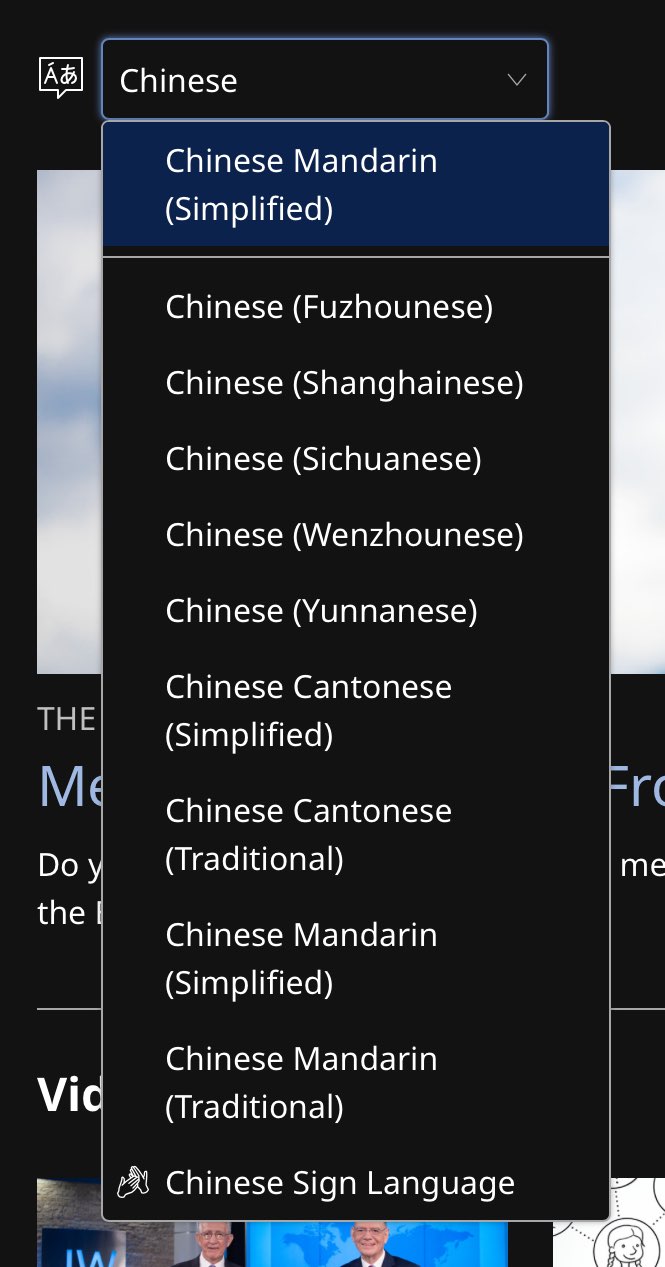
Eventually, the organization came to also publish publications written in other Chinese varieties in addition to Mandarin. As of this writing, searching for “Chinese” on jw.org results in the following options, which includes Cantonese options:

Chinese varieties on jw.org as of 2024-04-14

Something to Remember

This week’s MEotW, “Yuèyǔ (Yuè·yǔ Yue · Language [→ [Cantonese]] 粤语 粵語)”, reminds us that while the central government of China wants everyone to just think of China as one monolithic political entity that should be governed by them, the central government, modern China actually is made up of many different parts. If it wasn’t for Qín Shǐhuáng ((Qín {Qin (dynasty)} 秦) (Shǐ·huáng Beginning · Emperor 始皇) (the founder of the Qín dynasty and the first emperor of China)) (Wikipedia article), who (rather forcefully) united several warring states and became the first emperor of China, China could have ended up like modern Europe, with its several independent nations.

These different parts of modern China, that in an alternate timeline could have become independent nations, each have their own history, including their own linguistic history—just like modern France, Spain, Germany, etc. have historically had their own mutually unintelligible languages, modern Guǎngdōng (Guǎng·dōng Wide · East → [Guangdong (Canton) Province] 广东 廣東), Shànghǎi (Shàng·hǎi Upon · {the Sea} → [Shanghai] 上海), Fújiàn (Fú·jiàn {Blessing (abbr. for the city name Fúzhōu)} · {Established (abbr. for the city name Jiànzhōu)} → [Fujian (Province)] 福建), etc. also have historically had their own mutually unintelligible languages, even if China’s central government would like everyone to just (erroneously) call them dialects of “Chinese”. This reality of China’s many mutually unintelligible languages is being emphasized, not for any political purpose, but rather, to help us language learners in the Chinese fields to be equipped with the truth as we try to make practical progress in learning and using Chinese languages to spread our God-honouring and life-saving message.