Categories
Culture Language Learning Theocratic

bùzú

bùzú+ (bù·zú sectional · {ethnic group} → [tribe] 部族) ← Tap/click to show/hide the “flashcard”

Appendix A2 of the English New World Translation of the Holy Scriptures (Study Edition), entitled “Features of This Revision”, discusses vocabulary changes that have been made in the current revision, words that have been translated differently than before. As noted in various entries in the excellent resource Referenced Theo. Expressions (RTE), Appendix A2 of the current Mandarin version of the New World Translation Bible (nwtsty) correspondingly discusses words that have been translated differently in the current revision of the Mandarin NWT Bible, compared to how they had been translated before.

Since we base what we say in Jehovah’s service on his Word the Bible, the vocabulary used in it—and the way those vocabulary words are translated—should be reflected in how we speak in our ministry, at our meetings, etc. So, it is beneficial for us Mandarin field language learners to be familiar with the latest thinking from the organization on how Bible terms should be translated into Mandarin.

Adding Context

In past Mandarin Bible translations, a name like “Yóudà (Judah 犹大 猶大)” might be used to refer to a man, a tribe, a nation, etc., and this could cause readers to be confused. So, the current Mandarin version of the New World Translation Bible (nwtsty) translates such names more clearly, for example using “Yóudà (Judah 犹大 猶大) bùzú+ (bù·zú sectional · {ethnic group} → [tribe] 部族)” to mean “the tribe of Judah”, using “Yóudà (Judah 犹大 猶大) guó (nation)” to mean “the nation of Judah”, using “Yóudà (Judah 犹大 猶大) dìqū (dì·qū land · region 地区 地區)” to mean “the land of Judah”, etc.—Mínshùjì (Mín·shù·jì {The People} · Numbers · Record → [Numbers] 民数记 民數記) 1:7; Lièwángjì Shàng ((Liè·wáng·jì {Series of} · Kings · Record 列王纪 列王紀) (Shàng Upper 上) [1 Kings]) 13:1; Níxīmǐjì (Níxīmǐ·jì Nehemiah · Record 尼希米记 尼希米記) 11:3.
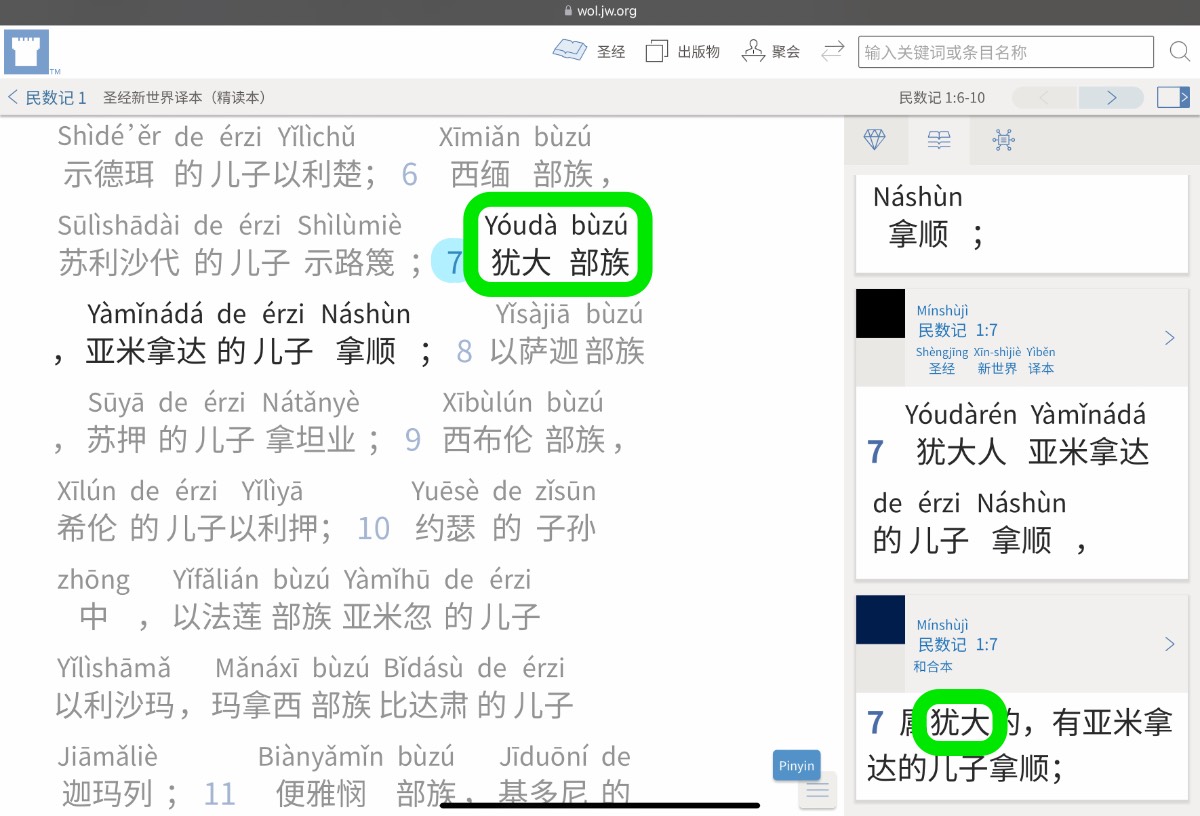
Numbers 1:7 (WOL CHS+Pinyin Parallel Translations)

By the way, the “ (part; section [→ [unit; ministry; department; board]] | [mw for large books, films, machines, vehicles, etc.] 部)” in “bùzú (bù·zú sectional · {ethnic group} → [tribe] 部族)” (this week’s MEotW) is also the one that appears in the well-known expression “bùfen (bù·fen part; section · component; share; part; portion 部分)”.

Solving “The Homophone Problem”

A section of the article “Pīnyīn (Pīn·yīn {Piecing Together} · Sounds → [Pinyin] 拼音) Was Plan A” addresses the common contention that Pīnyīn (Pīn·yīn {Piecing Together} · Sounds → [Pinyin] 拼音) is not suitable as a writing system for Mandarin because of the high number of homophones in Mandarin:

Some may object, saying that there are so many homophones in Chinese that the characters are needed to tell them apart from each other. (A homophone is a word that has the same pronunciation as another word, but that has a different meaning from it.) However, consider: When people are just speaking Mandarin, with no characters in sight to help them, do they have problems understanding each other because of all the homophones? Can blind Mandarin-speakers, who cannot see characters, still “see” what people mean when those people speak Mandarin? Native Mandarin-speakers have confirmed to me that no, homophones are not a significant problem in spoken Mandarin—people can use the context and understand each other okay. So, people can use the context and understand each other okay when using Pīnyīn too, since Pīnyīn directly represents the sound of spoken Mandarin.

…other ways [besides resorting to characters] to alleviate the problem. Those other ways could include:

  • Including as much clarifying context in the written language as is necessary, as is done in the spoken language
  • Reducing the number of homophones by
    • Adding syllables to existing homophones

The above-described practice used in the current Mandarin NWT, of adding expressions like “bùzú (bù·zú sectional · {ethnic group} → [tribe] 部族)” to expressions like “Yóudà (Judah 犹大 猶大)”, is an example of adding context, and also an example of reducing the number of expressions that sound the same by adding syllables to existing expressions that sound the same, to clarify what means what without resorting to the homophone-enabling crutch that is the characters. In fact, in this case, disambiguation by using different characters is not an option anyway because “Yóudà (Judah 犹大 猶大)” must be written with the same characters whether it means “the man named Judah”, “the tribe of Judah”, “the nation of Judah”, etc. Theoretically, one might contemplate the possibility of using different characters to represent “Judah” depending on whether it refers to “the man named Judah”, “the tribe of Judah”, “the nation of Judah”, etc., but that way lies even madder madness than the madness that already is the Chinese characters!
Categories
Theocratic

dìqū

dìqū+ (dì·qū land · area; district; region [→ [territory]] 地区 地區) ← Tap/click to show/hide the “flashcard”

Appendix A2 of the English New World Translation of the Holy Scriptures (Study Edition), entitled “Features of This Revision”, discusses vocabulary changes that have been made in the current revision, words that have been translated differently than before. As noted in various entries in the excellent resource Referenced Theo. Expressions (RTE), Appendix A2 of the current Mandarin version of the New World Translation Bible (nwtsty) correspondingly discusses words that have been translated differently in the current revision of the Mandarin NWT Bible, compared to how they had been translated before.

Since we base what we say in Jehovah’s service on his Word the Bible, the vocabulary used in it—and the way those vocabulary words are translated—should be reflected in how we speak in our ministry, at our meetings, etc. So, it is beneficial for us Mandarin field language learners to be familiar with the latest thinking from the organization on how Bible terms should be translated into Mandarin.

The Land of…

Past versions of the Mandarin NWT Bible added “ (Land (of) 地)” after the names of lands, as in “Āijí (Egypt 埃及) (Land (of) 地)” (“the Land of Egypt”). However, that isn’t the usual way to render the names of lands in Mandarin Chinese, resulting in readers finding such renderings unnatural.

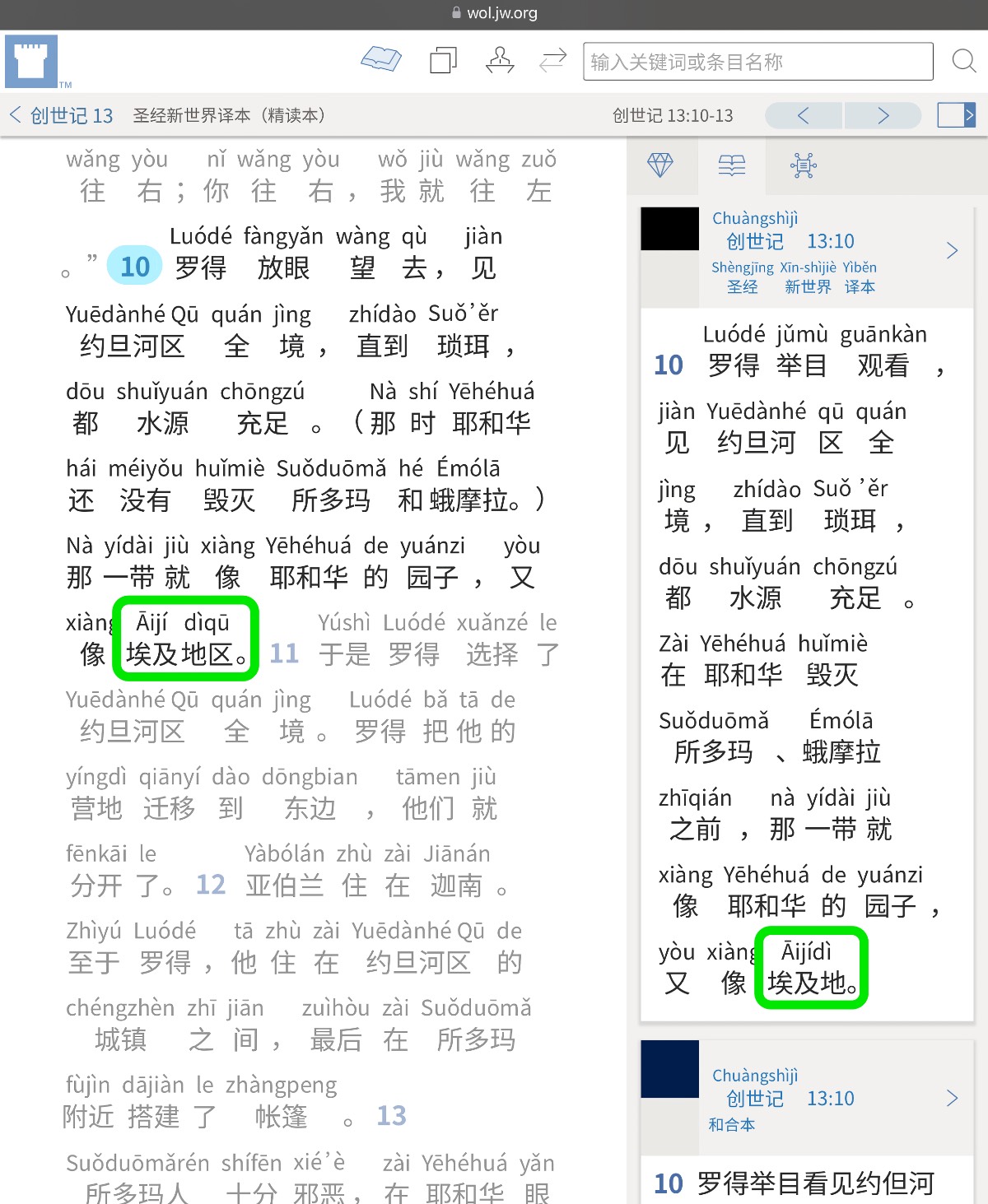
So, the current Mandarin version of the NWT Bible (nwtsty) now renders the names of lands differently. For example, “Āijí (Egypt 埃及) (Land (of) 地)” is now rendered as “Āijí (Egypt 埃及) Dìqū (Dì·qū Land · Region (of) 地区 地區)”, as can be seen at Genesis 13:10:

Genesis 13:10 (WOL CHS+Pinyin Parallel Translations)

The Territory of…

Incidentally, “dìqū (dì·qū land · area; district; region [→ [territory]] 地区 地區)” has also long been the expression used in Mandarin groups and congregations to refer to the “territory” that a group or congregation carries out the preaching work in. As with the English expression “territory”, one could speak of a congregation’s “dìqū+ (dì·qū land · region → [territory] 地区 地區)” as a whole, or of a particular “dìqū+ (dì·qū land · region → [territory] 地区 地區)” within that whole that, say, a car group of publishers is working.

Categories
Current Events Theocratic

shìjiè mòrì

shìjiè+ (shì·jiè {generation → [world]} · extent’s → [world’s] 世界)
mòrì+ (mò·rì end · {sun → [day]} 末日) ← Tap/click to show/hide the “flashcard”

[Notes: Tap/click on a Pīnyīn (Pīn·yīn {Piecing Together} · Sounds → [Pinyin] 拼音) expression to reveal its “flashcard”; tap/click on a “flashcard” or its Pīnyīn (Pīn·yīn {Piecing Together} · Sounds → [Pinyin] 拼音) expression to hide the “flashcard”. 📖 📄 ➕ icons mean 📖 Reveal All, 📄 Reveal Advanced, and ➕ Reveal + Symbols re all the “flashcards” in the heading, paragraph, etc. that they are placed at the beginning of.]

At the time of this writing, jw.org was featuring the article “Politicians Warn of Armageddon—What Does the Bible Say?”. Where the English version of this article uses the word “Armageddon”, the Mandarin version often uses this week’s MEotW, “shìjiè (shì·jiè {generation → [world]} · extent’s → [world’s] 世界) mòrì (mò·rì end · {sun → [day]} 末日)” (which basically means “the end of the world”), with the first occurrence of “Hāmǐjíduōdùn (Armageddon 哈米吉多顿 哈米吉多頓)”, the direct Mandarin translation of “Armageddon”, occurring in parentheses after an occurrence of “shìjiè (shì·jiè {generation → [world]} · extent’s → [world’s] 世界) mòrì (mò·rì end · {sun → [day]} 末日)”.

This shows that the expression “Hāmǐjíduōdùn (Armageddon 哈米吉多顿 哈米吉多頓)” is not considered by the organization to be commonly known by householders in the Mandarin field. The English word “Armageddon”, which refers to something mentioned in the Bible, may be relatively well known in the English-speaking world, but compared to the English-speaking world, the Mandarin-speaking world is significantly less familiar with the Bible and the things mentioned in it.—Revelation 16:14, 16.

[Not taking for granted that Mandarin-speaking people are familiar with the Bible includes not taking for granted that they are familiar with Bible characters and Bible stories. In this regard, some publishers find it helpful to refer their Mandarin-speaking Bible students to publications like the Learn From the Bible (lfb) book. (Mandarin-learning publishers may find it helpful to follow along with the resources at the following links: official CHS+Pīnyīn (Pīn·yīn {Piecing Together} · Sounds → [Pinyin] 拼音) 🔗; unofficial Pīnyīn (Pīn·yīn {Piecing Together} · Sounds → [Pinyin] 拼音) Plus 🔗).]

Related Expressions

The “shì (generation [→ [life; lifetime | world | age; era; epoch]] 世)” in “shìjiè (shì·jiè {generation → [world]} · extent → [world] 世界)” has an original meaning of “generation”, from which is often derived the meaning “world”, since the current generation of people makes up the current world of people. “Dài ({take the place of}; replace; subsitute | replacing; substituting → [acting; substitute | generation [→ [period; era; age]]] 代)”, a past MEotW, is also used to mean “generation”. So, it is no surprise that “shìdài (shì·dài generation · {replacing → [generation]} [→ [generation | generation after generation | period; epoch; era; age]] 世代)”, which could mean “generation”, is a thing. “Shì (generation [→ [life; lifetime | world | age; era; epoch]] 世)” also occurs in past MEotWshìsú+ (shì·sú {generation’s → [world’s]} · customs | {(of the) generation → [world]} · secular | {generation → [world]} · {secular (world)} 世俗)”, which is used in 1 Corinthians 3:1 (Mandarin NWT (nwtsty)) to effectively mean “fleshly”, “worldly”, or “secular”.

The “ (tip; end [→ [last/final stage]] 末)” in “mòrì (mò·rì end · {sun → [day]} 末日)” also appears in “mòqī (mò·qī end · period 末期)”, and indeed, in “mòshì+ (mò·shì {end of → [last stage/phase of]} · {generation → [world | age; era]} 末世)”. Some who have been in the Mandarin field for a while may also remember the expression “mòhòu (mò·hòu end · last 末后 末後) de (’s 的) rìzi (rì·zi {suns → [days]} · [suf for nouns] 日子)”. However, note that in the current version of the Mandarin New World Translation Bible (nwtsty), this expression has been replaced with “zuìhòu (zuì·hòu most · afterwards → [final] 最后 最後) de (’s 的) shíqī (shí·qī {(particular) time} · period 时期 時期)” in scriptures such as Ezekiel 38:16.

Ezekiel 38:16 (WOL CHS+Pinyin Parallel Translations)

Usage Examples

Here are a couple of examples of “shìjiè (shì·jiè {generation → [world]} · extent’s → [world’s] 世界) mòrì (mò·rì end · {sun → [day]} 末日)” in use, taken from the above-mentioned article:

English:

Politicians [warn] that we may be facing Armageddon.

Mandarin:

📖 📄 📘 Zhèngzhì (Zhèng·zhì political · governing → [political] 政治) lǐngxiù+ (lǐng·xiù leading · sleeves → [leaders] 领袖 領袖)fāchū (fā·chū sent · out 发出 發出) jǐnggào (jǐng·gào warning · declarings → [warnings] 警告), shìjiè (shì·jiè {generation → [world]} · extent → [world] 世界) jiāng ({is going to}) miànlín (miàn·lín {be facing} · {be drawing near to} 面临 面臨) mòrì (mò·rì end · {sun → [day]} 末日).

English:

Will the possible use of nuclear weapons lead to Armageddon? What does the Bible say?

Mandarin:

📖 📄 📘 Shǐyòng (using 使用) + ({pit (of a fruit)} → [nuclear]核/覈) wǔqì (wǔ·qì military · instruments → [weapons] 武器) huì (will) dǎozhì (dǎo·zhì lead · {to extend to} 导致 導致) shìjiè (shì·jiè {generation → [world]} · extent’s → [world’s] 世界) mòrì (mò·rì end · {sun → [day]} 末日) ma ([? ptcl for “yes/no” questions])? Shèngjīng (Shèng·jīng (the) Holy · Scriptures → [the Bible] 圣经 聖經) zěnme (zěn·me what · [suf] 怎么 怎麼/麽) shuō ({does say}說/説)?