Categories
Culture Language Learning Languages Science

yǔzĂș

yǔzĂș (yǔ·zĂș language · {ethnic group → [group of things with common characteristics] → [group]} èŻ­æ— èȘžæ—) ← Tap/click to show/hide the “flashcard”

While “language family” seems to be a commonly accepted linguistic term, there does not seem to be universal consensus on what terms to use for subdivisions of language families. This is suggested by the wording used in the Wikipedia article on language families, under the subheading “Structure of a family”:

Language families can be divided into smaller phylogenetic units, conventionally referred to as branches of the family because the history of a language family is often represented as a tree diagram. A family is a monophyletic unit; all its members derive from a common ancestor, and all attested descendants of that ancestor are included in the family. 


Some taxonomists restrict the term family to a certain level, but there is little consensus in how to do so. Those who affix such labels also subdivide branches into groups, and groups into complexes.

So, it seems that one common—but not universal—language classification scheme is:

  • family > branch > group > complex


In contrast, noted American sinologist and University of Pennsylvania Professor of East Asian Languages and Civilizations Victor H. Mair, in his article “The Classification of Sinitic Languages: What Is ‘Chinese’?” (p. 749), sets out a slightly different language classification scheme:

  • family > group > branch > language > dialect

The Mandarin Word for “Language Group”

Regardless of whether we consider language families to be first subdivided into branches or into groups, an accepted and acceptable Mandarin translation for “language group” is this week’s MEotW, “yǔzĂș (yǔ·zĂș language · {ethnic group → [group of things with common characteristics] → [group]} èŻ­æ— èȘžæ—)”, as Prof. Mair confirms in the article (p. 747) mentioned above.

If “zĂș (clan; race; tribe; {ethnic group}; nationality [→ [class or group of things or people with common characteristics]] 族)” seems familiar, perhaps that is because it occurs in some fairly well-known scriptures. For example, the 2019 Edition of the Mandarin New World Translation Bible translates “every nation and tribe and tongue and people” in Revelation 14:6 as “měi (every æŻ) ge ([mw] äžȘ 怋/缇/äžȘ) guĂłzĂș (guó·zĂș national · {ethnic group} → [nation] ć›œæ— ćœ‹æ—), bĂčzĂș (bĂč·zĂș sectional · {ethnic group} → [tribe] 郚族), yǔyĂĄn (yǔ·yĂĄn language · {(type of) speech} èŻ­èš€ èȘžèš€), hĂ© (and 撌) mĂ­nzĂș (mĂ­n·zĂș {(of) people} · {ethnic group} → [people] 民族)”.

The Mandarin Word for “Language Branch”

For reference, the Mandarin word for “language branch” is “yǔzhÄ« (yǔ·zhÄ« language · branch èŻ­æ”Ż èȘžæ”Ż)”, as Prof. Mair confirms in the article (p. 747) mentioned above.

It’s interesting to note that according to Prof. Mair’s article (p. 737) mentioned above, not only are Mandarin and Cantonese separate languages (not just “dialects”), it would be more accurate to consider them to be in separate language branches, as defined by the language classisification scheme he uses:

Cantonese and Mandarin are separate languages. Cantonese is not a ‘dialect’ of Mandarin or of Hanyu, and it is grossly erroneous to refer to it as such. Since Cantonese and Mandarin are separate languages (or, perhaps more accurately, separate branches), it is wrong to refer to them as ‘dialects.’ The same holds for Hokkien, Shanghainese, and so forth.

That Mandarin and Cantonese should really be considered to be in separate language branches emphasizes to us politically neutral Mandarin field language learners that we must not repeat or be misled by the politically motivated erroneous assertion that Mandarin, Cantonese, Shanghainese, etc. are just dialects of “Chinese”. That might be even more wrong than saying that English, French, Spanish, etc. are just dialects of “European”!

Categories
Culture History

bĂĄihuĂ 

bĂĄihuĂ  (bĂĄi·huĂ  {white → [colloquial; vernacular]} · speech [→ [writing based on vernacular speech]] ç™œèŻ 癜話) ← Tap/click to show/hide the “flashcard”

As mentioned in last week’s MEotW on “chĂ©ngyǔ (chĂ©ng·yǔ {(sth. that) has become} · saying → [set phrase (typically of 4 characters); idiom] æˆèŻ­ 成èȘž)”, Literary Chinese was the standard style of writing in China for a long, long time. Since language naturally changes as time goes by, though, the way people actually talked became more and more different from Literary Chinese.

Eventually, starting about a century ago, in the early 1920s, written vernacular Chinese, or bĂĄihuĂ  (bĂĄi·huĂ  {white → [colloquial; vernacular]} · speech [→ [writing based on vernacular speech]] ç™œèŻ 癜話)—this week’s MEotW—began replacing Literary Chinese in literary works, and it eventually became the standard style of writing for Modern Standard Mandarin.

A Literary Turning Point

The Wikipedia article on written vernacular Chinese provides this summary regarding this literary turning point:

Jin Shengtan, who edited several novels in vernacular Chinese in the 17th century, is widely regarded as the pioneer of literature in the vernacular style. However, it was not until after the May Fourth Movement in 1919 and the promotion by scholars and intellectuals such as pragmatist reformer Hu Shih, pioneering writer Chen Hengzhe, leftist Lu Xun, Chen Duxiu, and leftist Qian Xuantong that vernacular Chinese, or Bai hua, gained widespread importance. In particular, The True Story of Ah Q by Lu Xun is generally accepted as the first modern work to fully utilize the vernacular language.[source]

The Wikipedia article on the May Fourth Movement adds the following:

In Chinese literature, the May Fourth Movement is regarded as the watershed after which the use of the vernacular language (baihua) gained currency over and eventually replaced the use of Literary Chinese in literary works. Intellectuals were driven toward expressing themselves using the spoken tongue under the slogan æˆ‘æ‰‹ć†™æˆ‘ćŁ [wǒ (my 我) shǒu (hand 手) xiě (writes 憙 毫) wǒ (my 我) kǒu ({mouth(’s utterances)} 揣)] (‘my hand writes [what] my mouth [speaks]’), although the change was actually gradual: Hu Shih had already argued for the use of the modern vernacular language in literature in his 1917 essay “Preliminary discussion on literary reform” (æ–‡ć­Šæ”čè‰Żćˆèźź), while the first short story written exclusively in the vernacular language, The True Story of Ah Q by Lu Xun, was not published until 1921.

Punctuation! Arabic Numerals!

Interestingly, the Wikipedia article on written vernacular Chinese, quoted above, goes on to make the following claim about what came along with this change to the vernacular style:

Along with the growing popularity of vernacular writing in books in this period was the acceptance of punctuation, modeled after that used in Western languages (traditional Chinese literature was almost entirely unpunctuated), and the use of Arabic numerals.

The above claim about how it came to be that we now benefit from punctuation in modern Chinese writings is repeated in the separate Wikipedia article on Chinese punctuation:

Although there was a long native tradition of textual annotation to indicate the boundaries of sentences and clauses, the concept of punctuation marks being a mandatory and integral part of the text was only adapted in the written language during the 20th century due to Western influence.

A quick web search also turned up this post on the Chinese Language Stack Exchange website, part of which says:

I have seen some old Chinese books. The words flowed from top to bottom on the page and there was no punctuation.

We can be thankful that bĂĄihuĂ  (bĂĄi·huĂ  {white → [colloquial; vernacular]} · speech [→ [writing based on vernacular speech]] ç™œèŻ 癜話) (along with, apparently, punctuation and Arabic numerals) replaced Literary Chinese as the standard style of writing for Mandarin, just as I’m sure that the English-speakers among us are thankful that the standard written English of today is no longer the written English of Shakespeare or that of the King James Version of the Bible.

How About Cantonese, Shanghainese, Etc.?

BĂĄihuĂ  (BĂĄi·huĂ  {white → [colloquial; vernacular]} · speech [→ [writing based on vernacular speech]] ç™œèŻ 癜話) not only became the standard style of writing for Modern Standard Mandarin, but due to China’s particular language and political situation, it also became the standard style of writing for speakers of Cantonese and of other Chinese languages, as Wikipedia points out:

Since the early 1920s, this modern vernacular form has been the standard style of writing for speakers of all varieties of Chinese throughout mainland China, Taiwan, Malaysia and Singapore

As someone who was in the Cantonese field for a long time before joining the Mandarin field, I can attest to the fact that years ago in the Cantonese field, we would use official publications that were actually in written Mandarin, with its different vocabulary, etc., because bĂĄihuĂ  (bĂĄi·huĂ  {white → [colloquial; vernacular]} · speech [→ [writing based on vernacular speech]] ç™œèŻ 癜話), the standard writing style in the Chinese world, is based on Mandarin.

Recently, though, Jehovah’s organization has carried on in the direction gone in by bĂĄihuĂ  (bĂĄi·huĂ  {white → [colloquial; vernacular]} · speech [→ [writing based on vernacular speech]] ç™œèŻ 癜話), of having writing reflect how people actually talk, by making available publications in which the writing is based on spoken Cantonese, in addition to the existing publications using written Mandarin. (Publications in which the writing is based on other spoken Chinese languages are also available.) This is in harmony with a basic principle regarding how God designed and created humans to use language, which, as linguists have figured out, is that speech is primary and writing is secondary.

Different kinds of written Chinese on jw.org

Publications are available on jw.org in writing based on different Chinese languages, to better match how people actually talk in those languages.

Categories
Culture History Language Learning Languages Science

fāngyån

fāngyĂĄn (fāng·yĂĄn {direction → [place]} · speech → [topolect; dialect (common but misleading translation)] æ–č蚀) ← Tap/click to show/hide the “flashcard”

The term “fāngyĂĄn (fāng·yĂĄn {direction → [place]} · speech → [topolect; dialect (common but misleading translation)] æ–č蚀)” has been used in the Chinese-speaking world in various ways, but the literal meanings of the words that make it up indicate that it refers to the speech pattern of a place, even a place as small as a village. For reference, the “fāng (direction [→ [side; party | place; region | method; way [→ [prescription; recipe]] | power (math.)]] | {[is] square} [→ [[is] upright; honest]] | [mw for square things] æ–č)” in “fāngyĂĄn (fāng·yĂĄn {direction → [place]} · speech → [topolect; dialect (common but misleading translation)] æ–č蚀)” is the “fāng (direction [→ [side; party | place; region | method; way [→ [prescription; recipe]] | power (math.)]] | {[is] square} [→ [[is] upright; honest]] | [mw for square things] æ–č)” in “dĂŹfang (dÏ·fang {(section of) earth → [place]} · {direction → [place]} → [place] 㜰æ–č)”, and the “yĂĄn (speech; word; talk; language | say; talk; speak | character; syllable; word 蚀)” in “fāngyĂĄn (fāng·yĂĄn {direction → [place]} · speech → [topolect; dialect (common but misleading translation)] æ–č蚀)” is the “yĂĄn (speech; word; talk; language | say; talk; speak | character; syllable; word 蚀)” in “yǔyĂĄn (yǔ·yĂĄn language · {(type of) speech} èŻ­èš€ èȘžèš€)”.

“FāngyĂĄn (Fāng·yĂĄn {direction → [place]} · speech → [topolect; dialect (common but misleading translation)] æ–č蚀)” has customarily been translated into English as “dialect”, but this practice can be misleading and confusing, because while “fāngyĂĄn (fāng·yĂĄn {direction → [place]} · speech → [topolect; dialect (common but misleading translation)] æ–č蚀)” and “dialect” can sometimes both be applied to a particular speech pattern, the two terms don’t mean exactly the same thing.

What is a Chinese “Dialect”?

American sinologist and University of Pennsylvania Professor of East Asian Languages and Civilizations Victor H. Mair wrote an extensive article on this subject, “What Is a Chinese ‘Dialect/Topolect’? Reflections on Some Key Sino-English Linguistic Terms”, which can be found here (PDF) and here (web page) on his website Sino-Platonic Papers.

It has been said that “a language is a dialect with an army and navy”, but in his article Professor Mair gives us a more linguistically correct and useful way to distinguish between a language and a dialect:

Regardless of the imprecision of lay usage, we should strive for a consistent means of distinguishing between language and dialect. Otherwise we might as well use the two terms interchangeably. That way lies chaos and the collapse of rational discourse. Mutual intelligibility [emphasis added] is normally accepted by most linguists as the only plausible criterion for making the distinction between language and dialect in the vast majority of cases. Put differently, no more suitable, workable device for distinguishing these two levels of speech has yet been proposed. If there are to be exceptions to the useful principle of mutual intelligibility, there should be compelling reasons for them. Above all, exceptions should not be made the rule.

What is mutual intelligibility? Simply put, in linguistics, two or more speech varieties are said to be mutually intelligible if they are “able to be understood by one another’s speakers”. For example, if one person only knows English, and another person only knows Spanish, they can’t really understand each other if they try to talk to each other—English and Spanish are not mutually intelligible, and are suitably recognized as being different languages, not just different dialects of “European”.

Similarly, if one person only knows Mandarin, and another person only knows Cantonese, they can’t really understand each other if they try to talk to each other—Mandarin and Cantonese are not mutually intelligible. So, while they may be “fāngyĂĄn (fāng·yĂĄn {direction → [place]} · {(patterns of) speech} æ–č蚀)”, linguistically, Mandarin and Cantonese should really be considered to be different languages, not just different dialects of “Chinese”.

If many of the varieties of speech in China are really different languages, as linguists would refer to them, why have so many people come to think that they are just dialects of a single Chinese language? China’s central government is highly motivated to convince people that China is one unified political and cultural entity which should thus be governed by one central government—them—so they have promoted this idea. In other words, it’s basically political propaganda!

Being Clear on What’s What

Why is it especially important for language-learners in a language field like the Mandarin field to recognize, in spite of the commonly accepted political propaganda, that Chinese varieties of speech like Mandarin and Cantonese really function like different languages, and not different dialects of the same language? Well, as someone who along with many others has come to the Mandarin field from the Cantonese field, I have had the dubious pleasure of observing how some have tried to speak Mandarin by just taking the Cantonese they knew and twisting it a little, since they were relying on the conventional wisdom that Mandarin and Cantonese are just different dialects of the same language. As well-meaning as they may have been, the results were often just as bad as when someone sings badly off-key, or as Star Trek fans may say, they often sounded like the language equivalent of a transporter accident 🙀. Even after decades in the Mandarin field, some publishers who had come over from the Cantonese field still say some Mandarin words with Cantonese-y pronunciations.

In contrast, when one recognizes, for example, that Cantonese is Cantonese and Mandarin is Mandarin, and that neither one is just a slightly mutated version of the other, then that paves the way for language-learning progress that is free of being distorted by untruthful and misleading beliefs. Yes, by recognizing and accepting a variety of speech for what it really is, we can go on to freely learn to speak it well and properly, so that we can be as effective as possible at helping people whose mother tongue is that variety of speech.

As with everything else in life, in language-learning too, the truth matters. As Jehovah’s people, we especially want to “worship the Father with spirit and truth”, and when we seek to do so as we learn a language to use it in Jehovah’s service, we will find that ‘the truth will set us free’ from the distortions and burdens of untruthful and misleading beliefs.—John 4:23; 8:32.

Some Official Recognition

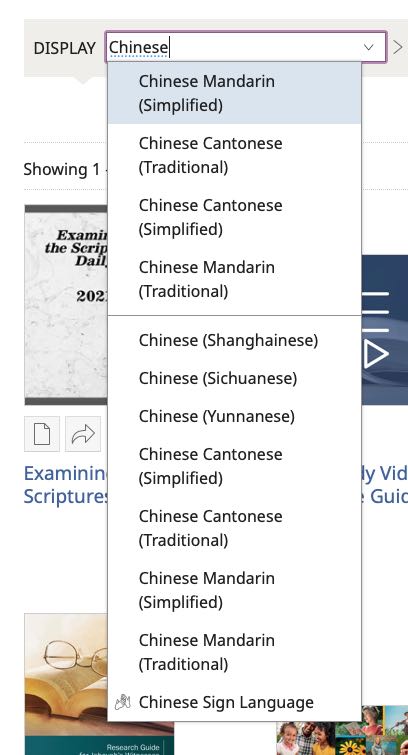
The organization has recently demonstrated that it recognizes the truth about how different many of the Chinese varieties of speech are from one another. For example, whereas before there was one Chinese edition of each publication (using Mandarin wording), now, some publications are available in different Chinese editions for different Chinese languages (including Cantonese), each with different wording.

List of different Chinese languages in which publications are available on jw.org
jw.org now has publications in different Chinese languages.

To help reduce the confusion around the inappropriate use of the English word “dialect” to translate “fāngyĂĄn (fāng·yĂĄn {direction → [place]} · speech → [topolect; dialect (common but misleading translation)] æ–č蚀)”, Professor Mair proposed that the word “topolect” (topo- (“place”) +‎ -lect (“[language] variety”)) be used instead as an exact, neutral English translation of “fāngyĂĄn (fāng·yĂĄn {direction → [place]} · speech → [topolect; dialect (common but misleading translation)] æ–č蚀)”. While not as well-known as “dialect”, the word “topolect” has gained a certain amount of recognition, and it can now be found in several dictionaries, e.g., The American Heritage Dictionary of the English Language, Wordnik, and Wiktionary.