Categories
Languages

Xībānyá Yǔ

Xībānyá+ (Spanish 西班牙) Yǔ+ (Language; Speech 语 語) ← Tap/click to show/hide the “flashcard”

In addition to all the English-speaking publishers who are helping in the Mandarin field, there are also many whose mother tongue is Spanish. “Spanish” in Spanish is “español”, and in Mandarin, it’s “Xībānyá (Spanish 西班牙) Yǔ (Language; Speech 语 語)”, this week’s MEotW.

ES Spanish Language Symbol ISO 639-1 IETF Language Tag Icon
es is the ISO 639-1 code and the IETF language tag for Spanish.

The syllables/morphemes that make up “Xībānyá (Spain | Spanish 西班牙)”—“xī+ (west | western 西)”, “bān+ (class; team | squad | {work shift} 班)”, and “yá+ (tooth [→ [ivory]] 牙)”—seem to have no semantic or meaningful connection to Spain or Spanish things, so it is evident that they were chosen because of sounding at least vaguely like “Spain” when spoken together.

As for “yǔ+ (language; speech | saying; proverb | words; expression | speak; say 语 語)”, as mentioned in the MEotW post on “Yīngyǔ (Yīng·yǔ English · Language; Speech 英语 英語)”, “yǔ (language; speech | saying; proverb | words; expression | speak; say 语 語)” refers specifically to the speech of a language—its linguistically primary aspect—not to any writing that came to be developed based on that speech.

Interesting Statistics

Wikipedia provides the following interesting statistics on Spanish:

Today, it is a global language with nearly 500 million native speakers, mainly in Spain and the Americas. It is the world’s second-most spoken native language, after Mandarin Chinese,[source][source] and the world’s fourth-most spoken language overall after English, Mandarin Chinese, and Hindi.

(Note that one of the sources for the above quote is the Ethnologue website, which seems to be one of the foremost authorities on the world’s languages.)

With so many Spanish-speakers in the world, it’s little wonder that they are so well represented in the worldwide Mandarin field.

Spanish’s Place in Its Language Family Tree

Wikipedia also tells us the following regarding Spanish’s place in its language family tree:

Spanish is a part of the Ibero-Romance group of languages of the Indo-European language family, which evolved from several dialects of Vulgar Latin in Iberia after the collapse of the Western Roman Empire in the 5th century.

This language family tree placement seems to be generally accepted, and is confirmed, for example, by American sinologist and University of Pennsylvania Professor of East Asian Languages and Civilizations Victor H. Mair in his article “What Is a Chinese ‘Dialect/Topolect’? Reflections on Some Key Sino-English Linguistic Terms” (p. 2), which can be found here (PDF) and here (web page) on his website Sino-Platonic Papers.

In comparison, English is also generally considered to be in the Indo-European language family, but in the Germanic group, not in the Ibero-Romance group like Spanish is.

Categories
Culture History

báihuà

báihuà+ (bái·huà {white → [colloquial; vernacular]} · speech [→ [writing based on vernacular speech]] 白话 白話) ← Tap/click to show/hide the “flashcard”

As mentioned in last week’s MEotW on “chéngyǔ (chéng·yǔ {(sth. that) has become} · saying → [set phrase (typically of 4 characters); idiom] 成语 成語)”, Literary Chinese was the standard style of writing in China for a long, long time. Since language naturally changes as time goes by, though, the way people actually talked became more and more different from Literary Chinese.

Eventually, starting about a century ago, in the early 1920s, written vernacular Chinese, or báihuà (bái·huà {white → [colloquial; vernacular]} · speech [→ [writing based on vernacular speech]] 白话 白話)—this week’s MEotW—began replacing Literary Chinese in literary works, and it eventually became the standard style of writing for Modern Standard Mandarin.

A Literary Turning Point

The Wikipedia article on written vernacular Chinese provides this summary regarding this literary turning point:

Jin Shengtan, who edited several novels in vernacular Chinese in the 17th century, is widely regarded as the pioneer of literature in the vernacular style. However, it was not until after the May Fourth Movement in 1919 and the promotion by scholars and intellectuals such as pragmatist reformer Hu Shih, pioneering writer Chen Hengzhe, leftist Lu Xun, Chen Duxiu, and leftist Qian Xuantong that vernacular Chinese, or Bai hua, gained widespread importance. In particular, The True Story of Ah Q by Lu Xun is generally accepted as the first modern work to fully utilize the vernacular language.[source]

The Wikipedia article on the May Fourth Movement adds the following:

In Chinese literature, the May Fourth Movement is regarded as the watershed after which the use of the vernacular language (baihua) gained currency over and eventually replaced the use of Literary Chinese in literary works. Intellectuals were driven toward expressing themselves using the spoken tongue under the slogan 我手写我口 [wǒ (my 我) shǒu (hand 手) xiě (writes 写 寫) wǒ (my 我) kǒu ({mouth(’s utterances)} 口)] (‘my hand writes [what] my mouth [speaks]’), although the change was actually gradual: Hu Shih had already argued for the use of the modern vernacular language in literature in his 1917 essay “Preliminary discussion on literary reform” (文学改良刍议), while the first short story written exclusively in the vernacular language, The True Story of Ah Q by Lu Xun, was not published until 1921.

Punctuation! Arabic Numerals!

Interestingly, the Wikipedia article on written vernacular Chinese, quoted above, goes on to make the following claim about what came along with this change to the vernacular style:

Along with the growing popularity of vernacular writing in books in this period was the acceptance of punctuation, modeled after that used in Western languages (traditional Chinese literature was almost entirely unpunctuated), and the use of Arabic numerals.

The above claim about how it came to be that we now benefit from punctuation in modern Chinese writings is repeated in the separate Wikipedia article on Chinese punctuation:

Although there was a long native tradition of textual annotation to indicate the boundaries of sentences and clauses, the concept of punctuation marks being a mandatory and integral part of the text was only adapted in the written language during the 20th century due to Western influence.

A quick web search also turned up this post on the Chinese Language Stack Exchange website, part of which says:

I have seen some old Chinese books. The words flowed from top to bottom on the page and there was no punctuation.

We can be thankful that báihuà (bái·huà {white → [colloquial; vernacular]} · speech [→ [writing based on vernacular speech]] 白话 白話) (along with, apparently, punctuation and Arabic numerals) replaced Literary Chinese as the standard style of writing for Mandarin, just as I’m sure that the English-speakers among us are thankful that the standard written English of today is no longer the written English of Shakespeare or that of the King James Version of the Bible.

How About Cantonese, Shanghainese, Etc.?

Báihuà (Bái·huà {white → [colloquial; vernacular]} · speech [→ [writing based on vernacular speech]] 白话 白話) not only became the standard style of writing for Modern Standard Mandarin, but due to China’s particular language and political situation, it also became the standard style of writing for speakers of Cantonese and of other Chinese languages, as Wikipedia points out:

Since the early 1920s, this modern vernacular form has been the standard style of writing for speakers of all varieties of Chinese throughout mainland China, Taiwan, Malaysia and Singapore

As someone who was in the Cantonese field for a long time before joining the Mandarin field, I can attest to the fact that years ago in the Cantonese field, we would use official publications that were actually in written Mandarin, with its different vocabulary, etc., because báihuà (bái·huà {white → [colloquial; vernacular]} · speech [→ [writing based on vernacular speech]] 白话 白話), the standard writing style in the Chinese world, is based on Mandarin.

Recently, though, Jehovah’s organization has carried on in the direction gone in by báihuà (bái·huà {white → [colloquial; vernacular]} · speech [→ [writing based on vernacular speech]] 白话 白話), of having writing reflect how people actually talk, by making available publications in which the writing is based on spoken Cantonese, in addition to the existing publications using written Mandarin. (Publications in which the writing is based on other spoken Chinese languages are also available.) This is in harmony with a basic principle regarding how God designed and created humans to use language, which, as linguists have figured out, is that speech is primary and writing is secondary.

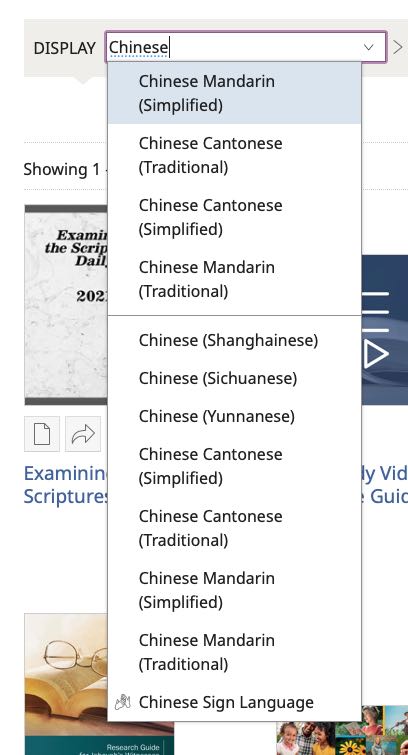
Different kinds of written Chinese on jw.org

Publications are available on jw.org in writing based on different Chinese languages, to better match how people actually talk in those languages.

Categories
Culture Languages

zìmǔ

zìmǔ+ (zì·mǔ character; word · mothers → [letters (of an alphabet) [→ [alphabet]]] 字母) ← Tap/click to show/hide the “flashcard”

As previous MEotW posts (like this one) have shown, “zì (character; word; letter 字)” in Mandarin can mean “character”, such that “Hànzì (Hàn·zì {Han (Chinese)} · Characters 汉字 漢字)”, for example, means “Chinese characters”. In fact, even though “zì (character; word; letter 字)”, like its English counterpart “character”, can refer to printed or written letters or symbols in general, Hànzì (Hàn·zì {Han (Chinese)} · Characters 汉字 漢字) are such an 800-pound gorilla in Chinese culture that in Mandarin, “zì (character; word; letter 字)” by itself is often understood to specifically mean the Hànzì (Hàn·zì {Han (Chinese)} · Characters 汉字 漢字), the Chinese characters. This way of thinking has spilled over into the English-speaking world as well, which is why when English-speaking publishers in the Chinese fields speak of “the characters”, that’s generally understood to mean “the Chinese characters”, which in turn is understood to mean the 汉字 and not the Pīnyīn (Pīn·yīn {Piecing Together of} · Sounds → [Pinyin] 拼音), even though Pīnyīn (Pīn·yīn {Piecing Together of} · Sounds → [Pinyin] 拼音) is also Chinese and made up of characters (printed or written letters or symbols).

So, when we want to refer to a letter of an alphabet, as opposed to a Chinese character, when speaking Mandarin, we can make that clear by using this week’s MEotW, “zìmǔ (zì·mǔ character; word · mothers → [letters (of an alphabet) [→ [alphabet]]] 字母)”. In Mandarin, a zìmǔ+ (zì·mǔ character; word · mothers → [letters (of an alphabet) [→ [alphabet]]] 字母) is literally a “character/word mother”, something that characters or words come from.

How is it that even Chinese characters or words come from letters? Well, contrary to the traditional Chinese cultural view that Chinese characters are the primary aspect of Chinese languages, linguists (language scientists) now recognize that speech is primary and writing is secondary. So, a Mandarin expression is not primarily something written with Chinese characters, but rather is primarily something spoken in Mandarin. Whereas a Chinese character coarsely represents an entire syllable, letters of alphabets in general represent the individual speech sounds (called phonemes by linguists) that make up the spoken expressions that are the primary part of a language, and this is especially true of a purpose-designed phonetic alphabet like Pīnyīn (Pīn·yīn {Piecing Together of} · Sounds → [Pinyin] 拼音).

For example, whereas the Chinese character “字” represents an entire Mandarin syllable as one coarse unit, the Pīnyīn (Pīn·yīn {Piecing Together of} · Sounds → [Pinyin] 拼音) expression “zì (character; word; letter 字)” finely spells out the initial sound, the final sound, and even the tone that actually make up that Mandarin syllable.

That speech and the individual sounds that make it up are the real foundation of any human language is such an important, unignorable linguistic principle that even schoolchildren in China (see especially the Z.T. subheading) learn basic Mandarin speech and Pīnyīn (Pīn·yīn {Piecing Together of} · Sounds → [Pinyin] 拼音) before getting immersed in Hànzì (Hàn·zì {Han (Chinese)} · Characters 汉字 漢字), Chinese characters, as tradition dictates.

Perhaps, then, it would be appropriate for Chinese culture, which values filial piety, to be more respectful towards the letters of its phonetic alphabet Pīnyīn (Pīn·yīn {Piecing Together of} · Sounds → [Pinyin] 拼音), which, both linguistically and educationally, are the “mothers” of the characters it loves so much!