Categories
Culture Current Events Language Learning

nànmín

nànmín (nàn·mín calamity; disaster; adversity; distress · {person of a certain occupation} → [refugee] 难民 難民) ← Tap/click to show/hide the “flashcard”

On February 24, 2022, Russia sent significant military forces into Ukraine, resulting in the largest scale open warfare in Europe since World War II. Knowing certain Mandarin expressions will help us in the Mandarin field as we hear about and talk about Ukraine in the time ahead.

As of this writing, the article “Refugee Crisis​—Millions Flee Ukraine” is being featured on jw.org. In the Mandarin version of that article, the English word “refugee” is translated as “nànmín (nàn·mín calamity; disaster; adversity; distress · {person of a certain occupation} → [refugee] 难民 難民)”, this week’s MEotW.

While it may seem odd to say in the Pīnyīn (Pīn·yīn {Piecing Together} · Sounds → [Pinyin] 拼音) Plus information that a refugee has an “occupation”, note that an occupation can be defined, not just as a job or profession, but also as “any activity that occupies a person’s attention”. Unfortunately, being a refugee certainly “occupies a person’s attention”.

(By the way, in the Mandarin version of the above-mentioned article, “refugee crisis” is translated as “nànmín (nàn·mín calamity · {persons of a certain occupation} → [refugees] 难民 難民) cháo (tide → [(social) upsurge] 潮)”. “Cháo (tide [→ [(social) upsurge; current; trend]] 潮)” literally means “tide”, which is an easily understood metaphor, similar to how in English we may speak of a “wave” of refugees.)

A Shifty Character

One may notice that the first Chinese character used to write “nànmín (nàn·mín calamity; disaster; adversity; distress · {person of a certain occupation} → [refugee] 难民 難民)”, “难/難”, is also the Chinese character used to write “nán ({[is] difficult}; {[is] hard} | difficultly | {make difficult/difficulties})”, a common word that basically means “difficult”. One then can hardly fail to notice that whereas with “nànmín (nàn·mín calamity; disaster; adversity; distress · {person of a certain occupation} → [refugee] 难民 難民)”, “难/難” is pronounced with a fourth tone, with “nán ({[is] difficult}; {[is] hard} | difficultly | {make difficult/difficulties})” it is pronounced with a second tone. But, aren’t characters supposed to be the grand clarifiers of meaning in a Mandarin language awash in homophones (words that sound the same, but that have different meanings)?

Yes, it has become customary to rely (too much) on characters that are seen to disambiguate or clarify pronunciations that are heard, but the truth is that characters themselves can also be ambiguous on their own, since, as our example above shows, characters can have multiple pronunciations and meanings.

What is the real ultimate clarifier of meaning in Mandarin, even when it has been allowed to develop as many homophones as it has? The ultimate clarifier is context, not characters! For example, when we see that “难/難” is followed by “民”, that context tells us that here, “难/難” is pronounced as “nàn”, with its associated meaning, not as “nán”, with its different associated meaning. On its own, without context, the character “难/難” is ambiguous.

For more information on why it’s problematic to rely on characters to disambiguate homophones in Mandarin, see the subheading “But There Are So Many Words That Sound the Same!” in the article “Pīnyīn (Pīn·yīn {Piecing Together} · Sounds → [Pinyin] 拼音) Was Plan A”.

“Context is God”

Regarding context, the MEotW post on “yǔjìng (yǔ·jìng language · {(set of) boundaries → [(bounded) place; area] → [condition; situation; circumstances]} → [context] 语境 語境)” had this to say:

Context and Mandarin Writing Systems

Research into the importance of context turned up a couple of interesting sayings from the business world:

Content is king.
—Bill Gates

Content is king, but context is God.
—Gary Vaynerchuk

Mandarin field language-learners may hear the assertion from Chinese culture traditionalists that it is necessary to use Chinese characters to clarify the ambiguity that results from Mandarin having so many homophones, words that sound the same but that have different meanings. The insinuation, or even the outright accusation, is that the upstart Pīnyīn (Pīn·yīn {Piecing Together} · Sounds → [Pinyin] 拼音) system is thus unusable as a writing system for Mandarin, that the Chinese characters writing system is still the rightful king. Besides, there is so much existing content written in Chinese characters, and content is king!

However, a little consideration of the yǔjìng (yǔ·jìng language · {(set of) boundaries → [(bounded) place] → [situation]} → [context] 语境 語境), the language situation or context, shows up the fallacy of this assertion. The Chinese characters writing system exists along with Mandarin speech, and if Chinese characters are truly required to clearly communicate meaning in Mandarin, then that would mean that Mandarin speech on its own, without the help of visible characters, is unusable as a means of communication. That, however, is obviously not true—people who are proficient in spoken Mandarin communicate clearly with each other all the time, undoubtedly pretty much as clearly as proficient English speakers communicate with each other.

The key reason why proficient Mandarin speakers can communicate clearly with each other despite all of the homophones in Mandarin is not that they are constantly referring to Chinese characters, although people do occasionally do that in the current characters-saturated cultural climate. No, the key reason why Mandarin-speakers routinely communicate clearly with each other is because they use sufficient context to clarify any potentially ambiguous homophones. And, since Pīnyīn (Pīn·yīn {Piecing Together} · Sounds → [Pinyin] 拼音) is a simple and direct representation of Mandarin speech, anything that is understandable when spoken in Mandarin is understandable when written in Pīnyīn (Pīn·yīn {Piecing Together} · Sounds → [Pinyin] 拼音).—1 Corinthians 14:8–11.

So, while Chinese characters-based content may be so predominant in the Chinese world that it’s king there, context is God, relatively and metaphorically speaking, and Mandarin speech and Pīnyīn (Pīn·yīn {Piecing Together} · Sounds → [Pinyin] 拼音) rightly rely on context, not on Chinese characters, just like we rightly rely on God, not on merely human kings.

Categories
Current Events

Àomìkèróng

Àomìkèróng (Omicron 奥密克戎 奧密克戎) ← Tap/click to show/hide the “flashcard”

[Note: Tap/click on a Pīnyīn (Pīn·yīn {Piecing Together} · Sounds → [Pinyin] 拼音) expression to reveal its “flashcard”, tap/click on a “flashcard” or its Pīnyīn (Pīn·yīn {Piecing Together} · Sounds → [Pinyin] 拼音) expression to hide the “flashcard”.]

As of this writing, near the end of 2021, the subject of the COVID-19 pandemic has been, to say the least, on people’s minds now for a while. So, it would be good to be able to refer to things related to it in Mandarin when speaking to people in the Mandarin field, or when speaking to our brothers and sisters in the truth.

electron microscope image of SARS-CoV-2—also known as 2019-nCoV, the virus that causes COVID-19

An electron microscope image of SARS-CoV-2—also known as 2019-nCoV, the virus that causes COVID-19
Creative Commons Attribution License logo NIAID

This week’s MEotW, “Àomìkèróng (Omicron 奥密克戎 奧密克戎)”, is one way to say “Omicron”—as in the Omicron variant of the virus that causes COVID-19—in Mandarin.

Another way to say “Omicron” in Mandarin is “Àomǐkěróng (Omicron 奥米可戎 奧米可戎)”.

To get an idea of how commonly used these expressions are compared to each other, consider the numbers of Google search results involving these expressions, together with “biànzhǒng (biàn·zhǒng changed · kind; type; variety → [mutation; variant; variety] 变种 變種)” (a past MEotW) and “biànyì zhū ((biàn·yì changed · {to be different} 变异 變異) (zhū {trunk of a tree → [strain]} 株) [(virus) strain/variant])”, two common ways to say “variant”:

Àomìkèróng (Omicron 奥密克戎 奧密克戎)
Search Terms Google Results Approx. No.
"奥密克戎变种"
(Àomìkèróng (Omicron 奥密克戎 奧密克戎) biànzhǒng (biàn·zhǒng changed · kind; type; variety → [mutation; variant; variety] 变种 變種))
696,000
"奥密克戎变异株"
(Àomìkèróng (Omicron 奥密克戎 奧密克戎) biànyì zhū ((biàn·yì changed · {to be different} 变异 變異) (zhū {trunk of a tree → [strain]} 株) [(virus) strain/variant]))
4,220,000
Àomǐkěróng (Omicron 奥米可戎 奧米可戎)
Search Terms Google Results Approx. No.
"奥米可戎变种"
(Àomǐkěróng (Omicron 奥米可戎 奧米可戎) biànzhǒng (biàn·zhǒng changed · kind; type; variety → [mutation; variant; variety] 变种 變種))
4
"奥米可戎变异株"
(Àomǐkěróng (Omicron 奥米可戎 奧米可戎) biànyì zhū ((biàn·yì changed · {to be different} 变异 變異) (zhū {trunk of a tree → [strain]} 株) [(virus) strain/variant]))
0

(Note that the quotation marks in the search terms tell Google to look for the exact sequences of characters that are inside the quotation marks—the results of searching without the quotation marks can be very different.)

Sounds Like…

Note that both “Àomìkèróng (Omicron 奥密克戎 奧密克戎)” and “Àomǐkěróng (Omicron 奥米可戎 奧米可戎)” are Mandarin expressions that were constructed, not because of the meanings represented by the Chinese characters used to write them, but because the Mandarin syllables used to say them sound like the English word “Omicron”.

In fact, when talking or writing in Mandarin about the Omicron variant, it is very common for people to just use the actual English word “Omicron”, which sounds more like the English word “Omicron” than anything else, and is not a Mandarin word written using the supposedly ideographic (representing meaning through visible symbols) Chinese characters.

Omicron
Search Terms Google Results Approx. No.
"omicron变种"
(Omicron biànzhǒng (biàn·zhǒng changed · kind; type; variety → [mutation; variant; variety] 变种 變種))
3,880,000
"omicron变异株"
(Omicron biànyì zhū ((biàn·yì changed · {to be different} 变异 變異) (zhū {trunk of a tree → [strain]} 株) [(virus) strain/variant]))
2,850,000

It is no surprise to linguists (language scientists/scholars) that people naturally focus on what words sound like when spoken, because, while of course meaning is what, well, gives life meaning, one of the basic principles of modern linguistics (the scientific study of language) is that speech is primary, and writing is secondary. That means that God designed us humans to express meaning via language primarily using speech that is heard, not writing that is seen, no matter how much lovers of Chinese characters traditionally focus on that visually intricate writing system above all else.—1 Corinthians 14:8–11.

Categories
Culture Current Events Language Learning

sàng

sàng ({lost (by death)} [→ [lost (sth. important) | bereaved | dejected; frustrated; disappointed; discouraged]]) ← Tap/click to show/hide the “flashcard”

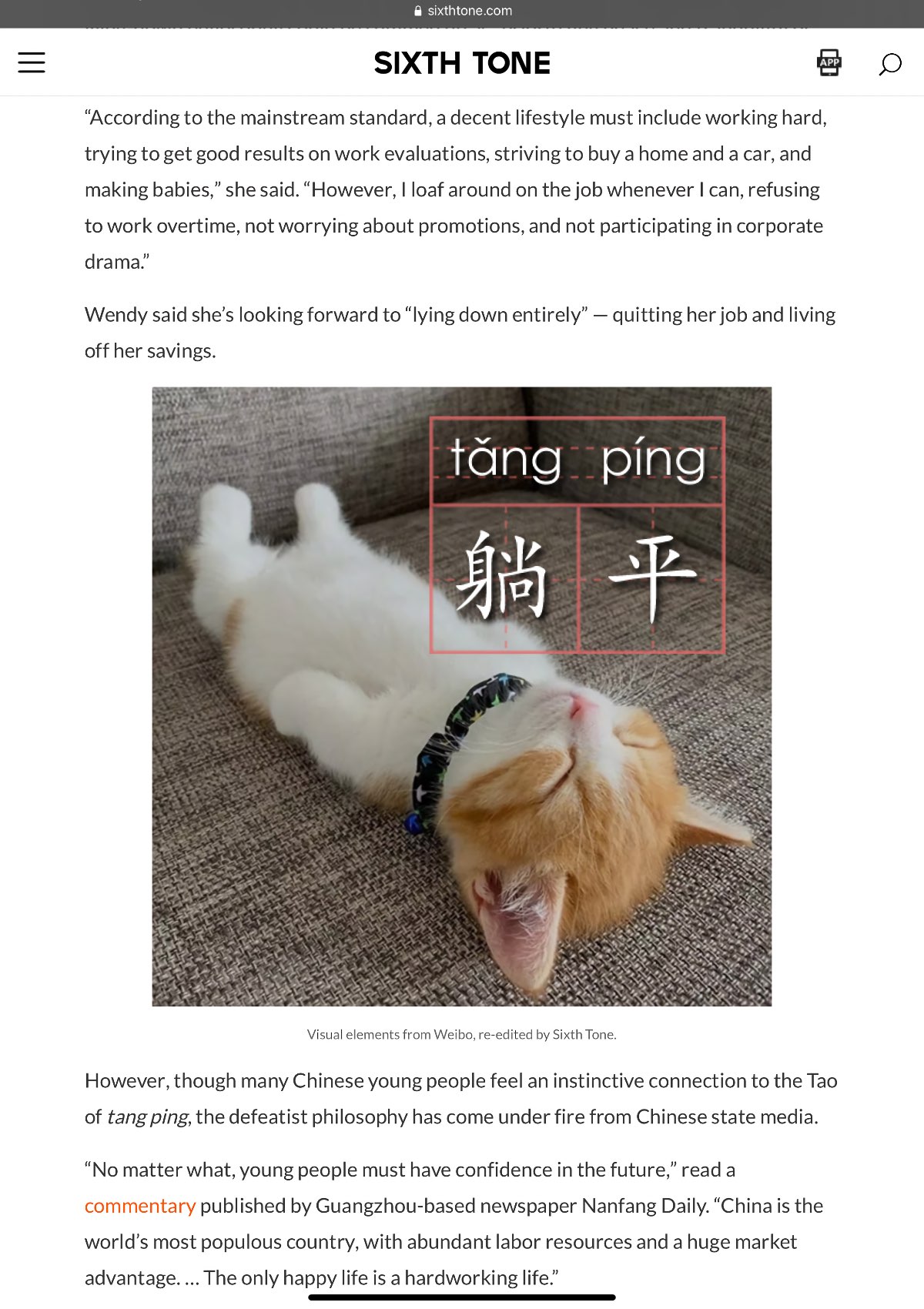
The post about past MEotW “tǎngpíng (tǎng·píng lie; recline · {[to be] flat} 躺平)” refers to this article:

Screenshot of the article “Tired of Running in Place, Young Chinese ‘Lie Down’ ”, on the Sixth Tone website

This article in turn refers to an article about the culture of “sàng ({lost (by death)} [→ [lost (sth. important) | bereaved | dejected; frustrated; disappointed; discouraged]])”, this week’s MEotW.

What is sàng ({lost (by death)} [→ [lost (sth. important) | bereaved | dejected; frustrated; disappointed; discouraged]]) culture, or, in Mandarin, sàng ({lost (by death)} [→ [lost (sth. important) | bereaved | dejected; frustrated; disappointed; discouraged]]) wénhuà (wén·huà {(with) writing} · transformed (system) → [culture] 文化)?

Another article that I found provides this nice, simple description: (Note: The rest of the article contains some good information, but has a couple of curse words.)

A little Mandarin lesson here-

The character 丧 is a polyphone in mandarin Chinese. When it is pronounced sāng, it loosely translates to funeral or mourning. When as sàng, it could be referring to either losing certain things or people (“丧失”), or a conglomeration of negative emotions such as feeling depressed, angry, disappointed and vexed.

And the sàng culture we are talking about here really takes both meanings: it is, very vaguely, the idea that you’ve lost something and are feeling horrible about it.

Manifestations

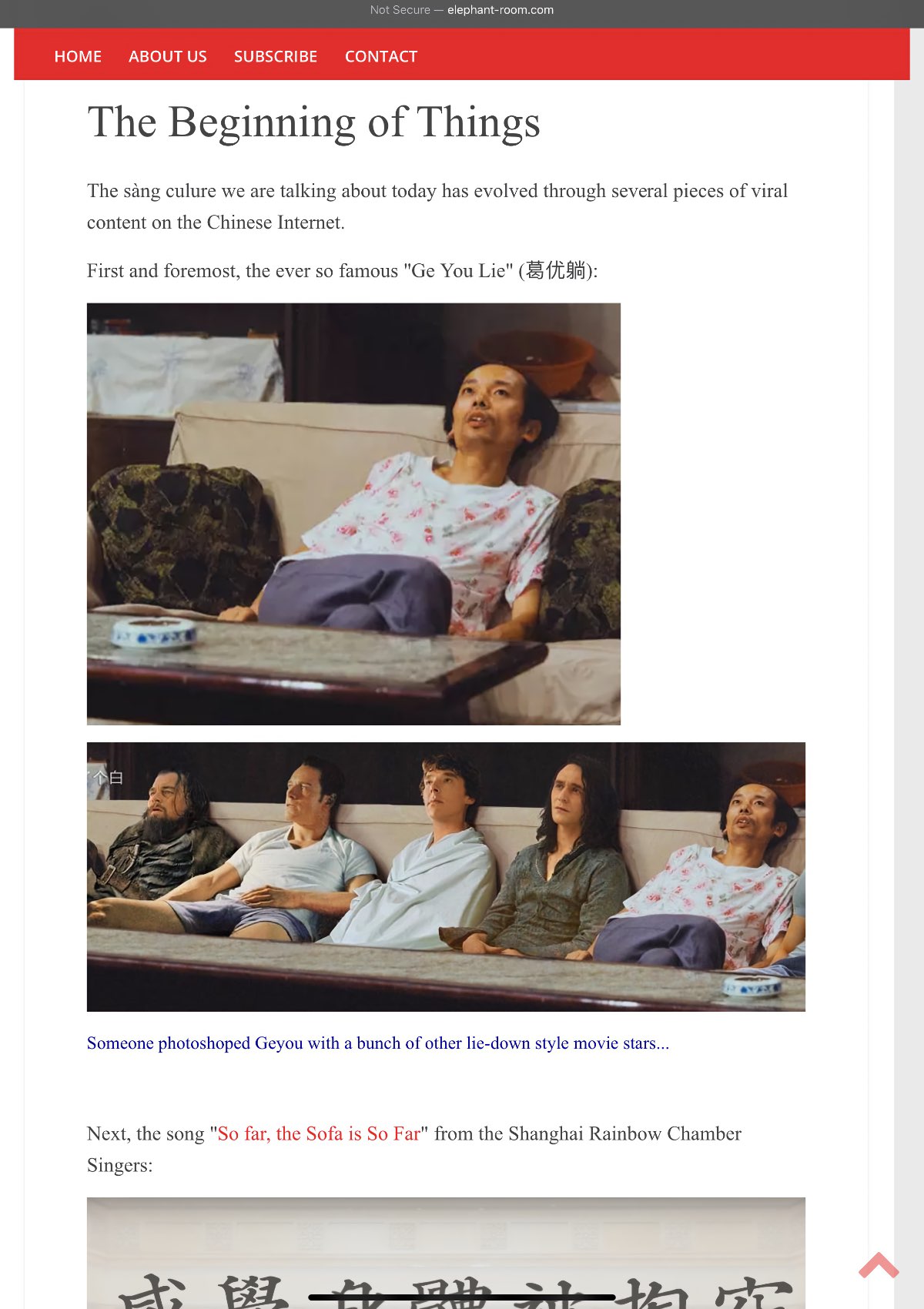
This article also goes on to mention some ways in which sàng ({lost (by death)} [→ [lost (sth. important) | bereaved | dejected; frustrated; disappointed; discouraged]]) wénhuà (wén·huà {(with) writing} · transformed (system) → [culture] 文化) has been manifested:

Screenshot of the article “The Culture of sàng: a Generation Lying-down? | China Buzz Report”, on the Elephant Room website

As the above article mentions, and as shown in the above screenshot, one of the first manifestations of sàng ({lost (by death)} [→ [lost (sth. important) | bereaved | dejected; frustrated; disappointed; discouraged]]) wénhuà (wén·huà {(with) writing} · transformed (system) → [culture] 文化) was the “Gě Yōu ((Gě [surname] 葛) (Yōu Ample; Abundant [→ [Excellent; Superior]] | Actor; Actress優/优) (a Chinese actor)) tǎng ({lies down} 躺)” set of memes, viral content on the Chinese Internet. (Gě Yōu ((Gě [surname] 葛) (Yōu Ample; Abundant [→ [Excellent; Superior]] | Actor; Actress優/优) (a Chinese actor)) is a well-known Chinese actor, and the picture in the above screenshot is from the 1993 TV show (I 我) Ài (Love) (My 我) Jiā (Family 家), in which he plays the role of “a parasitical freeloader who was unemployed and broke and consistently failed in his filial responsibilities”, as one academic article put it.)

A translation of a Chinese article on sàng ({lost (by death)} [→ [lost (sth. important) | bereaved | dejected; frustrated; disappointed; discouraged]]) wénhuà (wén·huà {(with) writing} · transformed (system) → [culture] 文化) contains these comments about the image that the “Gě Yōu ((Gě [surname] 葛) (Yōu Ample; Abundant [→ [Excellent; Superior]] | Actor; Actress優/优) (a Chinese actor)) tǎng ({lies down} 躺)” memes are based on:

This image runs contrary to the positive, healthy and upwardly mobile mainstream views that people of all generations favor. It does, however, fit in well with the youth culture of today. His decadence, despair, pessimism and hopelessness are exactly the inner state of this group of masses who work overtime, eat overtime, are under constant pressure and are having a hard time making a living.

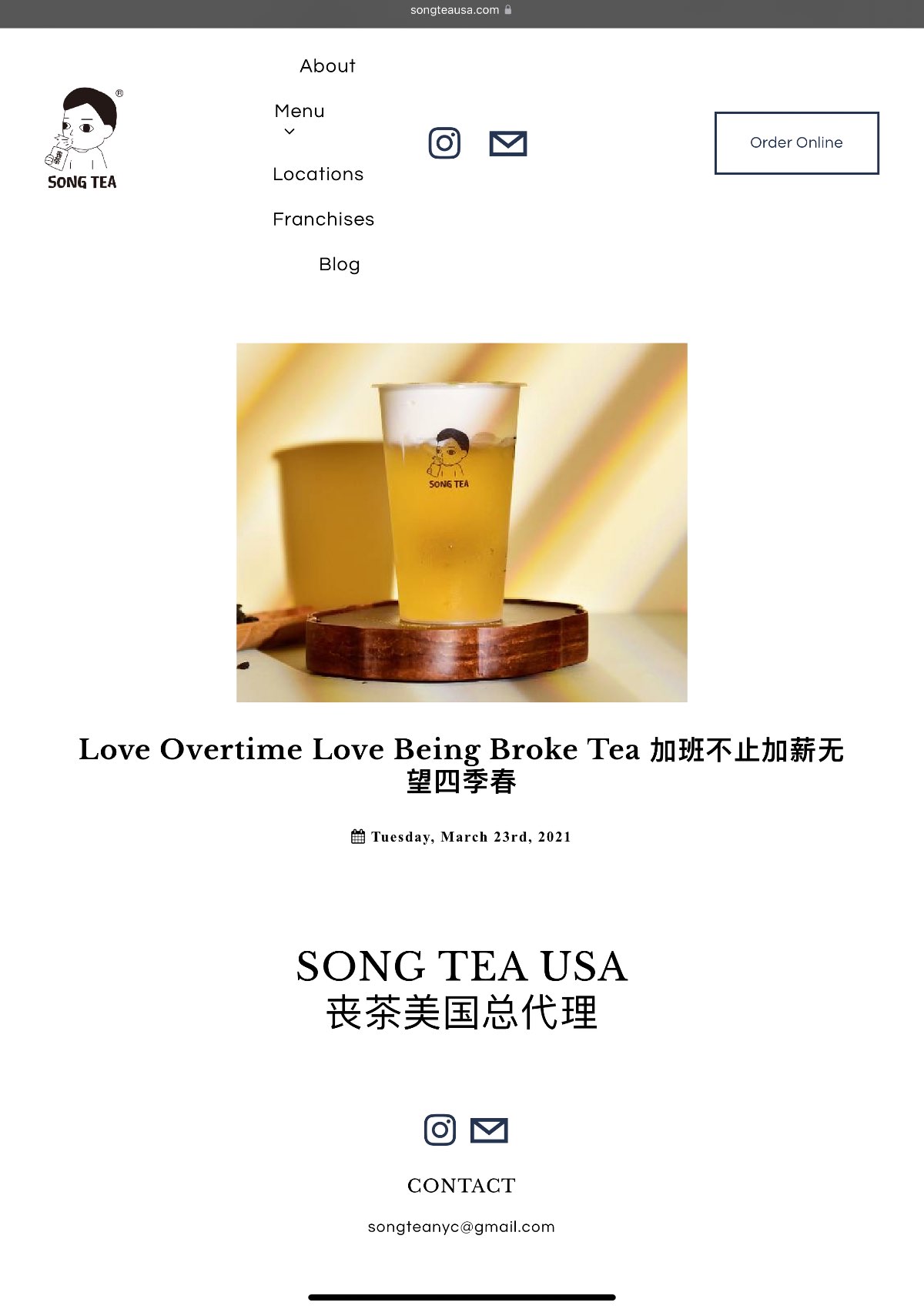
Speaking of making a living, one business named Sàng ({Lost (by Death)} [→ [Lost (Sth. Important) | Bereaved | Dejected; Frustrated; Disappointed; Discouraged]]) Chá (Tea 茶) (English name: Song Tea) is opportunistically riding the wave of sàng ({lost (by death)} [→ [lost (sth. important) | bereaved | dejected; frustrated; disappointed; discouraged]]) culture with a chain of tea shops that uses tongue-in-cheek black humour in the names of its drinks, such as this one featured on its USA blog:

Screenshot of the blog post “Love Overtime Love Being Broke Tea 加班不止加薪无望四季春 - 丧茶美国总代理Song Tea”, on the Song Tea USA website

From Feeling Bereaved to Lying Flat

The “tǎng ({lies down} 躺)” used in “Gě Yōu ((Gě [surname] 葛) (Yōu Ample; Abundant [→ [Excellent; Superior]] | Actor; Actress優/优) (a Chinese actor)) tǎng ({lies down} 躺)” is the same one as the one in “tǎngpíng (tǎng·píng lie; recline · {[to be] flat} 躺平)”, and “sàng ({lost (by death)} [→ [lost (sth. important) | bereaved | dejected; frustrated; disappointed; discouraged]])” is indeed related to “tǎngpíng (tǎng·píng lie; recline · {[to be] flat} 躺平)”. Perhaps it can be said that the feeling of sàng ({lost (by death)} [→ [lost (sth. important) | bereaved | dejected; frustrated; disappointed; discouraged]]) moves many of those experiencing it to take the action of tǎngpíng (tǎng·píng lying; reclining · {[to be] flat} 躺平). As an above-mentioned article on tǎngpíng (tǎng·píng lie; recline · {[to be] flat} 躺平) says:

Unlike similar, previous terms to have had their time in the spotlight in recent years, tang ping is an action rather than a feeling — resolving to just scrape by, exerting the bare minimum effort at an unfulfilling job, as opposed to the futility of raging against the capitalist machine.

Echoing the West?

The title of one of the articles mentioned above, “Turn Off, Drop Out: Why Young Chinese Are Abandoning Ambition”, appears to be a play on the Western counterculture-era phrase “turn on, tune in, drop out”. In the 1960s, while the West was going through its counterculture era, China was in contrast undergoing its Cultural Revolution—a very different thing! Perhaps, similarly to how China is now racing off into space, and even to the moon, as the West did decades ago, it is now also in some ways changing in its popular culture, as the West did decades ago.

Stand Strong for These “Sheep Without a Shepherd”

If you are mourning your lack of progress in learning Mandarin despite your strenuous efforts to learn the traditionally mandated but extraordinarily and unnecessarily complex Chinese characters, please be assured that there is an alternative to just quitting the Mandarin field. Focusing on Mandarin SPEECH with the help of the simple and elegant Pīnyīn (Pīn·yīn {Piecing Together} · Sounds → [Pinyin] 拼音) writing system can help you get a grip on understanding Mandarin speech, and on using it to give meaningful spiritual help to those in the worldwide field whose mother tongue is Mandarin.

As this look at sàng ({lost (by death)} [→ [lost (sth. important) | bereaved | dejected; frustrated; disappointed; discouraged]]) culture shows us, many of them are feeling the need for something beyond the selfish, materialistic, and ultimately meaningless rat race promoted by Satan’s world—they need the good news of God’s Kingdom, and they need people like us to share it with them in a language that they will understand and respond to from the heart.—Mr. 6:34.