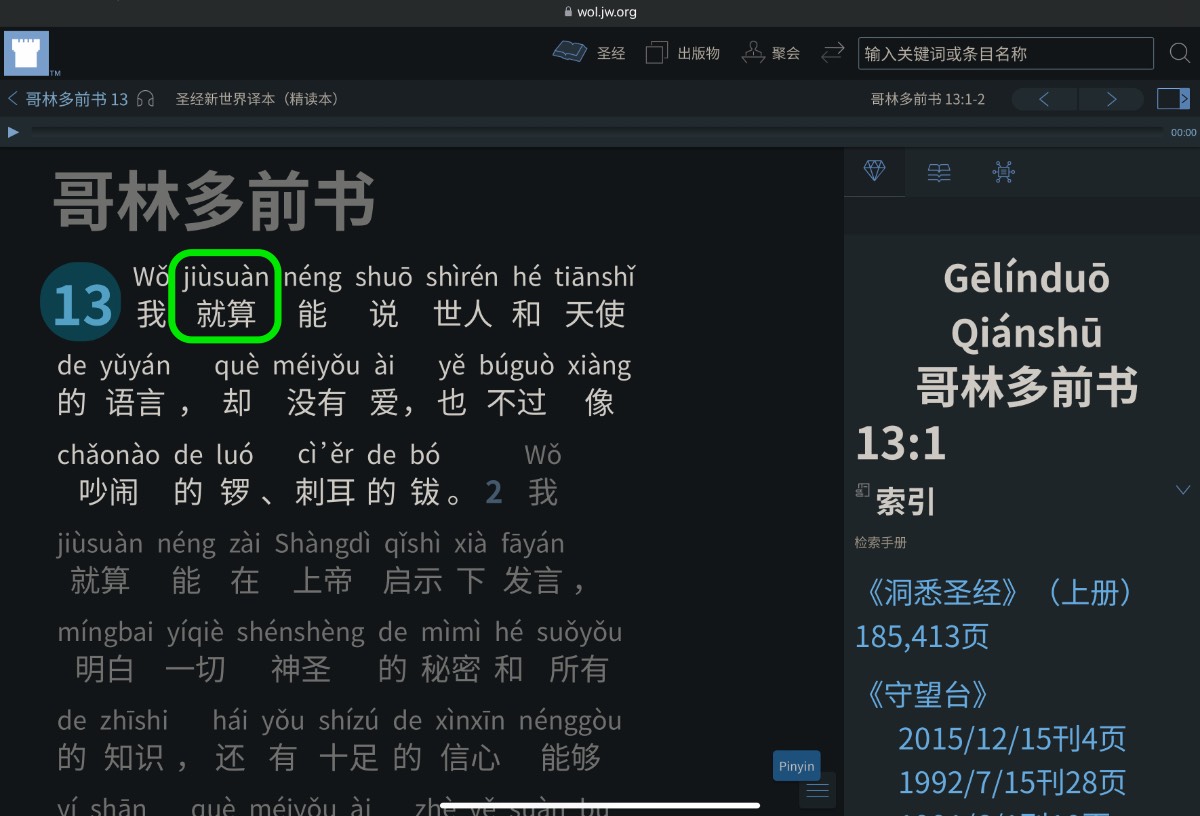
cì’ěr+ (cì’·ěr {stabs; pricks → [irritates; pierces]} · ear → [grating on the ear; jarring; ear-piercing] 刺耳) ← Tap/click to show/hide the “flashcard”
I have long especially liked 1 Corinthians 13. It contains counsel on what really does and doesn’t matter in life, an extensive description and definition of the most important kind of love, and a sublime discussion about the need to become complete, mature, as a person. As these apply to life in general, so too do they apply to our lives as Mandarin field language learners.
As Mandarin field language learners, it can benefit us greatly to consider what we can learn from 1 Corinthians 13, and along the way, we can also consider some of the Mandarin expressions used in that chapter in the current version of the Mandarin New World Translation Bible (nwtsty).
“Clashing”
This week’s MEotW, “cì’ěr (cì’·ěr {stabs; pricks → [irritates; pierces]} · ear → [grating on the ear; jarring; ear-piercing] 刺耳)”, occurs in verse 1 (WOL, Pīnyīn (Pīn·yīn {Piecing Together of} · Sounds → [Pinyin] 拼音) Plus) of 1 Corinthians 13:
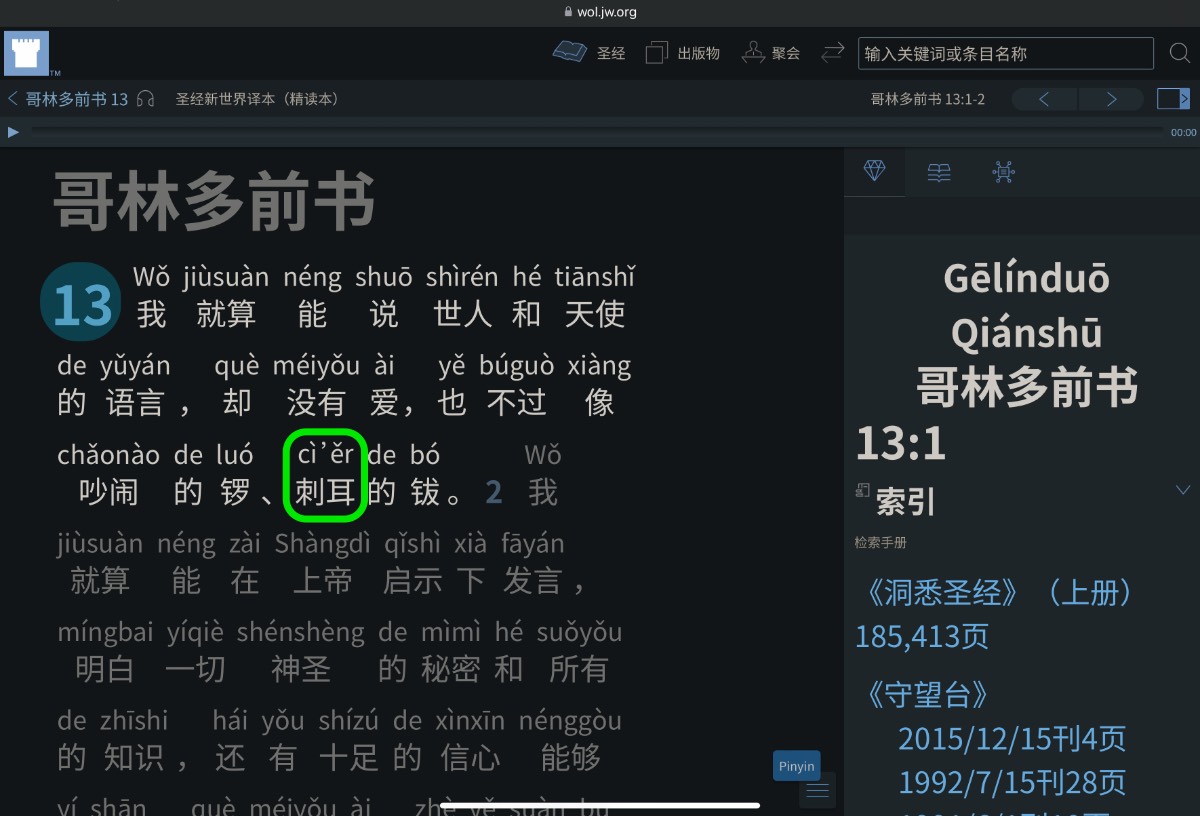
(Dark mode for the Watchtower ONLINE LIBRARY (WOL) website, as shown in the above image, can be enabled in the Safari web browser by using the Noir Safari extension.)
“Cì’ěr (Cì’·ěr {stabs; pricks → [irritates; pierces]} · ear → [grating on the ear; jarring; ear-piercing] 刺耳)” literally means “stabs ear”, and is used in the Mandarin New World Translation Bible’s rendering of 1 Corinthians 13:1 to translate the “clashing” in “clashing cymbal”. In this context, “cì’ěr (cì’·ěr {stabs; pricks → [irritates; pierces]} · ear → [grating on the ear; jarring; ear-piercing] 刺耳)” effectively means “grating on the ear; jarring; ear-piercing”.
Mandarin Field Need-Greater? Or Ear-Grater 😬?
First, let me establish that of course Jehovah and we who are in the Mandarin field deeply appreciate those who have been moved by love to come and try to learn Mandarin and help out in the Mandarin field. Given that, sometimes things do happen that can literally and figuratively grate on the ears of those who truly serve in this field out of love, and who have become acquainted with what good Mandarin sounds like.
The Tone Beast…
One time, a brother I know whose mother tongue is English gave a Mandarin talk during which so many of his tones were off that at times I was genuinely having trouble making out what words he was saying, even when I was listening closely. After that meeting, when I tried to kindly advise him that this was the case, he jokingly quipped something like ‘Well, at least I made you listen closely!’
Maybe this brother really did try his best, and maybe his reply was just an attempt to lighten the mood with some humour. He may also have felt safe using some humour because we know each other and generally get along fairly well. However, his words in this case might also be taken to show that he took his responsibility to give a good Mandarin talk a bit lightly. If so, things said with such a flippant attitude could grate on the ears of someone who views with appropriate seriousness the God-honouring and life-saving work that needs to be done in the Mandarin field.
It is true that especially for those whose mother tongue is, say, English, the tones can be one of the most difficult aspects of Mandarin for them to master, since that way of using pitch (how high or low a “note” is) is so different from how they use pitch in English. The sincere efforts of Mandarin field language learners in this regard are much appreciated!
…And How to Tame It
For those of us who are trying to learn Mandarin for the Mandarin field, it should help if we keep the following points in mind regarding Mandarin tones:
- Tones are just as important to conveying meaning in Mandarin as vowels are to conveying meaning in English. In English, if someone says a wrong vowel, that person is not actually saying the word that person meant to say, and that person is not expressing the meaning that person meant to express. For example, there’s a world of difference between “I love you” and “I leave you”, even though it’s “only” the matter of a single vowel. Similarly, in Mandarin, if someone uses a wrong tone, that person is saying a whole different word from what that person meant to say, as shown by the classic example of “mā+ (ma; mom; mummy; mother 妈 媽)/má (hemp; flax; linen | (surname) | {[is] pocked; pockmarked; pitted; spotty} [→ [[is] rough; coarse]] | numbed; tingling | sesame 麻 麻/蔴)/mǎ+ (horse [(surname)] [→ [knight chess piece; horse piece in Chinese chess | [is] big; large]] 马 馬)/mà ({verally abuse}; curse; swear; {call names} [→ [condemn; rebuke; reprove; scold]] 骂 罵/駡)/ma ([? ptcl for “yes/no” questions] 吗 嗎)”.
- In languages like English, we may change the pitch of what we are saying to do things like add emphasis, ask a question, etc. In Mandarin, though, as explained above, the tone of a syllable—which involves how pitch is used while saying it—is an essential part of how that syllable represents meaning. So, while in English the way we use pitch while saying a word may be negotiable based on how we want to emphasize it, etc., in Mandarin, tones are non-negotiable, like our stand on blood transfusions is non-negotiable. A first tone, for example, must always be recognizable as a first tone and must not be changed into a fourth tone or something, no matter how much we want to emphasize a Mandarin word with a first tone in it!
- How can we add emphasis in Mandarin, then? Study 10 of the Teaching (th) brocure, entitled “Modulation”, tells us that ‘we can convey ideas clearly and stir emotion by varying our volume, pitch, and pace’. So, while the pitches of Mandarin tones are non-negotiable, we can still add emphasis in Mandarin by varying volume—by speaking softer or louder—and/or by varying pace—by speaking slower or faster.
- Wrong tones can be really cì’ěr (cì’·ěr {stabbing → [irritating]} · ear → [grating on the ear] 刺耳) because, as mentioned above, tones are made of pitch, and when one speaks with wrong pitches, it’s a lot like singing off-key—very grating to the ears of those who know how the music of the language should sound! 🎵
With the above points in mind, do the following:
- Practise recognizing the different tones and telling them apart when listening to Mandarin speech. This is especially important if you have just recently started to learn Mandarin, and are not used to what Mandarin tones sound like yet. Such practice is needed to gradually train your hearing. As it is with determining if a musical instrument is in tune or not, eventually, with focus and practice, recognizing Mandarin tones will become easier, even second nature.
- As you get better at being able to recognize good Mandarin tones when you hear them, that will in turn help you to make sure you speak with good Mandarin tones. Speaking of which…
- Practise speaking with correct Mandarin tones. This is also especially important if you have just recently started to learn Mandarin, and are not used to speaking with Mandarin tones yet. Such practice is needed to gradually train your body’s system for producing speech. Beware: If you let yourself get into bad habits early on involving the tones, then you’ll have to walk a long, hard road to get rid of these bad habits later. As it is with playing a musical instrument well, eventually, with focus, study, and practice, speaking with correct Mandarin tones will become easier, even second nature. 🎸
The Cantonese Twist
As discussed in the MEotW post on “fāngyán (fāng·yán {direction → [place]} · speech → [topolect; dialect (common but misleading translation)] 方言)”, to those who know Mandarin well, Cantonese that is twisted to try to make it sound like Mandarin sounds awful:
Well, as someone who along with many others has come to the Mandarin field from the Cantonese field, I have had the dubious pleasure of observing how some have tried to speak Mandarin by just taking the Cantonese they knew and twisting it a little, since they were relying on the conventional wisdom that Mandarin and Cantonese are just different dialects of the same language. As well-meaning as they may have been, the results were often just as bad as when someone sings badly off-key, or as Star Trek fans may say, they often sounded like the language equivalent of a transporter accident 🙀. Even after decades in the Mandarin field, some publishers who had come over from the Cantonese field still say some Mandarin words with Cantonese-y pronunciations.
Any Cantonese-speakers who help out in the Mandarin field are very much appreciated, but it would be good for everyone involved if they realized that, contrary to worldly political propaganda, Mandarin and Cantonese are not just different dialects of the same Chinese language. Rather, as linguists recognize, Mandarin and Cantonese, being mutually unintelligible, are really different languages, like French and English are different languages. So, we should all understand and expect that as different languages, Mandarin and Cantonese have different phonologies. That is, they basically sound different, not just like slightly twisted versions of each other. Some, in fact, have compared how different Mandarin and Cantonese sound to how different chickens and ducks sound.
Avoiding Being “a Clashing Cymbal”
If I speak in the tongues of men and of angels but do not have love, I have become a clanging gong or a clashing cymbal.
—1 Corinthians 13:1.
Chinese people are known for being very appreciative of Westerners who try to speak Mandarin or one of the other Chinese languages, and for often praising the spoken results of such efforts as being much better than they actually are. Beginning Chinese language learners especially are often given lots of leeway when it comes to how they sound.
After a few years or even decades, though, does our Mandarin speech, for example, still sound not much better than it did when we started learning Mandarin? Some have observed that those who focus on Chinese characters and pay relatively little attention to Mandarin speech often—unsurprisingly—don’t speak Mandarin very well. Some may say that their focusing on Chinese characters shows their love for Chinese culture, but is it not more important for Christians especially to show love for Chinese people by learning to actually understand what they say and learning to speak to them understandably? And as Witnesses of Jehovah, is it not more important to show love for Jehovah by being able to speak clearly, understandably, and movingly in Mandarin about him and the good news of his Kingdom?
While a lot of leeway is rightly given to beginning Mandarin language leaners, one not progressing after learning Mandarin for a long time might in some cases give at least the impression of a lack of caring, a lack of love on the part of that one. (Hebrews 5:12) As humans, we can often tell if something has not been made, done, or said lovingly, with care, for example, if not much attention to “details” like tones is evident. On the other hand, even if some music is performed or something is said in a way that may show only a modest amount of skill or talent, but that does show a lot of love, people often appreciate that more than if one is displaying great skill or talent, but is only doing so to show off or something. Such a one would indeed seem like “a clanging gong or a clashing cymbal”, or, as the Mandarin NWT Bible says, a “chǎonào ({(disturbing by) making noise} 吵闹 吵鬧) de (’s 的) luó (gong 锣 鑼), cì’ěr+ (cì’·ěr {stabbing → [irritating]} · ear → [grating on the ear] 刺耳) de (’s 的) bó (cymbal 钹 鈸)”.—1 Corinthians 13:1 (English, Mandarin).