zài‐suǒ‐bùxī ((zài in 在)‐(suǒ place 所)‐(bù·xī not · {cherish → [stint [on]]} 不惜) → [not grudge/balk [at]/stint [on]]) 👈🏼 Tap/click to show/hide the “flashcard”
[Notes: Tap/click on a Pīnyīn (Pīn·yīn {Piecing Together of} · Sounds → [Pinyin] 拼音) expression to reveal its “flashcard”; tap/click on a “flashcard” or its Pīnyīn (Pīn·yīn {Piecing Together of} · Sounds → [Pinyin] 拼音) expression to hide the “flashcard”. 📖 📄 📘 icons mean 📖 Reveal All, 📄 Reveal Advanced, and 📘 Reveal None re all the “flashcards” in the heading, paragraph, etc. that they are placed at the beginning of.]
Rather than dismissively thinking to ourselves that the songs produced by the organization are “just songs”, we should remember that the slave class takes seriously its responsibility to provide spiritual food to God’s people, and so it is going to make sure that the lyrics in its songs are spiritually correct, while also being emotionally moving.—Ezekiel 33:32; Matthew 24:45.
Not Balking
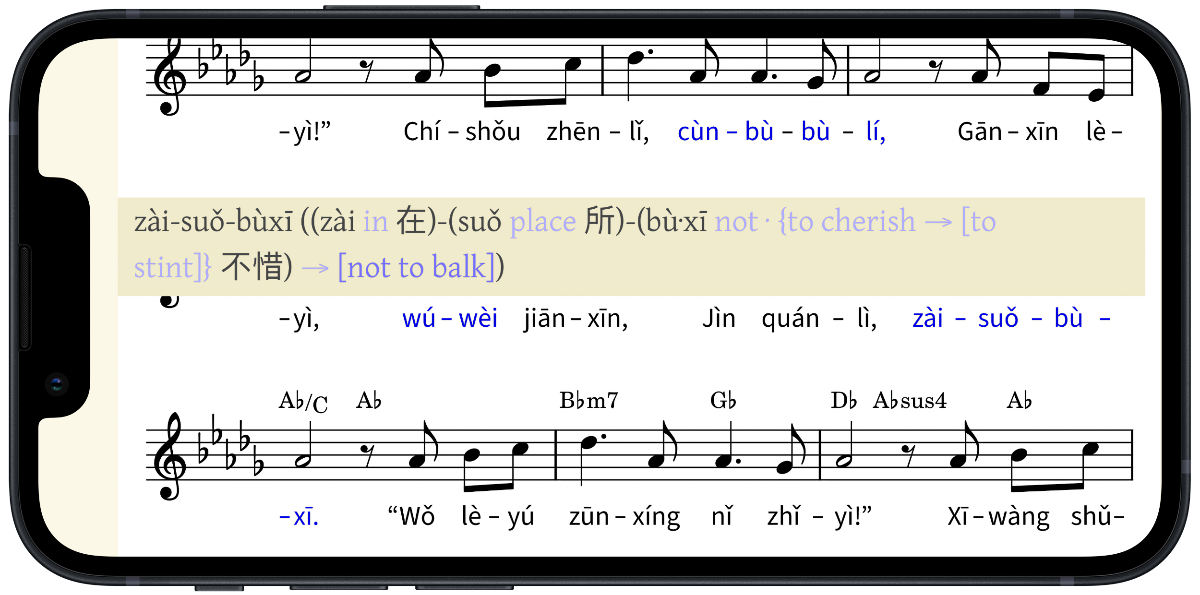
This week’s MEotW in the unofficial Pīnyīn (Pīn·yīn {Piecing Together of} · Sounds → [Pinyin] 拼音) Plus resource “Sing Out Joyfully” Bk. (Pīnyīn+Music, Pīnyīn Plus, Web)
This week’s MEotW, “zài‐suǒ‐bùxī ((zài in 在)‐(suǒ place 所)‐(bù·xī not · {cherish → [stint [on]]} 不惜) → [not grudge/balk [at]/stint [on]])”, comes from the chorus of song 161, which is entitled “To Do Your Will Is My Delight” in English and “Wǒ (I 我) Lèyú (Lè·yú {Am Happy} · to 乐于 樂於) Zūnxíng (Zūn·xíng {Abide by} · {Walk → [Do]} 遵行) Nǐ de ((Nǐ You 你) (de ’s 的) → [Your]) Zhǐyì (Zhǐ·yì Will · {Meaning → [Will]} → [Will] 旨意)” in Mandarin:
To do your will is my delight.
I give you all my strength and might.
This joy I feel; this joy is real.
I will walk on in your light.
Mandarin (WOL, Pīnyīn (Pīn·yīn {Piecing Together of} · Sounds → [Pinyin] 拼音) Plus):
📖 📄 📘 “Wǒ (I 我) lèyú (lè·yú {am happy} · to 乐于 樂於) zūnxíng (zūn·xíng {abide by} · {walk → [do]} 遵行) nǐ (your 你) zhǐyì (zhǐ·yì will · {meaning → [will]} → [will] 旨意)!”
Chíshǒu (Chí·shǒu {to hold → [to support]} · {to defend → [to abide by]} → [to hold fast to] 持守) zhēnlǐ (zhēn·lǐ true · reasoning → [the truth] 真理), cùnbù (cùn·bù {Ch. inch (3⅓ cm) → [tiny]} · step 寸步)‐bù (not 不)‐lí ({to depart} 离 離/离),
Gānxīn (Gān·xīn {to be (of) sweet → [to be of willing]} · heart → [to be willing] 甘心) lèyì (lè·yì {to be (of) happy} · {meaning → [intention]} → [to be willing] 乐意 樂意), wúwèi (wú·wèi {to be without} · {fearing of} 无畏 無畏) jiānxīn (jiān·xīn {(things being) arduous} · {(things being) hot (in taste) → [(things being) hard]} → [hardships] 艰辛 艱辛),
Jìn ({to expend to the limit} 尽 盡) quánlì (quán·lì whole · strength 全力), zài‐suǒ‐bùxī ((zài in 在)‐(suǒ place 所)‐(bù·xī not · {to cherish → [to stint]} 不惜) → [not to balk]).
While not being a direct translation, “jìn ({to expend to the limit} 尽 盡) quánlì (quán·lì whole · strength 全力), zài‐suǒ‐bùxī ((zài in 在)‐(suǒ place 所)‐(bù·xī not · {to cherish → [to stint]} 不惜) → [not to balk])” seems to correspond with “I give you all my strength and might” in the above example. In this context, it seems that “zài‐suǒ‐bùxī ((zài in 在)‐(suǒ place 所)‐(bù·xī not · {cherish → [stint [on]]} 不惜) → [not grudge/balk [at]/stint [on]])” effectively means “not to balk” when faced with a certain situation. The delightfully awkward English word “balk” means “to stop short and refuse to go on”.
Getting Past the Great Wall of Characters

Do we balk when faced with the Great Wall of Characters?
Some who are in the Mandarin field or considering joining it may balk at the prospect of dealing with the extaordinarily and inhumanly complex Chinese characters. However, while characters have been and can be like a Great Wall in the way of Mandarin language learners being able to function and contribute well in the Mandarin field, the historical experience of those who have braved the Mandarin field over the last few decades has been that Jehovah and his appointed King and Leader Jesus have evidently arranged for the Great Wall of Characters to be made manageable by those who take advantage of their provisions. For many years now, both official and unofficial resources have provided Pīnyīn (Pīn·yīn {Piecing Together of} · Sounds → [Pinyin] 拼音) alternative routes around and past the Great Wall of Characters, and many unofficial resources have also included English, Spanish, etc. meanings.
Jesus did not balk at confronting the human traditions of his day that made it unnecessarily and unreasonably difficult to serve God, and evidently, neither are he and his heavenly Father content to allow modern-day human traditions like those surrounding Chinese characters to keep making things unnecessarily and unreasonably difficult for those who serve him today in the vast worldwide Mandarin field.—Mark 7:13.
“How Much More Valuable”
While some may balk at the idea of using Pīnyīn (Pīn·yīn {Piecing Together of} · Sounds → [Pinyin] 拼音) instead of the Chinese characters mandated by human tradition, we should consider how Jesus handled a situation involving the human tradtions of his day regarding the Sabbath, as recorded at Matthew 12:9–13:
After departing from that place, he went into their synagogue, and look! there was a man with a withered hand! So they asked him, “Is it lawful to cure on the Sabbath?” so that they might accuse him. He said to them: “If you have one sheep and that sheep falls into a pit on the Sabbath, is there a man among you who will not grab hold of it and lift it out? How much more valuable is a man than a sheep! So it is lawful to do a fine thing on the Sabbath.” Then he said to the man: “Stretch out your hand.” And he stretched it out, and it was restored sound like the other hand.
To adapt what Jesus spoke of to the modern day Mandarin field, suppose a businessman who is still learning Mandarin is negotiating a potentially lucrative business deal with some Mandarin-speaking people in China. If Chinese characters were making it difficult for him to understand those people and their proposed business contracts, would this businessman balk at using Pīnyīn (Pīn·yīn {Piecing Together of} · Sounds → [Pinyin] 拼音) to help him understand and use the language necessary to conduct this business, close this deal, and potentially make a lot of money? Probably not! Why leave money on the table? But, how much more valuable are human beings, Mandarin-speaking “sheep” whom we could help to gain everlasting life, than any amount of Old World money that will soon be worthless? Jesus used the power available to him to do a fine thing even thought it was the Sabbath, so let us not allow mere human tradition to cause us to balk at using the empowering resources available to us to do fine things in the Mandarin field!—Matthew 25:31–46; Ezekiel 7:19.
And by the way, in a way, Chinese characters are seven times worse than the Sabbath traditions of Jesus’ day—the Sabbath traditions only made things unnecessarily difficult for God’s people one day a week, but Chinese characters place unnecessary burdens on Jehovah’s people seven days a week!
For convenience:
The direct link for the Pīnyīn (Pīn·yīn {Piecing Together of} · Sounds → [Pinyin] 拼音) Plus resource for the “Sing Out Joyfully” book is:
The short link for Chinese field language-learning links for the “Sing Out Joyfully” book is:
More Pīnyīn (Pīn·yīn {Piecing Together of} · Sounds → [Pinyin] 拼音) and Pīnyīn (Pīn·yīn {Piecing Together of} · Sounds → [Pinyin] 拼音) Plus web material based on the Mandarin “Sing Out Joyfully” book will be made available in the Pīnyīn (Pīn·yīn {Piecing Together of} · Sounds → [Pinyin] 拼音) Plus web resource as time allows.