Categories
Culture Language Learning Science Theocratic

Yètèluó

Yètèluó (Jethʹro 叶特罗 葉特羅) ← Tap/click to show/hide the “flashcard”

Appendix A2 of the English New World Translation of the Holy Scriptures (Study Edition), entitled “Features of This Revision”, discusses vocabulary changes that have been made in the current revision, words that have been translated differently than before. As noted in various entries in the excellent resource Referenced Theo. Expressions (RTE), Appendix A2 of the current Mandarin version of the New World Translation Bible (nwtsty) correspondingly discusses words that have been translated differently in the current revision of the Mandarin NWT Bible, compared to how they had been translated before.

Since we base what we say in Jehovah’s service on his Word the Bible, the vocabulary used in it—and the way those vocabulary words are translated—should be reflected in how we speak in our ministry, at our meetings, etc. So, it is beneficial for us Mandarin field language learners to be familiar with the latest thinking from the organization on how Bible terms should be translated into Mandarin.

Avoiding Rarely‐Used, Hard‐to‐Recognize Characters

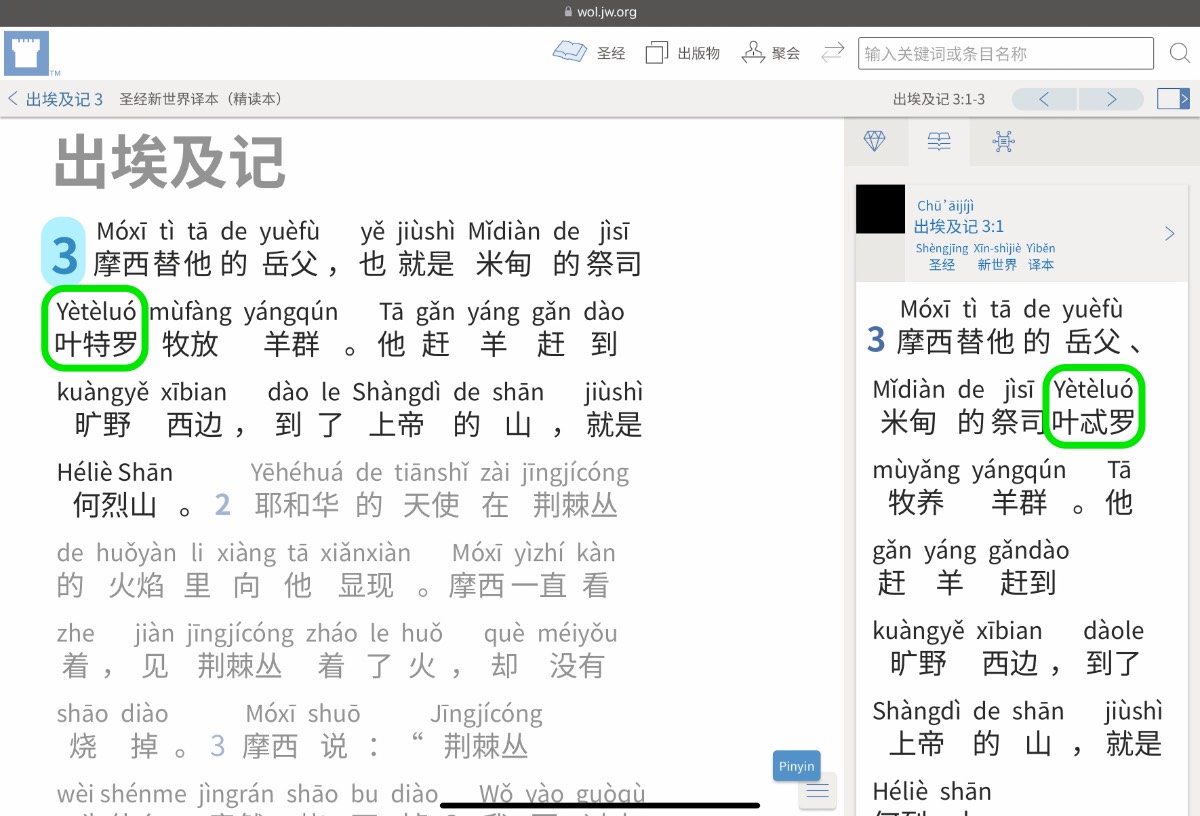
Appendix A2 of the current Mandarin version of the New World Translation Bible (nwtsty) mentions that one of the goals for this version was to reduce the number of hard-to-recognize, hard-to-read Chinese characters used, and to replace them with more commonly used characters. The first example it provides is that “Yètèluó (Jethʹro (old way of writing with characters) 叶忒罗 葉忒羅) was changed to this week’s MEotW, “Yètèluó (Jethʹro 叶特罗 葉特羅).—Exodus 3:1.

Exodux 3:1 (WOL CHS+Pinyin Parallel Translations)

While the pronunciation and the Pīnyīn (Pīn·yīn {Piecing Together of} · Sounds → [Pinyin] 拼音) were kept the same, a relatively rarely-used, hard-to-recognize character (“忒”) was replaced with a different, more common and recognizable character (“特”). As we can see, the translators who worked on the current version of the Mandarin NWT recognized that it was good to preserve the spoken pronunciation of the expression, an expression that as a whole was not changed. At the same time, they did not consider the particular character that was replaced to be sacred. This reinforces to us the basic principle of linguistics (language science) that SPEECH is primary, not writing, which shows up the traditional and ongoing Chinese cultural emphasis on characters as being fundamentally misplaced.

A Real-Life Example

The importance of avoiding unnecessarily hard-to-recognize characters was well demonstrated by the incident discussed in the tiandi.info blog post “An Avoidable Minefield of Human Tradition and Cultural Pride” (Email me if you need login information, and include information on who referred you and/or what group/cong. you are in.):

A few nights ago, my Mandarin congregation had a Memorial meeting that went well overall. However, there was a momentary hiccup that I think we Chinese field publishers can learn from.

The speaker who gave the talk is a fluent, eloquent native Mandarin speaker originally from mainland China, and he is one of the best Mandarin speakers in a city of several Mandarin congregations. In fact, he was one of the instructors in the very first official Mandarin class ever held in this country. However, while reading a scripture from his paper Bible as he was giving the Memorial talk, he, of all people, just…got…stuck…on…a…Chinese…character…. He struggled with it for what felt like quite a while, and eventually, a young brother who was serving as an attendant at the side of the stage approached and gave him a hint, and he was able to carry on.

While not a showstopper, this unfortunate incident was indeed an awkward showpauser, during the very meeting, out of all the meetings in the entire service year, at which the highest proportion of interested ones from the field was present—truly a nightmare scenario for anyone who gives Chinese talks!

FYI, in this case, the character that the brother couldn’t read was the “虺” in “虺蛇”, which has been replaced in the current version of the Mandarin NWT with “眼镜蛇”. (Isaiah 11:8) (While not being especially visually complex compared to some other Chinese characters, “虺” is relatively rarely used, ranking way down at #5543 on Prof. Dá Jùn (Dá {Tow Rope} (surname) 笪) ((Jùn {Fine Horse}駿) (Associate Professor of Linguistics, Director of the Media Center for Language Acquisition Department of Foreign Languages and Literatures, Middle Tennessee State University))’s character frequency list of Modern Chinese. “眼” is #281 on that list, and “镜” is #1251.)

Mitigations and Alternatives

In a way, though, even such fine efforts on the part of the NWT translators, working with what they have, are mere mitigations. On a more basic level, the incident mentioned above also highlights the problematic nature of the Chinese characters writing system itself, which makes it all too possible for such hard-to-recognize characters to exist, without any reasonable, consistent, and reliable system to work out their pronunciations. This makes any block of Chinese characters a potential minefield that can blow up in the face of even the most knowledgeable and experienced native speaker, because even such a one is still a mere imperfect human contending with the inhumanly complex and numerous Chinese characters, of which there are over 100,000.

In contrast, Pīnyīn (Pīn·yīn {Piecing Together of} · Sounds → [Pinyin] 拼音), with its Latin alphabet letters and four tone symbols, is a simple, elegant full writing system for Modern Standard Mandarin that is eminently learnable by mere imperfect humans. Thus, it is an eminently good thing that Jehovah, through his organization, has made official Pīnyīn (Pīn·yīn {Piecing Together of} · Sounds → [Pinyin] 拼音) available for the current version of the Mandarin NWT Bible, unlikely and uncommon though such a provision is from a worldly, human viewpoint. (Work is also ongoing to provide unofficial Pīnyīn (Pīn·yīn {Piecing Together of} · Sounds → [Pinyin] 拼音) Plus material for the current version of the Mandarin NWT, as language-learning material, not as spiritual food.)
Categories
Culture History Theocratic

Jìniàn Jùhuì

Jìniàn Jùhuì ((Jì·niàn Remembering · {Thinking Of} → [Commemorating] 记/纪念 記/紀念) (Jùhuì Meeting 聚会 聚會) [[the] Memorial]) ← Tap/click to show/hide the “flashcard”

The page on jw.org entitled “Memorial of Jesus’ Death” invites people to this year’s Memorial, which as of this writing is fast approaching.

Appearing in the title of the Mandarin version of that page is this week’s MEotW, “Jìniàn Jùhuì ((Jì·niàn Remembering · {Thinking Of} → [Commemorating] 记/纪念 記/紀念) (Jùhuì Meeting 聚会 聚會) [[the] Memorial])”, which corresponds to “Memorial”, or “the Memorial”.

Note that in this post, “Jìniàn Jùhuì ((Jì·niàn Remembering · {Thinking Of} → [Commemorating] 记/纪念 記/紀念) (Jùhuì Meeting 聚会 聚會) [[the] Memorial])” is capitalized, rather than being rendered in all lowercase letters. Why has this been done? The answer involves another question: Is Pīnyīn (Pīn·yīn {Piecing Together} · Sounds → [Pinyin] 拼音) just a pronunciation aid or actually a full writing system?

To Be or Not to Be…a Full Writing System?

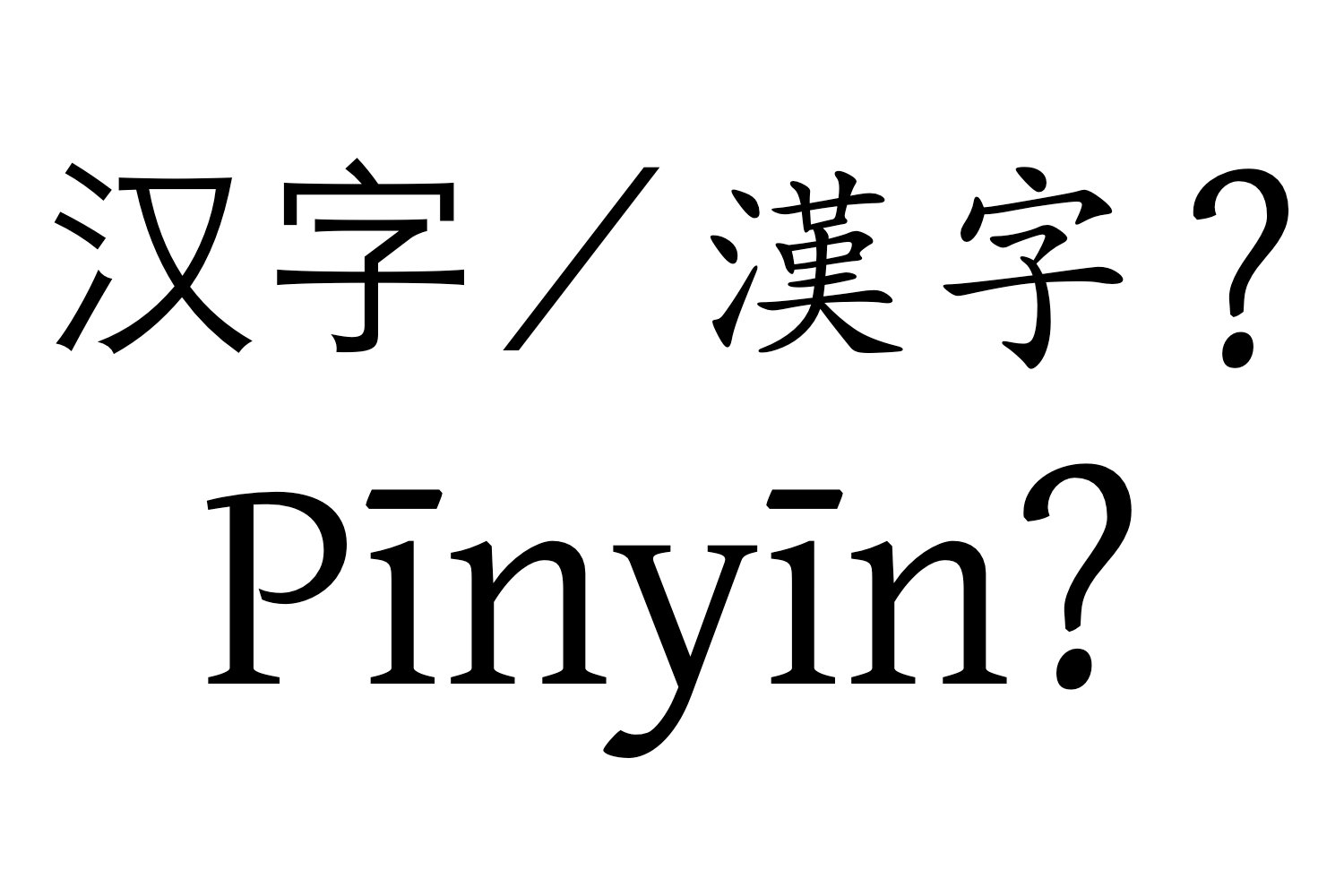
汉字 / 漢字? Pīnyīn?

The article “Pīnyīn (Pīn·yīn {Piecing Together} · Sounds → [Pinyin] 拼音) Was Plan A” explains that Pīnyīn (Pīn·yīn {Piecing Together} · Sounds → [Pinyin] 拼音) was originally meant by Máo Zédōng ((Máo Hair (surname) 毛) (Zé·dōng Marsh · East 泽东 澤東) (the founder of the People’s Republic of China)) and some of the other early movers and shakers of the People’s Republic of China to eventually replace Chinese characters. (Yes, seriously—it’s April, but we Jehovah’s Witnesses don’t make April Fools’ jokes!) Even though in this case cultural pride, tradition, and inertia have been allowed in the Mandarin-speaking part of the world to leave no room for innovation and progress, the fact remains that Pīnyīn (Pīn·yīn {Piecing Together} · Sounds → [Pinyin] 拼音) was intended by design to work as a full writing system. That it actually does so is shown in the scholarly paper “Two Steps Toward Digraphia in China”, and in the article “Pīnyīn (Pīn·yīn {Piecing Together} · Sounds → [Pinyin] 拼音) Is a Good, Workable Writing System on Its Own”.

R-E-S-P-E-C-T

Since Pīnyīn (Pīn·yīn {Piecing Together} · Sounds → [Pinyin] 拼音) is a full writing system like English is, there is good reason to consider it appropriate to capitalize Pīnyīn (Pīn·yīn {Piecing Together} · Sounds → [Pinyin] 拼音) words similarly to how English words are capitalized. Of course, there are different style guides with different rules regarding how and what to capitalize in English, especially when it comes to titles, but at the very least, any particular piece of writing should generally stick to whatever capitalization style has been chosen for it. (Hopefully it’s a good one.)

Unfortunately, in the part of the world that uses written Mandarin, Pīnyīn (Pīn·yīn {Piecing Together} · Sounds → [Pinyin] 拼音) is generally relegated to being just a pronunciation aid—it is not given the respect and dignity of being recognized as a full writing system, even though, as discussed above, it linguistically qualifies as one. Thus, Pīnyīn (Pīn·yīn {Piecing Together} · Sounds → [Pinyin] 拼音) is generally not capitalized in the world, if it is used at all. In contrast, Pīnyīn (Pīn·yīn {Piecing Together} · Sounds → [Pinyin] 拼音) Plus material gives Pīnyīn (Pīn·yīn {Piecing Together} · Sounds → [Pinyin] 拼音) the respect it has earned—it uses Pīnyīn (Pīn·yīn {Piecing Together} · Sounds → [Pinyin] 拼音) as its default main writing system and carefully follows the capitalization example of the official English version of the Mandarin material it is based on. E.g., since “God’s Kingdom” is rendered in the official English material with capital letters at the beginnings of its words, the Pīnyīn (Pīn·yīn {Piecing Together} · Sounds → [Pinyin] 拼音) Plus material follows suit with “Shàngdì (Shàng·dì Above’s · {Emperor → [God]} → [God] 上帝) de (’s 的) Wángguó (Wáng·guó King’s · Nation → [Kingdom] 王国 王國)”.

So, since “the Memorial” is capitalized in the organization’s official English material, such as the English version of the article “Memorial of Jesus’ Death” on jw.org, “Jìniàn Jùhuì ((Jì·niàn Remembering · {Thinking Of} → [Commemorating] 记/纪念 記/紀念) (Jùhuì Meeting 聚会 聚會) [[the] Memorial])” is capitalized in this post and in other material containing Pīnyīn (Pīn·yīn {Piecing Together} · Sounds → [Pinyin] 拼音) Plus material.

The Precedent of Punctuation

Is it “beneath” the Chinese world to follow the example of English when it comes to the capitalization of the alphabet it uses? Well, the Chinese world has followed Western writing style examples before, with punctuation. As the MEotW post on “diǎnliàng (diǎn·liàng {dot → [light (v); ignite]} · {to be bright} [→ [illuminate; shine light on]] 点亮 點亮)” pointed out:

Chinese writing in the past didn’t have punctuation, and now it has punctuation largely modeled after European punctuation. (For reference: Chinese punctuation – Wikipedia, Q&A: When were punctuation marks first used? – HistoryExtra, history – When was punctuation introduced into Chinese? – Chinese Language Stack Exchange)

Categories
Culture History Theocratic

xīshēng

xīshēng (xī·shēng {sacrifice (n or v) | sacrificial} · {[(as with a)] domestic animal} → [sacrifice] 牺牲 犧牲) ← Tap/click to show/hide the “flashcard”

As the war Ukraine rages on, time marches on, and this year’s Memorial season is now upon us. As of this writing, the home page of jw.org now features a page inviting people to this year’s Memorial. Appearing in the title of the Mandarin version of that page is this week’s MEotW, “xīshēng (xī·shēng {sacrifice (n or v) | sacrificial} · {[(as with a)] domestic animal} → [sacrifice] 牺牲 犧牲)”, which effectively means “sacrifice”.

Note that while the “shēng ({domestic animal}; {sacrificial animal}; livestock 牲)” part of “xīshēng (xī·shēng {sacrifice (n or v) | sacrificial} · {[(as with a)] domestic animal} → [sacrifice] 牺牲 犧牲)” sounds like the word for “life”, and while Jesus did indeed give his life for us, in this case the “shēng ({domestic animal}; {sacrificial animal}; livestock 牲)” used literally means “domestic animal”. When applied to Jesus’ sacrifice, we can take the “shēng ({domestic animal}; {sacrificial animal}; livestock 牲)” part of “xīshēng (xī·shēng {sacrifice (n or v) | sacrificial} · {[(as with a)] domestic animal} → [sacrifice] 牺牲 犧牲)” to effectively mean “(as with a) domestic animal”. It’s understandable that this particular morpheme is used in “xīshēng (xī·shēng {sacrifice (n or v) | sacrificial} · {[(as with a)] domestic animal} → [sacrifice] 牺牲 犧牲)”, since domestic animals were commonly used in sacrifices in ancient China, as they were in ancient Israel.

(It’s interesting to note, though, that an Internet search for “ancient China sacrifices” will turn up many references to human sacrifices in ancient China, as there were in ancient Canaan—let us be careful not to think more highly of worldly Chinese history and culture than they actually deserve!)

Referring to the Memorial in Mandarin

By comparing the English and Mandarin versions of the page on jw.org as of this writing inviting people to the Memorial, we can see that the organization is now translating “Memorial of Jesus’ Death” into Mandarin as “Yēsū (Jesus’ 耶稣 耶穌) Xīshēng (Xī·shēng {Sacrifice (n)} · {(as with a) Domestic Animal} → [Sacrifice] 牺牲 犧牲) Jìniàn Jùhuì ((Jì·niàn Remembering · {Thinking Of} → [Commemorating] 记/纪念 記/紀念) (Jùhuì Meeting 聚会 聚會) [Memorial])”. This is in contrast to the past rendering “Yēsū (Jesus’ 耶稣 耶穌) Shòunàn (Shòu·nàn {Being Subjected to → [Suffering of]} · Calamity 受难 受難)Jìniàn (Jì·niàn Remembering · {Thinking of} → [Commemorating] 记/纪念 記/紀念) Jùhuì (Meeting 聚会 聚會)” (km 2/2011) that the excellent resource Referenced Theo. Expressions (RTE) tells us about. (It also tells us about the current rendering, memtioned above.) For the Memorial, it does seem more relevant to emphasize Jesus’ sacrifice (“xīshēng (xī·shēng sacrifice (n)} · {(as with a) domestic animal} → [sacrifice] 牺牲 犧牲)”) itself, as opposed to the suffering (“shòunàn (shòu·nàn {being subjected to → [suffering of]} · calamity 受难 受難)”) that he had to endure in the process of offering it.