jiǎntǐ (jiǎn·tǐ simplified · {body → [style] → [typeface; font]} → [simplified Chinese] 简体 簡體)‐zì (characters 字) 👈🏼 Tap/click to show/hide the “flashcard”
For a long, long, long time, Chinese characters were just Chinese characters. Then, in 1956, the Communist government of mainland China issued what came to be known as the First Chinese Character Simplification Scheme (a second round of Chinese character simplification was later attempted and ultimately rescinded), and official simplified Chinese characters came into the world. (Some characters had been unofficially simplified and used for various purposes, both everyday and artistic, before that.)
On the matter of what simplified Chinese characters are called in Mandarin, Wikipedia provides this summary:
Simplified Chinese characters may be referred to by their official name above [(简化字; jiǎnhuàzì)[source]] or colloquially (简体字; jiǎntǐzì). In its broadest sense, the latter term refers to all characters that have undergone simplifications of character “structure” or “body”[source], some of which have existed for millennia alongside regular, more complicated forms. On the other hand, the official name refers to the modern systematically simplified character set, which (as stated by then-Chairman Mao Zedong in 1952) includes not only structural simplification but also substantial reduction in the total number of standardized Chinese characters.[source]
For reference, this is the term used on jw.org when referring to Mandarin written using simplified Chinese characters:
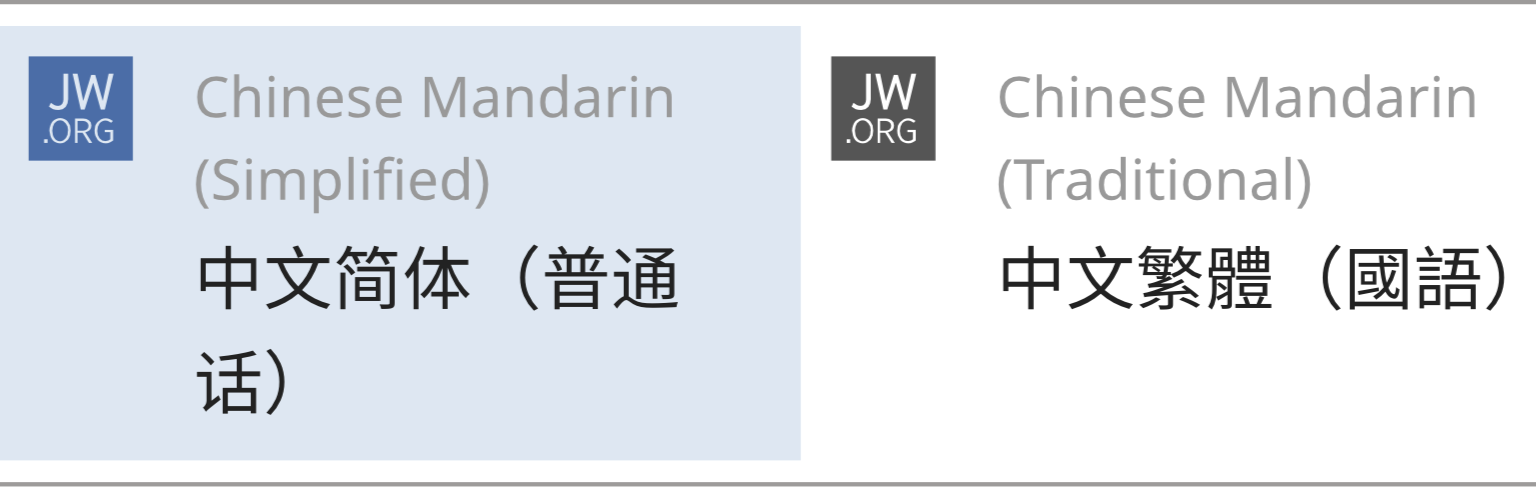
jw.org refers to simplified Chinese characters as “jiǎntǐ (jiǎn·tǐ simplified · {body → [style] → [typeface; font]} → [simplified Chinese] 简体 簡體)” characters.
The Great Simplified vs. Traditional Debate
While it seems obvious that simpler is generally better, there is actually much, much debate about the pros and cons of simplified characters vs. traditional characters, as discussed in these articles:
- Debate on traditional and simplified Chinese characters – Wikipedia
- The Chinese Language, Ever Evolving – The New York Times
The following posts summarize how many feel about traditional and simplified characters:
“愛” is the Traditional Chinese character for “love”. It appropriately has the “heart” radical (“心”) in it, but it’s quite…complicated. 😓
— Troubadour WW (@troubadourww) February 20, 2017
“爱” is the Simplified Chinese character for “love”. It’s simpler, but omits the “heart” radical (“心”), and has been “friend” (“友”)-zoned. 💔
— Troubadour WW (@troubadourww) February 20, 2017
Standards and Compromises
While the simplified characters themselves are indeed easier to learn and remember compared to the traditional characters, for many, they have become another set of characters in addition to the traditional characters that has to be learned and remembered. (There is, at least, some overlap between the two systems. Where do they overlap? That is yet more information that has to be learned and remembered…) And while simplified characters have been simplified, they are still characters, and characters are inherently extraordinarily complex and hard to learn and remember.
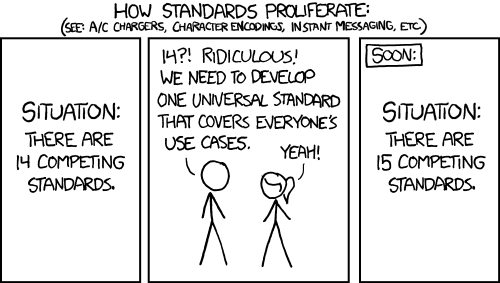

The simplified characters became a new standard that many have had to learn in addition to that of the traditional characters.
While Pīnyīn (Pīn·yīn {Piecing Together of} · Sounds → [Pinyin] 拼音) is also a different system to be learned and remembered, it is in a whole different league compared to any system of Chinese characters when it comes to ease of learning and remembering. One of the scholars who helped create Hangul (or Hankul), the Korean alphabet, said of it: “The wise can learn it in one morning, and even the unwise can learn it in ten days.” Being also a phonetic alphabet, Pīnyīn (Pīn·yīn {Piecing Together of} · Sounds → [Pinyin] 拼音) can be reasonably said to be in the same ballpark (with the added advantage that the Latin alphabet letters used in Pīnyīn (Pīn·yīn {Piecing Together of} · Sounds → [Pinyin] 拼音) are already familiar to many people)—downright revolutionary compared to the years (decades?) required to learn even simplified characters.
Simplified characters are thus a compromise that mainland China, Singapore, etc. have settled on—simpler than traditional characters, but perhaps thus not as good at being characters. Meanwhile, they are still characters, still having many of the complexities and vagaries of characters. They fall short of the fundamental reform envisioned by Máo Zédōng ((Máo Hair (surname) 毛) (Zé·dōng Marsh · East 泽东 澤東) (the founder of the People’s Republic of China)) (Wikipedia article), Lǔ Xùn ((Lǔ Stupid; Rash (surname) 鲁 魯) (Xùn Fast; Quick; Swift 迅) (pen name of Zhōu Shùrén, the greatest Chinese writer of the 20th cent. and a strong advocate of alphabetic writing)) (Wikipedia article), and others, that would have involved eventually moving on from any kind of characters to alphabetic writing.

A letter written by Máo Zédōng ((Máo Hair (surname) 毛) (Zé·dōng Marsh · East 泽东 澤東) (the founder of the People’s Republic of China)) endorsing “a basic reform” involving a transition from Chinese characters to alphabetic writing1
“Ài” is how Pīnyīn represents “love”. It doesn’t play the games the characters play—it helps you actually say “I love you” (“Wǒ ài nǐ”). ❤️
— Troubadour WW (@troubadourww) February 20, 2017
1. John DeFrancis, The Chinese Language: Fact and Fantasy (Honolulu: University of Hawaii Press, 1984), p. ii. ^